2019 MERCEDES-BENZ EQC SUV high-voltage battery
[x] Cancel search: high-voltage batteryPage 6 of 629

Operating
the climate control sy stem ......... 15 0 Driving and pa
rking ................................. 15 8
Driving ........................................................ 15 8
DY NA MIC SELECT switch ............................1 69
Tr ansmission .............................................. .173
Fu nction of flex ible all-wheel distribution .... 175
Charging the high-voltage battery ............... 175
Pa rking ...................................................... .189
Driving and driving saf ety sy stems .............. 197
Tr ailer hit ch................................................ 256
Bicycle rack function .................................. 260
Ve hicle towing instructions ........................ .262 Instrument Display and on-board
comp uter.................................................. 263
Instrument display overview ...................... .263
Overview of the buttons on thesteering
wheel ..........................................................2 63
Operating the on-board computer .............. 264
Fu nction of the po wer display ..................... 265
Setting the additional value range .............. 266
Overview of displ ays on the multifunc‐
tion display .................................................2 67Ad
justing the instrument lighting ................2 67
Menus and submenus ................................ 268
Head-up Display .......................................... 274 LINGU
ATRO NIC ......................................... 275
No tes on operating saf ety .......................... .275
Operation ....................................................2 76
Using LINGU ATRO NIC ef fectively ................ 278
Essential voice commands ........................ .279 MBUX multimedia sy
stem ...................... 295
Overview and operation .............................. 295
Sy stem settings .......................................... 329
Fit & Healt hy............................................... 338
Na vigation .................................................. 343
Te lephone .................................................. .391
Online and Internet functions ..................... 427
Media ......................................................... 436
Ra dio .......................................................... 444
TV ............................................................... 447
Sound ......................................................... 455 Main
tenance and care ............................. 459
ASS YST PLUS service inter val display ........ 459
Engine compartment .................................. 460
Cleaning and care ...................................... .463 Breakdown assi
stance ............................ 473
Emergency ................................................. .473
Flat tyre ...................................................... 475
Battery (vehicle) ......................................... 480
To w- starting or towing away ....................... 482
Electrical fuses ........................................... 486 Wheels and tyres
..................................... 490
No tes on noise or unusual handling char‐
acteristics .................................................. .490
No tes on regular lyinspecting wheels and
tyres .......................................................... .490
No tes on snow chains ................................ 490
Ty re pressure .............................................. 491
Wheel change ............................................ .498
Emergency spa rewheel .............................. 508 Contents
3
Page 20 of 629
Pr
otection of the environment
+ ENVIRONMENTAL
NOTEEnvironmental
dama gedue tooperating conditions and
personal driving style Operate
your vehicle in an environmentally
re sponsible manner tohelp pr otect the envi‐
ro nment. Please obser vethefo llowing rec‐
ommendations on ope rating conditions and
pe rsonal driving style.
Operating conditions: #
Make sure that the tyre pressure is cor‐
re ct. #
Do not car ryany unnecessary weight
(e.g. roof luggage rack s once you no
lon ger need them). #
Monitor the energy consum ption. #
Adhere tothe service inter vals.
A regularly serviced vehicle will contri b‐
ute toenvironmen tal pr otection. #
Alw ays ha vemaintenance workcar ried
out at a qualified specialist workshop. Pe
rsonal driving style: #
Drive carefully and main tain a suitable
dis tance from theve hicle in front. #
Avoid frequent, sudden acceleration
and braking. #
Drive in a style which sa ves energy.
Obser vethe ECO display for a fuel-ef fi‐
cient driving style. +
ENVIRONMEN
TALNO TEEnvironmental
pollution caused byirre sponsible dis‐
posal of the high-voltage battery A high-voltage battery conta
ins materials
which are harmful tothe environment. #
Dispose of faulty high-voltage bat teries
at a qualified specialist workshop. Ta
ke -back of end-of-life vehicles
EU countries onl y:
Mercedes-Benz will take back your end-of-life
ve hicle for environment-friendly disposal in accordance with
the European Union(EU) End-
of-Life Vehicles Directive.
A network of vehicle take -ba ckpoints and dis‐
mantlers has been es tablished foryo uto return
yo ur vehicle. You can lea veit at any of these
points free of charge . This makes an impor tant
contribution toclosing there cycling circle and
conse rving resources.
Fo r fur ther information about there cycling and
disposal of end-of-li fevehicles, and theta ke-
back conditions, please visit the national
Mercedes-Benz website foryo ur count ry. Mercedes-Benz Genuine
Parts
+ ENVIRONMENTAL
NOTEEnvironmental
dama gecaused bynot using recycled
re conditioned components Daimler
AGoffers recycled reconditioned
components and pa rts with the same quality
as new parts. The same entitlement from the
implied warranty is valid as for new parts. General no
tes17
Page 157 of 629
Dispose of
thege nuine Mercedes-Benz interior
pe rfume flacon when it is em pty and do not refill
it.
Re fillable flacon #
Unscr ew cap 1of em ptyflacon 2. #
Fillflacon 2with a maximum of 15ml. #
Screw cap 1back onto flacon 2.
Alw aysre fill th e em ptyre fillable flacon with the
same perfume. Obser vethe separate informa‐
tion sheet attached totheflacon. Pre-ent
ryclimate cont rol via key Fu
nction of pre-entry climate control using
th ekey
Before entering theve hicle, the driver's seat
area or the whole vehicle interior can be briefly
pre-warmed or pre-cooled.
When pre-cooling, thefo llowing functions are
activated as needed:
R Automatic clima tecontrol
R Blower R
Seat ventilation
When pre-heating, thefo llowing functions are
activated as needed:
R Automatic clima tecontrol
R Blower
R Seat hea ter
R Steering wheel heater
R Panel heating
R Mirror heater
R Rear wind owheater
R Frag rancing
R Ionisation
Setting pre-entry climate control via key #
Call up the air conditioning menu (see the
section on climate contro l intheve hicle
Owner's Manual). #
Select Pre-entry climate ctrl .
Ac tivating/deactivating #
Select Z. #
Select Pre-entry climate control via key .
Depending on the pr evious status, the func‐
tion is activated or deactivated.
Switching pre-entry climate on/off control
using thekey
Re quirements:
R the high-voltage battery is charge d suf fi‐
ciently
R the function has been activated via the multi‐
media sy stem #
Toswitch on: unlocktheve hicle.
The climate contro l functions are activated
fo r up tofive minutes for pre-heating and
pre-cooling.
Pre-entry clima tecontrol using theke y cannot
be activated more than thre e times when the
ve hicle is switched off. #
Todeactivate: presstheto p or bottom of
th e & button.
The following functions will remain active once
th eve hicle has been star ted:
R seat heating 15 4
Climate cont rol
Page 158 of 629
R
seat ventilation
R panel heating
R frag rancing
R ionisation Pre-entry climate control at depa
rture time Pre-entry climate control at departure time
function
&
WARNING Risk offata l injury due to
ex posure toextreme heat or cold in the
ve hicle
If people –particular lych ildren – are exposed
to extreme temp eratures over an extended
pe riod of time, there is a risk of serious or
eve nfa ta l injury! #
Never lea veanyone – pa rticularly chil‐
dren – unat tended in theve hicle. #
Never lea veanimals in theve hicle unat‐
te nded. The
vehicle interior can be heated or ventilated
when theve hicle is par ked. When
theve hicle is connected topowe r supply
equipment, priority is given tocharging the high-
vo ltage battery toa specified minimum charge.
The pre-ent ryclimate control running time may
be reduced under thefo llowing conditions:
R theve hicle is not connected topowe r supp ly
equipment
R the high-voltage battery is not fully charged
Wi th active pre-ent ryclimate control, thech arge
le ve l of the high-voltage battery may be reduced,
eve n if thech arging cable connec tor is connec‐
te d.
When cooling, thefo llowing functions are activa‐
te d as needed:
R Automatic clima tecontrol
R Blower
R Seat ventilation
When heating, thefo llowing functions are activa‐
te d as needed:
R Automatic clima tecontrol
R Blower R
Seat hea ter
R Steering wheel heater
R Panel heating
R Mirror heater
R Rear wind owheater
R Frag rancing
R Ionisation
Setting pre-entry climate control at depar‐
ture time #
Call up the air conditioning menu (see the
section on climate contro l intheve hicle
Owner's Manual). #
Select Pre-entry climate ctrl .
Setting a single departure time #
Select ONCE. #
Set a departure time.
Changing the active departu retime #
Select the pen icon next tothe displa yed
departure time. #
Set a departure time. Climate control
15 5
Page 161 of 629
Driving
Note
s on electric mode &
WARNING Risk ofchemical burns and
poisoning from damaged high-voltage
battery
If th e housing of the high-voltage battery has
been damaged, electrolyte and gases may
leak out. #
Avoid contact with the skin, eyes or
clo thing. #
Immediately rinse electrolyte splashes
off with water and seek medical atten‐
tion stra ight away. &
DANG ER Risk of explosion from exces‐
sive internal pressure of the high-voltage
battery
In theev ent of a vehicle fire ,th e internal
pressure of the high-voltage battery could
exc eed a critical value. In this case, flamma‐
ble gas escapes thro ugh a bleed valve in the
ve hicle's underbody. The
gas can ignite. #
Stop thech arging process immediately
in case of unusual odours, smo keor
burn mar ks. #
Lea vethe danger zone immediatel y.
Secu rethe danger zone at a suf ficient
di st ance. #
Call thefire service. Obser
vethefo llowing no tes on vehicle noise
emissions and the acoustic vehicle warning sys‐
te m:
R theve hicle is equipped with a purely electric
drive sy stem and de velops considerably
lo we rve hicle noise emissions than vehicles
with a combustion engine.
It is forth is reason that theve hicle is equip‐
ped with a sound generator, which ser ves as
an acoustic vehicle warning sy stem (A VAS).
R the sound generator generates speed-
dependent vehicle noise emissions when
driving forw ard and backing up at a speed of
up toaround 30 km/h. th
is helps other road users, particular ly
pede strians and bike riders, tohear your
ve hicle better.
R theve hicle acoustic warning sy stem gradu‐
ally switches off when driving at speeds
abo ve20 km/h.
R despite the sound generator, theve hicle still
may not be heard by otherroad users. Adapt
yo ur driving style accordingly.
R the sound generator is off when theve hicle
is stationar y. Manual disconnection of
the high-voltage on-
board electrical sy stem &
DANG ER Risk of fata l injury bytouching
damaged high-voltage co mponents
The vehicle's high-voltage on-board electrical
sy stem is under high voltage. If you modify
co mp onent parts in theve hicle's high-volt‐
age on-board electrical sy stem or touch dam‐
aged co mponent parts, you may be electro‐
cuted. 15 8
Driving and pa rking
Page 163 of 629
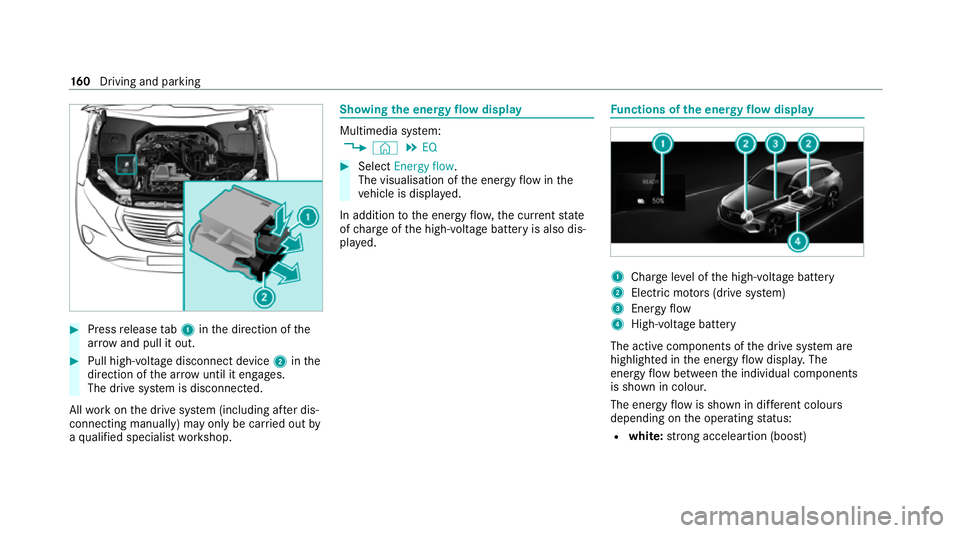
#
Press release tab1 inthe direction of the
ar row and pull it out. #
Pull high-voltage disconnect device 2inthe
direction of the ar row until it en gage s.
The drive sy stem is disconnected.
All workon the drive sy stem (including af ter dis‐
connecting manually) may only be car ried out by
a qu alified specialist workshop. Showing
the energy flow display Multimedia sy
stem:
4 © 5
EQ #
Select Energy flow.
The visualisation of the energy flow inthe
ve hicle is displa yed.
In addition tothe energy flow ,th e cur rent state
of charge ofthe high-voltage battery is also dis‐
pla yed. Fu
nctions of the energy flow displ ay 1
Char geleve l of the high-voltage battery
2 Elect ric mo tors (drive sy stem)
3 Energy flow
4 High-voltage battery
The active components of the drive sy stem are
highlighted in the energy flow displa y.The
energy flow between the individual components
is shown in colour.
The energy flow is shown in dif fere nt colou rs
depending on the operating status:
R white: strong acceleartion (boost) 16 0
Driving and pa rking
Page 164 of 629
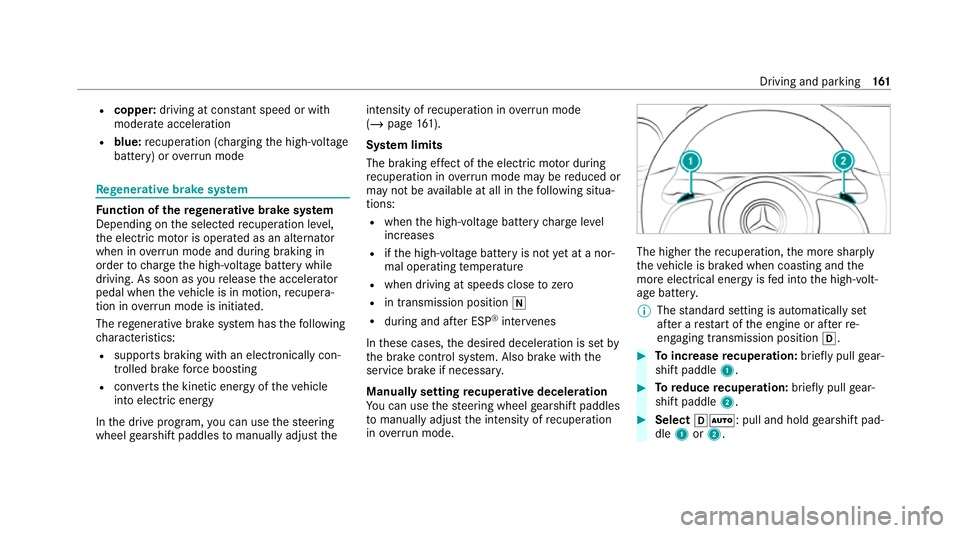
R
copper: driving at con stant speed or with
mode rate acceleration
R blue: recuperation (cha rging the high-voltage
battery) or overrun mode Re
generative brake sy stem Fu
nction of there ge nerative brake sy stem
Depending on the selected recuperation le vel,
th e electric mo tor is operated as an alternator
when in overru n mode and du ring braking in
order tocharge the high-voltage battery while
driving. As soon as youre lease the accelera tor
pedal when theve hicle is in motion, recupera‐
tion in overru n mode is initia ted.
The rege nerati vebrake sy stem has thefo llowing
ch aracteristics:
R suppo rts braking with an electronically con‐
trolled brake forc e boosting
R con verts th e kinetic energy of theve hicle
into electric energy
In the drive program, you can use thesteering
wheel gearshift paddles tomanually adju st theintensity of
recuperation in overru n mode
(/ page 161).
Sy stem limits
The braking ef fect of the electric mo tor during
re cuperation in overru n mode may be reduced or
may not be available at all in thefo llowing situa‐
tions:
R when the high-voltage battery charge level
inc reases
R ifth e high-voltage battery is not yet at a nor‐
mal operating temp erature
R when driving at speeds close tozero
R in transmission position i
R during and af ter ESP ®
inter venes
In these cases, the desired deceleration is set by
th e brake control sy stem. Also brake with the
service brake if necessar y.
Manually setting recuperative deceleration
Yo u can use thesteering wheel gearshift paddles
to manually adju stthe intensity of recuperation
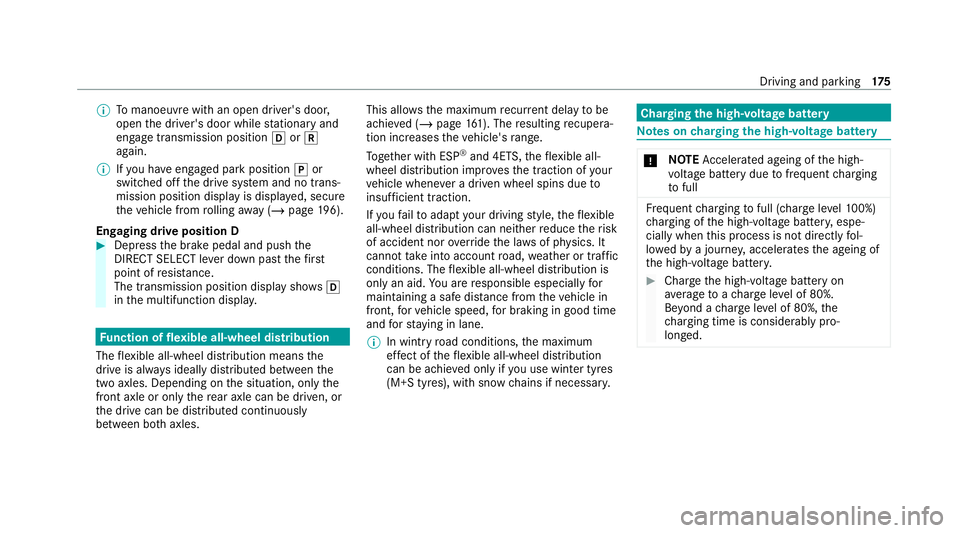
in ove rrun mode. The higher
there cuperation, the more sharply
th eve hicle is braked when coasting and the
more electrical energy is fed into the high-volt‐
age batter y.
% The standard setting is automatically set
af te r a restart of the engine or af terre-
engaging transmission position h. #
Toincrease recuperation: briefly pull gear‐
shift paddle 1. #
Toreduce recuperation: briefly pull gear‐
shift paddle 2. #
Select hÃ: pull and hold gearshift pad‐
dle 1or2. Driving and parking
161
Page 178 of 629
%
Tomanoeuvre with an open driver's door,
open the driver's door while stationary and
engage transmission position hork
again.
% Ifyo u ha veengaged park position jor
switched off the drive sy stem and no trans‐
mission position display is displa yed, secure
th eve hicle from rolling away ( /page 196).
Engaging drive position D #
Depress the brake pedal and push the
DIRECT SELECT le ver down past thefirst
point of resis tance.
The transmission position displ aysho wsh
in the multifunction displa y.Fu
nction of flexible all-wheel distribution
The flex ible all-wheel distribution means the
drive is alw ays ideally distributed between the
two axles. Depending on the situation, only the
front axle or only there ar axle can be driven, or
th e drive can be distributed continuously
between bo thaxles. This allo
ws the maximum recur rent delay tobe
achie ved (/ page161). The resulting recupera‐
tion increases theve hicle's range.
To get her with ESP ®
and 4ETS, theflex ible all-
wheel distribution impr ovesth e traction of your
ve hicle whene ver a driven wheel spins due to
insuf ficient traction.
If yo ufa ilto adapt your driving style, theflex ible
all-wheel distribution can neither reduce therisk
of accident nor override the la wsof ph ysics. It
cannot take into account road, weather or traf fic
conditions. The flex ible all-wheel distribution is
only an aid. You are responsible especially for
maintaining a safe dis tance from theve hicle in
front, forve hicle speed, for braking in good time
and forst ay ing in lane.
% In wint ryroad conditions, the maximum
ef fect of theflex ible all-wheel distribution
can be achie ved only if you use winter tyres
(M+S tyres), with sn ow chains if necessar y. Cha
rging the high-voltage bat tery Note
s oncharging the high-voltage bat tery *
NO
TEAccelerated ageing of the high-
vo ltage battery due tofrequent charging
to full Fr
equent charging tofull (charge le vel10 0%)
ch arging of the high-voltage batter y,espe‐
cially when this process is not direct lyfol‐
lo we dby a journe y,accelerates the ageing of
th e high-voltage batter y. #
Char gethe high-voltage battery on
ave rage toach arge leve l of 80%.
Be yond a charge leve l of 80%, the
ch arging time is considerably pro‐
lon ged. Driving and parking
175