(Continued)
quick coupling from the negative
pole (–) of the battery.
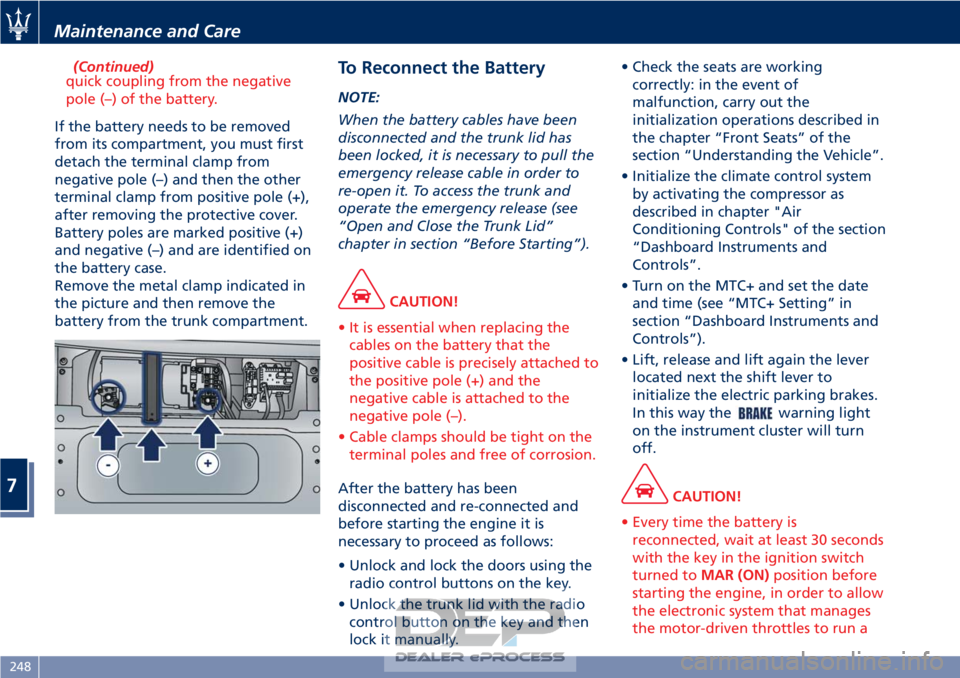
If the battery needs to be removed
from
its compartment, you must first
detach the terminal clamp from
negative pole (–) and then the other
terminal clamp from positive pole (+),
after removing the protective cover.
Battery poles are marked positive (+)
and negative (–) and are identified on
the battery case.
Remove the metal clamp indicated in
the picture and then remove the
battery from the trunk compartment.
To Reconnect the Battery
NOTE:
When the battery cables have been
disconnected and the trunk lid has
been locked, it is necessary to pull the
emergency release cable in order to
re-open it. To access the trunk and
operate the emergency release (see
“Open and Close the Trunk Lid”
chapter in section “Before Starting”).
CAUTION!
• It is essential when replacing the cables on the battery that the
positive cable is precisely attached to
the positive pole (+) and the
negative cable is attached to the
negative pole (–).
• Cable clamps should be tight on the terminal poles and free of corrosion.
After the battery has been
disconnected
and re-connected and
before starting the engine it is
necessary to proceed as follows:
• Unlock and lock the doors using the radio control buttons on the key.
• Unlock the trunk lid with the radio control button on the key and then
lock it manually. • Check the seats are working
correctly: in the event of
malfunction, carry out the
initialization operations described in
the chapter “Front Seats” of the
section “Understanding the Vehicle”.
• Initialize the climate control system by activating the compressor as
described in chapter "Air
Conditioning Controls" of the section
“Dashboard Instruments and
Controls”.
• Turn on the MTC+ and set the date and time (see “MTC+ Setting” in
section “Dashboard Instruments and
Controls”).
• Lift, release and lift again the lever located next the shift lever to
initialize the electric parking brakes.
In this way the
warning light
on the instrument cluster will turn
off.
CAUTION!
• Every time the battery is reconnected, wait at least 30 seconds
with the key in the ignition switch
turned to MAR (ON) position before
starting the engine, in order to allow
the electronic system that manages
the motor-driven throttles to run a
Maintenance and Care
7
248
WARNING!
The engine idle must be performed
outdoors. Exhaust gases contain
carbon monoxide which is strongly
toxic and potentially lethal.
WARNING!
California Proposition 65
Operating, servicing and maintaining
a passenger vehicle or off-road vehicle
can expose you to chemicals including
such as, engine exhaust, carbon
monoxide, phthalates and lead, that
which are know to the State of
California to cause cancer and birth
defects or other reproductive harm. To
minimize exposure, avoid breathing
exhaust, do not idle the engine except
as necessary, service your vehicle in a
well-ventilated area and wear gloves
or wash your hands frequently when
servicing your vehicle. For more
information go to:
www.P65Warnings.ca.gov/passenger-
vehicle
Battery Statement
Battery Statement Status of
Charge
To avoid problems with ignition and/or
the electrical system in general when
you are driving, the battery charge
status is constantly maintained and
guaranteed by the vehicle's recharge
circuit; the main component of which
is the alternator. This circuit is only
able to supply voltage to the battery
when the vehicle is traveling.
The
warning light on the
instrument cluster (see “Instrument
Cluster” in section “Dashboard
Instruments and Controls”), will
indicate any malfunctions in the
recharge circuit or an insufficient
battery charge status (flashing).
The vehicle is fitted with advanced
electronic systems, such as, for
example, the alarm system and various
electronic control modules, which
consume power even when the key in
the ignition switch is in the STOP (OFF)
position and the vehicle is not being
used.
Therefore, it is fundamental that the
battery is properly charged to ensure
that the engine starts properly and that all the electrical/electronic systems
in the vehicle work efficiently.
Maintaining Battery Charge
If you perform short daily trips
(approximately 10 miles/16 km), which
correspond to an annual total of 4000
miles/6000 km, or when the vehicle is
not going to be used for one week or
more, Maserati recommends
connecting the vehicle to a battery
charger, to save you the trouble of
having to recharge the battery (see
“Battery Charge Maintainer
Operation” in this chapter).
The battery charge maintainer will
keep the battery charged properly and
at the correct voltage levels required
by the systems and devices in the
vehicle.
Before using the battery charge
maintainer, carefully follow the
instructions provided.
If you do not use a battery charge
maintainer to prevent the battery
from going dead when you are not
going to use the vehicle for long
periods of time, you need to check and
recharge the battery at least once
every three weeks. Make this check if
you perform short daily trips
(approximately 10 mi/16 km) which
correspond to an annual total of 4000
Maintenance and Care
7
270
Abbreviations.................7
ABS (Anti-lock Braking System) . . .179
A/C Air Filter Replacement .......263
Accessories Aftermarket Parts and Accessories
Statement .................11
Accident, in the event of ........213
A/C System Maintenance ........262
Airbag.....................46 Air bag System Components .....46
Air bag Warning Light .........66
Passenger Air bag Labels .......18
Supplemental Restraint System
(SRS) .....................46
Air Conditioning Controls .......151
Air Conditioning Distribution .....112
Alarm, Vehicle Security ..........26
ALR (Automatic Locking Retractor) . .43
Assistance ....................9
Assistance, if you need .........9
Audio Controls ...............138
Steering Wheel Audio Controls . .138
Audio, Customer Setting ........147
Audio System ................140
Automatic Transmission ........160
Automatic Transmission Range . .162
AUX, USB and SD Memory Card Ports .....................132
Battery ....................247
Access the Battery ...........226
Jump Start Procedure ........226
Maintenance - Free Battery . . . .247 To Reconnect the Battery
......248
Bluetooth, Customer settings .....147
Bodywork Maintenance and Care . .265 Protection from Atmospheric
Agents ..................265
Useful Advice to Keep the
Bodywork in Good Condition . . .265
Brakes Brake and Stability Control
System ...................177
Brake Fluid Level Check .......242
Brake Overheating ..........182
Parking Brake ..............174
Parking Brake - Manual
Release ..................220
Using the Brakes ............181
Bulb Replacement ............257
Cargo Area .................107
Child Restraint Systems
Children too large for Booster
Seats .....................
56
Infants and Child Restraints .....55
Lower Anchors and Tether for
Children (LATCH) ............57
Older Children and Child
Restraints .................55
Tips on getting the most out of
your child restraint ...........56
Clock, analog ................144
Comfort Pack Front Seats ........76
Driver Memory Seat ..........77
Front Heated Seats ...........76 Console
Central Console Components ....73
Front Dome Console
Components ...............71
Cruise Control ...............185
Cupholders Front Seats Cupholders .......103
Rear Seats Cupholders ........104
Dashboard Components .........70
Data, Technical ..............279
Defroster ...................66
Doors Components .............72
Drive Mode, Controls ..........169
Driving Conditions Before the Trip .............204
Driving at Night ............204
Driving in Fog ..............205
Driving in the Mountains ......205
Driving in the Rain ..........204
Driving on Snow or Ice ........206
Driving through Flooded
Sections ..................206
Safe Driving ...............204
DRL (Daytime Running Light) ......83
Easy Entry/Exit function .........79
EDR (Event Data Recorder) .......52
Emergency Emergency Fuel Filler Door
Release ..................203
Hazard Warning Flasher .......88
In the Event of an Accident . . . .213
Index
9
286