2019 LEXUS UX250H open
[x] Cancel search: openPage 405 of 476

4057-2. Steps to take in an emergency
7
When trouble arises
setting, the power switch will turn to ACC.
3Firmly depress the brake pedal and
check that is shown on the
multi-information display.
4 Press the power switch.
In the event that the hybrid system still can-
not be started, contact your Lexus dealer.
■Stopping the hybrid system
Set the parking brake, shift the shift lever to
P and press the power switch as you nor-
mally do when stopping the hybrid system.
■Electronic key battery
As the above procedure is a temporary
measure, it is recomme nded that the elec-
tronic key battery be replaced immediately
when the battery is depleted. ( P.368)
■Changing power switch modes
Release the brake pedal and press the
power switch in step 3 above.
The hybrid system does not start and modes
will be changed each time the switch is
pressed. ( P.164)
If you have a set of jumper (or booster)
cables and a second vehicle with a 12-
volt battery, you can jump start your
vehicle by following the steps below.
1 Confirm that the electronic key is
being carried.
When connecting the jumper (or booster)
cables, depending on the situation, the
alarm may activate and doors locked.
( P.72)
2 Open the hood ( P.335) and fuse
box cover.
If the 12-volt battery is dis-
charged
The following procedures may be
used to start the hybrid system if the
vehicle’s 12-volt battery is dis-
charged.
You can also call your Lexus dealer
or a qualified repair shop.
Restarting the hybrid system
Page 406 of 476

4067-2. Steps to take in an emergency
Push the tab in and lift the lid off.
3Open the exclusive jump starting
terminal cover.
4 Remove the engine cover.
Page 407 of 476

4077-2. Steps to take in an emergency
7
When trouble arises
5Connect a positive jumper cable clamp to on your vehicle and connect the
clamp on the other end of the positive cab le to on the second vehicle. Then,
connect a negative cable clamp to on the second vehicle and connect the
clamp at the other end of the negative cable to .
Exclusive jump starting terminal (your vehicle)
Positive (+) battery terminal (second vehicle)
Negative (-) battery terminal (second vehicle)
Solid, stationary, unpainted metallic point away from the exclusive jump starting
terminal and any mo ving parts as shown in the illustration
6 Start the engine of the second vehi-
cle. Increase the engine speed
slightly and maintain at that level for
approximately 5 minutes to
recharge the 12-volt battery of your
vehicle.
7 Open and close any of the doors of
your vehicle with the power switch
OFF.
8 Maintain the engine speed of the
second vehicle and start the hybrid
system of your vehicle by turning
the power switch to ON.
9 Make sure the “READY” indicator
comes on. If the indicator light does not come on, contact your Lexus
dealer.
10 Once the hybrid system has
started, remove the jumper cables
in the exact reverse order from
which they were connected.
11 Close the exclusive jump starting
terminal cover, and reinstall the fuse
box cover to its original position.
Once the hybrid system starts, have
the vehicle inspected at your Lexus
dealer as soon as possible.A
B
C
D
A
B
C
D
Page 409 of 476

4097-2. Steps to take in an emergency
7
When trouble arises
Exhaust hole
Exhaust hole plug
Exhaust hose
Elbow
For details, consult your Lexus dealer.
WARNING
■When removing the 12-volt battery
terminals
Always remove the negative (-) terminal
first. If the positive (+) terminal contacts
any metal in the surrounding area when
the positive (+) terminal is removed, a
spark may occur, leadin g to a fire in addi-
tion to electrical shocks and death or
serious injury.
■Avoiding 12-volt battery fires or
explosions
Observe the following precautions to
prevent accidentally igniting the flamma-
ble gas that may be emitted from the 12-
volt battery:
●Make sure each jumper cable is con-
nected to the correct terminal and that
it is not unintentiona lly in contact with
any other than the intended terminal.
A
B
C
D
●Do not allow the other end of the
jumper cable connected to the “+” ter-
minal to come into contact with any
other parts or metal surfaces in the
area, such as brackets or unpainted
metal.
●Do not allow the + and - clamps of the
jumper cables to come into contact
with each other.
●Do not smoke, use matches, cigarette
lighters or allow open flame near the
12-volt battery.
■12-volt battery precautions
The 12-volt battery contains poisonous
and corrosive acidic electrolyte, while
related parts contain lead and lead com-
pounds. Observe the following precau-
tions when handling the 12-volt battery:
●When working with the 12-volt battery,
always wear safety glasses and take
care not to allow any battery fluids
(acid) to come into contact with skin,
clothing or the vehicle body.
●Do not lean over the 12-volt battery.
●In the event that battery fluid (acid)
comes into contact with the skin or
eyes, immediately wash the affected
area with water and seek medical
attention.
Place a wet sponge or cloth over the
affected area until medical attention
can be received.
●Always wash your hands after handling
the 12-volt battery and other battery-
related parts.
●Do not allow children near the 12-volt
battery.
■After recharging the 12-volt battery
Have the 12-volt battery inspected at
your Lexus dealer as soon as possible.
If the 12-volt battery is deteriorating, con-
tinued use may cause the 12-volt battery
to emit a malodorous gas, which may be
detrimental to the health of passengers.
Page 412 of 476

4127-2. Steps to take in an emergency
If “Hybrid system overheated Out-
put power reduced” is shown on the
multi-information display
1
Stop the vehicle in a safe place.
2
Stop the hybrid system and care-
fully lift the hood.
3
After the hybrid system has cooled
down, inspect the hoses and radia-
tor core (radiator) for any leaks.
Radiator
Cooling fans
If a large amount of coolant leaks, immedi-
ately contact your Lexus dealer.
4The coolant level is satisfactory if it
is between the “F” and “L” lines on
the reservoir.
Reservoir
“F” line
“L” line 5
Add coolant if necessary.
Water can be used in an emergency if
coolant is unavailable.
6After stopping the hybrid system
and waiting for 5 minutes or more,
start the hybrid system again and
check if “Hybrid system overheated
Output power reduced” is shown
on the multi-information display.
If the message does not disappear:
Stop the hybrid system and contact your
Lexus dealer.
If the message is not displayed:
The hybrid system temperature has
dropped and the vehicle may be driven
normally.
However, if the message appears again fre-
quently, contact your Lexus dealer.
A
B
A
B
C
WARNING
■To prevent an accident or injury when
inspecting under the hood of your
vehicle
Observe the following precautions.
Failure to do so may result in serious
injury such as burns.
●If steam is seen coming from under the
hood, do not open the hood until the
steam has subsided. The engine com-
partment may be very hot.
Page 420 of 476

4208-1. Specifications
■Spark plug
■12-volt battery
*: The fluid capacity is a reference quantity.If replacement is necessary, contact your Lexus dealer.
Ignition system
MakeDENSO FC16HR-Q8
Gap0.031 in. (0.8 mm)
NOTICE
■Iridium-tipped spark plugs
Use only iridium-tipped spark plugs. Do not adjust the spark plug gap.
Electrical system
Open voltage at 68°F (20°C):12.0 V or higher
If the voltage is lower than the standard value,
charge the battery.
(After charging the battery, turn on the high beam
headlights for 30 seconds with the power switch
OFF, and turn the headlights off.)
Charging rates:
Quick charge
Slow charge
15 A max.
5 A max.
Hybrid transmission
Fluid capacity*4.0 qt. (3.8 L, 3.3 Imp.qt.)
Fluid typeToyota Genuine ATF WS
NOTICE
■Hybrid transmission fluid type
Using transmission fluid other than “Toyota Genuine ATF WS” may ultimately damage
the hybrid transmission of your vehicle.
Page 423 of 476

4238-1. Specifications
8
Vehicle specifications
■Gasoline quality
In very few cases, driveability problems may
be caused by the brand of gasoline you are
using. If driveability problems persist, try
changing the brand of gasoline. If this does
not correct the problem, consult your Lexus
dealer.
■Recommendation of the use of gasoline
containing detergent additives
●Lexus recommends the use of gasoline
that contains detergent additives to avoid
the build-up of engine deposits.
●All gasoline sold in the U.S.A. contains
minimum detergent additives to clean
and/or keep clean intake systems, per
EPA’s lowest additive s concentration pro-
gram.
●Lexus strongly recommends the use of
Top Tier Detergent Gasoline. For more
information on Top Tier Detergent Gaso-
line and a list of marketers, please go to
the official websit e www.toptiergas.com.
■Recommendation of the use of low
emissions gasoline
Gasolines containing oxygenates such as
ethers and ethanol, as well as reformulated
gasolines, are available in some cities.
These fuels are typically acceptable for use,
providing they meet other fuel require-
ments. Lexus recommends these fuels, since the
formulations allow for reduced vehicle
emissions.
■Non-recommendation of the use of
blended gasoline
●Use only gasoline containing up to 15%
ethanol.
DO NOT use any flex-fuel or gasoline
that could contain more than 15% etha-
nol, including from
any pump labeled
E30 (30% ethanol ), E50 (50% eth-
anol ), E85 (85% ethanol )
(which are only some examples of fuel
containing more than 15% ethanol).
●If you use gasohol in your vehicle, be sure
that it has an octane rating no lower than
87.
●Lexus does not recommend the use of
gasoline containing methanol.
■Non-recommendation of the use of gas-
oline containing MMT
Some gasoline contains an octane enhanc-
ing additive called MMT (Methylcyclopen-
tadienyl Manganese Tricarbonyl).
Lexus does not recommend the use of gas-
oline that contains MMT. If fuel containing
MMT is used, your emission control system
may be adversely affected.
The malfunction indicator lamp on the
instrument cluster may come on. If this hap-
pens, contact your Lexus dealer for service.
■If your engine knocks
●Consult your Lexus dealer.
●You may occasionally notice light knock-
ing for a short time wh ile accelerating or
driving uphill. This is normal and there is
no need for concern.
Fuel information
You must only use unleaded gaso-
line.
Select octane rating 87 (Research
Octane Number 91) or higher. Use
of unleaded gasoline with an octane
rating lower than 87 may result in
engine knocking. Persistent knock-
ing can lead to engine damage.
At minimum, the gasoline you use
should meet the specifications of
ASTM D4814 in the U.S.A.
A
BC
Page 431 of 476
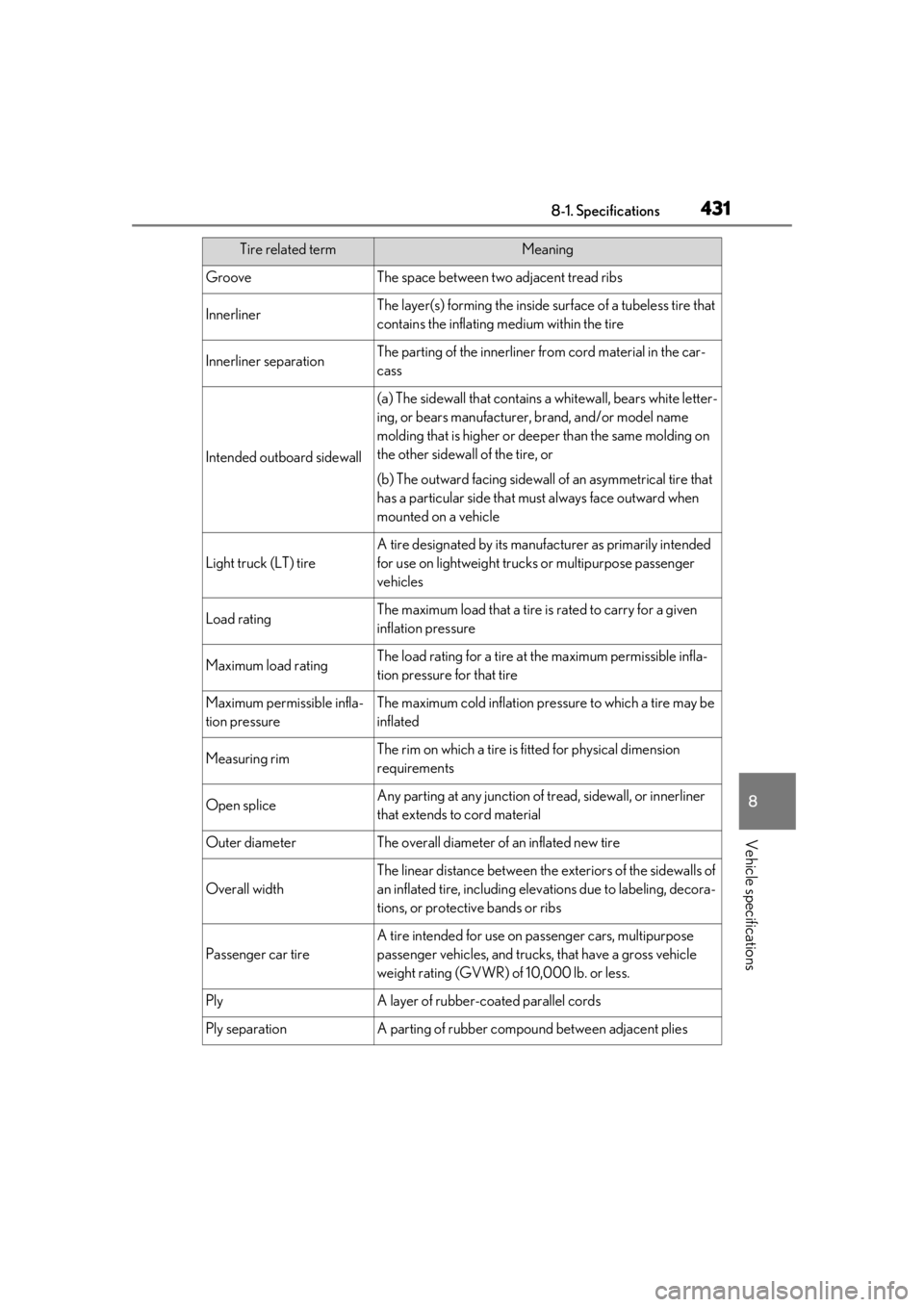
4318-1. Specifications
8
Vehicle specifications
GrooveThe space between two adjacent tread ribs
InnerlinerThe layer(s) forming the inside surface of a tubeless tire that
contains the inflating medium within the tire
Innerliner separationThe parting of the innerliner fr om cord material in the car-
cass
Intended outboard sidewall
(a) The sidewall that contains a whitewall, bears white letter-
ing, or bears manufacturer, brand, and/or model name
molding that is higher or deep er than the same molding on
the other sidewall of the tire, or
(b) The outward facing sidewall of an asymmetrical tire that
has a particular side that must always face outward when
mounted on a vehicle
Light truck (LT) tire
A tire designated by its manuf acturer as primarily intended
for use on lightweight trucks or multipurpose passenger
vehicles
Load ratingThe maximum load that a tire is rated to carry for a given
inflation pressure
Maximum load ratingThe load rating for a tire at the maximum permissible infla-
tion pressure for that tire
Maximum permissible infla-
tion pressureThe maximum cold inflation pre ssure to which a tire may be
inflated
Measuring rimThe rim on which a tire is fitted for physical dimension
requirements
Open spliceAny parting at any junction of tread, sidewall, or innerliner
that extends to cord material
Outer diameterThe overall diameter of an inflated new tire
Overall width
The linear distance between the exteriors of the sidewalls of
an inflated tire, including elev ations due to labeling, decora-
tions, or protective bands or ribs
Passenger car tire
A tire intended for use on passenger cars, multipurpose
passenger vehicles, and trucks, that have a gross vehicle
weight rating (GVWR) of 10,000 lb. or less.
PlyA layer of rubber-coated parallel cords
Ply separationA parting of rubber compound between adjacent plies
Tire related termMeaning