Page 554 of 685
7-5
7
Maintenance
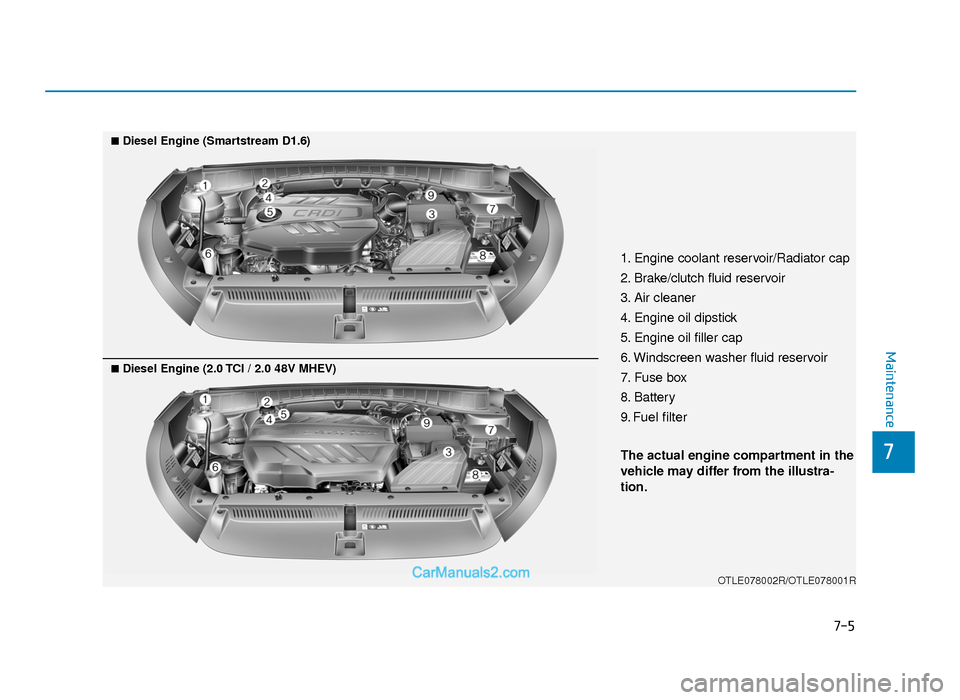
1. Engine coolant reservoir/Radiator cap
2. Brake/clutch fluid reservoir
3. Air cleaner
4. Engine oil dipstick
5. Engine oil filler cap
6. Windscreen washer fluid reservoir
7. Fuse box
8. Battery
9. Fuel filter
The actual engine compartment in the
vehicle may differ from the illustra-
tion.
OTLE078002R/OTLE078001R
■Diesel Engine (Smartstream D1.6)
■Diesel Engine (2.0 TCI / 2.0 48V MHEV)
TLe UK 7.qxp 5/10/2018 1:32 PM Page 5
Page 562 of 685
7-13
7
Maintenance
Vapour hose and fuel filler cap
The vapour hose and fuel filler cap
should be inspected at those inter-
vals specified in the maintenance
schedule. Make sure that a new
vapour hose or fuel filler cap is cor-
rectly replaced.
Vacuum crankcase ventilation
hoses (if equipped)
Inspect the surface of hoses for evi-
dence of heat and/or mechanical
damage. Hard and brittle rubber,
cracking, tears, cuts, abrasions, and
excessive swelling indicate deterio-
ration. Particular attention should be
paid to examine those hose surfaces
nearest to high heat sources, such
as the exhaust manifold.
Inspect the hose routing to assure
that the hoses do not come in con-
tact with any heat source, sharp
edges or moving component which
might cause heat damage or
mechanical wear. Inspect all hose
connections, such as clamps and
couplings, to make sure they are
secure, and that no leaks are pres-
ent. Hoses should be replaced
immediately if there is any evidence
of deterioration or damage.
Air cleaner filter
We recommend that the air cleaner
filter be replaced by a HYUNDAI
authorised repairer.
Spark plugs
(For Petrol Engine)
Make sure to install new spark plugs
of the correct heat range.
Valve clearance
(For Petrol Engine)
Inspect excessive valve noise and/or
engine vibration and adjust if neces-
sary. We recommend that the system
be serviced by a HYUNDAI authorised
repairer.
Cooling system
Check the cooling system parts, such
as radiator, coolant reservoir, hoses
and connections for leakage and dam-
age. Replace any damaged parts.
Engine coolant
The coolant should be changed at
the intervals specified in the mainte-
nance schedule.
Automatic transaxle fluid
Automatic transaxle fluid should not
be checked under normal usage
conditions. We recommend that the
automatic transaxle fluid changed by
a HYUNDAI authorised repairer
according to the maintenance sched-
ule.
Information
Automatic transaxle fluid colour is
basically red. As the vehicle is driven,
the automatic transaxle fluid will begin
to look darker. It is normal condition
and you should not judge the need to
replace the fluid based upon the
changed colour.
i
Do not disconnect and inspect
spark plugs when the engine is
hot. You may burn yourself.
WARNING
TLe UK 7.qxp 5/10/2018 1:32 PM Page 13
Page 567 of 685
7-18
Maintenance
• Do not spill engine oil, when adding or changing engine oil. If
you drop the engine oil on the
engine room, wipe it off immedi-
ately.
• When you wipe the oil level gauge, you should wipe it with a clean
cloth. When mixed with debris, it
can cause engine damage.
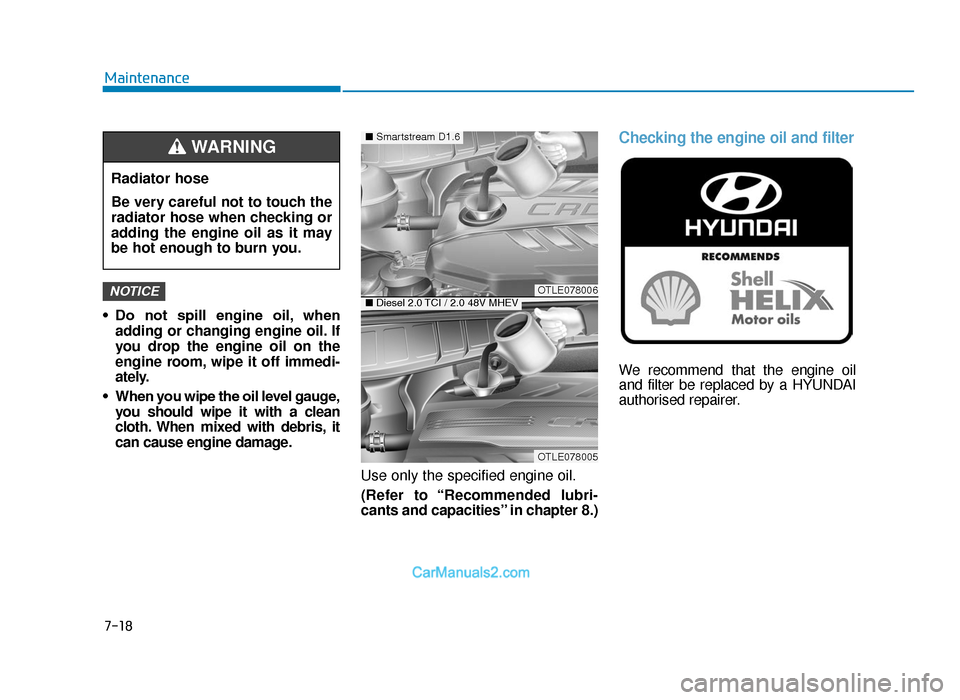
Use only the specified engine oil.
(Refer to “Recommended lubri-
cants and capacities” in chapter 8.)
Checking the engine oil and filter
We recommend that the engine oil
and filter be replaced by a HYUNDAI
authorised repairer.
NOTICEOTLE078006
OTLE078005
■Smartstream D1.6
■Diesel 2.0 TCI / 2.0 48V MHEV
Radiator hose
Be very careful not to touch the
radiator hose when checking or
adding the engine oil as it may
be hot enough to burn you.
WARNING
TLe UK 7.qxp 5/10/2018 1:33 PM Page 18
Page 570 of 685
7-21
7
Maintenance
Removing radiatorcap
• Never attempt to remove the
radiator cap whilst the engine
is operating or hot. Doing so
might lead to cooling system
and engine damage and could
result in serious personal
injury from escaping hot
coolant or steam.
(Continued)
WARNING (Continued)
•Turn the engine off and wait
until it cools down. Use
extreme care when removing
the radiator cap. Wrap a thick
towel around it, and turn it
counterclockwise slowly to
the first stop. Step back whilst
the pressure is released from
the cooling system.
When you are sure all the
pressure has been released,
press down on the cap, using
a thick towel, and continue
turning counterclockwise to
remove it.
• Even if the engine is not oper-
ating, do not remove the radi-
ator cap or the drain plug
whilst the engine and radiator
are hot. Hot coolant and
steam may still blow out
under pressure, causing seri-
ous injury.
The electric motor
(cooling fan) is con-
trolled by engine
coolant temperature,
refrigerant pressure
and vehicle speed. It may some-
times operate even when the
engine is not running. Use
extreme caution when working
near the blades of the cooling
fan so that you are not injured
by a rotating fan blades. As the
engine coolant temperature
decreases, the electric motor
will automatically shut off. This
is a normal condition.
The electric motor (cooling fan)
may operate until you discon-
nect the negative battery cable.
WARNING
TLe UK 7.qxp 5/10/2018 1:33 PM Page 21
Page 571 of 685
7-22
Maintenance
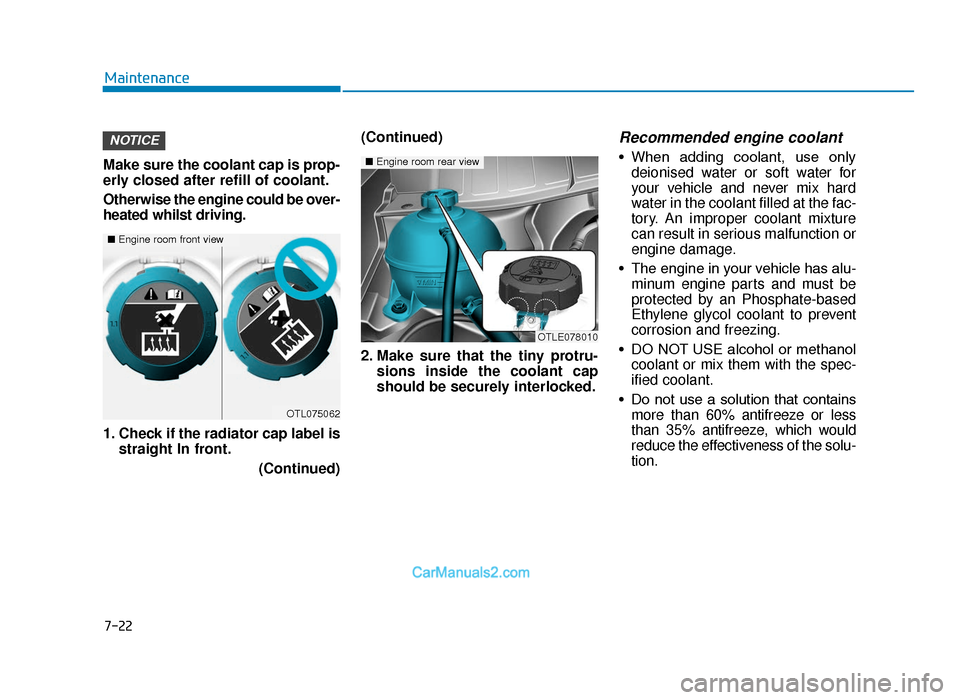
Make sure the coolant cap is prop-
erly closed after refill of coolant.
Otherwise the engine could be over-
heated whilst driving.
1. Check if the radiator cap label is straight In front.
(Continued)(Continued)
2. Make sure that the tiny protru-
sions inside the coolant cap
should be securely interlocked.
Recommended engine coolant
• When adding coolant, use onlydeionised water or soft water for
your vehicle and never mix hard
water in the coolant filled at the fac-
tory. An improper coolant mixture
can result in serious malfunction or
engine damage.
• The engine in your vehicle has alu- minum engine parts and must be
protected by an Phosphate-based
Ethylene glycol coolant to prevent
corrosion and freezing.
• DO NOT USE alcohol or methanol coolant or mix them with the spec-
ified coolant.
• Do not use a solution that contains more than 60% antifreeze or less
than 35% antifreeze, which would
reduce the effectiveness of the solu-
tion.
NOTICE
OTL075062
■ Engine room front view
OTLE078010
■Engine room rear view
TLe UK 7.qxp 5/10/2018 1:33 PM Page 22
Page 572 of 685
7-23
7
Maintenance
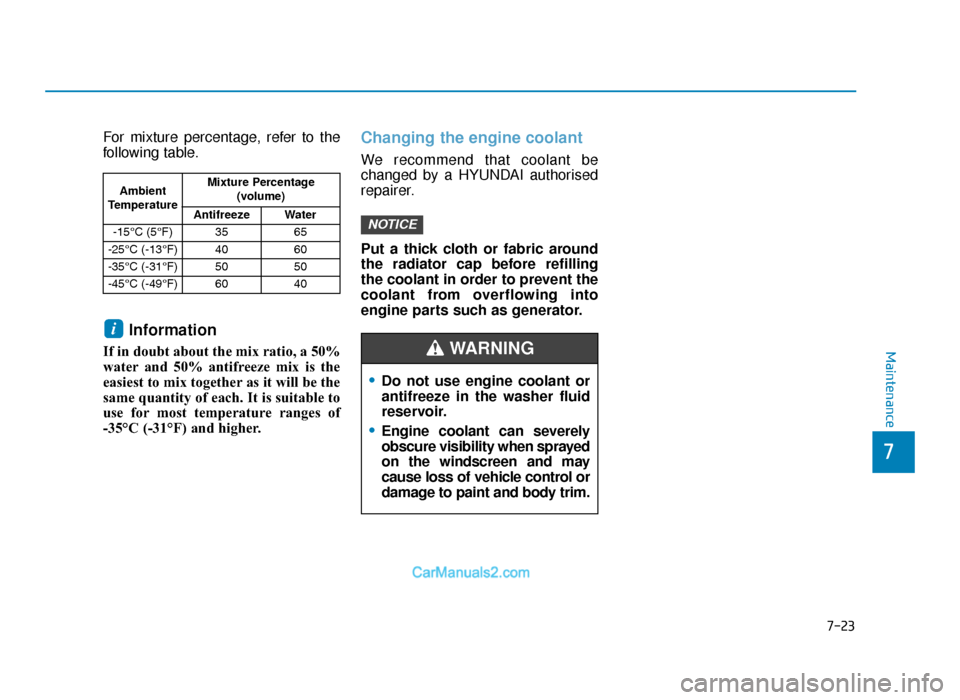
For mixture percentage, refer to the
following table.
Information
If in doubt about the mix ratio, a 50%
water and 50% antifreeze mix is the
easiest to mix together as it will be the
same quantity of each. It is suitable to
use for most temperature ranges of
-35°C (-31°F) and higher.
Changing the engine coolant
We recommend that coolant be
changed by a HYUNDAI authorised
repairer.
Put a thick cloth or fabric around
the radiator cap before refilling
the coolant in order to prevent the
coolant from overflowing into
engine parts such as generator.
NOTICE
i
Ambient
Temperature Mixture Percentage
(volume)
Antifreeze Water
-15°C (5°F) 35 65
-25°C (-13°F) 40 60
-35°C (-31°F) 50 50
-45°C (-49°F) 60 40
•Do not use engine coolant or
antifreeze in the washer fluid
reservoir.
•Engine coolant can severely
obscure visibility when sprayed
on the windscreen and may
cause loss of vehicle control or
damage to paint and body trim.
WARNING
TLe UK 7.qxp 5/10/2018 1:33 PM Page 23