2019 Hyundai Tucson maintenance schedule
[x] Cancel search: maintenance schedulePage 8 of 685
F8
Introduction
Use of MTBE
HYUNDAI recommends avoiding
fuels containing MTBE (Methyl
Tertiary Butyl Ether) over 15.0% vol.
(Oxygen Content 2.7% weight) in
your vehicle.
Fuel containing MTBE over 15.0%
vol. (Oxygen Content 2.7% weight)
may reduce vehicle performance and
produce vapour lock or hard starting.
Do not use methanol
Fuels containing methanol (wood
alcohol) should not be used in your
vehicle.This type of fuel can reduce
vehicle performance and damage
components of the fuel system, engine
control system and emission control
system.
Fuel Additives
HYUNDAI recommends that you use
unleaded petrol which has an octane
rating of RON (Research Octane
Number) 95 / AKI (Anti Knock Index)
91 or higher.
For customers who do not use good
quality petrols including fuel addi-
tives regularly, and have problems
starting or the engine does not run
smoothly, one bottle of additive
added to the fuel tank according to
the maintenance schedule is recom-
mended.
Additives are available from your
HYUNDAI authorised repairer along
with information on how to use them.
Do not mix other additives.
Operation in foreign countries
If you are going to drive your vehicle
in another country, be sure to:
• Observe all regulations regarding registration and insurance.
• Determine that acceptable fuel is available.
Your New Vehicle Limited
Warranty may not cover dam-
age to the fuel system and any
performance problems that are
caused by the use of fuels con-
taining methanol or fuels con-
taining MTBE (Methyl Tertiary
Butyl Ether) over 15.0% vol.
(Oxygen Content 2.7% weight.)
CAUTION
TLe UK foreword.qxp 6/19/2018 6:02 PM Page 8
Page 23 of 685
2-3
Safety system of your vehicle
• NEVER let the use of a mobiledevice distract you from driving.
You have a responsibility to your
passengers and others on the road
to always drive safely, with your
hands on the wheel as well as your
eyes and attention on the road.
Control your speed
Excessive speed is a major factor in
crash injuries and deaths. Generally,
the higher the speed, the greater the
risk, but serious injuries can also
occur at lower speeds. Never drive
faster than is safe for current condi-
tions, regardless of the maximum
speed posted.
Keep your vehicle in safe condi-
tion
Having a tyre blowout or a mechani-
cal failure can be extremely haz-
ardous. To reduce the possibility of
such problems, check your tyre pres-
sures and condition frequently, and
perform all regularly scheduled
maintenance.
2
TLe UK 2.qxp 6/12/2018 2:03 PM Page 3
Page 240 of 685
3-148
Convenient features of your vehicle
System maintenance
Climate control air filter
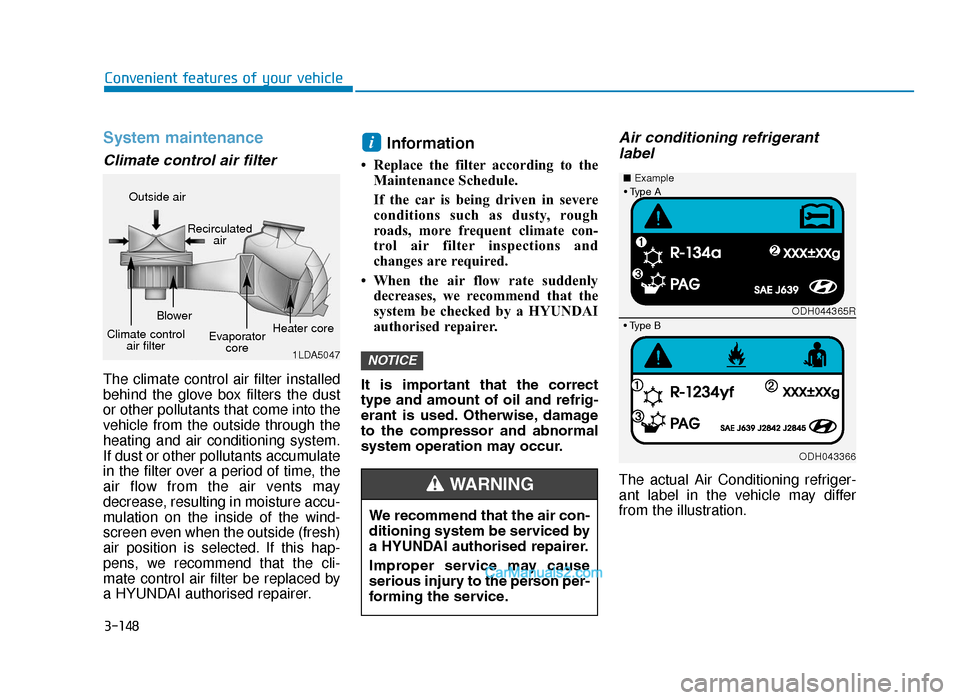
The climate control air filter installed
behind the glove box filters the dust
or other pollutants that come into the
vehicle from the outside through the
heating and air conditioning system.
If dust or other pollutants accumulate
in the filter over a period of time, the
air flow from the air vents may
decrease, resulting in moisture accu-
mulation on the inside of the wind-
screen even when the outside (fresh)
air position is selected. If this hap-
pens, we recommend that the cli-
mate control air filter be replaced by
a HYUNDAI authorised repairer.
Information
• Replace the filter according to theMaintenance Schedule.
If the car is being driven in severe
conditions such as dusty, rough
roads, more frequent climate con-
trol air filter inspections and
changes are required.
• When the air flow rate suddenly decreases, we recommend that the
system be checked by a HYUNDAI
authorised repairer.
It is important that the correct
type and amount of oil and refrig-
erant is used. Otherwise, damage
to the compressor and abnormal
system operation may occur.
Air conditioning refrigerant label
The actual Air Conditioning refriger-
ant label in the vehicle may differ
from the illustration.
NOTICE
i
1LDA5047
Outside air
Recirculatedair
Climate control air filter Blower
Evaporatorcore Heater core
We recommend that the air con-
ditioning system be serviced by
a HYUNDAI authorised repairer.
Improper service may cause
serious injury to the person per-
forming the service.
WARNING
ODH044365R
ODH043366
■
Example
• Type B
• Type A
TLe UK 3b(110~).qxp 6/12/2018 2:39 PM Page 148
Page 253 of 685
3-161
Convenient features of your vehicle
3
Information
• Replace the filter according to theMaintenance Schedule.
If the car is being driven in severe
conditions such as dusty, rough
roads, more frequent climate con-
trol air filter inspections and
changes are required.
• When the air flow rate suddenly decreases, we recommend that the
system be checked by a HYUNDAI
authorised repairer.
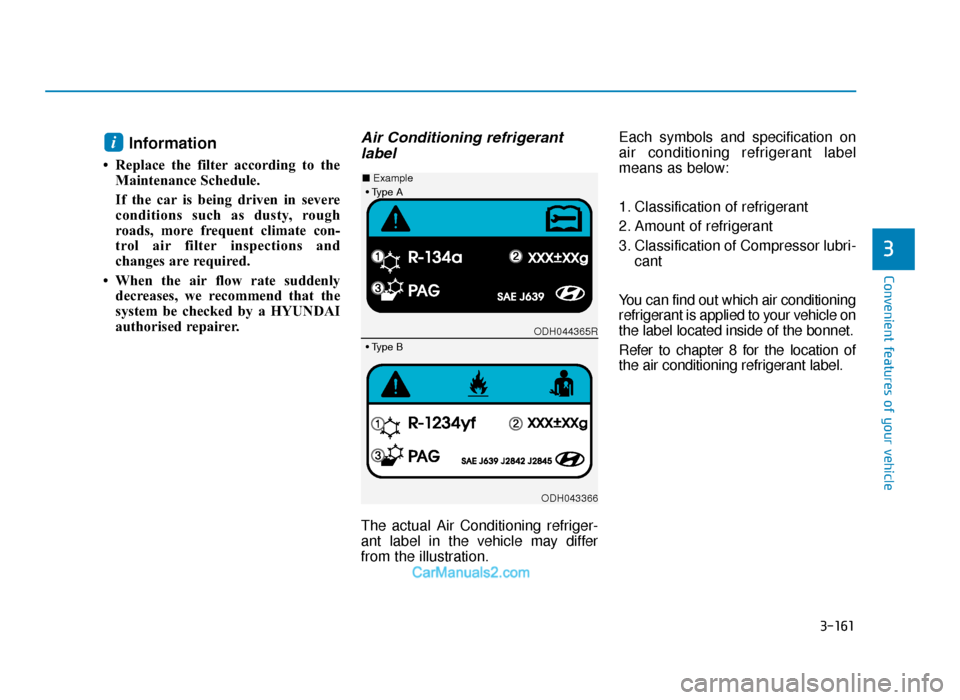
Air Conditioning refrigerantlabel
The actual Air Conditioning refriger-
ant label in the vehicle may differ
from the illustration. Each symbols and specification on
air conditioning refrigerant label
means as below:
1. Classification of refrigerant
2. Amount of refrigerant
3. Classification of Compressor lubri-
cant
You can find out which air conditioning
refrigerant is applied to your vehicle on
the label located inside of the bonnet.
Refer to chapter 8 for the location of
the air conditioning refrigerant label.
i
ODH044365R
ODH043366
■
Example
• Type B• Type A
TLe UK 3b(110~).qxp 6/12/2018 2:40 PM Page 161
Page 490 of 685
5-166
Driving your vehicle
Chain Installation
When installing tyre chains, follow
the manufacturer's instructions and
mount them as tightly possible. Drive
slowly (less than 20 mph (30 km/h))
with chains installed. If you hear the
chains contacting the body or chas-
sis, stop and tighten them. If they still
make contact, slow down until the
noise stops. Remove the tyre chains
as soon as you begin driving on
cleared roads.
When mounting snow chains, park
the vehicle on level ground away
from traffic. Turn on the vehicle
Hazard Warning Flasher and place a
triangular emergency warning device
behind the vehicle (if available).
Always place the vehicle in P (Park),
apply the parking brake and turn off
the engine before installing snow
chains.When using tyre chains:
• Wrong size chains or improperly
installed chains can damage
your vehicle's brake lines, sus-
pension, body and wheels.
• Use SAE “S” class or wire chains.
• If you hear noise caused by chains contacting the body,
retighten the chain to prevent
contact with the vehicle body.
• To prevent body damage, retight- en the chains after driving 0.3~0.6
miles (0.5~1.0 km).
• Do not use tyre chains on vehi- cles equipped with aluminium
wheels. If unavoidable, use a
wire type chain.
• Use wire chains less than 15 mm (0.59 in) wide to prevent damage
to the chain’s connection.
Winter Precautions
Use high quality ethylene glycol
coolant
Your vehicle is delivered with high
quality ethylene glycol coolant in the
cooling system. It is the only type of
coolant that should be used because
it helps prevent corrosion in the cool-
ing system, lubricates the water
pump and prevents freezing. Be sure
to replace or replenish your coolant
in accordance with the maintenance
schedule. Before winter, have your
coolant tested to assure that its
freezing point is sufficient for the
temperatures anticipated during the
winter.
NOTICE
TLe UK 5.qxp 5/10/2018 12:32 PM Page 166
Page 550 of 685
7
Maintenance
7
Maintenance
Engine compartment .............................................7-3
Maintenance services ...........................................7-6
Owner's responsibility ......................................................7-6
Owner maintenance precautions ..................................7-6
Owner maintenance ...............................................7-8
Owner maintenance schedule ........................................7-9
Scheduled maintenance services ......................7-11
Explanation of scheduled maintenance items .7-12
Engine oil ..............................................................7-15
Checking the engine oil level (Petrol Engine)..........7-15
Checking the engine oil level (Diesel Engine)..........7-17
Checking the engine oil and filter ..............................7-18
Engine coolant......................................................7-20
Checking the engine coolant level..............................7-20
Changing the engine coolant .......................................7-23
Brake/clutch fluid ................................................7-24
Checking the brake/clutch fluid level ........................7-24
Washer fluid .........................................................7-25
Checking the washer fluid level ..................................7-25
Parking brake .......................................................7-25
Checking the parking brake .........................................7-25
Fuel filter (For Diesel) ........................................7-26
Draining water from fuel filter ....................................7-26
Fuel filter cartridge replacement ................................7-26
Air cleaner ............................................................7-27
Filter replacement ...........................................................7-27
Climate control air filter .....................................7-29
Filter inspection ...............................................................7-29
Filter replacement ...........................................................7-29
Wiper blades .........................................................7-30
Blade inspection ..............................................................7-30
Blade replacement ..........................................................7-30
Battery...................................................................7-33
For best battery service................................................7-33
Battery capacity label ....................................................7-35
Battery recharging .........................................................7-35
Reset items .......................................................................7\
-36
Tyres and wheels .................................................7-37
Tyre care ........................................................................\
...7-37
Recommended cold tyre inflation pressures ...........7-37
Checking tyre inflation pressure.................................7-39
Tyre rotation ....................................................................7-40\
Wheel alignment and tyre balance.............................7-41
Tyre replacement ............................................................7-41
Wheel replacement ........................................................7-43
Tyre traction .....................................................................7-4\
3
Tyre maintenance ...........................................................7-43
Tyre sidewall labelling ....................................................7-43
Low aspect ratio tyre.....................................................7-48
7
TLe UK 7.qxp 5/10/2018 1:31 PM Page 1
Page 555 of 685
7-6
Maintenance
MAINTENANCE SERVICES
You should exercise the utmost care
to prevent damage to your vehicle
and injury to yourself whenever per-
forming any maintenance or inspec-
tion procedures.
We recommend you have your vehi-
cle maintained and repaired by a
HYUNDAI authorised repairer. a
HYUNDAI authorised repairer meets
HYUNDAI’s high service quality stan-
dards and receives technical support
from HYUNDAI in order to provide
you with a high level of service satis-
faction.Owner’s responsibility
Maintenance service and record reten-
tion are the owner’s responsibility.
You should retain documents that show
proper maintenance has been per-
formed on your vehicle in accordance
with the scheduled maintenance serv-
ice charts shown on the following
pages. You need this information to
establish your compliance with the
servicing and maintenance require-
ments of your vehicle warranties.
Detailed warranty information is pro-
vided in your Warranty Booklet.
Repairs and adjustments required as
a result of improper maintenance or
a lack of required maintenance are
not covered.
Owner maintenance precautions
Inadequate, incomplete or insufficient
servicing may result in operational
problems with your vehicle that could
lead to vehicle damage, an accident,
or personal injury. This chapter pro-
vides instructions only for the mainte-
nance items that are easy to perform.
Several procedures can be done only
by a HYUNDAI authorised repairer
with special tools.
Your vehicle should not be modified in
any way. Such modifications may
adversely affect the performance,
safety or durability of your vehicle and
may, in addition, violate conditions of
the limited warranties covering the
vehicle.
TLe UK 7.qxp 5/10/2018 1:32 PM Page 6
Page 558 of 685
7-9
7
Maintenance
Owner maintenance schedule
When you stop for fuel:
• Check the engine oil level.
• Check coolant level in the enginecoolant reservoir.
• Check the windscreen washer fluid level.
• Check for low or under-inflated tyres.
Whilst operating your vehicle:
• Note any changes in the sound of the exhaust or any smell of exhaust
fumes in the vehicle.
• Check for vibrations in the steering wheel. Notice if there is any
increased steering effort or loose-
ness in the steering wheel, or
change in its straight-ahead position.
• Notice if your vehicle constantly turns slightly or “pulls” to one side when
travelling on smooth, level road.
• When stopping, listen and check for unusual sounds, pulling to one side,
increased brake pedal travel or
“hard-to-push” brake pedal.
• If any slipping or changes in the operation of your transaxle occurs,
check the transaxle fluid level.
• Check the automatic transaxle/ dual clutch transmission P (Park)
function.
• Check the parking brake.
• Check for fluid leaks under your vehicle (water dripping from the air
conditioning system during or after
use is normal).
Be careful when checking your
engine coolant level when the
engine is hot. This may result in
coolant being blown out of the
opening and cause serious
burns and other injuries.
WARNING
Diesel Engine
Never manipulate or modify the
injection system whilst running
the diesel engine or within 30
seconds after turning OFF the
diesel engine. The high-pres-
sure pump, high-pressure
pipes, rail, and injectors are still
subject to the high pressure
right after stopping the diesel
engine.
When the fuel leakage vents
out, it may cause serious body
injury. Any people, who are
implemented with the artificial
cardiac pacemaker, should
remain away from the ECU or
the wiring harness by at least 30
cm, whilst running the diesel
engine. The high currents of the
electric engine control system
produce a considerable amount
of magnetic fields.
WARNING
TLe UK 7.qxp 5/10/2018 1:32 PM Page 9