2019 Hyundai Tucson coolant level
[x] Cancel search: coolant levelPage 176 of 685
3-84
Convenient features of your vehicle
Engine has overheated
This warning message illuminates
with a warning chime when the
engine coolant temperature is above
120°C (248°F). This means that the
engine is overheated and may be
damaged.
If your vehicle is overheated, refer
to “Overheating” in chapter 6.
Check headlight (if equipped)
This warning message is displayed if
the headlamps are not operating
properly.
In addition, if a specific lamp(turn
signal lamp etc.) is not operating
properly, the warning message
according to a specific lamp (turn
signal lamp etc.) is displayed. A cor-
responding bulb may need to be
replaced.
Information
Make sure to replace the burned out
bulb with a new one of the same
wattage rating.
If not, this warning message will not
be displayed.
Low engine oil (if equipped)
This warning message is displayed
when the engine oil level should be
checked.
If this warning message is displayed,
check the engine oil level as soon as
possible and add engine oil as
required.
Slowly pour the recommended oil lit-
tle by little into a funnel. (Oil refill
capacity : approximately 0.6 ~ 1.0 l)
Use only the specified engine oil.
(Refer to "Recommended lubricants
and capacities" in chapter 8.)
Do not overfill the engine oil. Make
sure the oil level is not above F (Full)
mark on the dipstick.
i
TLe UK 3a(~109).qxp 6/12/2018 2:27 PM Page 84
Page 490 of 685
5-166
Driving your vehicle
Chain Installation
When installing tyre chains, follow
the manufacturer's instructions and
mount them as tightly possible. Drive
slowly (less than 20 mph (30 km/h))
with chains installed. If you hear the
chains contacting the body or chas-
sis, stop and tighten them. If they still
make contact, slow down until the
noise stops. Remove the tyre chains
as soon as you begin driving on
cleared roads.
When mounting snow chains, park
the vehicle on level ground away
from traffic. Turn on the vehicle
Hazard Warning Flasher and place a
triangular emergency warning device
behind the vehicle (if available).
Always place the vehicle in P (Park),
apply the parking brake and turn off
the engine before installing snow
chains.When using tyre chains:
• Wrong size chains or improperly
installed chains can damage
your vehicle's brake lines, sus-
pension, body and wheels.
• Use SAE “S” class or wire chains.
• If you hear noise caused by chains contacting the body,
retighten the chain to prevent
contact with the vehicle body.
• To prevent body damage, retight- en the chains after driving 0.3~0.6
miles (0.5~1.0 km).
• Do not use tyre chains on vehi- cles equipped with aluminium
wheels. If unavoidable, use a
wire type chain.
• Use wire chains less than 15 mm (0.59 in) wide to prevent damage
to the chain’s connection.
Winter Precautions
Use high quality ethylene glycol
coolant
Your vehicle is delivered with high
quality ethylene glycol coolant in the
cooling system. It is the only type of
coolant that should be used because
it helps prevent corrosion in the cool-
ing system, lubricates the water
pump and prevents freezing. Be sure
to replace or replenish your coolant
in accordance with the maintenance
schedule. Before winter, have your
coolant tested to assure that its
freezing point is sufficient for the
temperatures anticipated during the
winter.
NOTICE
TLe UK 5.qxp 5/10/2018 12:32 PM Page 166
Page 491 of 685
5-167
Driving your vehicle
5
Check battery and cables
The winter temperature increases
the battery consumption.Inspect
the battery and cables, as speci-
fied in the chapter 7. The battery
charging level can be checked by a
HYUNDAI authorised repairer or in a
service station.
Change to "winter weight" oil if
necessary
In some regions during winter, it is
recommended to use the "winter
weight" oil with lower viscosity. For
further information, refer to the chap-
ter 8. When you are not sure about a
type of winter weight oil, consult a
HYUNDAI authorised repairer. Check spark plugs and ignition
system
Inspect the spark plugs, as speci-
fied in the chapter 7.
If necessary,
replace them. Also check all ignition
wirings and components for any
cracks, wear-out, and damage.
To prevent locks from freezing
To prevent the locks from being
frozen, spray approved de-icing fluid
or glycerin into key holes. When a
lock opening is already covered with
ice, spray approved de-icing fluid
over the ice to remove it. When an
internal part of a lock freezes, try to
thaw it with a heated key. Carefully
use the heated key to avoid an injury. Use approved window washer
anti-freeze solution in system
To prevent the window washer from
being frozen, add authorised window
washer anti-freeze solution, as spec-
ified on the window washer contain-
er. Window washer anti-freeze solu-
tion is available from a HYUNDAI
authorised repairer, and so are the
most vehicle accessory outlets. Do
not use engine coolant or other types
of anti-freeze solution to prevent any
damage to the vehicle paint.
TLe UK 5.qxp 5/10/2018 12:32 PM Page 167
Page 512 of 685
6-9
What to do in an emergency
6
6. If you cannot find the cause of theoverheating, wait until the engine
temperature has returned to nor-
mal. Then, if coolant has been
lost, carefully add coolant to the
reservoir to bring the fluid level in
the reservoir up to the halfway
mark.
7. Proceed with caution, keeping alert for further signs of overheat-
ing. If overheating happens again,
we recommend that you call a
HYUNDAI authorised repairer for
assistance.
•Serious loss of coolant indi-
cates a leak in the cooling
system and we recommend
the system be checked by a
HYUNDAI authorised repairer.
•When the engine overheats
from low engine coolant, sud-
denly adding engine coolant
may cause cracks in the
engine. To prevent damage,
add engine coolant slowly in
small quantities.
CAUTION
NEVER remove the
radiator cap or the
drain plug whilst the
engine and radiator
are hot. Hot coolant
and steam may blow out under
pressure, causing serious injury.
Turn the engine off and wait
until the engine cools down.
Use extreme care when remov-
ing the radiator cap. Wrap a
thick towel around it, and turn it
counterclockwise slowly to the
first stop. Step back whilst the
pressure is released from the
cooling system. When you are
sure all the pressure has been
released, press down on the
cap, using a thick towel, and
continue turning counterclock-
wise to remove it.
WARNING
TLe UK 6.qxp 5/10/2018 1:20 PM Page 9
Page 550 of 685
7
Maintenance
7
Maintenance
Engine compartment .............................................7-3
Maintenance services ...........................................7-6
Owner's responsibility ......................................................7-6
Owner maintenance precautions ..................................7-6
Owner maintenance ...............................................7-8
Owner maintenance schedule ........................................7-9
Scheduled maintenance services ......................7-11
Explanation of scheduled maintenance items .7-12
Engine oil ..............................................................7-15
Checking the engine oil level (Petrol Engine)..........7-15
Checking the engine oil level (Diesel Engine)..........7-17
Checking the engine oil and filter ..............................7-18
Engine coolant......................................................7-20
Checking the engine coolant level..............................7-20
Changing the engine coolant .......................................7-23
Brake/clutch fluid ................................................7-24
Checking the brake/clutch fluid level ........................7-24
Washer fluid .........................................................7-25
Checking the washer fluid level ..................................7-25
Parking brake .......................................................7-25
Checking the parking brake .........................................7-25
Fuel filter (For Diesel) ........................................7-26
Draining water from fuel filter ....................................7-26
Fuel filter cartridge replacement ................................7-26
Air cleaner ............................................................7-27
Filter replacement ...........................................................7-27
Climate control air filter .....................................7-29
Filter inspection ...............................................................7-29
Filter replacement ...........................................................7-29
Wiper blades .........................................................7-30
Blade inspection ..............................................................7-30
Blade replacement ..........................................................7-30
Battery...................................................................7-33
For best battery service................................................7-33
Battery capacity label ....................................................7-35
Battery recharging .........................................................7-35
Reset items .......................................................................7\
-36
Tyres and wheels .................................................7-37
Tyre care ........................................................................\
...7-37
Recommended cold tyre inflation pressures ...........7-37
Checking tyre inflation pressure.................................7-39
Tyre rotation ....................................................................7-40\
Wheel alignment and tyre balance.............................7-41
Tyre replacement ............................................................7-41
Wheel replacement ........................................................7-43
Tyre traction .....................................................................7-4\
3
Tyre maintenance ...........................................................7-43
Tyre sidewall labelling ....................................................7-43
Low aspect ratio tyre.....................................................7-48
7
TLe UK 7.qxp 5/10/2018 1:31 PM Page 1
Page 558 of 685
7-9
7
Maintenance
Owner maintenance schedule
When you stop for fuel:
• Check the engine oil level.
• Check coolant level in the enginecoolant reservoir.
• Check the windscreen washer fluid level.
• Check for low or under-inflated tyres.
Whilst operating your vehicle:
• Note any changes in the sound of the exhaust or any smell of exhaust
fumes in the vehicle.
• Check for vibrations in the steering wheel. Notice if there is any
increased steering effort or loose-
ness in the steering wheel, or
change in its straight-ahead position.
• Notice if your vehicle constantly turns slightly or “pulls” to one side when
travelling on smooth, level road.
• When stopping, listen and check for unusual sounds, pulling to one side,
increased brake pedal travel or
“hard-to-push” brake pedal.
• If any slipping or changes in the operation of your transaxle occurs,
check the transaxle fluid level.
• Check the automatic transaxle/ dual clutch transmission P (Park)
function.
• Check the parking brake.
• Check for fluid leaks under your vehicle (water dripping from the air
conditioning system during or after
use is normal).
Be careful when checking your
engine coolant level when the
engine is hot. This may result in
coolant being blown out of the
opening and cause serious
burns and other injuries.
WARNING
Diesel Engine
Never manipulate or modify the
injection system whilst running
the diesel engine or within 30
seconds after turning OFF the
diesel engine. The high-pres-
sure pump, high-pressure
pipes, rail, and injectors are still
subject to the high pressure
right after stopping the diesel
engine.
When the fuel leakage vents
out, it may cause serious body
injury. Any people, who are
implemented with the artificial
cardiac pacemaker, should
remain away from the ECU or
the wiring harness by at least 30
cm, whilst running the diesel
engine. The high currents of the
electric engine control system
produce a considerable amount
of magnetic fields.
WARNING
TLe UK 7.qxp 5/10/2018 1:32 PM Page 9
Page 559 of 685
7-10
Maintenance
At least monthly:
• Check coolant level in the enginecoolant reservoir.
• Check the operation of all exterior lights, including the stoplights, turn
signals and hazard warning flashers.
• Check the inflation pressures of all tyres including the spare for tyres
that are worn, show uneven wear,
or are damaged.
• Check for loose wheel lug nuts.
At least twice a year: (i.e., every Spring and Fall)
• Check radiator, heater and air condi-
tioning hoses for leaks or damage.
• Check windscreen washer spray and wiper operation. Clean wiper
blades with clean cloth dampened
with washer fluid.
• Check headlamp alignment.
• Check muffler, exhaust pipes, shields and clamps.
• Check the seat belts for wear and function.
At least once a year:
• Clean body and door drain holes.
• Lubricate door hinges and bonnethinges.
• Lubricate door and bonnet locks and latches.
• Lubricate door rubber weather strips.
• Check the air conditioning system.
• Inspect and lubricate automatic transaxle linkage and controls.
• Clean the battery and terminals.
• Check the brake fluid level.
TLe UK 7.qxp 5/10/2018 1:32 PM Page 10
Page 569 of 685
7-20
Maintenance
ENGINE COOLANT
The high-pressure cooling system
has a reservoir filled with year-round
antifreeze coolant. The reservoir is
filled at the factory.
Check the antifreeze protection and
coolant concentration level at least
once a year, at the beginning of the
winter season, and before travelling
to a colder climate.
• When the engine overheats fromlow engine coolant, suddenly
adding engine coolant may cause
cracks in the engine. To prevent
damage, add engine coolant
slowly in small quantities.
• Do not drive with no engine coolant. It may cause water pump
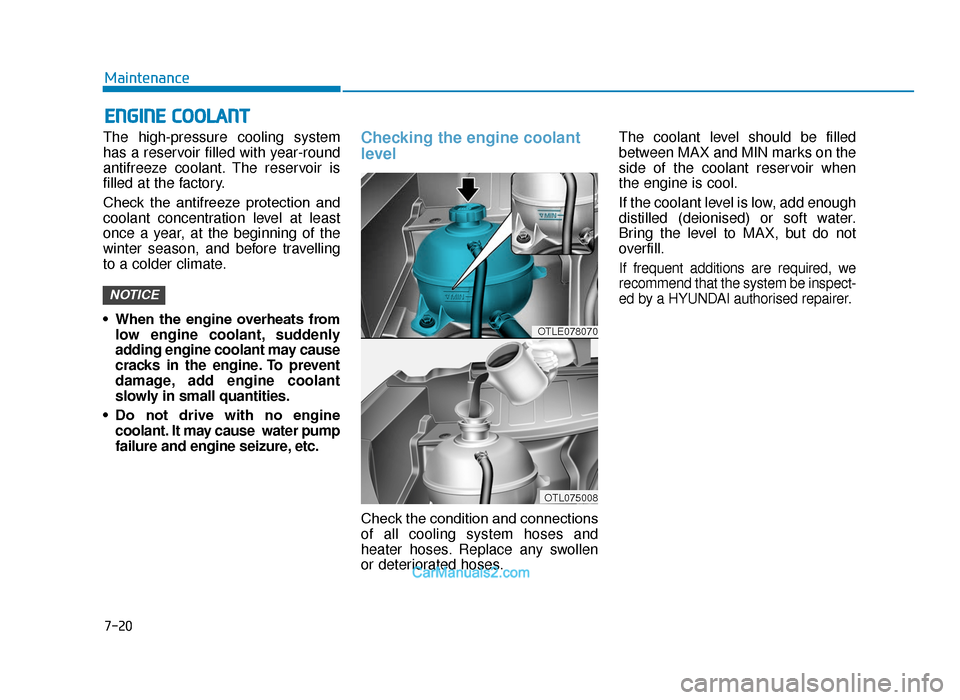
failure and engine seizure, etc.Checking the engine coolant
level
Check the condition and connections
of all cooling system hoses and
heater hoses. Replace any swollen
or deteriorated hoses. The coolant level should be filled
between MAX and MIN marks on the
side of the coolant reservoir when
the engine is cool.
If the coolant level is low, add enough
distilled (deionised) or soft water.
Bring the level to MAX, but do not
overfill.
If frequent additions are required, we
recommend that the system be inspect-
ed by a HYUNDAI authorised repairer.
NOTICE
OTLE078070
OTL075008
TLe UK 7.qxp 5/10/2018 1:33 PM Page 20