Page 559 of 685
7-10
Maintenance
At least monthly:
• Check coolant level in the enginecoolant reservoir.
• Check the operation of all exterior lights, including the stoplights, turn
signals and hazard warning flashers.
• Check the inflation pressures of all tyres including the spare for tyres
that are worn, show uneven wear,
or are damaged.
• Check for loose wheel lug nuts.
At least twice a year: (i.e., every Spring and Fall)
• Check radiator, heater and air condi-
tioning hoses for leaks or damage.
• Check windscreen washer spray and wiper operation. Clean wiper
blades with clean cloth dampened
with washer fluid.
• Check headlamp alignment.
• Check muffler, exhaust pipes, shields and clamps.
• Check the seat belts for wear and function.
At least once a year:
• Clean body and door drain holes.
• Lubricate door hinges and bonnethinges.
• Lubricate door and bonnet locks and latches.
• Lubricate door rubber weather strips.
• Check the air conditioning system.
• Inspect and lubricate automatic transaxle linkage and controls.
• Clean the battery and terminals.
• Check the brake fluid level.
TLe UK 7.qxp 5/10/2018 1:32 PM Page 10
Page 561 of 685
7-12
Maintenance
EXPLANATION OF SCHEDULED MAINTENANCE ITEMS
Engine oil and filter
The engine oil and filter should be
changed at the intervals specified in
the maintenance schedule. If the car
is being driven in severe conditions,
more frequent oil and filter changes
are required.
Drive belts
Inspect all drive belts for evidence of
cuts, cracks, excessive wear or oil
saturation and replace if necessary.
Drive belts should be checked peri-
odically for proper tension and
adjusted as necessary.
Fuel filter (cartridge)
A clogged-up fuel filter may limit the
vehicle driving speed, damage the
emission system, and cause the
hard starting. When a considerable
amount of foreign substances are
accumulated in the fuel tank, the fuel
filter should be replaced.
Upon installing a new fuel filter, oper-
ate the diesel engine for several min-
utes, and check the connections for
any leakages. We recommend you to
have the fuel filter replaced by a
HYUNDAI authorised repairer.
Fuel lines, fuel hoses and con-
nections
Check the fuel lines, fuel hoses and
connections for leakage and dam-
age. We recommend that the fuel
lines, fuel hoses and connections be
replaced by a HYUNDAI authorised
repairer.
When you are inspecting the belt,
place the ignition switch to the
LOCK/OFF or ACC position.
CAUTION
Diesel Engine
Never manipulate or modify the
injection system whilst running
the diesel engine or within 30
seconds after turning OFF the
diesel engine. The high-pressure
pump, high-pressure pipes, rail,
and injectors are still subject to
the high pressure right after
stopping the diesel engine. When
the fuel leakage vents out, it may
cause serious body injury. Any
people, who are implemented
with the artificial cardiac pace-
maker, should remain away from
the ECU or the wiring harness by
at least 30 cm whilst running the
diesel engine. The high currents
of the common rail system pro-
duce a considerable amount of
magnetic fields.
WARNING
TLe UK 7.qxp 5/10/2018 1:32 PM Page 12
Page 570 of 685
7-21
7
Maintenance
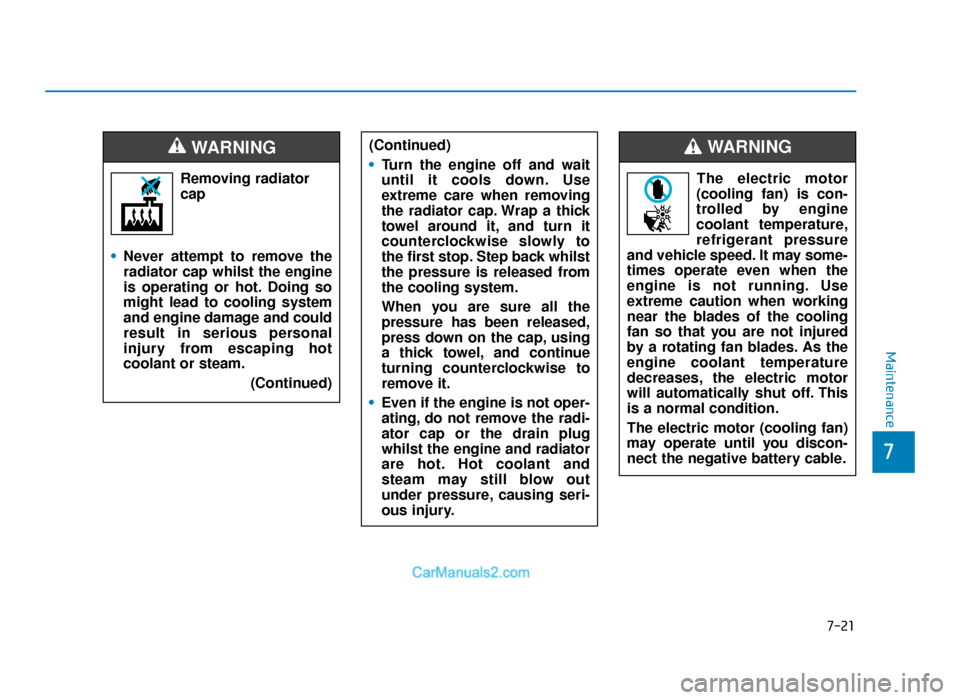
Removing radiatorcap
• Never attempt to remove the
radiator cap whilst the engine
is operating or hot. Doing so
might lead to cooling system
and engine damage and could
result in serious personal
injury from escaping hot
coolant or steam.
(Continued)
WARNING (Continued)
•Turn the engine off and wait
until it cools down. Use
extreme care when removing
the radiator cap. Wrap a thick
towel around it, and turn it
counterclockwise slowly to
the first stop. Step back whilst
the pressure is released from
the cooling system.
When you are sure all the
pressure has been released,
press down on the cap, using
a thick towel, and continue
turning counterclockwise to
remove it.
• Even if the engine is not oper-
ating, do not remove the radi-
ator cap or the drain plug
whilst the engine and radiator
are hot. Hot coolant and
steam may still blow out
under pressure, causing seri-
ous injury.
The electric motor
(cooling fan) is con-
trolled by engine
coolant temperature,
refrigerant pressure
and vehicle speed. It may some-
times operate even when the
engine is not running. Use
extreme caution when working
near the blades of the cooling
fan so that you are not injured
by a rotating fan blades. As the
engine coolant temperature
decreases, the electric motor
will automatically shut off. This
is a normal condition.
The electric motor (cooling fan)
may operate until you discon-
nect the negative battery cable.
WARNING
TLe UK 7.qxp 5/10/2018 1:33 PM Page 21
Page 571 of 685
7-22
Maintenance
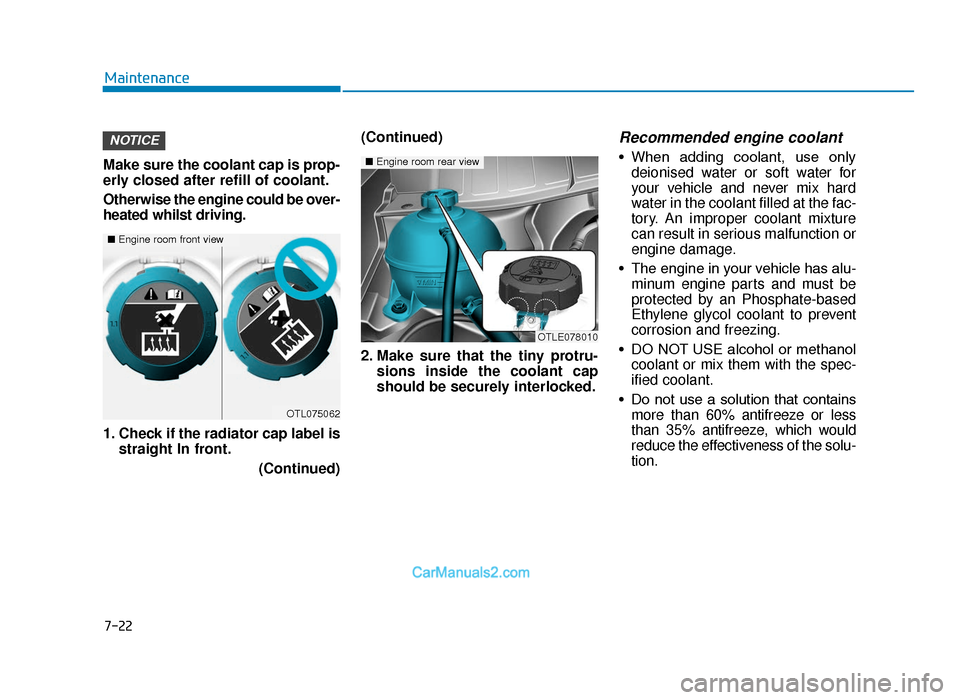
Make sure the coolant cap is prop-
erly closed after refill of coolant.
Otherwise the engine could be over-
heated whilst driving.
1. Check if the radiator cap label is straight In front.
(Continued)(Continued)
2. Make sure that the tiny protru-
sions inside the coolant cap
should be securely interlocked.
Recommended engine coolant
• When adding coolant, use onlydeionised water or soft water for
your vehicle and never mix hard
water in the coolant filled at the fac-
tory. An improper coolant mixture
can result in serious malfunction or
engine damage.
• The engine in your vehicle has alu- minum engine parts and must be
protected by an Phosphate-based
Ethylene glycol coolant to prevent
corrosion and freezing.
• DO NOT USE alcohol or methanol coolant or mix them with the spec-
ified coolant.
• Do not use a solution that contains more than 60% antifreeze or less
than 35% antifreeze, which would
reduce the effectiveness of the solu-
tion.
NOTICE
OTL075062
■ Engine room front view
OTLE078010
■Engine room rear view
TLe UK 7.qxp 5/10/2018 1:33 PM Page 22
Page 576 of 685
7-27
7
Maintenance
AIR CLEANER
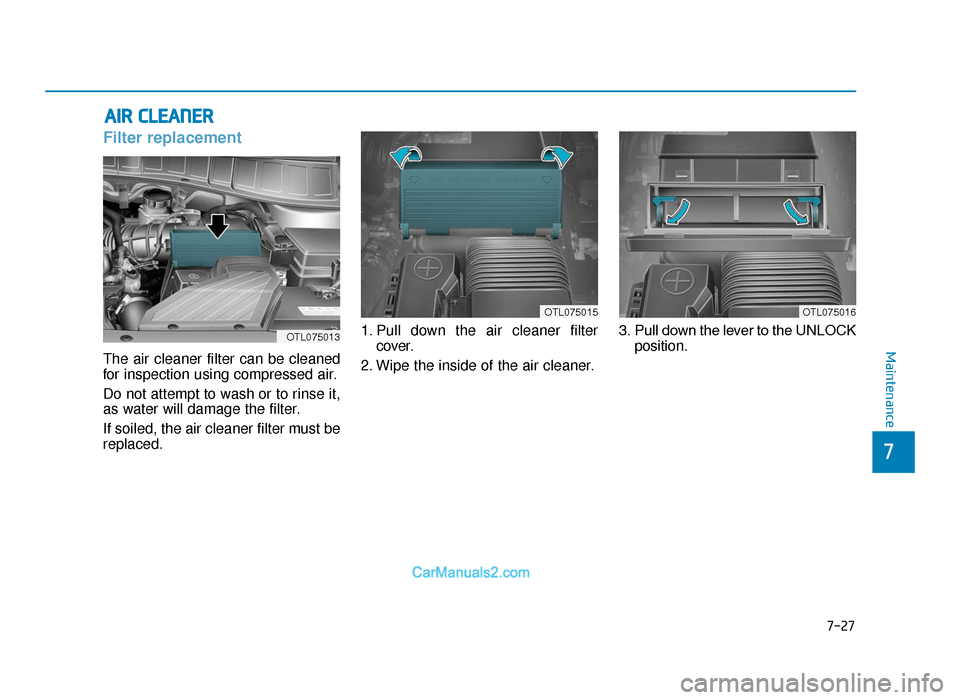
Filter replacement
The air cleaner filter can be cleaned
for inspection using compressed air.
Do not attempt to wash or to rinse it,
as water will damage the filter.
If soiled, the air cleaner filter must be
replaced.1. Pull down the air cleaner filter
cover.
2. Wipe the inside of the air cleaner. 3. Pull down the lever to the UNLOCK
position.
OTL075013
OTL075015OTL075016
TLe UK 7.qxp 5/10/2018 1:33 PM Page 27
Page 577 of 685
7-28
Maintenance
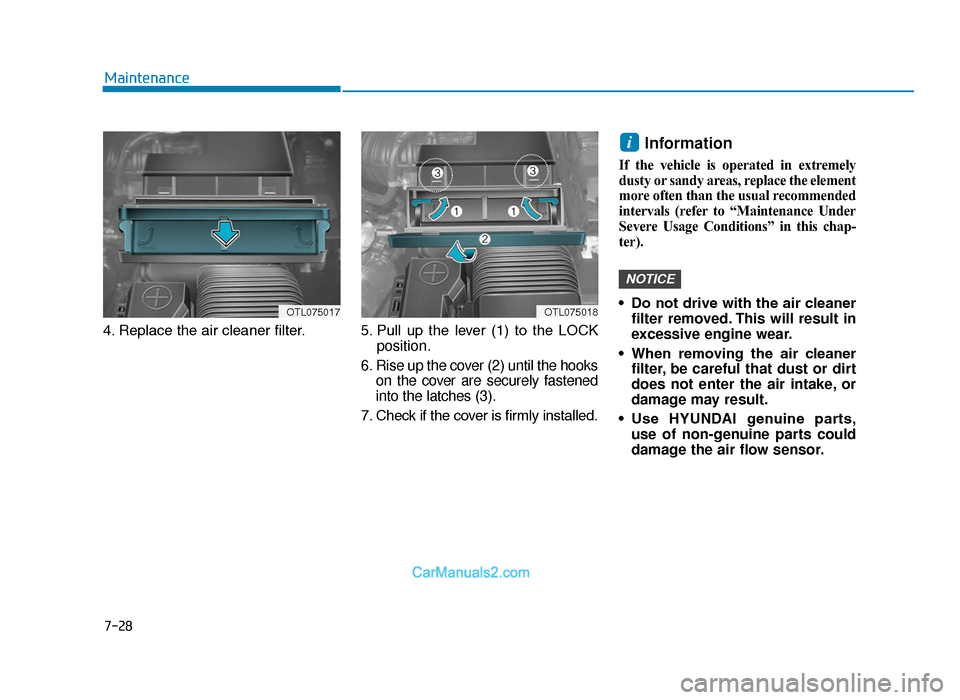
4. Replace the air cleaner filter. 5. Pull up the lever (1) to the LOCK position.
6. Rise up the cover (2) until the hooks on the cover are securely fastened
into the latches (3).
7. Check if the cover is firmly installed.
Information
If the vehicle is operated in extremely
dusty or sandy areas, replace the element
more often than the usual recommended
intervals (refer to “Maintenance Under
Severe Usage Conditions” in this chap-
ter).
• Do not drive with the air cleaner filter removed. This will result in
excessive engine wear.
• When removing the air cleaner filter, be careful that dust or dirt
does not enter the air intake, or
damage may result.
• Use HYUNDAI genuine parts, use of non-genuine parts could
damage the air flow sensor.
NOTICE
i
OTL075017OTL075018
TLe UK 7.qxp 5/10/2018 1:34 PM Page 28
Page 578 of 685
7-29
7
Maintenance
CLIMATE CONTROL AIR FILTER
Filter inspection
If the vehicle is operated in the
severely air-polluted cities or on
dusty rough roads for a long period,
it should be inspected more fre-
quently and replaced earlier. When
you, the owner, replace the climate
control air filter, replace it performing
the following procedure, and be care-
ful to avoid damaging other compo-
nents.
Replace the filter according to the
Maintenance Schedule.
Install a new climate control air filter
in the correct direction with the
arrow symbol(
↓) facing downwards.
Otherwise, the climate control effects
may decrease, possibly with a noise.
Filter replacement
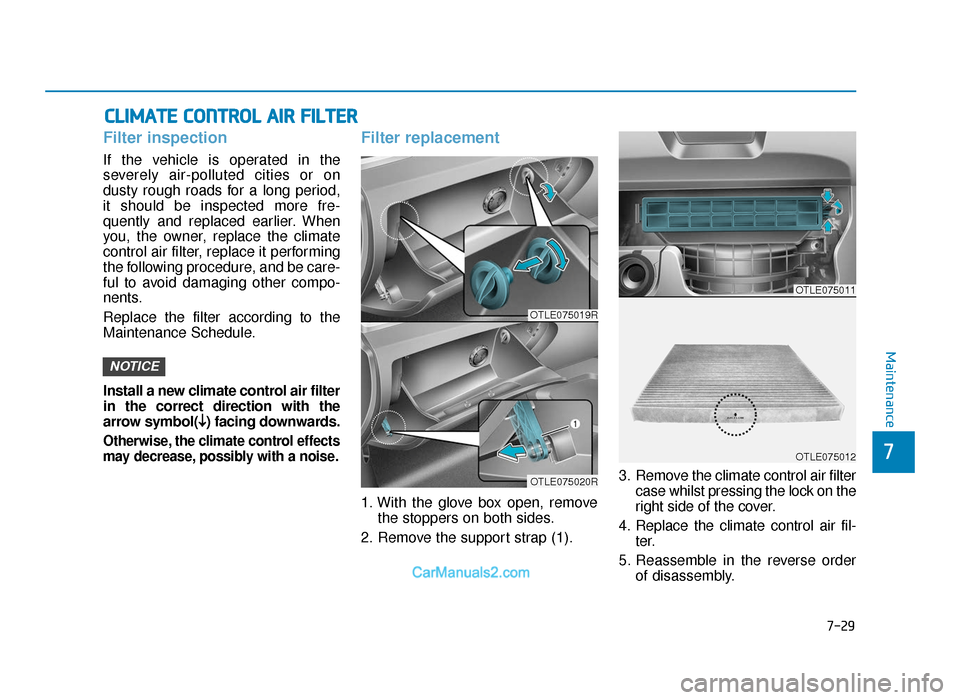
1. With the glove box open, removethe stoppers on both sides.
2. Remove the support strap (1). 3. Remove the climate control air filter
case whilst pressing the lock on the
right side of the cover.
4. Replace the climate control air fil- ter.
5. Reassemble in the reverse order of disassembly.
NOTICE
OTLE075019R
OTLE075020R
OTLE075011
OTLE075012
TLe UK 7.qxp 5/10/2018 1:34 PM Page 29
Page 591 of 685
7-42
Maintenance
Compact spare tyre replacement (if equipped)
A compact spare tyre has a shorter
tread life than a regular size tyre.
Replace it when you can see the
tread wear indicator bars on the tyre.
The replacement compact spare tyre
should be the same size and design
tyre as the one provided with your
new vehicle and should be mounted
on the same compact spare tyre
wheel. The compact spare tyre is not
designed to be mounted on a regular
size wheel, and the compact spare
tyre wheel is not designed for mount-
ing a regular size tyre.
(Continued)
•
The use of any other tyre size
or type may seriously affect
ride, handling, ground clear-
ance, stopping distance, body
to tyre clearance, snow tyre
clearance, and speedometer
reliability.
• When replacing tyres (or
wheels), it is recommended to
replace the two front or two
rear tyres (or wheels) as a
pair. Replacing just one tyre
can seriously affect your vehi-
cle’s handling.
• The ABS works by comparing
the speed of the wheels. Tyre
size can affect wheel speed.
When replacing tyres, all 4
tyres must use the same size
originally supplied with the
vehicle. Using tyres of a dif-
ferent size can cause the ABS
(Anti-lock Brake System) and
ESC (Electronic Stability
Control) (if equipped) to work
irregularly.•Driving on worn-out tyres is
very hazardous and will
reduce braking effectiveness,
steering accuracy, and trac-
tion.
• Your vehicle is equipped with
tyres designed to provide for
safe ride and handling capa-
bility. Do not use a size and
type of tyre and wheel that is
different from the one that is
originally installed on your
vehicle. It can affect the safety
and performance of your vehi-
cle, which could lead to han-
dling failure or rollover and
serious injury. When replacing
the tyres, be sure to equip all
four tyres with the tyre and
wheel of the same size, type,
tread, brand and load-carrying
capacity.
(Continued)
WARNING
TLe UK 7.qxp 5/10/2018 1:35 PM Page 42