2019 Hyundai Santa Fe Drive info
[x] Cancel search: Drive infoPage 4 of 682
F4
FOREWORD
Congratulations, and thank you for choosing HYUNDAI.We are pleased to welcome you to the growing number of dis-
tinguished people who drive HYUNDAIS.We are very proud of the advanced engineering and high-quality construc-
tion of each HYUNDAI we build.
Your Owner’s Manual will introduce you to the features and operation of your new HYUNDAI. To become familiar with
your new HYUNDAI, so that you can fully enjoy it, read this Owner’s Manual carefully before driving your new vehicle.
This manual contains important safety information and instructions intended to familiarize you with your vehicle’s con-
trols and safety features so you can safely operate your vehicle.
This manual also contains information on maintenance designed to enhance safe operation of the vehicle. It is rec-
ommended that all service and maintenance on your car be performed by a HYUNDAI authorised repairer. HYUNDAI
dealers are prepared to provide high-quality service, maintenance and any other assistance that may be required.
This Owner’s Manual should be considered a permanent part of your vehicle, and should be kept in the vehicle so
you can refer to it at any time. The manual should stay with the vehicle if you sell it to provide the next owner with
important operating, safety and maintenance information.
HYUNDAI MOTOR COMPANY
Copyright 2018 HYUNDAI Motor Company. All rights reserved. No part of this publication may be reproduced, stored
in any retrieval system or transmitted in any form or by any means without the prior written permission of HYUNDAI
Motor Company.Severe engine and transmission damage may result from the use of poor quality fuels and lubricants that
do not meet HYUNDAI specifications. You must always use high quality fuels and lubricants that meet the
specifications listed on Page 8-7 in the Vehicle Specifications section of the Owner's Manual.
CAUTION
Page 9 of 682
Do not use methanol
Fuels containing methanol (wood
alcohol) should not be used in your
vehicle.This type of fuel can reduce
vehicle performance and damage
components of the fuel system, engine
control system and emission control
system.
Fuel Additives
We recommend to use unleaded
petrol which has an octane rating of
RON (Research Octane Number) 91
/ AKI (Anti Knock Index) 87 or higher.
For customers who do not use good
quality petrols including fuel addi-
tives regularly, and have problems
starting or the engine does not run
smoothly, one bottle of additive
added to the fuel tank according to
the maintenance schedule is recom-
mended. Additives are available from
your HYUNDAI authorised repairer
along with information on how to use
them. Do not mix other additives.
Operation in foreign countries
If you are going to drive your vehicle
in another country, be sure to:
• Observe all regulations regarding
registration and insurance.
• Determine that acceptable fuel is
available.
Diesel engine
Diesel fuel
Diesel engine must be operated only
on commercially available diesel fuel
that complies with EN 590 or compa-
rable standard. (EN stands for
"European Norm"). Do not use
marine diesel fuel, heating oils, or
non-approved fuel additives, as this
will increase wear and cause dam-
age to the engine and fuel system.
The use of non-approved fuels and /
or fuel additives will result in a limita-
tion of your warranty rights.
Diesel fuel of above cetane 51 is
used in your vehicle. If two types of
diesel fuel are available, use summer
or winter fuel properly according to
the following temperature conditions.
• Above -5°C (23°F) ... Summer type
diesel fuel.
• Below -5°C (23°F) ... Winter type
diesel fuel.
Watch the fuel level in the tank very
carefully : If the engine stops through
fuel failure, the circuits must be com-
pletely purged to permit restarting.
F9
Introduction
Page 11 of 682
As with other vehicles of this type,
failure to operate this vehicle correct-
ly may result in loss of control, an
accident or vehicle rollover.
Specific design characteristics (high-
er ground clearance, track, etc.) give
this vehicle a higher centre of gravity
than other types of vehicles. In other
words they are not designed for cor-
nering at the same speeds as con-
ventional 2-wheel drive vehicles.
Avoid sharp turns or abrupt manoeu-
vres. Again, failure to operate this
vehicle correctly may result in loss of
control, an accident or vehicle
rollover.Be sure to read the
"Reducing the risk of a rollover"
driving guidelines, in section 5 of
this manual.By following a few simple precautions
for the first 600 miles (1,000 km) you
may add to the performance, econo-
my and life of your vehicle.
• Do not race the engine.
• Whilst driving, keep your engine
speed (rpm, or revolutions per
minute) between 2,000 rpm and
4,000 rpm.
• Do not maintain a single speed for
long periods of time, either fast or
slow. Varying engine speed is need-
ed to properly break-in the engine.
• Avoid hard stops, except in emer-
gencies, to allow the brakes to seat
properly.
• Don't tow a trailer during the first
1,200 miles (2,000 km) of operation.HYUNDAI promotes an environmen-
tally sound treatment for end of life
vehicles and offers to take back your
HYUNDAI end of life vehicles in
accordance with the European Union
(EU) End of Life Vehicles Directive.
You can get detailed information
from your national HYUNDAI home-
page.
F11
Introduction
VEHICLE HANDLING
INSTRUCTIONSVEHICLE BREAK-IN
PROCESSRETURNING USED VEHICLES
Page 22 of 682
Safety system of your vehicle
2
Important safety precautions...............................2-2
Always wear your seat belt............................................2-2
Restrain all children ..........................................................2-2
Air bag hazards..................................................................2-2
Driver distraction ...............................................................2-2
Control your speed ...........................................................2-3
Keep your vehicle in safe condition .............................2-3
Seats ........................................................................2-4
Safety precautions............................................................2-5
Front seats ..........................................................................2-6
Rear seats .........................................................................2-12
Head restraint ..................................................................2-19
Seat warmers and air ventilation seats.....................2-24
seat belts...............................................................2-27
Seat belt safety precautions ........................................2-27
Seat belt warning light ..................................................2-28
Seat belt restraint system ............................................2-31
Additional seat belt safety precautions ....................2-37
Care of seat belts ...........................................................2-39
Child restraint system (CRS) ..............................2-40
Our recommendation:Children always in the rear ..2-40
Selecting a Child Restraint System (CRS) .................2-41
Installing a Child Restraint System (CRS)..................2-43
Suitability of each seating position for belted &
ISOFIX Child Restraint Systems according to UN
regulations ........................................................................2-48
Air bag - supplemental restraint system .........2-52
Where are the air bags? ...............................................2-54
How does the air bags system operate? ..................2-59
What to expect after an air bag inflates..................2-62
Why didn't my air bag go off in a collision? ...........2-64
SRS care ............................................................................2-69
Additional safety precautions ......................................2-70
Air bag warning labels ...................................................2-70
This chapter provides you with important information about how to protect yourself and your passengers.
It explains how to properly use your seats and seat belts, and how your air bags work.
Additionally, this chapter explains how to properly restrain infants and children in your vehicle.
Page 39 of 682
2-18
Safety system of your vehicle
2nd row seat folding
(from outside) (if equipped)
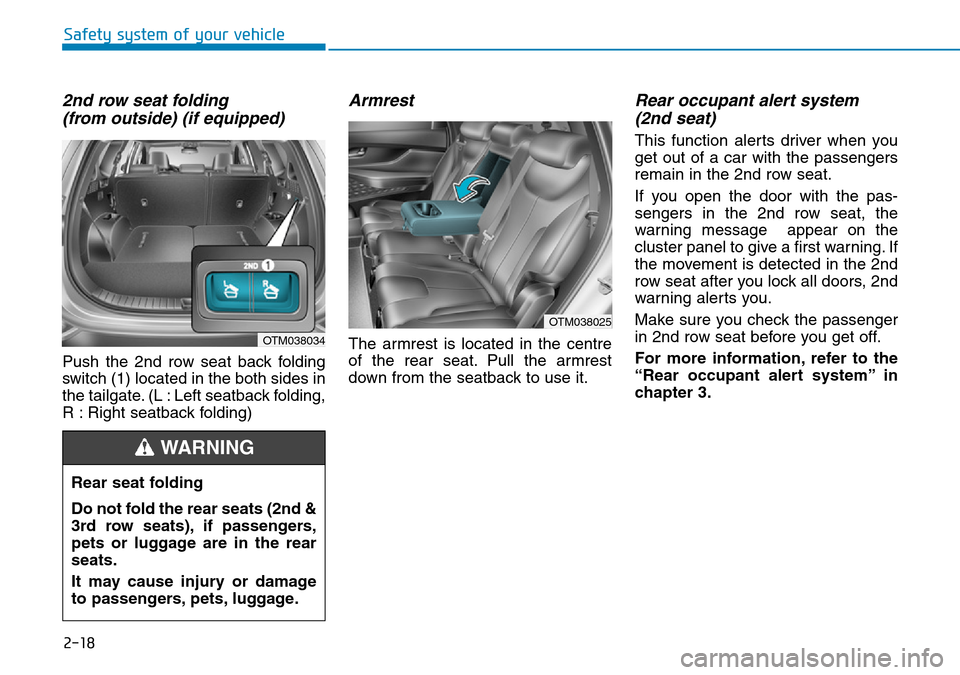
Push the 2nd row seat back folding
switch (1) located in the both sides in
the tailgate. (L : Left seatback folding,
R : Right seatback folding)
Armrest
The armrest is located in the centre
of the rear seat. Pull the armrest
down from the seatback to use it.
Rear occupant alert system
(2nd seat)
This function alerts driver when you
get out of a car with the passengers
remain in the 2nd row seat.
If you open the door with the pas-
sengers in the 2nd row seat, the
warning message appear on the
cluster panel to give a first warning. If
the movement is detected in the 2nd
row seat after you lock all doors, 2nd
warning alerts you.
Make sure you check the passenger
in 2nd row seat before you get off.
For more information, refer to the
“Rear occupant alert system” in
chapter 3.
OTM038034
OTM038025
Rear seat folding
Do not fold the rear seats (2nd &
3rd row seats), if passengers,
pets or luggage are in the rear
seats.
It may cause injury or damage
to passengers, pets, luggage.
WARNING
Page 46 of 682
2-25
Safety system of your vehicle
2
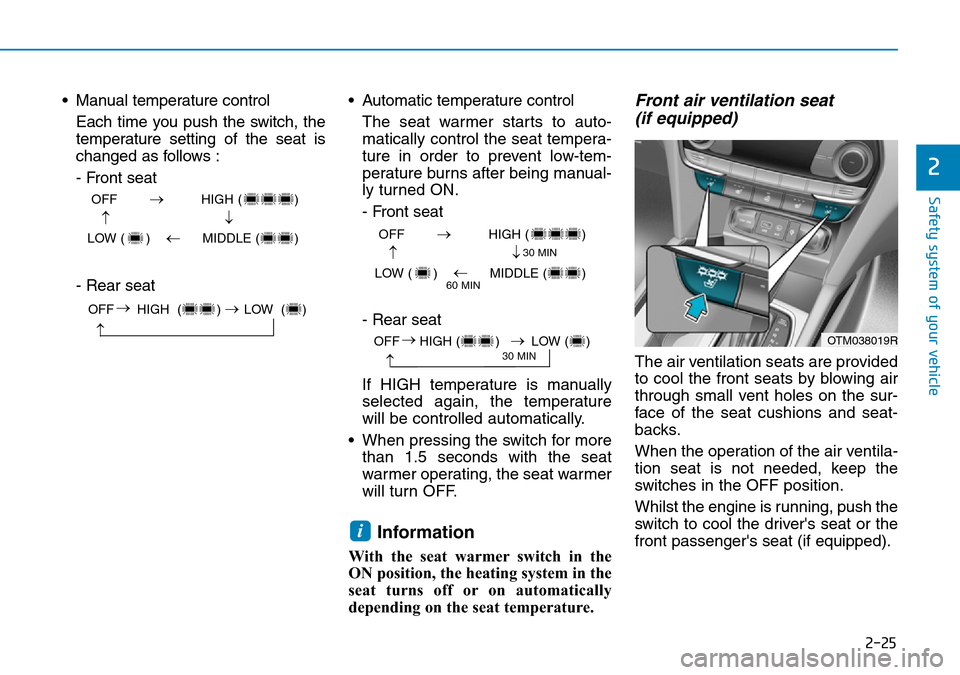
• Manual temperature control
Each time you push the switch, the
temperature setting of the seat is
changed as follows :
- Front seat
- Rear seat• Automatic temperature control
The seat warmer starts to auto-
matically control the seat tempera-
ture in order to prevent low-tem-
perature burns after being manual-
ly turned ON.
- Front seat
- Rear seat
If HIGH temperature is manually
selected again, the temperature
will be controlled automatically.
• When pressing the switch for more
than 1.5 seconds with the seat
warmer operating, the seat warmer
will turn OFF.
Information
With the seat warmer switch in the
ON position, the heating system in the
seat turns off or on automatically
depending on the seat temperature.
Front air ventilation seat
(if equipped)
The air ventilation seats are provided
to cool the front seats by blowing air
through small vent holes on the sur-
face of the seat cushions and seat-
backs.
When the operation of the air ventila-
tion seat is not needed, keep the
switches in the OFF position.
Whilst the engine is running, push the
switch to cool the driver's seat or the
front passenger's seat (if equipped).
i
OFF HIGH ( )
LOW ( ) MIDDLE ( )
→→
→
→
OFF HIGH ( )
LOW ( ) MIDDLE ( )
→→
→
→
30 MIN
60 MIN
OFF HIGH ( ) LOW ( )
→
→
→
OTM038019R30 MINOFF HIGH ( ) LOW ( )→
→
→
Page 50 of 682
2-29
Safety system of your vehicle
2
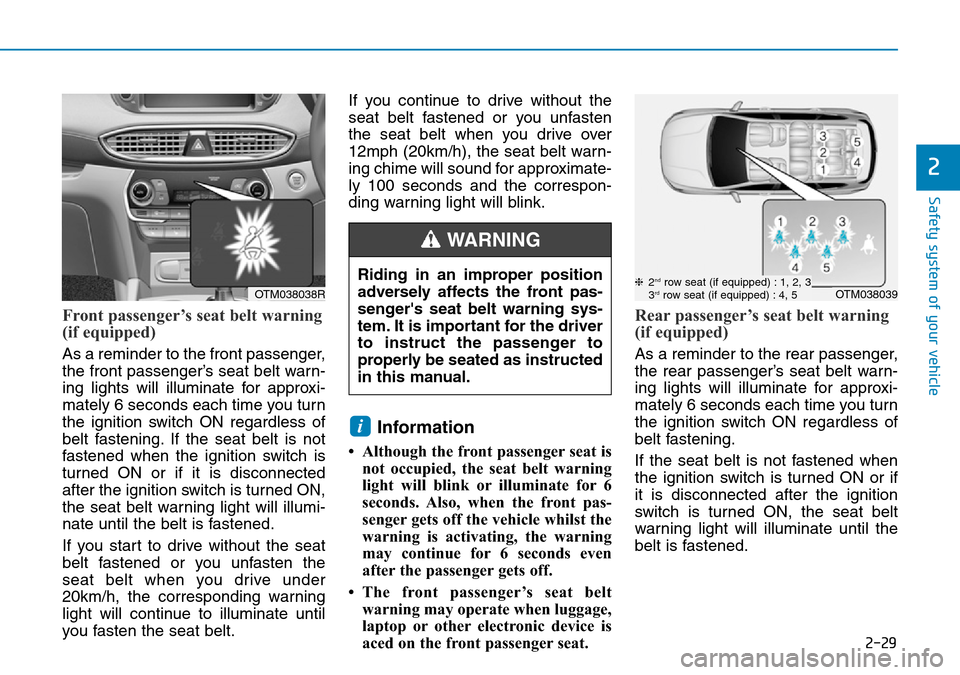
Front passenger’s seat belt warning
(if equipped)
As a reminder to the front passenger,
the front passenger’s seat belt warn-
ing lights will illuminate for approxi-
mately 6 seconds each time you turn
the ignition switch ON regardless of
belt fastening. If the seat belt is not
fastened when the ignition switch is
turned ON or if it is disconnected
after the ignition switch is turned ON,
the seat belt warning light will illumi-
nate until the belt is fastened.
If you start to drive without the seat
belt fastened or you unfasten the
seat belt when you drive under
20km/h, the corresponding warning
light will continue to illuminate until
you fasten the seat belt.If you continue to drive without the
seat belt fastened or you unfasten
the seat belt when you drive over
12mph (20km/h), the seat belt warn-
ing chime will sound for approximate-
ly 100 seconds and the correspon-
ding warning light will blink.
Information
• Although the front passenger seat is
not occupied, the seat belt warning
light will blink or illuminate for 6
seconds. Also, when the front pas-
senger gets off the vehicle whilst the
warning is activating, the warning
may continue for 6 seconds even
after the passenger gets off.
• The front passenger’s seat belt
warning may operate when luggage,
laptop or other electronic device is
aced on the front passenger seat.
Rear passenger’s seat belt warning
(if equipped)
As a reminder to the rear passenger,
the rear passenger’s seat belt warn-
ing lights will illuminate for approxi-
mately 6 seconds each time you turn
the ignition switch ON regardless of
belt fastening.
If the seat belt is not fastened when
the ignition switch is turned ON or if
it is disconnected after the ignition
switch is turned ON, the seat belt
warning light will illuminate until the
belt is fastened.
i
Riding in an improper position
adversely affects the front pas-
senger's seat belt warning sys-
tem. It is important for the driver
to instruct the passenger to
properly be seated as instructed
in this manual.
WARNING
OTM038038ROTM038039❈2ndrow seat (if equipped) : 1, 2, 3
3rdrow seat (if equipped) : 4, 5
Page 51 of 682
2-30
Safety system of your vehicle
If you start to drive without the seat
belt fastened or you unfasten the
seat belt when you drive under 12
mph (20km/h), the corresponding
warning light will continue to illumi-
nate until you fasten the seat belt.
If you continue to drive without the
seat belt fastened or you unfasten
the seat belt when you drive over 12
mph (20km/h), the seat belt warning
chime will sound for approximately
35 seconds and the corresponding
warning light will blink.
Information
• Although the rear side passenger
seat is not occupied, the seat belt
warning light will blink or illumi-
nate for 6 seconds.
• The rear side passenger’s seat belt
warning may operate when luggage,
laptop or other electronic device is
placed on the rear side passenger
seat.
Rear centre passenger’s seat belt
warning (if equipped)
The seat belt warning lights will illu-
minate for approximately 6 seconds
each time you turn the ignition switch
ON regardless of seat belt fastening.
And then, the rear corresponding
seat belt warning light will illuminate
for approximately 70 seconds if any
of the following occurs:
- The rear seat belt is not fastened.
- The rear seat belt is disconnected
whilst driving under .
If you drive over 12 mph (20km/h)
when the rear seat belt is not fas-
tened or the rear seat belt is discon-
nected whilst driving over 12 mph
(20km/h), the corresponding seat
belt warning light will blink and a
warning chime will sound for 35 sec-
onds.
i
Riding in an improper position
adversely affects the rear pas-
senger's seat belt warning sys-
tem.
It is important for the driver to
instruct the passenger to prop-
erly be seated as instructed in
this manual.
WARNING