Page 574 of 682
6-36
What to do in an emergency
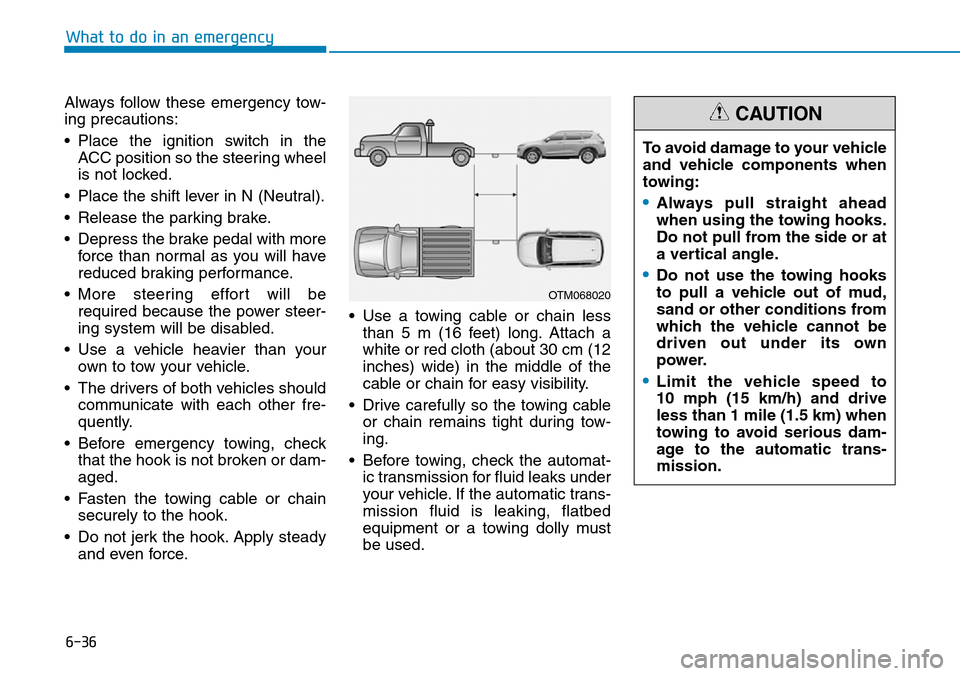
Always follow these emergency tow-
ing precautions:
• Place the ignition switch in the
ACC position so the steering wheel
is not locked.
• Place the shift lever in N (Neutral).
• Release the parking brake.
• Depress the brake pedal with more
force than normal as you will have
reduced braking performance.
• More steering effort will be
required because the power steer-
ing system will be disabled.
• Use a vehicle heavier than your
own to tow your vehicle.
• The drivers of both vehicles should
communicate with each other fre-
quently.
• Before emergency towing, check
that the hook is not broken or dam-
aged.
• Fasten the towing cable or chain
securely to the hook.
• Do not jerk the hook. Apply steady
and even force.• Use a towing cable or chain less
than 5 m (16 feet) long. Attach a
white or red cloth (about 30 cm (12
inches) wide) in the middle of the
cable or chain for easy visibility.
• Drive carefully so the towing cable
or chain remains tight during tow-
ing.
• Before towing, check the automat-
ic transmission for fluid leaks under
your vehicle. If the automatic trans-
mission fluid is leaking, flatbed
equipment or a towing dolly must
be used.
OTM068020
To avoid damage to your vehicle
and vehicle components when
towing:
•Always pull straight ahead
when using the towing hooks.
Do not pull from the side or at
a vertical angle.
•Do not use the towing hooks
to pull a vehicle out of mud,
sand or other conditions from
which the vehicle cannot be
driven out under its own
power.
•Limit the vehicle speed to
10 mph (15 km/h) and drive
less than 1 mile (1.5 km) when
towing to avoid serious dam-
age to the automatic trans-
mission.
CAUTION
Page 582 of 682
7-7
7
Maintenance
OWNER MAINTENANCE
The following lists are vehicle checks
and inspections that should be per-
formed by the owner or a HYUNDAI
authorised repairer at the frequencies
indicated to help ensure safe, depend-
able operation of your vehicle.
Any adverse conditions should be
brought to the attention of your dealer
as soon as possible.
These Owner Maintenance vehicle
checks are generally not covered by
warranties and you may be charged
for labour, parts and lubricants used. Performing maintenance work
on a vehicle can be dangerous.
If you lack sufficient knowledge
and experience or the proper
tools and equipment to do the
work, we recommend that the
system be serviced by a
HYUNDAI authorised repairer.
ALWAYS follow these precau-
tions for performing mainte-
nance work:
•Park your vehicle on level
ground, move the shift lever
into the P (Park, for automatic
transmission vehicle) position
or neutral (for manual trans-
mission vehicle) position,
apply the parking brake, and
place the ignition switch in
the LOCK/ OFF position.
•Block the tyres (front and
back) to prevent the vehicle
from moving.
Remove loose clothing or jew-
ellery that can become entan-
gled in moving parts.
WARNING •If you must run the engine
during maintenance, do so
out doors or in an area with
plenty of ventilation.
•Keep flames, sparks, or smok-
ing materials away from the
battery and fuel-related parts.
Diesel Engine
Never manipulate or modify the
injection system whilst running
the diesel engine or within 30
seconds after turning OFF the
diesel engine. The high-pressure
pump, high-pressure pipes, rail,
and injectors are still subject to
high pressure immediately after
stopping the diesel engine.
When the fuel leakage vents out,
it may cause serious body injury.
Any people, who are implanted
with the artificial cardiac pace-
maker, should remain away from
the ECU or the wiring harness by
at least 30 cm, whilst running the
diesel engine. The high currents
of the electronic engine control
system produce a considerable
amount of magnetic fields.
WARNING
Page 585 of 682
7-10
Maintenance
EXPLANATION OF SCHEDULED MAINTENANCE ITEMS
Engine oil and filter
The engine oil and filter should be
changed at the intervals specified in
the maintenance schedule. If the
vehicle is being driven in severe con-
ditions, more frequent oil and filter
changes are required.
Drive belts
Inspect all drive belts for evidence of
cuts, cracks, excessive wear or oil
saturation and replace if necessary.
Drive belts should be checked peri-
odically for proper tension and
adjusted as necessary.
Fuel lines, fuel hoses and con-
nections
Check the fuel lines, fuel hoses and
connections for leakage and dam-
age. We recommend that the fuel
lines, fuel hoses and connections be
replaced by a HYUNDAI authorised
repairer.
Fuel filter (cartridge)
A clogged-up fuel filter may limit the
vehicle driving speed, damage the
emission system, and cause the
hard starting. When a considerable
amount of foreign substances are
accumulated in the fuel tank, the fuel
filter should be replaced.
Upon installing a new fuel filter, oper-
ate the diesel engine for several min-
utes, and check the connections for
any leakages. We recommend you to
have the fuel filter replaced by a
HYUNDAI authorised repairer.
Vapour hose and fuel filler cap
The vapour hose and fuel filler cap
should be inspected at those inter-
vals specified in the maintenance
schedule. Make sure that a new
vapour hose or fuel filler cap is cor-
rectly replaced.
Vacuum crankcase ventilation
hoses (if equipped)
Inspect the surface of hoses for evi-
dence of heat and/or mechanical
damage. Hard and brittle rubber,
cracking, tears, cuts, abrasions, and
excessive swelling indicate deterio-
ration. Particular attention should be
paid to examine those hose surfaces
nearest to high heat sources, such
as the exhaust manifold.
Inspect the hose routing to ensure
that the hoses do not come in con-
tact with any heat source, sharp
edges or moving component which
might cause heat damage or
mechanical wear. Inspect all hose
connections, such as clamps and
couplings, to make sure they are
secure, and that no leaks are pres-
ent. Hoses should be replaced
immediately if there is any evidence
of deterioration or damage. When you are inspecting the belt,
place the ignition switch to the
LOCK/OFF or ACC position.
CAUTION
Page 596 of 682
7-21
7
Maintenance
PARKING BRAKE
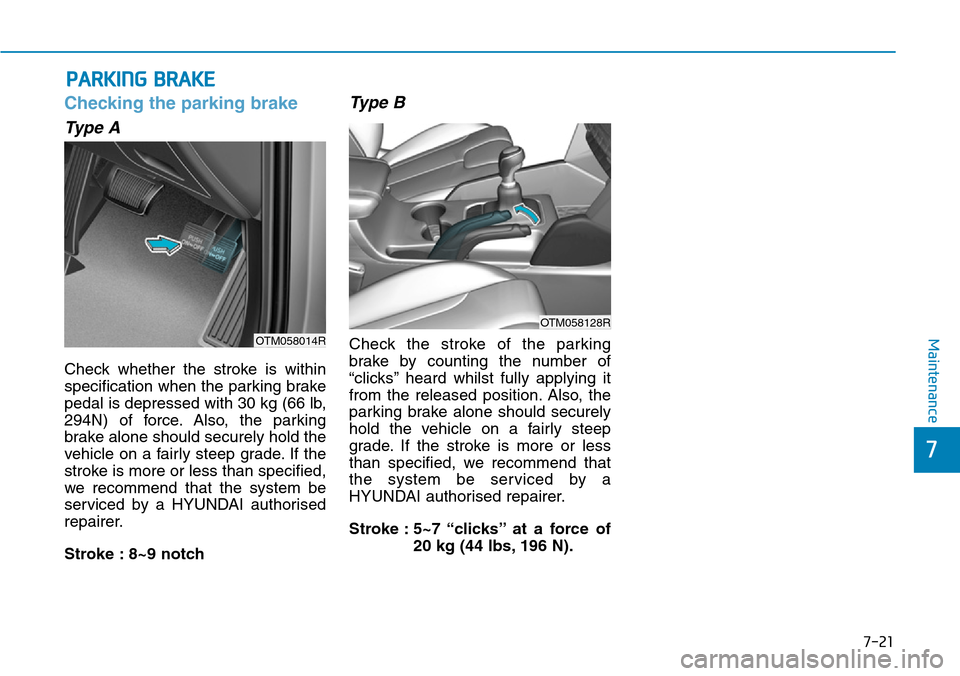
Checking the parking brake
Type A
Check whether the stroke is within
specification when the parking brake
pedal is depressed with 30 kg (66 lb,
294N) of force. Also, the parking
brake alone should securely hold the
vehicle on a fairly steep grade. If the
stroke is more or less than specified,
we recommend that the system be
serviced by a HYUNDAI authorised
repairer.
Stroke : 8~9 notch
Type B
Check the stroke of the parking
brake by counting the number of
“clicks’’ heard whilst fully applying it
from the released position. Also, the
parking brake alone should securely
hold the vehicle on a fairly steep
grade. If the stroke is more or less
than specified, we recommend that
the system be serviced by a
HYUNDAI authorised repairer.
Stroke : 5~7 “clicks’’ at a force of
20 kg (44 lbs, 196 N).
OTM058128R
OTM058014R
Page 604 of 682
7-29
7
Maintenance
For best battery service
• Keep the battery securely mounted.
• Keep the battery top clean and dry.
• Keep the terminals and connec-
tions clean, tight, and coated with
petroleum jelly or terminal grease.
• Rinse any spilled electrolyte from
the battery immediately with a
solution of water and baking soda.
• If the vehicle is not going to be
used for an extended time, discon-
nect the battery cables.
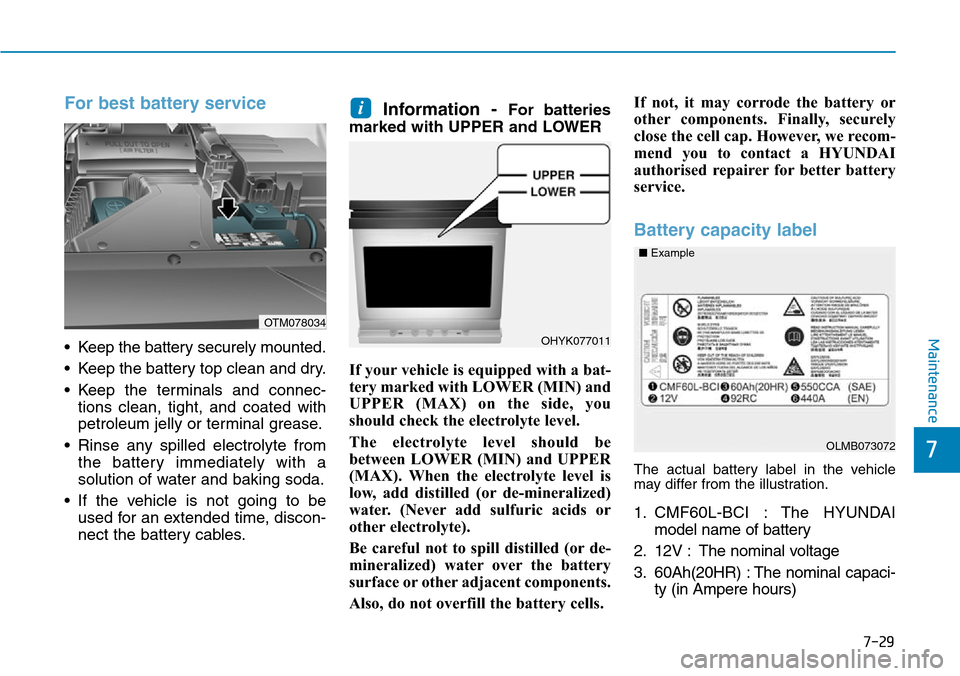
Information - For batteries
marked with UPPER and LOWER
If your vehicle is equipped with a bat-
tery marked with LOWER (MIN) and
UPPER (MAX) on the side, you
should check the electrolyte level.
The electrolyte level should be
between LOWER (MIN) and UPPER
(MAX). When the electrolyte level is
low, add distilled (or de-mineralized)
water. (Never add sulfuric acids or
other electrolyte).
Be careful not to spill distilled (or de-
mineralized) water over the battery
surface or other adjacent components.
Also, do not overfill the battery cells. If not, it may corrode the battery or
other components. Finally, securely
close the cell cap. However, we recom-
mend you to contact a HYUNDAI
authorised repairer for better battery
service.
Battery capacity label
The actual battery label in the vehicle
may differ from the illustration.
1. CMF60L-BCI : The HYUNDAI
model name of battery
2. 12V : The nominal voltage
3. 60Ah(20HR) : The nominal capaci-
ty (in Ampere hours)
i
OHYK077011
OTM078034
OLMB073072 ■Example
Page 619 of 682
7-44
Maintenance
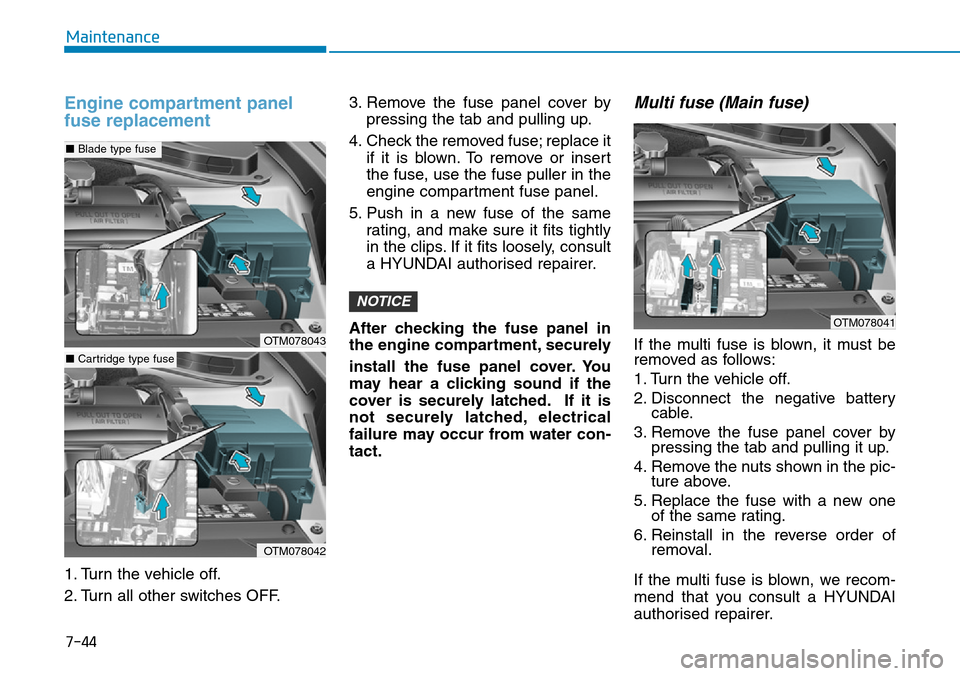
Engine compartment panel
fuse replacement
1. Turn the vehicle off.
2. Turn all other switches OFF.3. Remove the fuse panel cover by
pressing the tab and pulling up.
4. Check the removed fuse; replace it
if it is blown. To remove or insert
the fuse, use the fuse puller in the
engine compartment fuse panel.
5. Push in a new fuse of the same
rating, and make sure it fits tightly
in the clips. If it fits loosely, consult
a HYUNDAI authorised repairer.
After checking the fuse panel in
the engine compartment, securely
install the fuse panel cover. You
may hear a clicking sound if the
cover is securely latched. If it is
not securely latched, electrical
failure may occur from water con-
tact.
Multi fuse (Main fuse)
If the multi fuse is blown, it must be
removed as follows:
1. Turn the vehicle off.
2. Disconnect the negative battery
cable.
3. Remove the fuse panel cover by
pressing the tab and pulling it up.
4. Remove the nuts shown in the pic-
ture above.
5. Replace the fuse with a new one
of the same rating.
6. Reinstall in the reverse order of
removal.
If the multi fuse is blown, we recom-
mend that you consult a HYUNDAI
authorised repairer.
NOTICE
OTM078043
■Blade type fuse
OTM078042
■Cartridge type fuse
OTM078041
Page 628 of 682
7-53
7
Maintenance
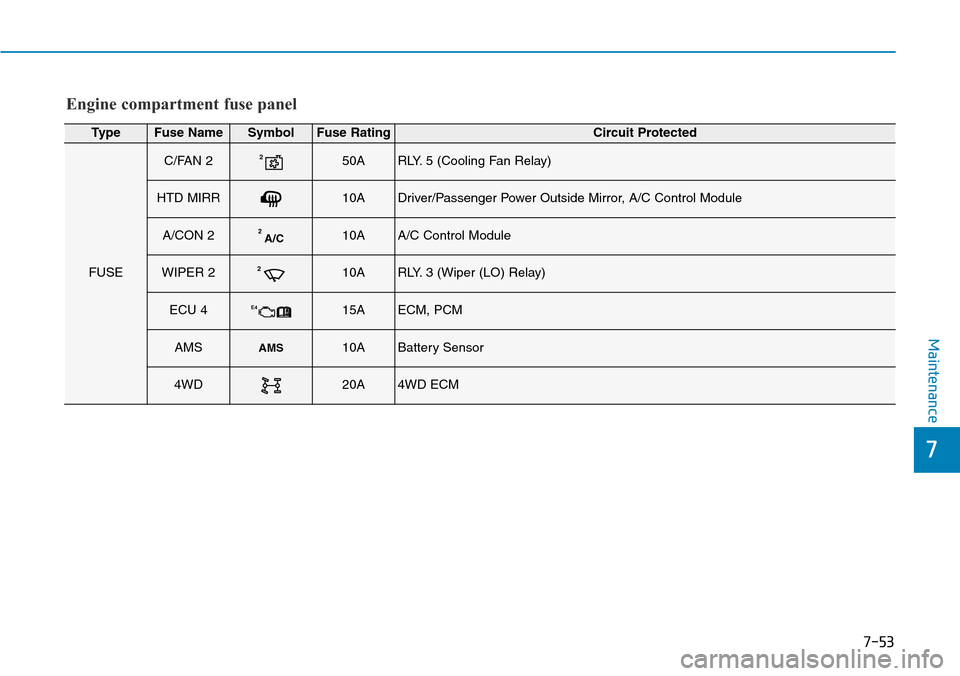
Engine compartment fuse panel
TypeFuse NameSymbolFuse RatingCircuit Protected
FUSE
C/FAN 2250ARLY. 5 (Cooling Fan Relay)
HTD MIRR10ADriver/Passenger Power Outside Mirror, A/C Control Module
A/CON 2A/C210AA/C Control Module
WIPER 2210ARLY. 3 (Wiper (LO) Relay)
ECU 4E415AECM, PCM
AMSAMS10ABattery Sensor
4WD20A4WD ECM
Page 630 of 682
7-55
7
Maintenance
Fuse NameSymbolFuse RatingCircuit Protected
SENSOR 1S110A[D4HA/D4HB/G4KJ/G4KE] Fuel Pump Relay
[G6DC] Fuel Pump Relay, Injector #1/#2/#3/#4/#5/#6
DCU 2DCU 220A[D4HA/D4HB] Doosing Control Unit
A/CON 1A/C110A[D4HA/D4HB] A/C Comp Relay
WIPER FRT 1125AWiper Main Relay
TCU 2T210A[D4HA/D4HB/G6DC] TCM
Transmission Range Switch
ECU 3E310AECM/PCM
B/A HORN15ABurglar Alarm Horn Relay, Horn Relay
HORN15AHorn Relay
TRAILER 1115ATRAILER LMAP (Europe)
FUEL PUMPFUEL PUMP20AFuel Pump Relay
ECU 1E120AECM/PCM
ECU 2E220A[G4KE] Injector #1/#2/#3/#4
[G6DC] PCM
![Hyundai Santa Fe 2019 Owners Manual - RHD (UK, Australia) 7-55
7
Maintenance
Fuse NameSymbolFuse RatingCircuit Protected
SENSOR 1S110A[D4HA/D4HB/G4KJ/G4KE] Fuel Pump Relay
[G6DC] Fuel Pump Relay, Injector #1/#2/#3/#4/#5/#6
DCU 2DCU 220A[D4HA/D4HB] Doosing Co](/manual-img/35/16317/w960_16317-629.png "Hyundai Santa Fe 2019 Owners Manual - RHD (UK, Australia) 7-55
7
Maintenance
Fuse NameSymbolFuse RatingCircuit Protected
SENSOR 1S110A[D4HA/D4HB/G4KJ/G4KE] Fuel Pump Relay
[G6DC] Fuel Pump Relay, Injector #1/#2/#3/#4/#5/#6
DCU 2DCU 220A[D4HA/D4HB] Doosing Co")