Page 447 of 526
7-30
MaintenanceAlways follow these instruc-
tions when recharging your
vehicle’s battery to avoid the
risk of SERIOUS INJURY or
DEATH from explosions or acid
burns:
Before performing mainte-
nance or recharging the bat-
tery, turn off all accessories
and place the Engine Start/
Stop button to the OFF posi-
tion.
Keep all flames, sparks, or
smoking materials away from
the battery.
Always work outdoors or in an
area with plenty of ventilation.
Wear eye protection when
checking the battery during
charging.
The battery must be removed
from the vehicle and placed in
a well ventilated area.
WARNING Watch the battery during
charging, and stop or reduce
the charging rate if the battery
cells begin boiling violently.
The negative battery cable
must be removed first and
installed last when the battery
is disconnected. Disconnect
the battery charger in the fol-
lowing order:
(1) Turn off the battery charg-
er main switch.
(2) Unhook the negative
clamp from the negative
battery terminal.
(3) Unhook the positive clamp from the positive battery
terminal.
Always use a genuine
HYUNDAI approved battery
when you replace the battery.
AGM battery (if equipped)
Absorbent Glass Matt (AGM)
batteries are maintenance-
free and we recommend that
the AGM battery be serviced
by a HYUNDAI authorised
repairer. For charging your
AGM battery, use only fully
automatic battery chargers
that are specially developed
for AGM batteries.
When replacing the AGM bat-
tery, we recommend that you
use parts for replacement
from a HYUNDAI authorised
repairer.
Do not open or remove the
cap on top of the battery. This
may cause leaks of internal
electrolyte that could result in
severe injury.
CAUTION
Page 466 of 526
7-49
7
Maintenance
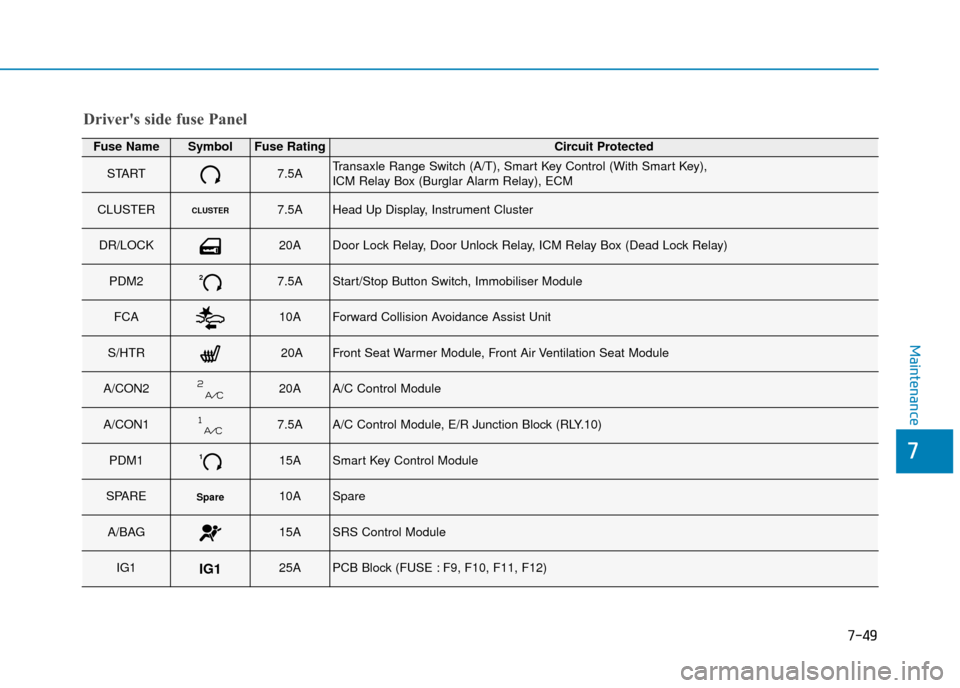
Driver's side fuse Panel
Fuse NameSymbolFuse RatingCircuit Protected
START7.5ATransaxle Range Switch (A/T), Smart Key Control (With Smart Key),
ICM Relay Box (Burglar Alarm Relay), ECM
CLUSTERCLUSTER7.5AHead Up Display, Instrument Cluster
DR/LOCK20ADoor Lock Relay, Door Unlock Relay, ICM Relay Box (Dead Lock Relay)
PDM227.5AStart/Stop Button Switch, Immobiliser Module
FCA10AForward Collision Avoidance Assist Unit
S/HTR20AFront Seat Warmer Module, Front Air Ventilation Seat Module
A/CON220AA/C Control Module
A/CON17.5AA/C Control Module, E/R Junction Block (RLY.10)
PDM1115ASmart Key Control Module
SPARESpare10ASpare
A/BAG15ASRS Control Module
IG1IG125APCB Block (FUSE : F9, F10, F11, F12)
Page 499 of 526
7-82
Maintenance
Engine exhaust gas precautions (carbon monoxide)
Carbon monoxide can be present
with other exhaust fumes. Therefore,
if you smell exhaust fumes of any
kind inside your vehicle, have it
inspected and repaired immediately.
If you ever suspect exhaust fumes
are coming into your vehicle, drive it
only with all the windows fully open.
Have your vehicle checked and
repaired immediately. Do not operate the engine in con-
fined or closed areas (such as
garages) any more than what is
necessary to move the vehicle in or
out of the area.
When the vehicle is stopped in an open area for more than a short
time with the engine running,
adjust the ventilation system (as
needed) to draw outside air into the
vehicle.
Never sit in a parked or stopped vehicle for any extended time with
the engine running.
When the engine stalls or fails to start, excessive attempts to restart
the engine may cause damage to
the emission control system.
Operating precautions for cat-alytic converters (if equipped)
Engine exhaust gases contain
carbon monoxide (CO). Though
colourless and odourless, it is
dangerous and could be lethal if
inhaled. Follow the instructions
following to avoid CO poisoning.
WARNING
A hot exhaust system can
ignite flammable items under
your vehicle. Do not park, idle,
or drive the vehicle over or
near flammable objects, such
as dry grass, paper, leaves, etc.
The exhaust system and cat-
alytic system are very hot
whilst the engine is running or
immediately after the engine
is turned off. Keep away from
the exhaust system and cat-
alytic converter as you may
get burned.
Also, do not remove the heat
sink around the exhaust sys-
tem, do not seal the bottom of
the vehicle and do not coat the
vehicle for corrosion control. It
may present a fire risk under
certain conditions.
WARNING