Page 225 of 560
Lights
Have someone observe the operation of brake lights and
exterior lights while you work the controls. Check turn
signal and high beam indicator lights on the instrument
panel.
Door Latches
Check for proper closing, latching, and locking.
Fluid Leaks
Check area under the vehicle after overnight parking for
fuel, coolant, oil, or other fluid leaks. Also, if gasoline
fumes are detected or if fuel, or brake fluid leaks are
suspected. The cause should be located and corrected
immediately.
5
SAFETY 223
Page 227 of 560
STARTING AND OPERATING
CONTENTS
�STARTING THE ENGINE ..................228
▫ Automatic Transmission ..................228
▫ Normal Starting ...................... .229
▫ Keyless Enter-N-Go — Ignition .............232
▫ Cold Weather Operation
(Below –22°F Or 30°C) ..................232
▫ If Engine Fails To Start ..................232
▫ After Starting ......................... .233
� ENGINE BLOCK HEATER — IF EQUIPPED . . . .233
� ENGINE BREAK-IN RECOMMENDATIONS . . . .233
� PARKING BRAKE ...................... .235
� AUTOMATIC TRANSMISSION ..............237
▫ Ignition Park Interlock ...................239 ▫
Brake/Transmission Shift Interlock System . . . .239
▫ Eight-Speed Automatic Transmission .........239
� SPORT MODE — WITHOUT PERFORMANCE
CONTROL ........................... .249
� FUEL SAVER TECHNOLOGY 5.7L AND
6.4L ONLY — IF EQUIPPED ................249
� POWER STEERING ..................... .249
� SPEED CONTROL — IF EQUIPPED ..........250
▫ To Activate .......................... .251
▫ To Set A Desired Speed ..................251
▫ To Vary The Speed Setting ................251
▫ To Accelerate For Passing .................252
▫ To Resume Speed ..................... .253
▫ To Deactivate ........................ .253
6
Page 229 of 560
�PARKVIEW REAR BACK UP CAMERA ........285
� REFUELING THE VEHICLE ................287
▫ Emergency Fuel Filler Door Release ..........290
� VEHICLE LOADING .....................291
▫ Vehicle Certification Label ................291
▫ Gross Vehicle Weight Rating (GVWR) ........291
▫ Gross Axle Weight Rating (GAWR) ..........291
▫ Overloading ......................... .291
▫ Loading ............................ .292
� TRAILER TOWING ..................... .292
▫ Common Towing Definitions ...............292 ▫
Trailer Hitch Classification ................295
▫ Trailer Towing Weights (Maximum Trailer
Weight Ratings) ...................... .295
▫ Trailer And Tongue Weight ...............296
▫ Towing Requirements ...................297
▫ Towing Tips ......................... .301
� RECREATIONAL TOWING
(BEHIND MOTORHOME, ETC.) .............302
� DRIVING TIPS ......................... .302
▫ Driving On Slippery Surfaces ..............302
▫ Driving Through Water ..................303
6
STARTING AND OPERATING 227
Page 234 of 560
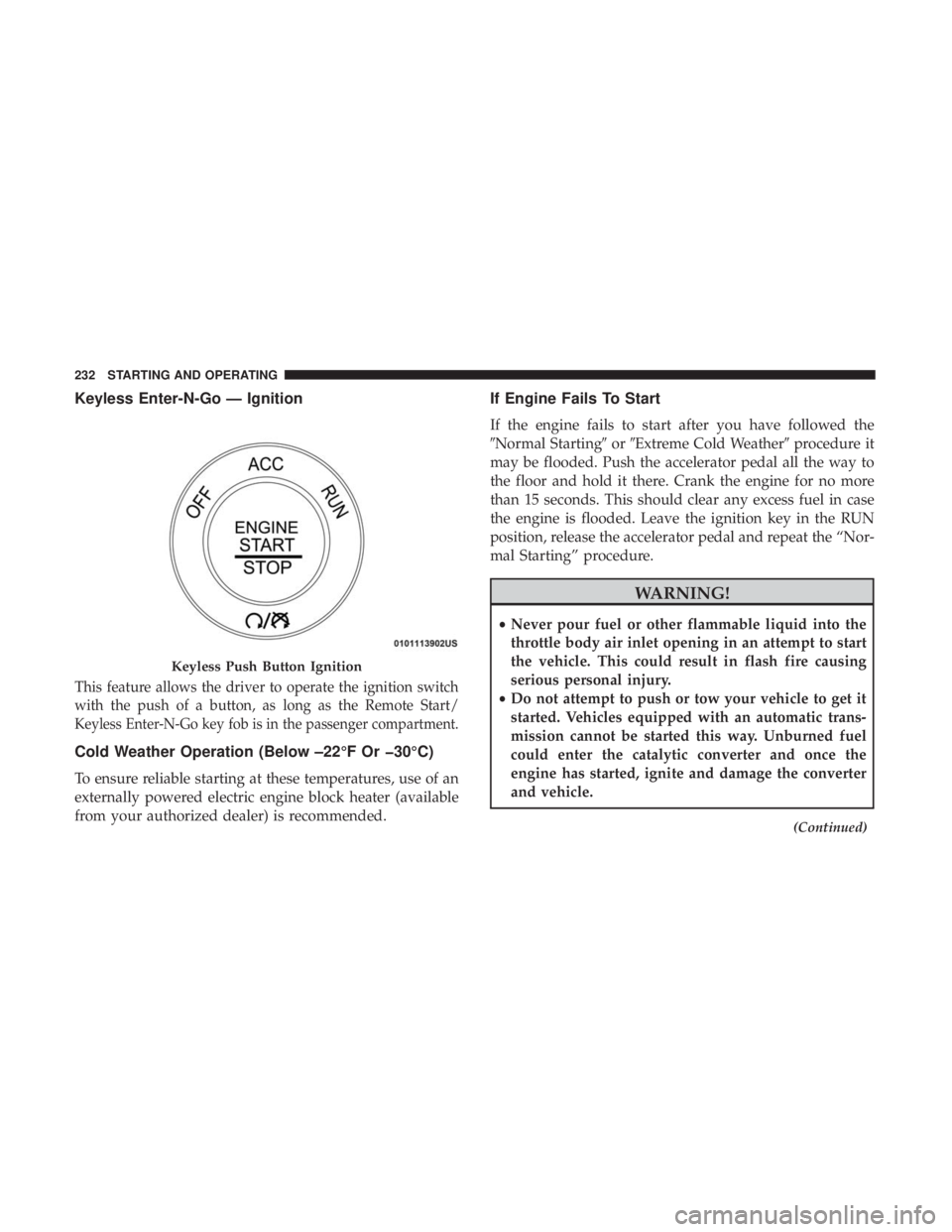
Keyless Enter-N-Go — Ignition
This feature allows the driver to operate the ignition switch
with the push of a button, as long as the Remote Start/
Keyless Enter-N-Go key fob is in the passenger compartment.
Cold Weather Operation (Below –22°F Or 30°C)
To ensure reliable starting at these temperatures, use of an
externally powered electric engine block heater (available
from your authorized dealer) is recommended.
If Engine Fails To Start
If the engine fails to start after you have followed the
�Normal Starting� or�Extreme Cold Weather� procedure it
may be flooded. Push the accelerator pedal all the way to
the floor and hold it there. Crank the engine for no more
than 15 seconds. This should clear any excess fuel in case
the engine is flooded. Leave the ignition key in the RUN
position, release the accelerator pedal and repeat the “Nor-
mal Starting” procedure.
WARNING!
• Never pour fuel or other flammable liquid into the
throttle body air inlet opening in an attempt to start
the vehicle. This could result in flash fire causing
serious personal injury.
• Do not attempt to push or tow your vehicle to get it
started. Vehicles equipped with an automatic trans-
mission cannot be started this way. Unburned fuel
could enter the catalytic converter and once the
engine has started, ignite and damage the converter
and vehicle.
(Continued)
Keyless Push Button Ignition
232 STARTING AND OPERATING
Page 237 of 560
100 to 300 miles (161 to 483 km):
•Press the accelerator pedal slowly and not more than
halfway to avoid rapid acceleration in lower gears (1st to
3rd gears).
• Avoid aggressive braking.
• Drive with the engine speed less than 5,000 RPM.
• Maintain vehicle speed below 70 mph (112 km/h) and
observe local speed limits.
300 to 500 miles (483 to 805 km):
• Exercise the full engine rpm range, shifting manually
(paddles or gear shift) at higher rpms when possible.
• Do not perform sustained operation with the accelerator
pedal at wide open throttle.
• Maintain vehicle speed below 85 mph (136 km/h) and
observe local speed limits.
For the first 1500 miles (2414 km):
• Do not participate in track events, sport driving schools,
or similar activities during the first 1500 miles (2414 km).
NOTE: Check engine oil with every refueling and add if
necessary. Oil and fuel consumption may be higher
through the first oil change interval.PARKING BRAKE
Before leaving the vehicle, make sure that the parking
brake is fully applied and place the gear selector in the
PARK position.
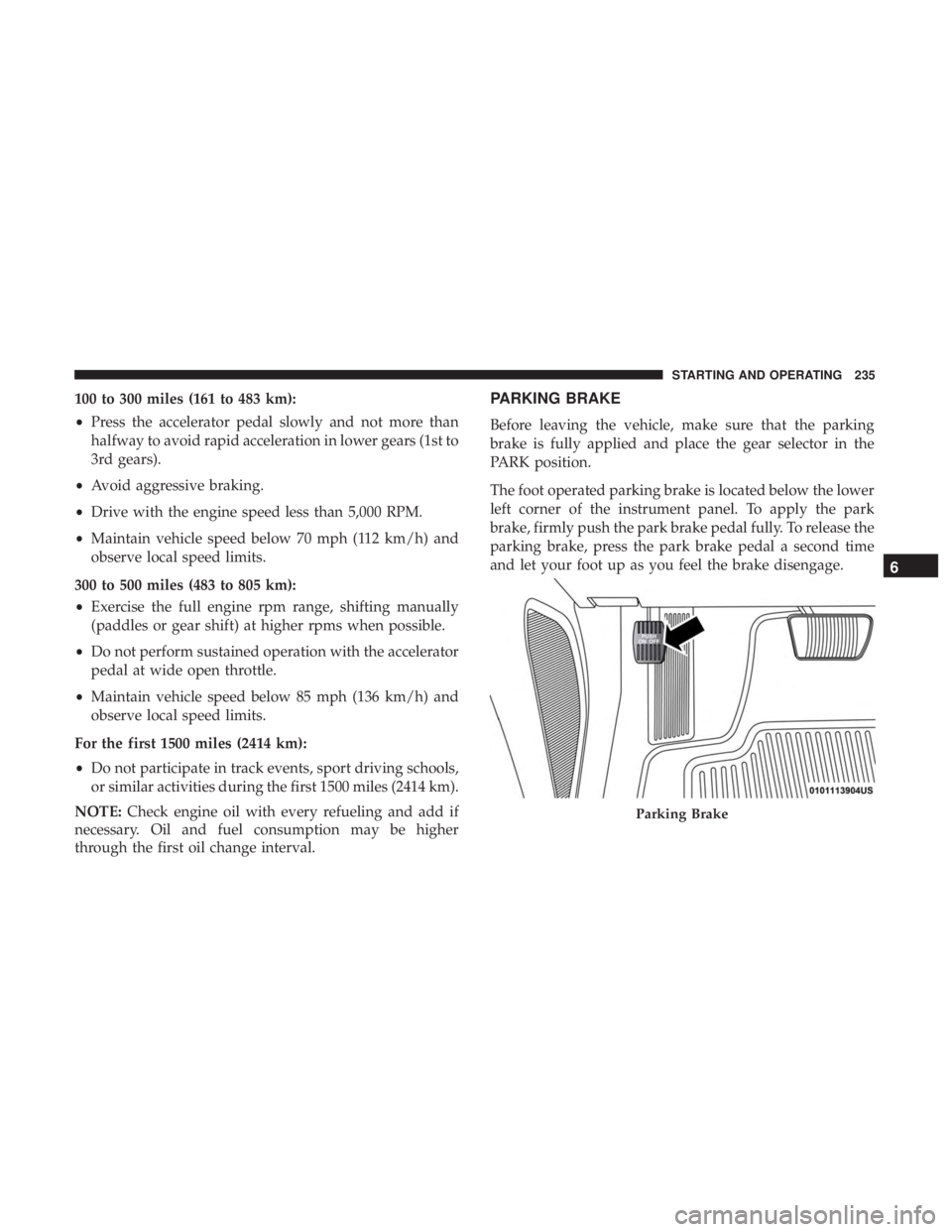
The foot operated parking brake is located below the lower
left corner of the instrument panel. To apply the park
brake, firmly push the park brake pedal fully. To release the
parking brake, press the park brake pedal a second time
and let your foot up as you feel the brake disengage.
Parking Brake
6
STARTING AND OPERATING 235
Page 246 of 560
The following indicators should be used to ensure that you
have properly engaged the transmission into the PARK
position:
•When shifting into PARK, push the lock button on the
gear selector and firmly move the selector all the way
forward until it stops and is fully seated.
• Look at the transmission gear position display and
verify that it indicates the PARK position (P), and is not
blinking.
• With the brake pedal released, verify that the gear
selector will not move out of PARK.
REVERSE (R)
This range is for moving the vehicle backward. Shift into
REVERSE only after the vehicle has come to a complete
stop.
NEUTRAL (N)
Use this range when the vehicle is standing for prolonged
periods with the engine running. Apply the parking brake
and shift the transmission into PARK if you must exit the
vehicle.WARNING!
Do not coast in NEUTRAL and never turn off the
ignition to coast down a hill. These are unsafe practices
that limit your response to changing traffic or road
conditions. You might lose control of the vehicle and
have a collision.
CAUTION!
Towing the vehicle, coasting, or driving for any other
reason with the transmission in NEUTRAL can cause
severe transmission damage.
Refer to “Recreational Towing” in “Starting And Op-
erating” and “Towing A Disabled Vehicle” in “In Case
Of Emergency” for further information.
DRIVE (D)
This range should be used for most city and highway
driving. It provides the smoothest upshifts and downshifts,
and the best fuel economy. The transmission automatically
upshifts through all forward gears. The DRIVE position
provides optimum driving characteristics under all normal
operating conditions.
244 STARTING AND OPERATING
Page 251 of 560

SPORT MODE — WITHOUT PERFORMANCE
CONTROL
Your vehicle is equipped with a Sport Mode feature. This
mode is a configuration set up for typical enthusiast
driving. The engine, transmission, and steering systems are
all set to their SPORT settings. Sport Mode will provide
improved throttle response and modified shifting for an
enhanced driving experience, as well the greatest amount
of steering feel. This mode may be activated and deacti-
vated by pushing the Sport button on the instrument panel
switch bank.
For vehicles equipped with Drive Modes or a “SUPER
TRACK PACK” button, refer to “Uconnect Settings” in
“Multimedia” for further information.
FUEL SAVER TECHNOLOGY 5.7L AND 6.4L ONLY —
IF EQUIPPED
This feature offers improved fuel economy by shutting off
four of the engine’s eight cylinders during light load and
cruise conditions. The system is automatic with no driver
inputs or additional driving skills required.
NOTE:This system may take some time to return to full
functionality after a battery disconnect.
POWER STEERING
The electric power steering system will give you good
vehicle response and increased ease of maneuverability in
tight spaces. The system will vary its assist to provide light
efforts while parking and good feel while driving. If the
electric steering system experiences a fault that prevents it
from providing assist, you will still have the ability to steer
the vehicle manually.
WARNING!
Continued operation with reduced assist could pose a
safety risk to yourself and others. Service should be
obtained as soon as possible.
Alternate electric power steering efforts can be selected
through the Uconnect System. Refer to ”Customer Pro-
grammable Features” within “Uconnect Settings” in “Mul-
timedia” for further information.
If the Electric Power Steering warning icon is
displayed and the “SERVICE POWER STEERING”
or the “POWER STEERING ASSIST OFF – SER-
VICE SYSTEM” message is displayed within the
instrument cluster display, this indicates the vehicle needs to
6
STARTING AND OPERATING 249
Page 289 of 560
CAUTION!
•To avoid vehicle damage, ParkView should only be
used as a parking aid. The ParkView camera is
unable to view every obstacle or object in your drive
path.
• To avoid vehicle damage, the vehicle must be driven
slowly when using ParkView to be able to stop in
time when an obstacle is seen. It is recommended
that the driver look frequently over his/her shoulder
when using ParkView.
NOTE: If snow, ice, mud, or any foreign substance builds
up on the camera lens, clean the lens, rinse with water, and
dry with a soft cloth. Do not cover the lens.
REFUELING THE VEHICLE
1. Push the fuel filler door release switch (located in the driver’s door map pocket).
Fuel Filler Door Release Switch
6
STARTING AND OPERATING 287