2019 CITROEN BERLINGO VAN ECU
[x] Cancel search: ECUPage 117 of 320

115
- run the strap of the child seat behind the top of the seat backrest, centring it between the
holes for the head restraint rods,
-
f
ix the hook of the upper strap to rear ring B ,
-
t
ighten the upper strap.The incorrect installation of a child seat in
a vehicle compromises the protection of
the child in the event of an accident.
Strictly follow the fitting instructions
provided in the installation guide supplied
with the child seat.
Recommended ISOFIX
child seats
Also consult the user guide from the child
seat’s manufacturer to find out how to
install and remove the seat. "
RÖMER Baby- Safe Plus and its ISOFIX
base"
(size category: E )
Group 0+: from bir th to 13 kg
Is installed "rearward facing" using an ISOFIX base which is attached to rings A .
The base has a support leg, height
adjustable, which rests on the vehicle's floor. This child seat can also be secured with a
seat belt. In this case, only the seat body is
used and is attached to the vehicle seat using the three-point seat belt. RÖMER Duo Plus ISOFIX
(size category: B1 )
Group 1: from 9 to 18kg
Is installed only in the "forward facing" position.
Is attached to the rings A and the upper ring
B , referred to as the TOP TETHER, using an
upper strap.
3 seat body angles: sitting, reclining and lying down.
This child seat can also be used on seats
not equipped with ISOFIX mountings. In this
case, it must be secured to the vehicle's seat using the three-point seat belt. Adjust the
position of the vehicle's front seat so that the child's feet are not touching the backrest.
5
Safety
Page 119 of 320

117
i-Size child seats
i-Size child seats have two latches that engage
on the two rings A.
i-Size child seats also have:
-
e
ither an upper strap that is attached to ring
B ,
-
o
r a support leg that rests on the vehicle
floor, compatible with the approved i-Size
seat position,
the role of which is to prevent the child seat
from tipping for ward in the event of a collision.
For more information on ISOFIX mountings ,
refer to the corresponding section.
Key
Seat position i-Size child
restraint system
Row 1 (a) Passenger
seat Not i-Size
Row 2 (b) (c) i-U
Row 3 (b) Not i-Size
(a) F
R
efer to the current legislation in your
country before installing your child on
this seat.
(b) F
T
o install a child seat on a rear
seat, "rear ward facing" or "for ward
facing", adjust the rear seat to the
fully back position with the backrest
straightened.
(c) F
A
djust the front seat to the maximum
height.
i-U Suitable for i-Size restraint systems in the
"Universal" category, "forward facing" and
"rearward facing".
i-UF Only suitable for i-Size restraint systems
in the "Universal" category, "forward
fac ing".
Key
(a)
F R efer to the current legislation in your
country before installing your child on
this seat.
(b) F
T
o install a child seat on a rear
seat, "rear ward facing" or "for ward
facing", adjust the rear seat to the
fully back position with the backrest
straightened.
(c) The installation of a carrycot on this seat
may prevent the use of one or more of the
other seats in this row.
(d) F
A
djust the rear passenger seat
without height adjuster to the fully
back position.
(e) Installing child seats with a support leg is
prohibited in the 3
rd row.
IUF Seat suitable for installing an ISOFIX
Universal seat, "Forward facing", secured
using the upper strap.
IL Seat suitable for an ISOFIX Semi-
Universal child seat which is either:
-
"
rear ward facing" fitted with an upper
strap or a support leg,
-
"
for ward facing" fitted with a support
leg,
-
a c
arrycot fitted with an upper strap or
a support leg.
For more information on ISOFIX child
seats and in particular on securing the
upper strap, refer to the corresponding
section.
Locations for i-Size child
seats
In accordance with the new European
regulations, this table indicates the options
for installing i-Size child seats on seats in the
vehicle fitted with ISOFIX mountings approved
for i-Size.
5
Safety
Page 120 of 320

118
Advice
The incorrect installation of a child seat in
a vehicle compromises the protection of
the child in the event of an accident.
Ensure that there is no seat belt or seat
belt buckle under the child seat, as this
could destabilise it.
Remember to fasten the seat belts or
the child seat harness keeping the slack
relative to the child's body to a minimum,
even for short journeys.
When installing a child seat using the seat
belt, ensure that the seat belt is tightened
correctly on the child seat and that it
secures the child seat firmly on the seat
of your vehicle. If your passenger seat is
adjustable, move it forwards if necessary.
The head restraint must be removed
before installing a child seat with a
backrest on a passenger seat.
Ensure that the head restraint is stored or
attached securely to prevent it from being
thrown around the vehicle in the event
of sharp braking. Refit the head restraint
when the child seat is removed.Children at the rear
At rear seating positions, always leave
sufficient space between the front seat
and:
-
a "
rear ward facing" child seat,
-
t
he child's feet for a child seat fitted
"forward facing".
To do this, move the front seat for wards
and, if necessary, move its backrest into
the upright position.
For optimal installation of the forward
facing child seat, verify that its backrest is
as close as possible to the backrest of the
vehicle seat, if possible in contact with it.
Children at the front
The legislation on carrying children on the
front passenger seat is specific to each
country. Refer to the legislation in force in
the country in which you are driving.
Deactivate the front passenger airbag
when a "rear ward facing" child seat is
installed on the front passenger seat.
Other wise, there is a risk of serious or
fatal injury to the child if the airbag is
deployed. Installing a booster seat
The chest part of the seat belt must be
positioned on the child's shoulder without
touching the neck.
Ensure that the lap part of the seat belt
passes correctly over the child's thighs.
We recommend using a booster seat with
a backrest, equipped with a belt guide at
shoulder level.
Additional protections
To prevent accidental opening of the doors
and rear windows, use the child lock.
Take care not to open the rear windows by
more than one third.
To protect young children from the rays
of the sun, fit side blinds on the rear
windows.
As a safety precaution, do not leave:
-
a c
hild or children alone and
unattended in a vehicle,
-
a c
hild or an animal in a vehicle
which is exposed to the sun, with the
windows closed,
-
t
he keys within reach of children inside
the vehicle.
Safety
Page 157 of 320

155
The system is not intended for the
following situations:
-
i
f the front end of the vehicle has
been modified (addition of long-range
headlamps, painting of the front
bumper),
-
d
riving on a racing circuit,
-
r
unning on a rolling road,
-
u
se of snow chains, non-slip covers or
studded tyres.
The use of mats not approved by
CITROËN may inter fere with the operation
of the cruise control.
To avoid any risk of jamming the pedals:
-
e
nsure that the mat is secured
c o r r e c t l y,
-
n
ever place one mat on top of another.
The following situations may interfere with
the operation of the system or prevent it
from working:
-
d
riving on a winding road,
-
p
oor visibility (inadequate street
lighting, falling snow, heavy rain, dense
f o g , e t c .),
-
d
azzle (headlamps of an oncoming
vehicle, low sun, reflections on a damp
road, leaving a tunnel, alternating
shade and light, etc.),
-
c
amera obstructed (mud, frost, snow,
condensation, etc.).
In these situations, detection performance
may be reduced.Malfunction
If the cruise control
malfunctions, dashes are
displayed instead of the
cruise control speed setting.
If this warning lamp comes
on, accompanied by an alert
message and an audible
signal, this confirms a
malfunction.
The adaptive cruise control deactivates
automatically if the use of a "space-saver"
type spare wheel is detected or if there is
a malfunction on the lateral brake lamps or
trailer brake lamps (for approved trailers).
The cruise control operates by day and
night, in fog or moderate rainfall.
However, it is strongly recommended that
you always adapt the speed and the safety
distance in relation to the vehicles ahead,
according to the driving conditions, the
weather and the road surface.
Use the cruise control only where the
driving conditions allow running at a
constant speed and keeping an adequate
safety distance.
Do not activate the cruise control in urban
areas where pedestrians are likely to
cross the road, in heavy traffic (except for
versions with EAT8 gearbox), on winding
or steep roads, on slippery or flooded
roads, when there is snowfall, if the
windscreen is damaged or when the brake
lamps have failed.
In certain circumstances, it may not
be possible for the speed setting to be
maintained or even attained: loaded
vehicle, ascending a steep hill, etc.
Have the system checked by a CITROËN
dealer or a qualified workshop.
Memorising speeds
Linked to the speed limiter and programmable
cruise control only, this function allows speed
limits to be registered which will then be
suggested as settings for these two systems.
6
Driving
Page 186 of 320

184
Removing
F On the towball, move the lever from position 3 to position 2 .
F
R
emove the towball by pulling it towards
you.
F
O
nce the towball has been removed, move
the lever from position 2 to position 1 .
F
F
it the end of the towball into the carrier,
located underneath the rear bumper, as far
as it can go.
F
S
ecure the towball correctly by moving the
lever to position 3 ("locked" position). F
C
onnect the trailer plug to the 13 -pin socket
provided next to the carrier.
F
S
ecure the trailer by connecting its safety
cable to the hoop provided on the carrier.
Connect the trailer plug with the engine
off.
If you connect the trailer plug in the
minutes after you have switched off the
ignition, do not touch the exhaust – risk
of burns! If the towball is not locked, the trailer can
detach. This may cause an accident.
Always lock the towball in accordance with
the descriptions.
Obser ve the legislation in force in the
country in which you are driving.
Remove the towball if it is not being used.
Before starting the vehicle, check that the
trailer lamps are working correctly.
Before setting off, check the adjustment of
the headlamp beam height.
Carrier systems (box or bicycle carrier)
Always comply with the maximum load
authorised on the towing device: if it
is exceeded, this device may detach
from the vehicle and so cause a serious
accident.
F
B
efore fitting the towball, check that the
contact points, shown by arrows, are clean.
Use a soft, clean cloth.
Practical information
Page 187 of 320

185
Remove the quickly detachable towball
when not towing a trailer.
Energy economy mode
System which manages the duration of use of
certain functions to conser ve a sufficient level
of charge in the battery.
After the engine has stopped, you can still use
functions such as the audio and telematics
system, windscreen wipers, dipped beam
headlamps,
courtesy lamps, etc. for a
maximum combined duration of about forty
minutes. For more information about the Engine
technical data and towed loads
and
particularly the maximum load applied
on the towing device, refer to the
corresponding section. If a telephone call is being made at this
time, it will be maintained for around
10 minutes with the Bluetooth hands-free
system of your audio system.
Exiting the mode
These functions will be automatically restored
the next time the vehicle is used.
In order to restore the use of these functions
immediately, start the engine and let it run:
-
f
or less than ten minutes, to use the
equipment for approximately five minutes,
-
f
or more than ten minutes, to use the
equipment for up to approximately thirty
minutes.
Let the engine run for the duration specified to
ensure that the battery charge is sufficient.
Do not repeatedly and continuously restart the
engine in order to charge the battery.
A flat battery prevents the engine from
starting.
For more information on the 12
V batter y,
refer to the corresponding section.
Load reduction mode
System which manages the use of certain
functions according to the level of charge
remaining in the battery.
When the vehicle is being driven, the load
reduction function temporarily deactivates
certain functions, such as air conditioning,
heated rear screen, etc.
The deactivated functions are reactivated
automatically as soon as conditions permit.
Roof bars/Roof rack
Recommendations
Distribute the load uniformly, taking care
to avoid overloading one of the sides.
Arrange the heaviest part of the load as
close as possible to the roof.
Secure the load firmly.
Drive gently: the vehicle will be more
susceptible to the effects of side winds
and its stability may be affected.
Regularly check the security and tight
fastening of the roof bars and racks, at
least before each trip.
Remove the roof bars once they are no
longer needed.
Switching to this mode
A message appears in the instrument panel
screen indicating that the vehicle has switched
to economy mode and the active functions are
put on standby.
7
Practical information
Page 199 of 320

197
With temporary puncture repair
kit
4.Temporary puncture repair kit.
Contains a 12
V compressor and a
cartridge of sealant to temporarily repair
the wheel and adjust the tyre pressure.
5. Speed limit sticker.
For more information on the Temporary
puncture repair kit , refer to the
corresponding section.
With a spare wheel
6. Wheelbrace.
For removing the wheel bolts and raising/
lowering the jack.
7. Jack.
Used to raise the vehicle.
8. Wheel bolt cover/wheel trim removal tools
(depending on equipment).
If present on your vehicle, it removes the
wheel bolt covers on alloy wheels or the
wheel trim on steel wheels.
9. Socket for the wheel security bolts.
Used for adapting the wheelbrace to the
special "security" bolts.
For more information on the Spare wheel ,
refer to the corresponding section. All of these tools are specific to your
vehicle and may vary depending on
equipment.
Do not use them for any other purposes.
The jack must only be used to change a wheel
with a damaged or punctured tyre.
The jack does not require any maintenance.
The jack meets European standards, as defined
in the Machinery Directive 2006/42/CE.
Certain parts of the jack such as the screw
thread or the joints could cause injury:
avoid touching them.
Carefully remove all traces of lubrication
grease.
Temporary puncture
repair kit
Scan the QR code on page 3 to view
explanatory videos.
Comprising a compressor and a sealant
cartridge, it allows the temporary repair of
a tyre so that you can drive to the nearest
garage.
8
In the event of a breakdown
Page 200 of 320
198
The vehicle's electric system allows the
connection of the compressor for long
enough to repair a damaged tyre.
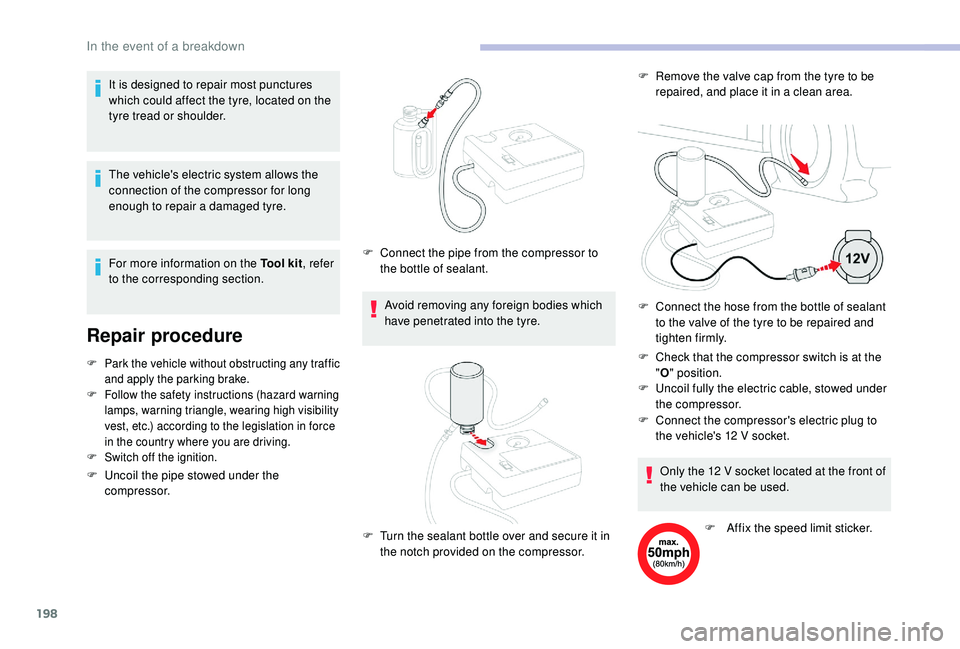
Repair procedure
F Park the vehicle without obstructing any traffic and apply the parking brake.
F
F
ollow the safety instructions (hazard warning
lamps, warning triangle, wearing high visibility
vest, etc.) according to the legislation in force
in the country where you are driving.
F
S
witch off the ignition.
F Uncoil the pipe stowed under the compressor. Avoid removing any foreign bodies which
have penetrated into the tyre.
F
C
onnect the pipe from the compressor to
the bottle of sealant.
F
T
urn the sealant bottle over and secure it in
the notch provided on the compressor.
It is designed to repair most punctures
which could affect the tyre, located on the
tyre tread or shoulder.
For more information on the Tool kit
, refer
to the corresponding section. F
R
emove the valve cap from the tyre to be
repaired, and place it in a clean area.
F
C
heck that the compressor switch is at the
" O " position.
F
U
ncoil fully the electric cable, stowed under
the compressor.
Only the 12 V socket located at the front of
the vehicle can be used.
F
A
ffix the speed limit sticker.
F
C
onnect the hose from the bottle of sealant
to the valve of the tyre to be repaired and
tighten firmly.
F
C
onnect the compressor's electric plug to
the vehicle's 12 V socket.
In the event of a breakdown