2019 AUDI TT ROADSTER ESP
[x] Cancel search: ESPPage 201 of 304

8S8012721BA
Airbag system
— when the electrical capacitance measured by
the capacitive passenger detection system for
the front passenger seat indicates that the pas-
senger side frontal airbag must be switched off
by the electronic control unit (the PASSENGER
AIR BAG OFF %; light > page 200 and how they
work comes on and stays on).
ZA\ WARNING
Sitting in the wrong position can increase the
risk of serious injury in crashes.
—To reduce the risk of injury when the airbags
inflate, the driver and passengers must al-
ways sit in an upright position, must not
lean against or place any part of their body
too close to the area where the airbags are
located.
— Occupants who are unbelted, out of position
or too close to the airbag can be seriously in-
jured by an airbag as it unfolds with great
force in the blink of an eye > page 190.
Z\ WARNING
A child in a rearward-facing child seat instal-
led on the front passenger seat will be seri-
ously injured and can be killed if the front air-
bag inflates - even with an Advanced Airbag
System.
— The inflating airbag will hit the child seat or
infant carrier with great force and will
smash the child seat and child against the
backrest, center armrest, door or roof.
— Never install a rearward facing child safety
seat on the front passenger seat unless the
PASSENGER AIR BAG OFF %; light comes
on and stays on. If the PASSENGER AIR
BAG OFF #%; light does not come on and stay
on, the inflating airbag will hit the child
safety seat or infant carrier with great force
and will smash the child safety seat and
child against the backrest, door or roof.
Have the airbag system inspected immedi-
ately by your authorized Audi dealer.
ZA WARNING
Objects between you and the airbag will in-
ing with the way the airbag unfolds or by be-
ing pushed into you as the airbag inflates.
— Never hold things in your hands or on your
lap when the vehicle is in use.
— Never transport items on or in the area of
the front passenger seat. Objects could
move into the area of the front airbags dur-
ing braking or other sudden maneuver and
become dangerous projectiles that can
cause serious personal injury if the airbags
inflate.
— Never place or attach accessories or other
objects (such as cup holders, telephone
brackets, large, heavy or bulky objects) on
the doors, over or near the area marked
“AIRBAG” on the steering wheel, instrument
panel, seat backrests or between those
areas and yourself. These objects could
cause injury in a crash, especially when the
airbags inflate.
— Never recline the front passenger's seat to
transport objects. Items can also move into
the area of the side airbag or the front air-
bag during braking or in a sudden maneuver.
Objects near the airbags can become projec-
tiles and cause injury, particularly when the
seat is reclined.
— Never place or transport objects on the front
passenger seat. Objects on the front passen-
ger seat could cause the capacitive sensor in
the seat to signal to airbag system that the
seat is occupied by a person when it in fact is
not, or that the person on the seat is heavier
than he or she actually is. The change in
electric capacitance because of such objects
can cause the passenger front airbag to be
turned on when it should be off, or can
cause the airbag to work in a way that is dif-
ferent from the way it would have worked
without objects on the seat.
— Always make sure that there is nothing on
the front passenger seat that will cause the
capacitive passenger detection system in
the seat to signal to the Airbag System that
the seat is occupied by a person when it is
not, or to signal that it is occupied by some-
one who is heavier than the person actually
crease the risk of injury in a crash by interfer-
199
Page 202 of 304

Airbag system
sitting on the seat. The presence of an ob-
ject could cause the passenger front airbag
to be turned on when it should be off, or
could cause the airbag to work in a way that
is different from the way it would have
worked without the object on the seat.
ZX WARNING
The fine dust created when airbags deploy can
cause breathing problems for people with a
history of asthma or other breathing condi-
tions.
—To reduce the risk of breathing problems,
those with asthma or other respiratory con-
ditions should get fresh air right away by
getting out of the vehicle or opening win-
dows or doors.
— Ifyou are in a collision in which airbags de-
ploy,
wash your hands and face with mild
soap and water before eating.
— Be careful not to get the dust into your eyes,
or into any cuts or scratches.
— If the residue should get into your eyes,
flush them with water.
Monitoring the
Advanced Airbag System
Airbag monitoring indicator light
Two separate indicators monitor the function of
the Advanced Airbag System: the 2] light and
the PASSENGER AIR BAG OFF 4; ON @ light.
The Advanced Airbag System as well as the side
airbags with ejection mitigation features (includ-
ing the electronic control unit, sensors and sys-
tem wiring) are all monitored continuously to
make sure that they are functioning properly
whenever the ignition is on. Every time you turn
on the ignition, the airbag system indicator light
B¥ will come on for a few seconds (function
check).
The system must be inspected when the
indicator light Ba:
— does not come on when the ignition is switched
on,
200
— does not go out a few seconds after you have
switched on the ignition, or
— comes on while driving.
If an airbag system malfunction is detected, the
indicator light will come on to serve as a constant
reminder to have the system inspected immedi-
ately.
If a malfunction occurs that turns the front air-
bag on the passenger side off, the PASSENGER
AIR BAG OFF 8%; light will come on and stay on
whenever the ignition is on.
Z\ WARNING
An airbag system that is not functioning prop-
erly cannot provide supplemental protection
in a frontal crash.
— If the airbag indicator light > page 18
comes when the vehicle is being used, have
the system inspected immediately by your
authorized Audi dealer. It is possible that
the airbag will inflate when it is not sup-
posed to, or will not inflate when it should.
PASS eae VNR) de ALO) MU Lig
Fig. 158 Section from the headliner: PASSENGER AIR BAG
OFF 2%; ON @ light
The PASSENGER AIR BAG OFF %; ON @ light is
located in the headliner > fig. 158.
The PASSENGER AIR BAG OFF %; light will come
on and stay on to tell you when the front Ad-
vanced Airbag on the passenger side has been
turned off by the electronic control unit. If the
bulb for the PASSENGER AIR BAG OFF #%; ON @
light burns out, the airbag indicator light ka will
come on to signal a malfunction in the Advanced
Airbag System. Although the burned-out bulb >
Page 205 of 304

8S8012721BA
Airbag system
from the airbag as possible. The backrest
must be adjusted to an upright position.
Make sure that the PASSENGER AIR BAG
OFF %; light comes on and stays on all the
time whenever the ignition is switched on.
ZA WARNING
If the PASSENGER AIR BAG OFF %; light does
not go out when an adult is sitting on the
front passenger seat after taking the steps
described above, have the airbag system in-
spected by your Audi dealer before transport-
ing anyone on the front passenger seat.
@ Tips
If the capacitive passenger detection system
determines that the front passenger seat is
empty, the frontal airbag on the passenger
side will be turned off, and the PASSENGER
AIR BAG OFF 3; light will stay on.
Repair, care and disposal of the airbags
Parts of the airbag system are installed at many
different places on your Audi. Installing, remov-
ing, servicing or repairing a part in an area of the
vehicle can damage a part of an airbag system
and prevent that system from working properly
in a collision.
There are some important things you have to
know to make sure that the effectiveness of the
system will not be impaired and that discarded
components do not cause injury or pollute the
environment.
ZA WARNING
Improper care, servicing and repair proce-
dures can increase the risk of personal injury
and death by preventing an airbag from de-
ploying when needed or deploying an airbag
unexpectedly:
— Never cover, obstruct, or change the steer-
ing wheel horn pad or airbag cover or the in-
strument panel or modify them in any way.
— Never attach any objects such as cup holders
or telephone mountings to the surfaces cov-
ering the airbag units.
— For cleaning the horn pad or instrument
panel, use only a soft, dry cloth or one mois-
tened with plain water. Solvents or cleaners
could damage the airbag cover or change
the stiffness or strength of the material so
that the airbag cannot deploy and protect
properly.
— Never repair, adjust, or change any parts of
the airbag system.
— All work on the steering wheel, instrument
panel, front seats or electrical system (in-
cluding the installation of audio equipment,
cellular telephones and CB radios, etc.)
must be performed by a qualified technician
who has the training and special equipment
necessary.
— For any work on the airbag system, we
strongly recommend that you see your au-
thorized Audi dealer or qualified workshop.
— Never modify the front bumper or parts of
the vehicle body.
— Always make sure that the side airbag can
inflate
without interference:
— Never install seat covers or replacement
upholstery over the front seatbacks that
have not been specifically approved by Au-
di.
— Never use additional seat cushions that
cover the areas where the side airbags in-
flate.
— Damage to the original seat covers or to
the seam in the area of the side airbag
module must always be repaired immedi-
ately by an authorized Audi dealer.
— The airbag system can deploy only once. Af-
ter an airbag has been deployed, it must be
replaced with new replacement parts de-
signed and approved especially for your Audi
model version. Replacement of complete
airbag systems or airbag components must
be performed by qualified workshops only.
Make sure that any airbag service action is
entered in your Audi Warranty & Mainte-
nance booklet under AIRBAG REPLACEMENT
RECORD.
— For safety reasons in severe accidents, the
alternator and starter are separated from
203
Page 208 of 304

Airbag system
Mii Selae eet Lamia adele Mol mate dal -1-)
airbag system
Airbags are only supplemental restraints. Always
wear safety belts correctly and ride in a proper
seating position.
There is a lot that you and your passenger must
know and do to help the safety belts and airbags
to provide supplemental protection.
ZA WARNING
An inflating knee airbag can cause serious in-
jury. Wearing safety belts incorrectly and im-
proper seating positions increase the risk of
serious personal injury and death whenever a
vehicle is being used.
— The knee airbag system cannot protect you
properly if you are seated too close to any of
the airbag locations. When adjusting their
seat positions, it is important that both the
driver and the front passenger keep their
upper bodies and knees at the following
minimum safe distances:
—at least 10 in (25 cm) between the chest
and
the steering wheel/instrument panel.
—at least 4 in (10 cm) between the knees
and the lower part of the instrument pan-
el.
— The risk of personal injury increases if you
lean forward or to the side, or if the seat is
improperly positioned and you are not wear-
ing your safety belt. The risk increases even
more should the airbag deploy.
— Always make sure that the knee airbag can
inflate without interference. Objects be-
tween you and the airbag can increase the
risk of injury in an accident by interfering
with the way the airbag deploys or by being
pushed into you as the airbag deploys.
— Never let anybody, especially children or
animals ride in the footwell in front of the
passenger seat. If the airbag deploys, this
can result in serious or fatal injuries.
— Never carry objects of any kind in the foot-
well area in front of the driver's or pas-
senger's seat. Bulky objects (shopping
bags, for example) can interfere with or
prevent proper deployment of the airbag.
206
Small objects can be thrown through the
vehicle if the airbag deploys and injure you
or your passenger.
— Make sure there are no cracks, deep scratch-
es or other damage in the area of the instru-
ment panel where the knee airbags are lo-
cated.
— If children are incorrectly seated, their risk
of injury increases in a collision > page 210,
Child safety.
Side airbags
Description of side airbags
The airbag system can provide supplemental
protection to properly restrained occupants.
The side airbags are located in the sides of the
front seat backrests > fig. 161 facing the doors.
They are identified by the word “AIRBAG”.
The side airbags installed for the front seating
positions have been designed and certified to
help reduce the risk of injury that can be caused
by airbags when they inflate, particularly when
the occupant sitting next to it is not seated prop-
erly. The side airbag for the front passenger seat
can be used with properly installed child re-
straints. Please be sure to read the important in-
formation and warnings whenever using a child
restraint in a vehicle: Safety belts > page 182,
Airbag system > page 189, Child safety
=> page 210.
The side airbag system basically consists of:
— the electronic control module and external side
impact sensors
Page 210 of 304
Airbag system
How supplemental side airbags work
Side airbags deploy instantly and can help re-
duce the risk of upper torso injuries for occu-
pants who are properly restrained.
S /
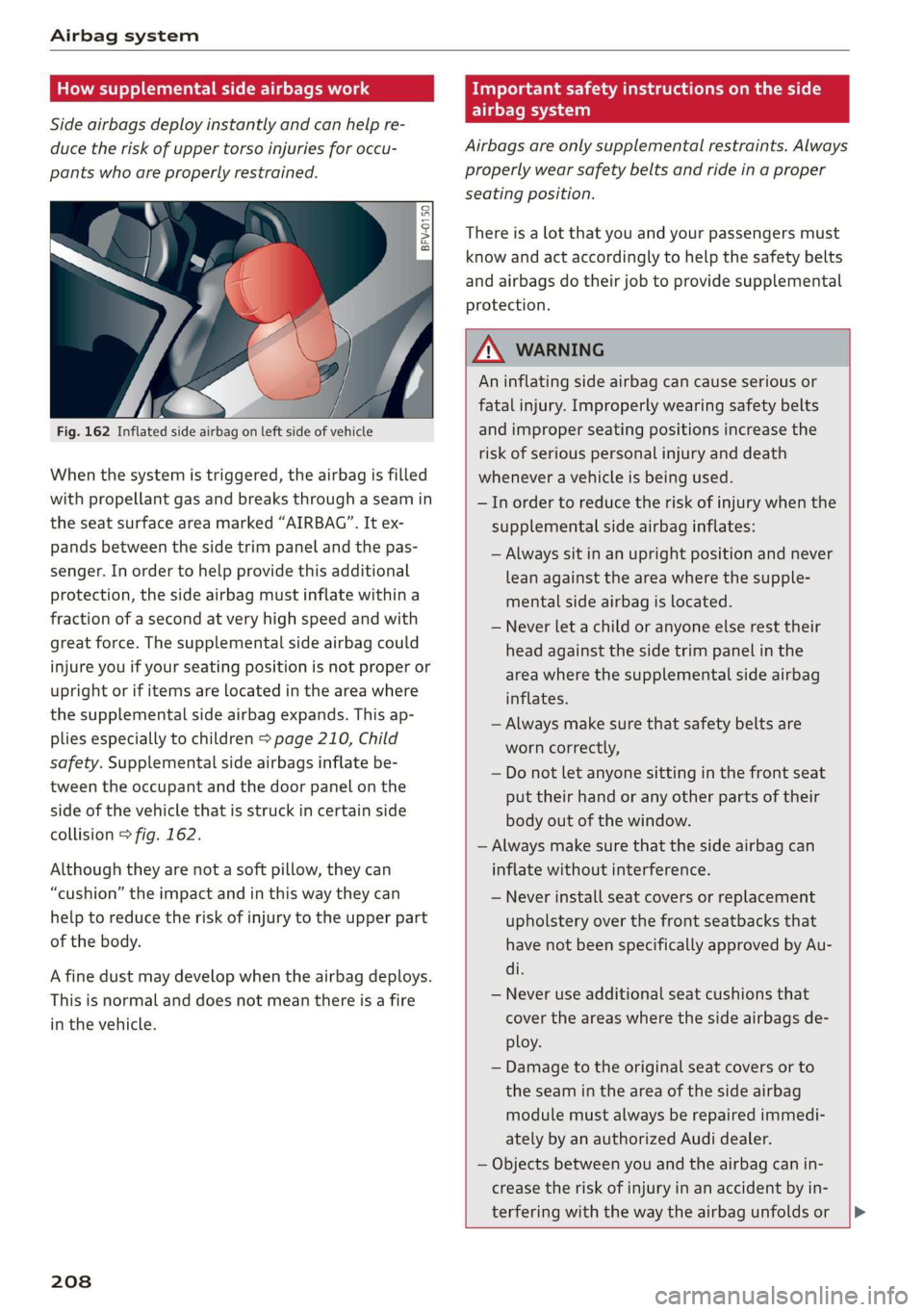
Fig. 162 Inflated side airbag on left side of vehicle
When the system is triggered, the airbag is filled
with propellant gas and breaks through a seam in
the seat surface area marked “AIRBAG”. It ex-
pands between the side trim panel and the pas-
senger. In order to help provide this additional
protection, the side airbag must inflate within a
fraction of a second at very high speed and with
great force. The supplemental side airbag could
injure you if your seating position is not proper or
upright or if items are located in the area where
the supplemental side airbag expands. This ap-
plies especially to children > page 210, Child
safety. Supplemental side airbags inflate be-
tween the occupant and the door panel on the
side of the vehicle that is struck in certain side
collision = fig. 162.
Although they are not a soft pillow, they can
“cushion” the impact and in this way they can
help to reduce the risk of injury to the upper part
of the body.
A fine dust may develop when the airbag deploys.
This is normal and does not mean there is a fire
in the vehicle.
208
Important safety instructions on the side
airbag system
Airbags are only supplemental restraints. Always
properly wear safety belts and ride in a proper
seating position.
There is a lot that you and your passengers must
know and act accordingly to help the safety belts
and airbags do their job to provide supplemental
protection.
Z\ WARNING
An inflating side airbag can cause serious or
fatal injury. Improperly wearing safety belts
and improper seating positions increase the
risk of serious personal injury and death
whenever a vehicle is being used.
— In order to reduce the risk of injury when the
supplemental side airbag inflates:
— Always sit in an upright position and never
lean against the area where the supple-
mental side airbag is located.
— Never let a child or anyone else rest their
head against the side trim panel in the
area where the supplemental side airbag
inflates.
— Always make sure that safety belts are
worn correctly,
— Do not let anyone sitting in the front seat
put their hand or any other parts of their
body out of the window.
— Always make sure that the side airbag can
inflate without interference.
— Never install seat covers or replacement
upholstery over the front seatbacks that
have not been specifically approved by Au-
di.
— Never use additional seat cushions that
cover the areas where the side airbags de-
ploy.
— Damage to the original seat covers or to
the seam in the area of the side airbag
module must always be repaired immedi-
ately by an authorized Audi dealer.
— Objects between you and the airbag can in-
crease the risk of injury in an accident by in-
terfering with the way the airbag unfolds or
Page 212 of 304
Child safety
Child safety
Important information
Introduction
The physical principles of what happens when
your vehicle is in a crash apply also to children
=> page 183, What happens to occupants not
wearing safety belts?. But unlike adults and
teenagers, their muscles and bones are not fully
developed. In many respects children are at
greater risk of serious injury in crashes than
adults.
Because children's bodies are not fully developed,
they require restraint systems especially de-
signed for their size, weight, and body structure.
Many countries and all states of the United
States and provinces of Canada have laws requir-
ing the use of approved child restraint systems
for infants and small children.
Ina frontal crash at a speed of 20-35 mph
(30-56 km/h) the forces acting on a 13 lbs (6 kg)
infant will be more than 20 times the weight of
the child. This means the weight of the child
would suddenly be more than 260 lbs (120 kg).
Under these conditions, only an appropriate child
restraint properly used can reduce the risk of seri-
ous injury. Child restraints, like adult safety belts,
must be used properly to be effective. Used im-
properly, they can increase the risk of serious in-
jury in an accident.
If you must install a child restraint on the front
passenger seat in exceptional circumstances, be
sure to read and heed the important information
and warnings > page 190. Infants and other chil-
dren who are properly restrained in an appropri-
ate child restraint that is for their size and age
can benefit from the protection that supplemen-
tal side airbags provide in some kinds of crashes.
For more information please see information pro-
vided by the:
— National Highway Traffic Safety Administration
(NHTSA), currently at : http://www.safercar.gov
(for the USA)
— Transport Canada Information Centre, currently
at: http://www.tc.gc.ca (for Canada)
210
Consult the child safety seat manufacturer's in-
structions in order to be sure the seat is right for
your child's size > page 213, Important safety
instructions
for using child safety seats. Please
be sure to read and heed all of the important in-
formation and WARNINGS about child safety, Ad-
vanced Airbags, and the installation of child re-
straints in this chapter.
There is a lot you need to know about the Ad-
vanced Airbags in your vehicle and how they work
when infants and children in child restraints are
on the front passenger seat. Because of the large
amount of important information, we cannot re-
peat it all here. We urge you to read the detailed
information in this owner's manual about airbags
and the Advanced Airbag System in your vehicle
and the very important information about trans-
porting children on the front passenger seat.
Please be sure to heed the WARNINGS - they are
extremely important for your safety and the safe-
ty of your passengers, especially infants and
small children.
ZA WARNING
All vehicle occupants and especially children
must be restrained properly whenever riding
in a vehicle. An unrestrained or improperly re-
strained child could be injured by striking the
interior or by being ejected from the vehicle
during a sudden maneuver or impact. An un-
restrained or improperly restrained child is al-
so at greater risk of injury or death through
contact with an inflating airbag.
ZA WARNING
Children on the front seat of any car even with
Advanced Airbags can be seriously injured or
even killed when an airbag inflates. A child in
a rearward-facing child safety seat installed
on the front passenger seat will be seriously
injured and can be killed if the front airbag in-
flates.
— The inflating airbag will hit the child safety
seat or infant carrier with great force and
will smash the child safety seat and child
against the backrest, center armrest, or
door.
Page 215 of 304
8S8012721BA
Child safety
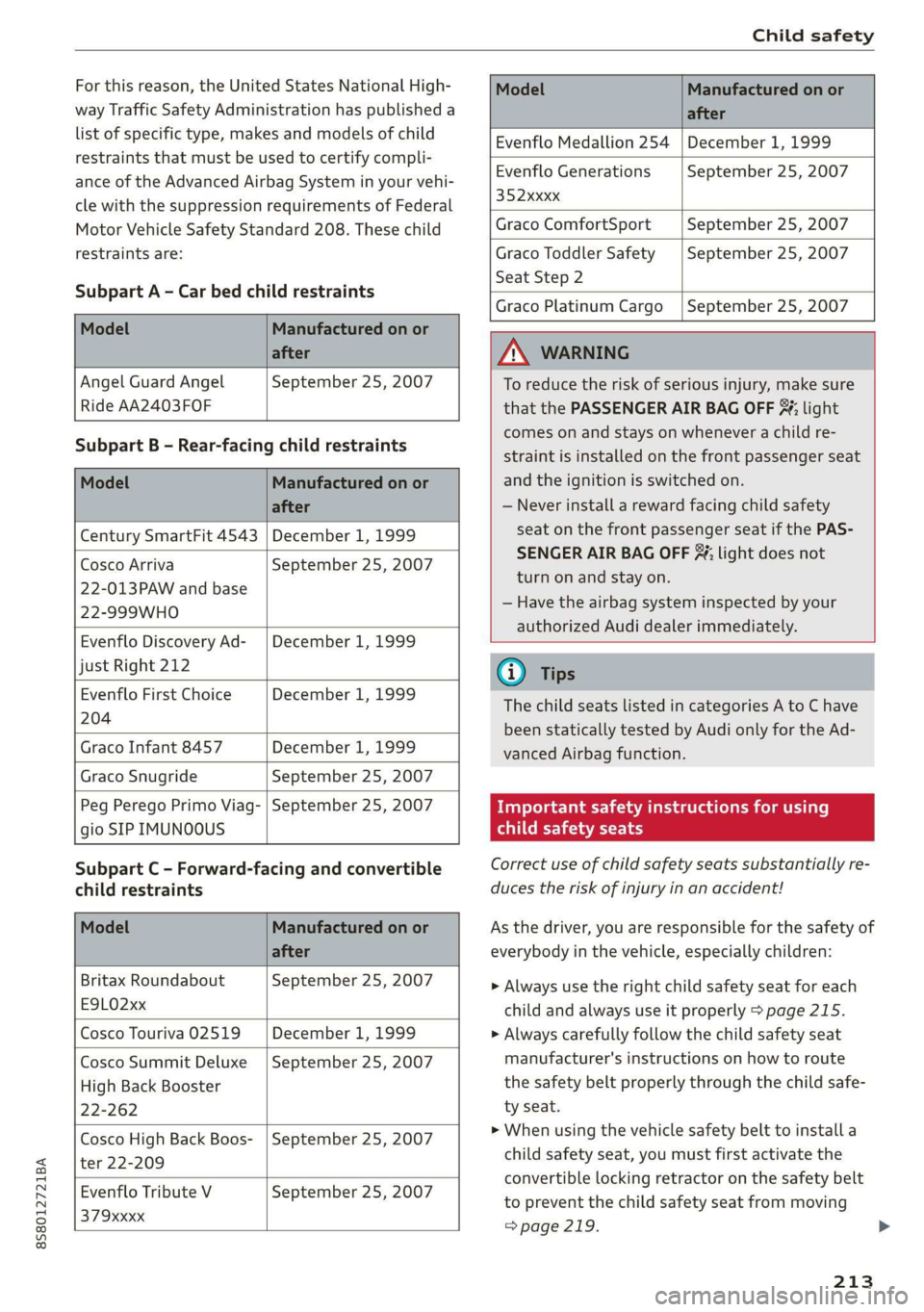
For this reason, the United States National High-
way Traffic Safety Administration has published a
list of specific type, makes and models of child
restraints that must be used to certify compli-
ance of the Advanced Airbag System in your vehi-
cle with the suppression requirements of Federal
Motor Vehicle Safety Standard 208. These child
restraints are:
Subpart A - Car bed child restraints
Model Manufactured on or
after
Evenflo Medallion 254 |December 1, 1999
Evenflo Generations
352xxxx
September 25, 2007
Graco ComfortSport September 25, 2007
Graco Toddler Safety
Seat Step 2
September 25, 2007
Model Manufactured on or
after
Graco Platinum Cargo | September 25, 2007
Angel Guard Angel September 25, 2007
Ride AA2403FOF
Subpart B - Rear-facing child restraints
Model Manufactured on or
after
Century SmartFit 4543 | December 1, 1999
Cosco Arriva
22-013PAW and base
September 25, 2007
ZA WARNING
To reduce the risk of serious injury, make sure
that the PASSENGER AIR BAG OFF %; light
comes on and stays on whenever a child re-
straint is installed on the front passenger seat
and the ignition is switched on.
— Never install a reward facing child safety
seat on the front passenger seat if the PAS-
SENGER AIR BAG OFF 3; light does not
turn on and stay on.
— Have the airbag system inspected by your
authorized Audi dealer immediately.
22-999WHO
Evenflo Discovery Ad- |December 1, 1999
just Right 212
Evenflo First Choice December 1, 1999
204
Graco Infant 8457 December 1, 1999
Graco Snugride September 25, 2007
Peg Perego Primo Viag- | September 25, 2007
gio SIP IMUNOOUS
Subpart C - Forward-facing and convertible
child restraints
Model Manufactured on or
after
Britax Roundabout
ESLO2xx
September 25, 2007
Cosco Touriva 02519 December 1, 1999
Cosco Summit Deluxe
High Back Booster
September 25, 2007
22-262
Cosco High Back Boos- | September 25, 2007
ter 22-209
Evenflo Tribute V September 25, 2007
37 9Xxxx
@ Tips
The child seats listed in categories A to C have
been statically tested by Audi only for the Ad-
vanced Airbag function.
a acetamide om eCd ile)
nema aes TL)
Correct use of child safety seats substantially re-
duces the risk of injury in an accident!
As the driver, you are responsible for the safety of
everybody in the vehicle, especially children:
> Always use the right child safety seat for each
child and always use it properly > page 215.
> Always carefully follow the child safety seat
manufacturer's instructions on how to route
the safety belt properly through the child safe-
ty seat.
> When using the vehicle safety belt to install a
child safety seat, you must first activate the
convertible locking retractor on the safety belt
to prevent the child safety seat from moving
=> page 219.
213
Page 216 of 304
Child safety
> Push the child safety seat down with your full
weight to get the safety belt really tight so that
the seat cannot move forward and sideways
more than 1 in (2.5 cm).
Always remember: Even though your vehicle is
equipped with an Advanced Airbag system, a
child should always ride in the seat properly re-
strained for its age and size.
Z\ WARNING
Not using a child safety seat, using the wrong
child safety seat or improperly installing a
child restraint increases the risk of serious
personal injury and death.
— All vehicle occupants and especially children
must be restrained properly whenever riding
in a vehicle. An unrestrained or improperly
restrained child could be injured by striking
the interior or by being ejected from the ve-
hicle during a sudden maneuver or impact.
An unrestrained or improperly restrained
child is also at greater risk of injury or death
through contact with an inflating airbag.
— Commercially available child safety seats are
required to comply with U.S. Federal Motor
Vehicle Safety Standard (FMVSS) 213 (in
Canada CMVSS 213).
— When buying a child restraint, select one
that fits your child and the vehicle.
— Only use child restraint systems that fully
contact the flat portion of the seat cush-
ion. The child restraint must not tip or
lean to either side. Audi does not recom-
mend using child safety seats that rest on
legs or tube-like frames. They do not pro-
vide adequate contact with the seat.
— Always heed all legal requirements per-
taining to the installation and use of child
safety seats and carefully follow the in-
structions provided by the manufacturer
of the seat you are using.
— Never let more than one child occupy a child
safety seat.
— Never let babies or older children ride ina
vehicle while sitting on the lap of another
passenger.
214
— Holding a child in your arms is never a sub-
stitute for a child restraint system.
— The strongest person could not hold the
child with the forces that exist in an acci-
dent. The child will strike the interior of
the vehicle and can also be struck by the
passenger.
— The child and the passenger can also injure
each other in an accident.
Never install rear-facing child safety seats or
infant carriers on the front passenger seat.
A child will be seriously injured and can be
killed when the passenger airbag inflates -
even with an Advanced Airbag System.
The inflating airbag will hit the child safety
seat or infant carrier with great force and
will smash the child safety seat and child
against the backrest, center armrest, door
or roof.
If exceptional circumstances require the use
of a forward-facing child restraint on the
front passenger's seat, the child's safety and
well-being require that the following special
precautions be taken:
— Make sure the forward-facing seat has
been designed and certified by its manu-
facturer for use on a front seat with a pas-
senger front and side airbag.
— Always carefully follow the manufacturer's
instructions provided with the child safety
seat or carrier.
— Always move the front passenger seat into
the rearmost position of the passenger
seat's fore and aft adjustment range, and
as far away from the airbag as possible be-
fore installing the child restraint.
— Always make sure that nothing prevents
the front passenger's seat from being
moved to the rearmost position in its fore
and aft adjustment range.
— Always make sure that the backrest is in
the upright position.
— Never place or use any electrical device
(such as a laptop, CD player, electronic
games device, power inverter or seat heat-
er for child seats) on the front passenger
seat if the device is connected to the 12-
volt socket or the cigarette lighter socket.