2019 AUDI TT ROADSTER door lock
[x] Cancel search: door lockPage 62 of 304
Driving
Setting/manually releasing the parking
brake
> Pull the ©) switch to set the parking brake. The
LED in the switch turns on. The PARK (USA mod-
els) (Canada models) indicator light also
turns on in the instrument cluster display.
> To release the parking brake manually, press
the brake or accelerator pedal while the igni-
tion is switched on and press the ©) switch at
the same time. The LED in the button and the
indicator light in the display turn off.
Releasing the parking brake automatically
Requirement: the driver's door must be closed.
> To start driving and release the parking brake
automatically, press the accelerator pedal as
usual.
In addition to releasing the parking brake auto-
matically, other convenience and safety functions
are available when you start driving > page 61,
Starting to drive.
Emergency braking function
You can use the emergency braking function in an
emergency situation, or if the standard brakes
are malfunctioning or the pedal is obstructed.
> Pull and hold the ©) switch.
> As soon as you release the ©) switch or acceler-
ate, the braking stops.
Pulling
and holding the ©) switch while driving
the vehicle activates the emergency braking func-
tion. The hydraulic brake system will brake all
four wheels. The braking effect is similar to heavy
braking > A\.
To reduce the risk of activating the emergency
braking by mistake, a warning tone (buzzer)
sounds when the ©) switch is pulled. Emergency
braking stops as soon as the ©) switch is released
or the accelerator pedal is pressed.
Parking
> Press the brake pedal to stop the vehicle.
> Pull the © switch to set the parking brake.
>» Place the selector lever in the “P” position.
> Turn the engine off > A\.
60
> Turn the steering wheel when parking on in-
clines so that the wheels will roll into the curb
if the vehicle starts moving.
ZA WARNING
— Ifa gear is engaged while the vehicle is sta-
tionary and the engine is running, do not
press the accelerator pedal inadvertently.
Otherwise, the vehicle will start to move im-
mediately and this could result in an acci-
dent.
— Emergency braking should only be used in
an emergency, when the when the standard
brake pedal is malfunctioning or obstructed.
During emergency braking, your vehicle will
brake similar to heavy braking. ESC and the
associated components (ABS, ASR, EDL) can-
not overcome the laws of physics. In corners
and when road or weather conditions are
bad, a full brake application can cause the
vehicle to skid or the rear end to swerve,
which increases the risk of an accident.
— If the power supply fails, you cannot set the
parking brake once it is released. In this
case, park the vehicle on level ground and
secure it by placing the selector lever in the
P position. See an authorized Audi dealer or
authorized Audi Service Facility for assis-
tance.
— If you leave the vehicle, switch the ignition
off and take the vehicle key with you. This
applies particularly when children remain in
the vehicle. Otherwise children could start
the engine, release the parking brake or op-
erate electrical equipment such as power
windows, which increases the risk of an acci-
dent.
— No one should remain in the vehicle when it
is locked - especially children. Locked doors
make it more difficult for emergency work-
ers to get into the vehicle, which puts lives
at risk.
C) Note
Do not leave your vehicle unattended while
the engine is running, because this increases
the risk of an accident.
Page 66 of 304

Driving
— If the vehicle does not move in the desired
direction, the system may not have engaged
the drive position correctly. Press the brake
pedal and select the drive position again.
— If the vehicle still does not move in the de-
sired direction, there is a system malfunc-
tion. See an authorized Audi dealer or au-
thorized Audi Service Facility for assistance
to have the system checked.
The transmission shifts up and down automati-
cally when in the driving gears.
Fig. 69 Section of the center console: selector lever with
interlock button
Starting the engine
> The selector lever must be in the P or the N po-
sition. At low temperatures (below 14 °F
(-10 °C)), the engine can only be started when
the selector lever is in the P position.
Starting from a stop
> Press and hold the brake pedal.
> Press and hold the interlock button in the selec-
tor lever handle, select the desired selector lev-
er position such as "D" > page 62 and release
the lock button.
> Wait a moment until the transmission shifts.
You will notice a slight movement when the
gear engages.
> Release the brake pedal and press the accelera-
tor pedal > A\.
Various convenience functions are available for
starting on hills > page 61.
64
Stopping temporarily
> Keep the vehicle stationary using the braking
pedal, for example at traffic lights.
> Do not press the accelerator pedal when doing
this.
> To prevent the vehicle from rolling when you
start driving, set the parking brake when stop-
ping on steep hills > A\ and >@.
> The parking brake will release automatically
and the vehicle will start moving once you press
the accelerator pedal.
Stopping/parking
If the selector lever is not in the "P" position
when you open the driver’s door, the vehicle
could roll. In vehicles with a convenience key*,
the message Shift to P, otherwise vehicle can
roll away. Doors do not lock if gearshift is not in
P appears. A warning tone will also sound.
> Press and hold the brake pedal > A\.
>» Set the parking brake.
> Select the "P" selector lever position.
Under certain circumstances, such as driving in
the mountains, it may be useful to switch tempo-
rarily to the manual shift program in order to
manually adjust the gears to the driving condi-
tions > page 66.
When parking ona level surface, simply place the
selector lever in the "P" position. On inclines, ac-
tivate the parking brake first and then move the
selector lever to the "P" position > page 59. This
prevents the locking mechanism from being load-
ed too heavily and will make it easier to move the
selector lever out of the "P" position.
ZA WARNING
— The vehicle can roll even when the engine is
switched off.
— Unintended vehicle movement can lead to
serious injuries.
— Never leave your vehicle with the engine
running while in gear. If you must leave your
vehicle when the engine is running, set the
parking brake and move the selector lever to
the P position. >
Page 187 of 304
8S8012721BA
Safety belts
— Never remove a safety belt while the vehicle
is moving. Doing so will increase your risk of
being injured or killed.
— Never wear belts twisted.
— Never wear belts over rigid or breakable ob-
jects in or on your clothing, such as eye
glasses, pens, keys, etc., as these may cause
injury.
— Never allow safety belts to become dam-
aged by being caught in door or seat hard-
ware.
— Do not wear the shoulder part of the belt
under your arm or otherwise out of position.
— Several layers of heavy clothing may inter-
fere with correct positioning of belts and re-
duce the overall effectiveness of the system.
— Always keep belt buckles free of anything
that may prevent the buckle from latching
securely.
— Never use comfort clips or devices that cre-
ate slack in the shoulder belt. However, spe-
cial clips may be required for the proper use
of some child restraint systems.
— Torn or frayed safety belts can tear and
damaged belt hardware can break in an acci-
dent. Inspect belts regularly. If webbing,
bindings, buckles, or retractors are dam-
aged, have belts replaced by an authorized
Audi dealer or qualified workshop.
— Safety belts that have been worn and loaded
in an accident must be replaced with the
correct replacement safety belt by an au-
thorized Audi dealer. Replacement may be
necessary even if damage cannot be clearly
seen. Anchorages that were loaded must al-
so be inspected.
— Never remove, modify, disassemble, or try
to repair the safety belts yourself.
— Always keep the belts clean. Dirty belts may
not work properly and can impair the func-
tion of the inertia reel > table Interior
cleaning on page 264.
Safety belts
Fastening safety belts
Safety first - everybody buckle up!
|
B4H-0462
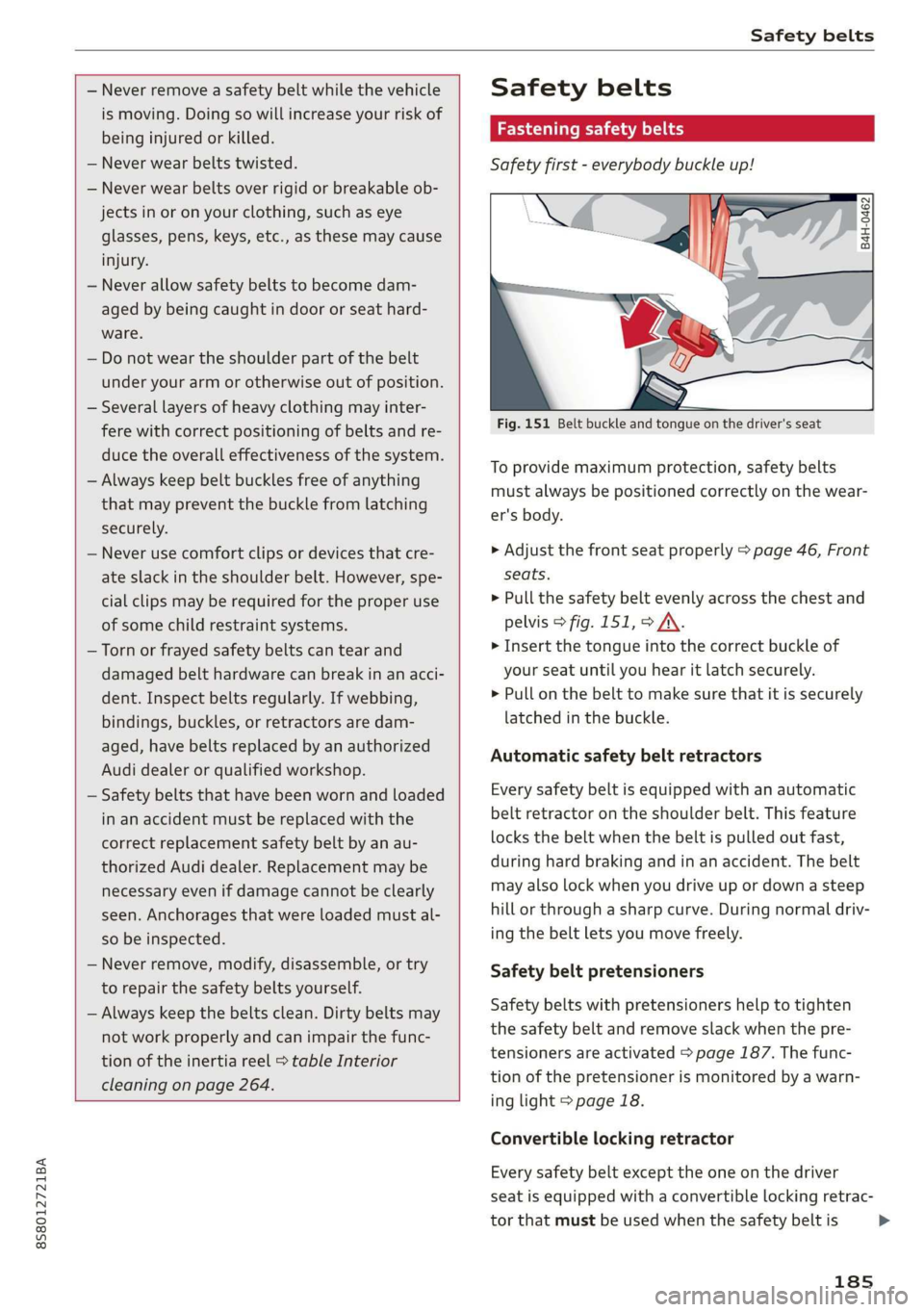
Fig. 151 Belt buckle and tongue on the driver's seat
To provide maximum protection, safety belts
must always be positioned correctly on the wear-
er's body.
> Adjust the front seat properly > page 46, Front
seats.
> Pull the safety belt evenly across the chest and
pelvis > fig. 151, > A\.
> Insert the tongue into the correct buckle of
your seat until you hear it latch securely.
> Pull on the belt to make sure that it is securely
latched in the buckle.
Automatic safety belt retractors
Every safety belt is equipped with an automatic
belt retractor on the shoulder belt. This feature
locks the belt when the belt is pulled out fast,
during hard braking and in an accident. The belt
may also lock when you drive up or down a steep
hill or through a sharp curve. During normal driv-
ing the belt lets you move freely.
Safety belt pretensioners
Safety belts with pretensioners help to tighten
the safety belt and remove slack when the pre-
tensioners are activated > page 187. The func-
tion of the pretensioner is monitored by a warn-
ing light > page 18.
Convertible locking retractor
Every safety belt except the one on the driver
seat is equipped with a convertible locking retrac-
tor that must be used when the safety belt is
185
>
Page 195 of 304
8S58012721BA
Airbag system
Front airbags
pyre al eee mice a TLeey-le (4
The airbag system can provide supplemental
protection to properly restrained front seat occu-
pants.
= x 2
z 6
BFV-0063
iff i
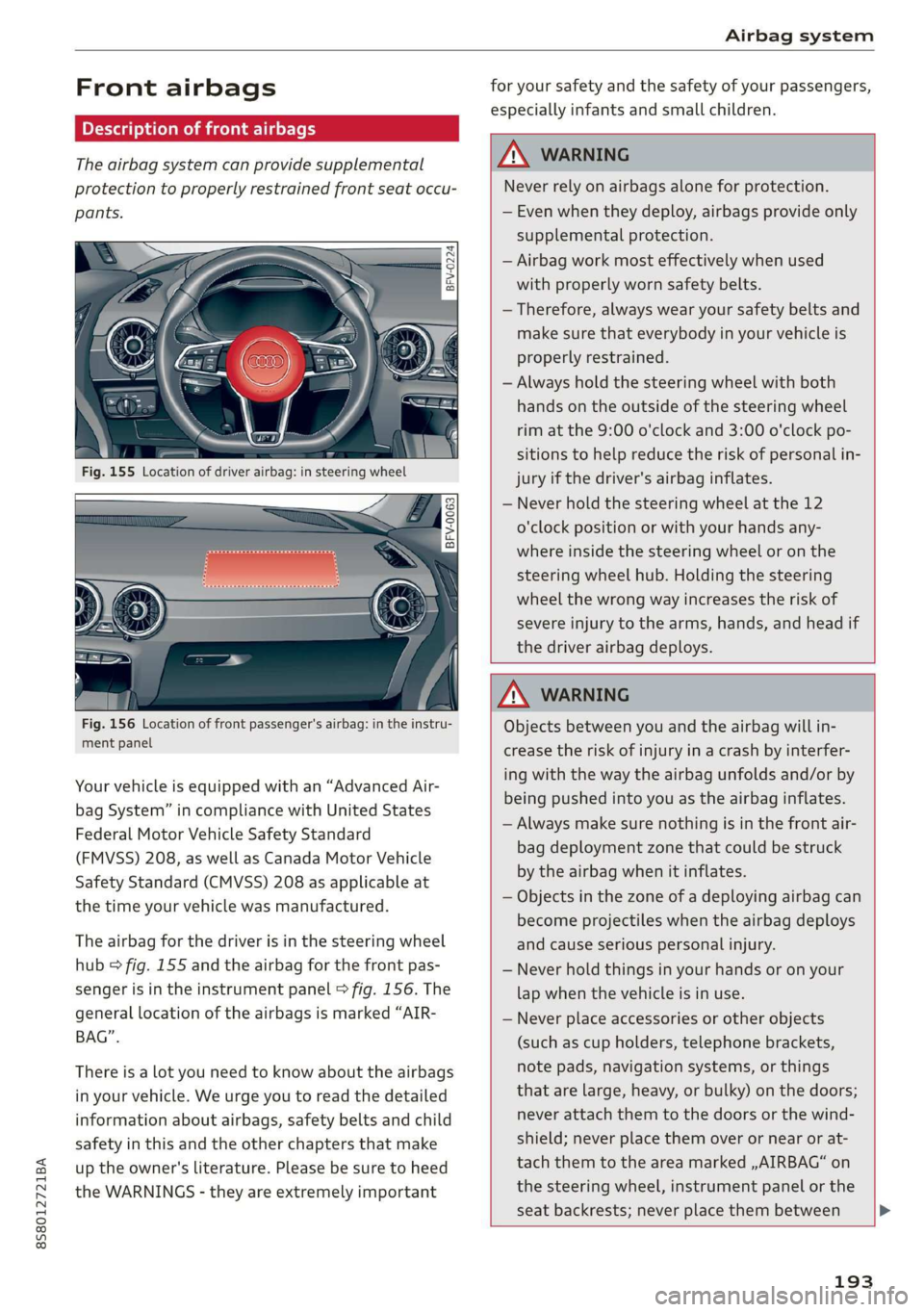
Fig. 156 Location of front passenger's airbag: in the instru-
ment panel
Your vehicle is equipped with an “Advanced Air-
bag System” in compliance with United States
Federal Motor Vehicle Safety Standard
(FMVSS) 208, as well as Canada Motor Vehicle
Safety Standard (CMVSS) 208 as applicable at
the time your vehicle was manufactured.
The airbag for the driver is in the steering wheel
hub > fig. 155 and the airbag for the front pas-
senger is in the instrument panel © fig. 156. The
general location of the airbags is marked “AIR-
BAG”.
There is a lot you need to know about the airbags
in your vehicle. We urge you to read the detailed
information about airbags, safety belts and child
safety in this and the other chapters that make
up the owner's literature. Please be sure to heed
the WARNINGS - they are extremely important
for your safety and the safety of your passengers,
especially infants and small children.
ZA\ WARNING
Never rely on airbags alone for protection.
— Even when they deploy, airbags provide only
supplemental protection.
— Airbag work most effectively when used
with properly worn safety belts.
— Therefore, always wear your safety belts and
make sure that everybody in your vehicle is
properly restrained.
— Always hold the steering wheel with both
hands on the outside of the steering wheel
rim at the 9:00 o'clock and 3:00 o'clock po-
sitions to help reduce the risk of personal in-
jury if the driver's airbag inflates.
— Never hold the steering wheel at the 12
o'clock position or with your hands any-
where inside the steering wheel or on the
steering wheel hub. Holding the steering
wheel the wrong way increases the risk of
severe injury to the arms, hands, and head if
the driver airbag deploys.
ZA\ WARNING
Objects between you and the airbag will in-
crease the risk of injury in a crash by interfer-
ing with the way the airbag unfolds and/or by
being pushed into you as the airbag inflates.
— Always make sure nothing is in the front air-
bag deployment zone that could be struck
by the airbag when it inflates.
— Objects in the zone of a deploying airbag can
become projectiles when the airbag deploys
and cause serious personal injury.
— Never hold things in your hands or on your
lap when the vehicle is in use.
— Never place accessories or other objects
(such as cup holders, telephone brackets,
note pads, navigation systems, or things
that are large, heavy, or bulky) on the doors;
never attach them to the doors or the wind-
shield; never place them over or near or at-
tach them to the area marked ,,AIRBAG“ on
the steering wheel, instrument panel or the
seat backrests; never place them between
193
Page 218 of 304
Child safety
— Never install a rearward facing child safety
seat on the front passenger seat unless the
PASSENGER AIR BAG OFF 3%; light comes
on and stays on. If the PASSENGER AIR
BAG OFF #¥; light does not come on and stay
on the inflating airbag will hit the child safe-
ty seat or infant carrier with great force and
will smash the child safety seat and child
against the backrest, center armrest, door
or roof. Have the airbag system inspected
immediately by your Audi dealer.
— Never place or use any electrical device
(such as a laptop, CD player, electronic
games device, power inverter or seat heater
for child seats) on the front passenger seat
if the device is connected to the 12-volt
socket or the cigarette lighter socket.
— If a seat heater has been retrofitted or oth-
erwise added to the front passenger seat,
never install any child restraint system on
this seat.
— Make sure that there are no wet objects
(such as a wet towel) and no water or other
liquids on the front passenger seat cushion.
— Never place objects on the seat (such as a
laptop, CD player, electronic games device,
power inverter or seat heater for child
seats). These may influence the electrical
capacitance measured by the capacitive pas-
senger detection system and can also fly
around in an accident and cause serious per-
sonal injury.
— Always read and heed all WARNINGS when-
ever using a child restrained in a vehicle is
being used > page 182, Safety belts,
=> page 189, Airbag system and > page 210,
Important information.
216
Convertible child safety seats
Properly used convertible child safety seats can
help protect toddlers and children over age one
who weigh between 20 and 40 lbs (9 and 18 kg)
inacrash.
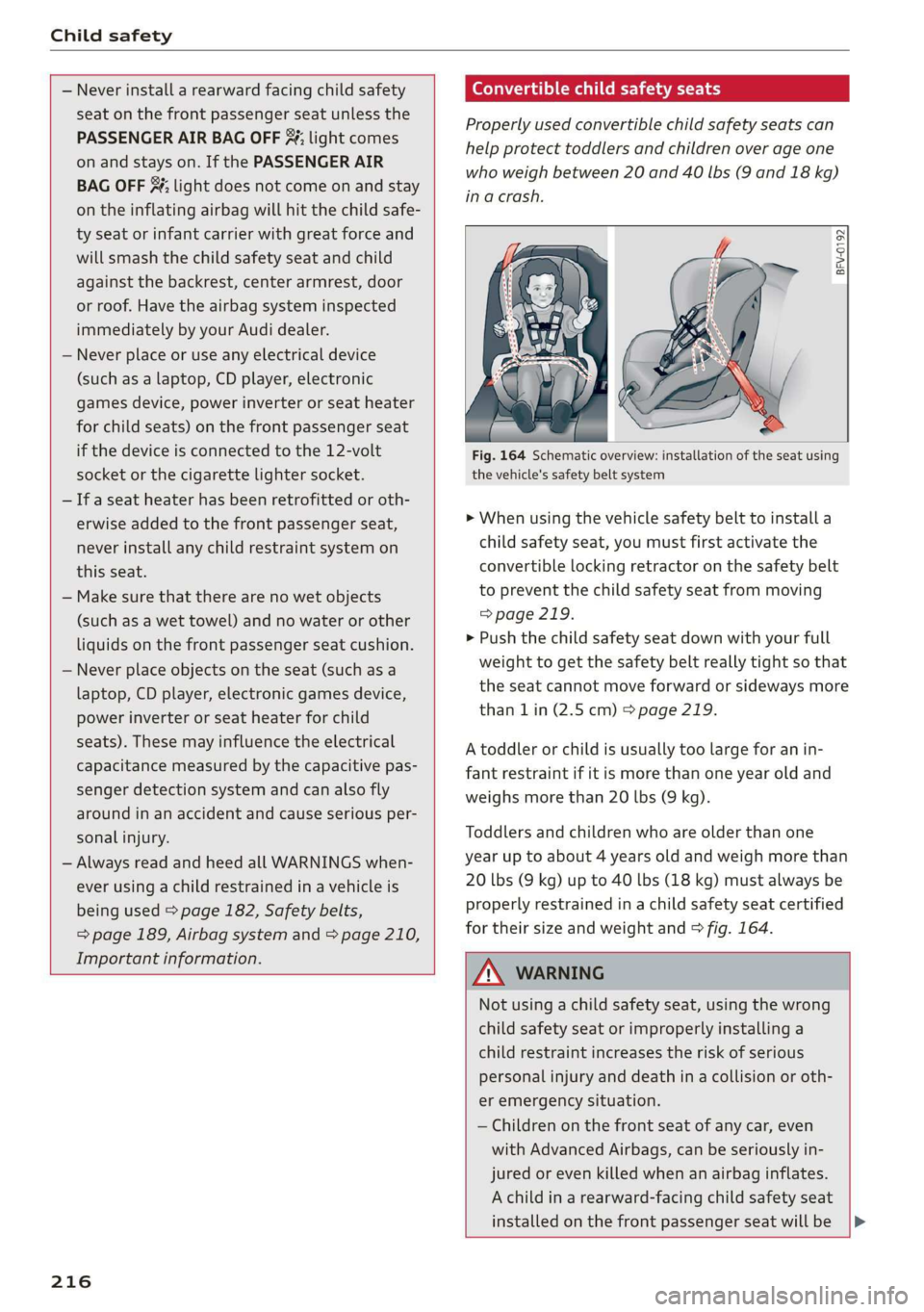
BFV-0192
Fig. 164 Schematic overview: installation of the seat using
the vehicle's safety belt system
> When using the vehicle safety belt to install a
child safety seat, you must first activate the
convertible locking retractor on the safety belt
to prevent the child safety seat from moving
> page 219.
> Push the child safety seat down with your full
weight to get the safety belt really tight so that
the seat cannot move forward or sideways more
than 1 in (2.5 cm) > page 219.
A toddler or child is usually too large for an in-
fant restraint if it is more than one year old and
weighs more than 20 lbs (9 kg).
Toddlers and children who are older than one
year up to about 4 years old and weigh more than
20 lbs (9 kg) up to 40 Lbs (18 kg) must always be
properly restrained in a child safety seat certified
for their size and weight and > fig. 164.
Z\ WARNING
Not using a child safety seat, using the wrong
child safety seat or improperly installing a
child restraint increases the risk of serious
personal injury and death in a collision or oth-
er emergency situation.
— Children on the front seat of any car, even
with Advanced Airbags, can be seriously in-
jured or even killed when an airbag inflates.
A child in a rearward-facing child safety seat
installed on the front passenger seat willbe |>
Page 221 of 304
8S8012721BA
Child safety
— Children on the front seat of any car, even
with Advanced Airbags, can be seriously in-
jured or even killed when an airbag inflates.
— Never let a child stand or kneel on the seat.
— Never let a child ride in the cargo area of
your vehicle.
— Always remember that a child leaning for-
ward, sitting sideways or out of position in
any way during an accident can be struck by
a deploying airbag. This will result in serious
personal injury or death.
— If you must install a booster seat on the
front passenger seat because of exceptional
circumstances the PASSENGER AIR BAG
OFF %; light must come on and stay on,
whenever the ignition is switched on.
— If the PASSENGER AIR BAG OFF 3%; light
does not come on and stay on, perform the
checks described > page 200, Monitoring
the Advanced Airbag System.
— If the PASSENGER AIR BAG OFF %; light
does not come on and stay on whenever the
ignition is switched on the inflating airbag
will hit the child safety seat or infant carrier
with great force and will smash the child
safety seat and child against the backrest,
center armrest, door or roof. Have the air-
bag system inspected immediately by your
Audi dealer.
— Always read and heed all WARNINGS when-
ever using a child restrained in a vehicle is
being used > page 182, Safety belts,
=> page 189, Airbag system and > page 210,
Important information.
Securing child safety
seats
Securing a child safety seat using a safety
Py i3
Safety belts for the front passenger can be
locked with the convertible locking retractor to
properly secure child safety seats.
The safety belt emergency locking retractor for
the front passenger’s seat safety belt have a con-
vertible locking retractor for child restraints. The
safety belt must be locked so that belt webbing
cannot unreel. The retractor can be activated to
lock the safety belt and prevent the safety belt
webbing from loosening up during normal driv-
ing. A child safety seat can only be properly in-
stalled when the safety belt is locked so that the
child and child safety seat will stay in place.
Always remember: Even though your vehicle is
equipped with an Advanced Airbag system, a
child should always ride in the seat properly re-
strained for its age and size.
ZA\ WARNING
Improperly installed child safety seats in-
crease the risk of serious personal injury and
death in a collision.
— Always make sure that the safety belt retrac-
tor is locked when installing a child safety
seat. An unlocked safety belt retractor can-
not hold the child safety seat in place during
normal driving or in a crash.
— Always buckle the child safety seat firmly in
place even if a child is not sitting in it. A
loose child safety seat can fly around during
a sudden stop or ina collision.
— If the backrest is not securely latched, the
child and the child restraint will be thrown
forward together with the backrest and will
strike parts of the vehicle interior. The child
can be seriously injured or killed.
— The inflating airbag will hit the child safety
seat or infant carrier with great force and
will smash the child safety seat and child
against the backrest, center armrest, door
or roof.
— Forward-facing child safety seats or infant
carriers installed on the front passenger's
seat may interfere with the deployment of
the airbag and cause serious injury to the
child.
— Always read and heed all WARNINGS when-
ever using a child restrained in a vehicle is
being used > page 210. Special precautions
apply when installing a child safety seat on
the front passenger seat > page 190, Child
restraints on the front seat - some impor-
tant things to know.
219
Page 222 of 304
Child safety
ZA WARNING
Always take special precautions if you must
install a forward or rearward-facing child re-
straint on the front passenger's seat in excep-
tional situations:
— Whenever a forward or rearward-facing
child restraint is installed on the front pas-
senger seat, the PASSENGER AIR BAG OFF
#; light must come on and stay on whenever
the ignition is switched on.
— If the PASSENGER AIR BAG OFF %; light
does not come on and stay on, perform the
checks described > page 200, Monitoring
the Advanced Airbag System.
— If the PASSENGER AIR BAG OFF %; light
does not come on and stay on whenever the
ignition is switched on the inflating airbag
will hit the child safety seat or infant carrier
with great force and will smash the child
safety seat and child against the backrest,
center armrest, door or roof. Have the air-
bag system inspected immediately by your
Audi dealer.
— Improper installation of child restraints can
reduce their effectiveness or even prevent
them from providing any protection.
— An improperly installed child restraint can
interfere with the airbag as it deploys and
seriously
injure or even kill the child.
— Always carefully follow the manufacturer's
instructions provided with the child safety
seat or carrier.
— After checking to make sure that the child
restraint is properly installed, make certain
that the child restraint is correctly recog-
nized by the capacitive passenger detection
system in the front passenger seat and that
the PASSENGER AIR BAG OFF %; light sig-
nals the correct front passenger frontal air-
bag status.
A WARNING
Forward-facing child restraints:
— Always make sure the forward-facing seat
has been designed and certified by its manu-
facturer for use on a front seat with a pas-
senger front and side airbag.
220
— Never put the forward-facing child restraint
up, against or very near the instrument pan-
el,
— Always move the passenger seat into its
rearmost position in the seat's fore and aft
adjustment range, as far away from the air-
bag as possible before installing the for-
ward-facing child restraint. The backrest
must be adjusted to an upright position.
— Make sure that the PASSENGER AIR BAG
OFF #¥; light comes on and stays on all the
time whenever the ignition is switched on.
ZA WARNING
Rearward-facing child restraints:
—Achild in a rearward-facing child safety seat
installed on the front passenger seat will be
seriously injured and can be killed if the
front airbag inflates - even with an Ad-
vanced Airbag System.
— The inflating airbag will hit the child safety
seat or infant carrier with great force and
will smash the child safety seat and child
against the backrest, center armrest, door
or roof.
— Always be especially careful if you must in-
stall a rearward facing child safety seat on
the front passenger seat in exceptional cir-
cumstances.
— Make sure that the PASSENGER AIR BAG
OFF %; light comes on and stays on all the
time whenever the ignition is switched on.
— If the PASSENGER AIR BAG OFF #; light
does not come on and stay on, have the air-
bag system inspected by your Audi dealer.
Nae ee mama adl le Cole deme teeta
Use the convertible locking retractor to secure a
child restraint.
Always heed the child safety seat manufacturer's
instructions when installing a child restraint in
your vehicle. To activate the convertible locking
retractor:
> Place the child restraint on a seat.
> Slowly pull the belt all the way out.
Page 226 of 304

Checking and Filling
— Do not use any gasoline mixture whose
composition cannot be identified.
— Audi does not assume any responsibility for
damage to the fuel system or for perform-
ance problems caused by using gasoline
mixtures different from those specified.
This type of damage also does not fall under
the New Vehicle Limited Warranty or under
the emissions control system warranty.
— If you notice a higher fuel consumption or
poor handling or performance problems due
to such gasoline mixtures, we recommend
fueling with unblended gasoline.
Gasoline additives
An important issue for many automobile manu-
facturers is combustion residue in the engine
that results from the use of certain fuels.
Although types of gasoline differ depending on
the manufacturer, there are similarities. Certain
substances in the gasoline may cause deposits in
the engine. Additives in the gasoline that should
keep the engine and fuel system clean do not all
function equally.
Audi recommends using TOP TIER Detergent Gas-
oline. For additional information on TOP TIER De-
tergent Gasoline, visit www.toptiergas.com.
If you use incorrect fuels over a long period of
time, the maximum engine performance may be
impaired by combustion residue.
@) Note
Damage or malfunctions caused by the use of
incorrect types of gasoline are not covered by
the New Vehicle Limited Warranty.
224
Refueling
Fueling procedure
Your vehicle is equipped with a capless fuel filler
system.
BFV-0225
Fig. 166 Right rear side of the vehicle: opening the fuel
filler door
BFV-0226
__ . —|)
Fig. 167 Right rear side of the vehicle: fuel pump nozzle
inserted
The fuel filler door is unlocked or locked by the
central locking system.
> Press on the left side of the fuel filler door to
open it > fig. 166.
> Insert the fuel pump nozzle all the way into the
fuel tank filler neck > fig. 167. Make sure it is
seated correctly.
> Begin fueling. Once the fuel pump nozzle turns
off the first time, the fuel tank is full. Do not
continue fueling, or else the expansion space in
the tank will be filled with fuel.
> After the fuel pump has switched off, wait five
seconds before removing the nozzle to allow
the rest of the fuel to finish dripping into the
fuel tank.
> Close the fuel filler door and then press on the
left side until it latches.