Page 468 of 632
4687-3. Do-it-yourself maintenance
YARIS_HV_OM_Europe_OM52J66E
Tire inflation pressure
■Effects of incorrect tire inflation pressure
Driving with incorrect tire inflation pressure may result in the following:
● Reduced fuel economy
● Reduced driving comfort and poor handling
● Reduced tire life due to wear
● Reduced safety
● Damage to the drive train
If a tire needs frequent inflating, have it checked by any authorized Toyota
retailer or Toyota authorized repairer, or any reliable repairer.
■ Instructions for checking tire inflation pressure
When checking tire inflation pressure, observe the following:
● Check only when the tires are cold.
If your vehicle has been parked for at least 3 hours or has not been driven
for more than 1.5 km or 1 mile, you will get an accurate cold tire inflation
pressure reading.
● Always use a tire pressure gauge.
It is difficult to judge if a tire is properly inflated based only on its appear-
ance.
● It is normal for the tire inflation pressure to be higher after driving as heat is
generated in the tire. Do not reduce tire inflation pressure after driving.
Make sure to maintain proper tire inflation pressure. Tire infla-
tion pressure should be checked at least once per month. How-
ever, Toyota recommends that tire inflation pressure be checked
once every two weeks. ( P. 598)
Page 469 of 632
4697-3. Do-it-yourself maintenance
7
Maintenance and care
YARIS_HV_OM_Europe_OM52J66E
WARNING
■Proper inflation is critical to save tire performance
Keep your tires properly inflated.
If the tires are not properly inflated, the following conditions may occur
which could lead to an accident resulting in death or serious injury:
● Excessive wear
● Uneven wear
● Poor handling
● Possibility of blowouts resulting from overheated tires
● Air leaking from between tire and wheel
● Wheel deformation and/or tire damage
● Greater possibility of tire damage while driving (due to road hazards,
expansion joints, sharp edges in the road, etc.)
NOTICE
■ When inspecting and adjusting tire inflation pressure
Be sure to put the tire valve caps back on.
If a valve cap is not installed, dirt or moisture may get into the valve and
cause an air leak, resulting in decreased tire inflation pressure.
Page 471 of 632
4717-3. Do-it-yourself maintenance
7
Maintenance and care
YARIS_HV_OM_Europe_OM52J66E
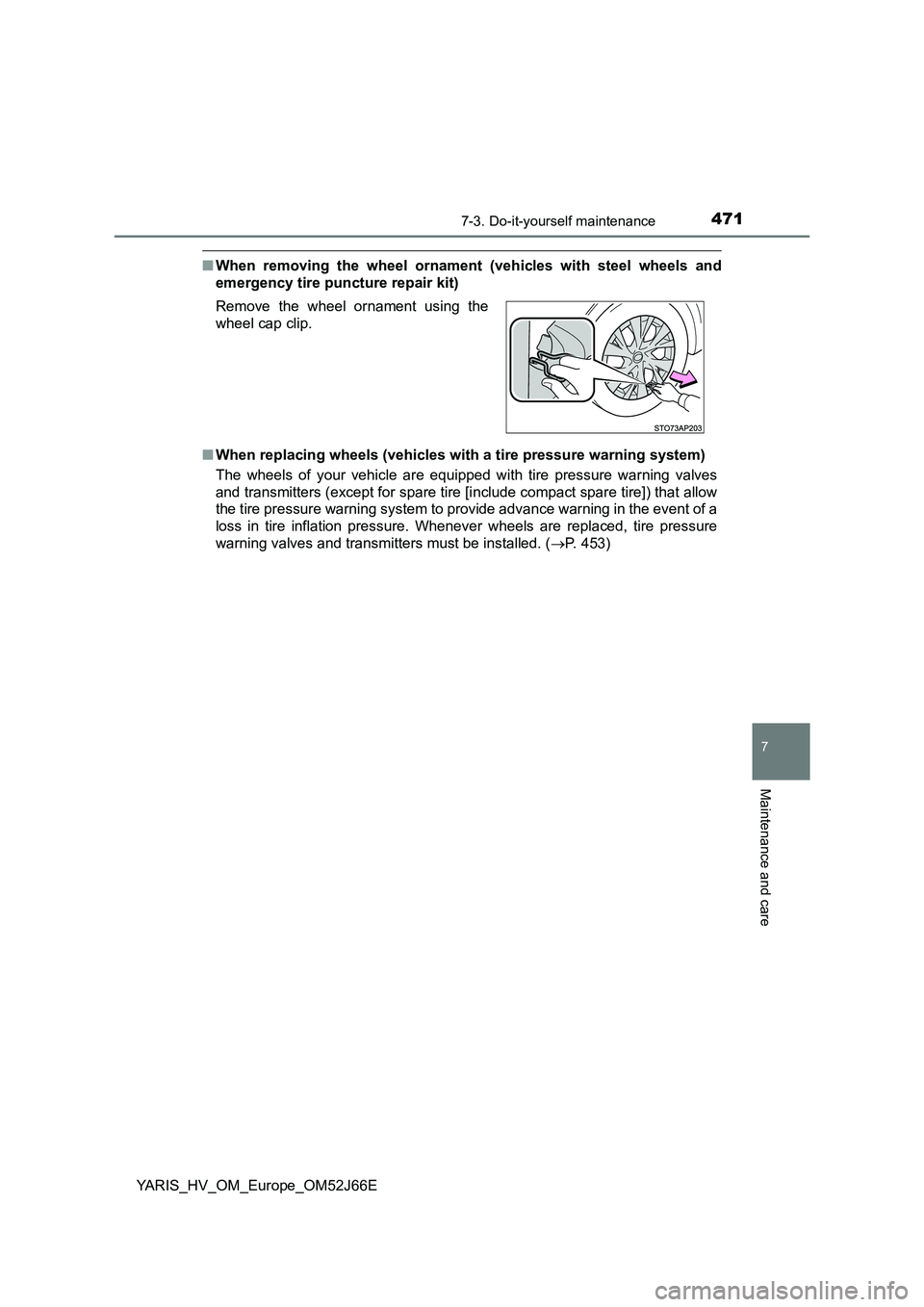
■When removing the wheel ornament (vehicles with steel wheels and
emergency tire puncture repair kit)
■ When replacing wheels (vehicles with a tire pressure warning system)
The wheels of your vehicle are equipped with tire pressure warning valves
and transmitters (except for spare tire [i nclude compact spare tire]) that allow
the tire pressure warning system to provide advance warning in the event of a
loss in tire inflation pressure. Whenever wheels are replaced, tire pressure
warning valves and transmitters must be installed. ( P. 453)
Remove the wheel ornament using the
wheel cap clip.
Page 522 of 632
5228-2. Steps to take in an emergency
YARIS_HV_OM_Europe_OM52J66E
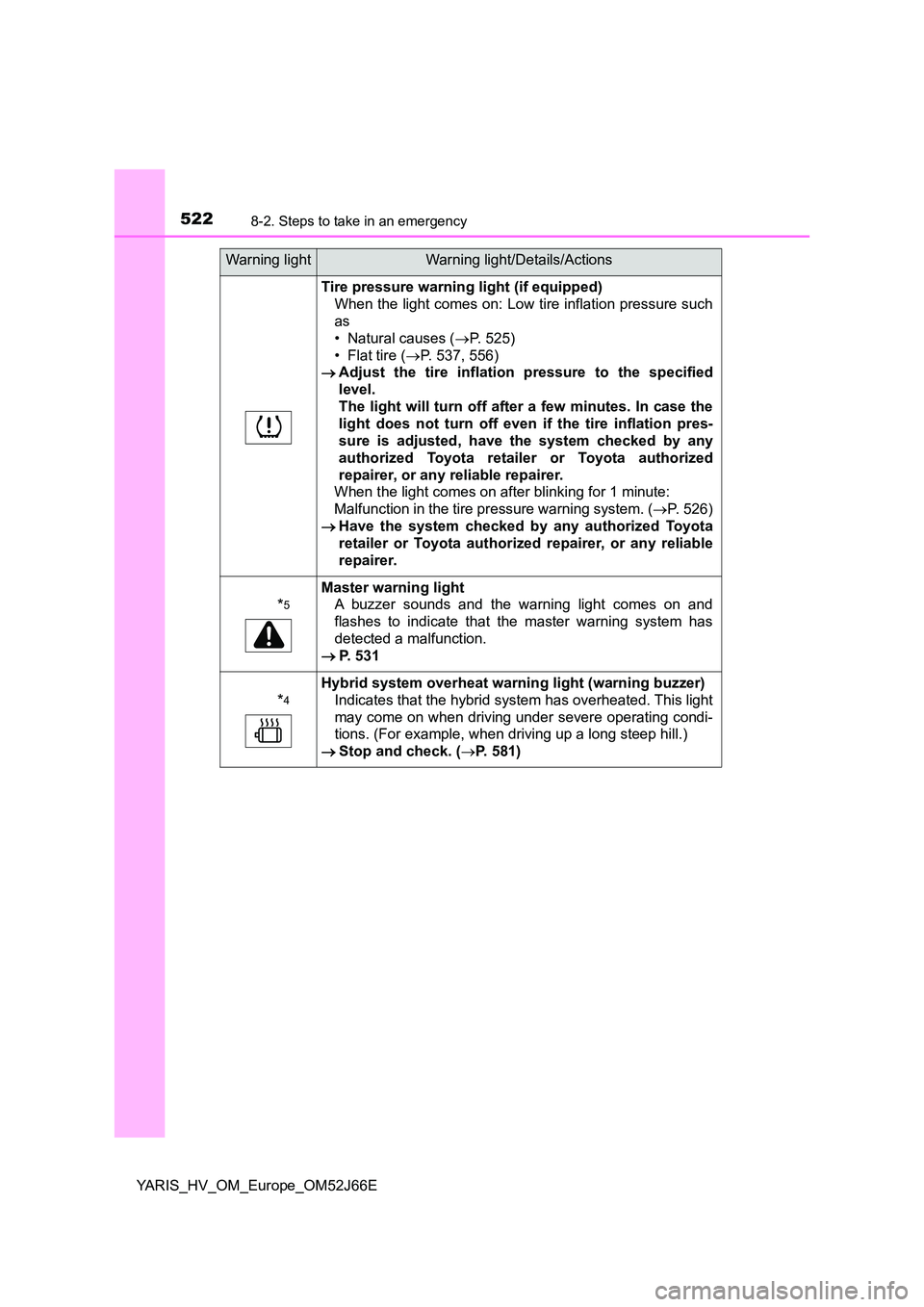
Tire pressure warning light (if equipped)
When the light comes on: Low tire inflation pressure such
as
• Natural causes ( P. 525)
• Flat tire ( P. 537, 556)
Adjust the tire inflation pressure to the specified
level.
The light will turn off after a few minutes. In case the
light does not turn off even if the tire inflation pres-
sure is adjusted, have the system checked by any
authorized Toyota retailer or Toyota authorized
repairer, or any reliable repairer.
When the light comes on after blinking for 1 minute:
Malfunction in the tire pressure warning system. ( P. 526)
Have the system checked by any authorized Toyota
retailer or Toyota authorized repairer, or any reliable
repairer.
*5
Master warning light
A buzzer sounds and the warning light comes on and
flashes to indicate that the master warning system has
detected a malfunction.
P. 531
*4
Hybrid system overheat warning light (warning buzzer)
Indicates that the hybrid system has overheated. This light
may come on when driving under severe operating condi-
tions. (For example, when driving up a long steep hill.)
Stop and check. (P. 581)
Warning lightWarning light/Details/Actions
Page 525 of 632
5258-2. Steps to take in an emergency
8
When trouble arises
YARIS_HV_OM_Europe_OM52J66E
■ Warning buzzer
In some cases, the buzzer may not be heard because of noisy place or an
audio sound.
■ Electric power steering system warning light (warning buzzer)
When the 12-volt battery charge becomes insufficient or the voltage tempo-
rarily drops, the electric power steering system warning light may come on
and the warning buzzer may sounds.
■ When the tire pressure warning light comes on (vehicles with a tire pres-
sure warning system)
Inspect the appearance of the tire to check that the tire is not punctured.
If the tire is punctured: P. 537, 556
If the tire is not punctured:
Carry out the following procedure after the tire temperature has lowered suffi-
ciently.
● Check the tire inflation pressure and adjust to the appropriate level.
● If the warning light does not go out even after several minutes, check that
the tire inflation pressure is at the specified level and carry out initialization.
The warning light may come on again if the above operations are conducted
without first allowing the tire temperature to lower sufficiently.
■ The tire pressure warning light may come on due to natural causes
(vehicles with a tire pressure warning system)
The tire pressure warning light may come on due to natural causes such as
natural air leaks and tire inflation pressure changes caused by temperature.
In this case, adjusting the tire inflation pressure will turn off the warning light
(after a few minutes).
■ When a tire is replaced with a spare tire (include compact spare tire)
(vehicles with a tire pressure warning system)
The spare tire (include compact spare tire) is not equipped with a tire pres-
sure warning valve and transmitter. If a tire goes flat, the tire pressure warn-
ing light will not turn off even though the flat tire has been replaced with the
spare tire. Replace the spare tire wi th the repaired tire and adjust the tire
inflation pressure. The tire pressure warning light will go off after a few min-
utes.
Page 527 of 632
5278-2. Steps to take in an emergency
8
When trouble arises
YARIS_HV_OM_Europe_OM52J66E
WARNING
■If both the ABS and the brake system warning lights remain on
Stop your vehicle in a safe place immediately and contact any authorized
Toyota retailer or Toyota authorized r epairer, or any reliable repairer. The
vehicle will become extremely unstable during braking, and the ABS system
may fail, which could cause an accident resulting in death or serious injury.
■ When the electric power steering system warning light comes on
The steering wheel may become extremely heavy.
If the steering wheel becomes heavier than usual when operating, hold
firmly and operate using more force than usual.
■ If the tire pressure warning light comes on (vehicles with a tire pres-
sure warning system)
Be sure to observe the following precautions. Failure to do so could cause a
loss of vehicle control and result in death or serious injury.
● Stop your vehicle in a safe place as soon as possible. Adjust the tire infla-
tion pressure immediately.
● Vehicles with spare tire: If the tire pressure warning light comes on even
after tire inflation pressure adjustment, it is probable that you have a flat
tire. Check the tires. If a tire is flat, change it with the spare tire and have
the flat tire repaired by the nearest any authorized Toyota retailer or Toyota
authorized repairer, or any reliable repairer.
● Vehicles with emergency tire puncture repair kit: If the tire pressure warn-
ing light comes on even after tire inflat ion pressure adjustment, it is proba-
ble that you have a flat tire. Check the tire s. If a tire is flat, repair the flat tire
by using emergency tire puncture repair kit. (P. 537)
● Avoid abrupt maneuvering and braking. If the vehicle tires deteriorate, you
could lose control of the steering wheel or the brakes.
■ If a blowout or sudden air leakage should occur (vehicles with a tire
pressure warning system)
The tire pressure warning system may not activate immediately.
Page 545 of 632
5458-2. Steps to take in an emergency
8
When trouble arises
YARIS_HV_OM_Europe_OM52J66E
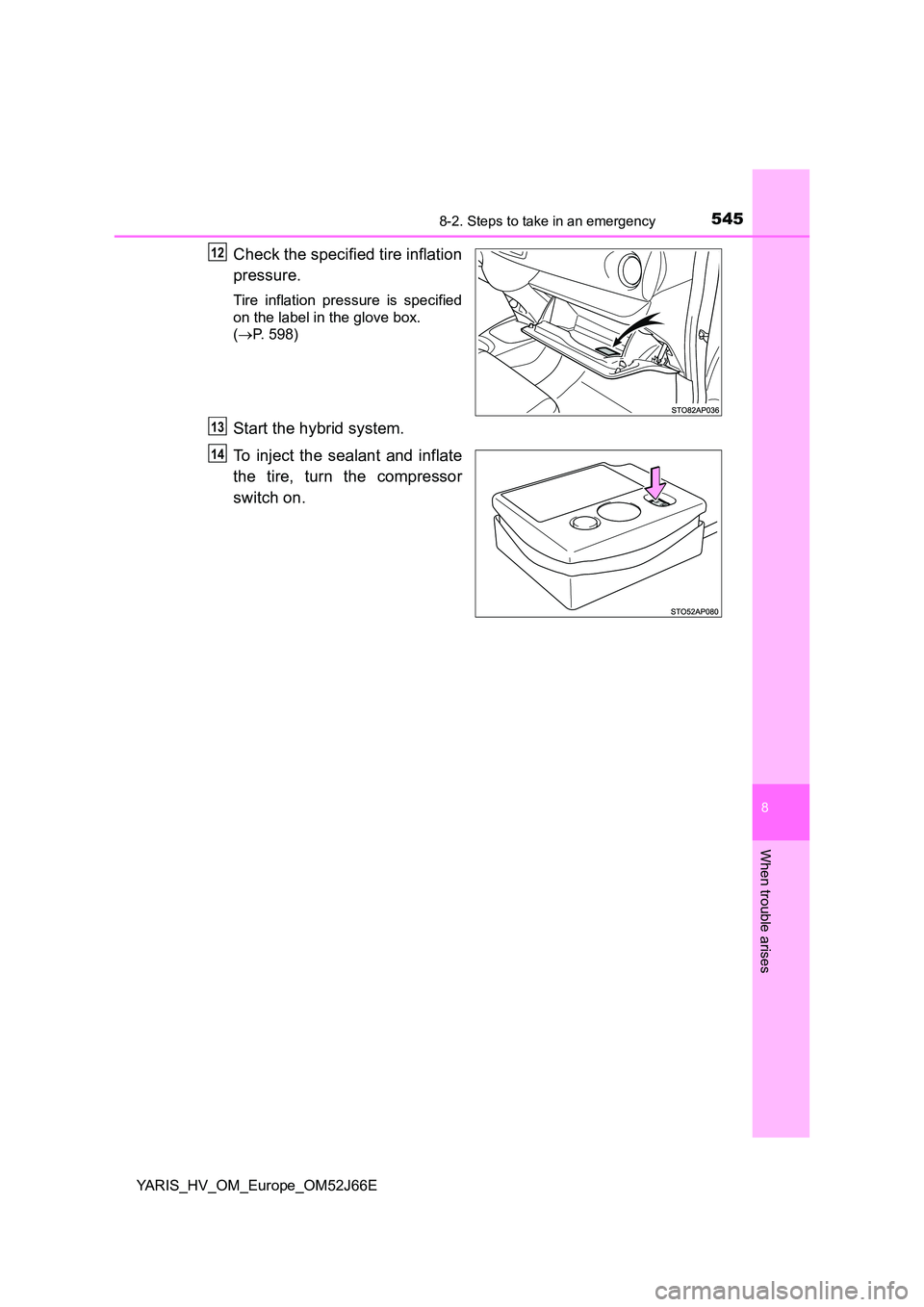
Check the specified tire inflation
pressure.
Tire inflation pressure is specified
on the label in the glove box.
( P. 598)
Start the hybrid system.
To inject the sealant and inflate
the tire, turn the compressor
switch on.
12
13
14
Page 546 of 632
5468-2. Steps to take in an emergency
YARIS_HV_OM_Europe_OM52J66E
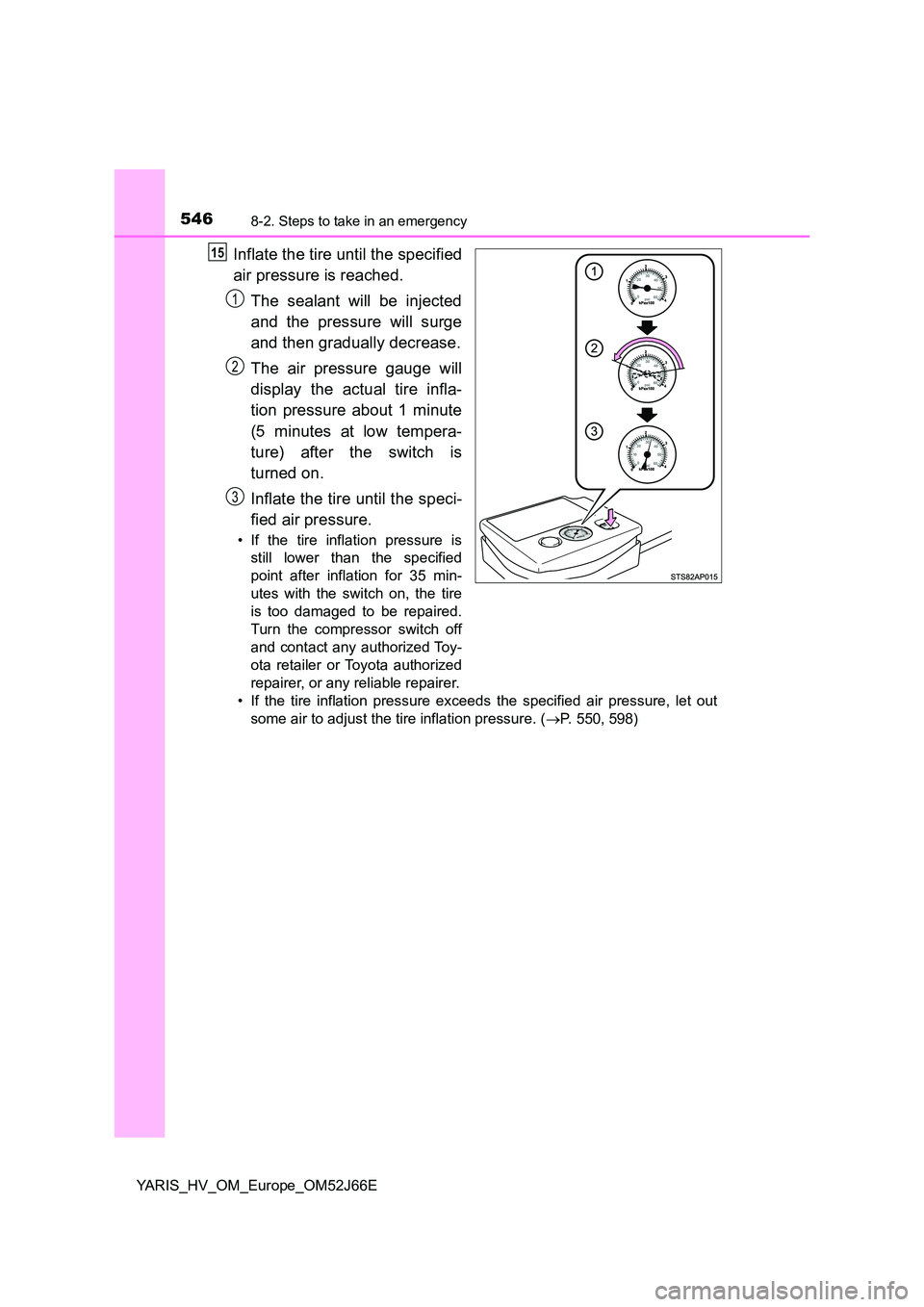
Inflate the tire until the specified
air pressure is reached.
The sealant will be injected
and the pressure will surge
and then gradually decrease.
The air pressure gauge will
display the actual tire infla-
tion pressure about 1 minute
(5 minutes at low tempera-
ture) after the switch is
turned on.
Inflate the tire until the speci-
fied air pressure.
• If the tire inflation pressure is
still lower than the specified
point after inflation for 35 min-
utes with the switch on, the tire
is too damaged to be repaired.
Turn the compressor switch off
and contact any authorized Toy-
ota retailer or Toyota authorized
repairer, or any reliable repairer.
• If the tire inflation pressure exceeds the specified air pressure, let out
some air to adjust the tire inflation pressure. ( P. 550,598)
15
1
2
3