2018 SUBARU WRX ESP
[x] Cancel search: ESPPage 506 of 578
(527,1)
北米Model "A1700BE-B" EDITED: 2017/ 10/ 11
CAUTION
.It is recommended that you dis-
connect the vehicle battery be-
fore replacing the brake pad.
However, it is dangerous to dis-
connect the vehicle battery. We
recommend that you have your
SUBARU dealer replace the brake
pad.
.If you continue to drive despite
the scraping noise from the audi-
ble brake pad wear indicator, it
will result in the need for costly
brake rotor repair or replace-
ment.&Breaking-in of new brake
pads (models with electronic
parking brake system)When replacing the brake pad, use only
genuine SUBARU parts. After replace-
ment, break in the new parts as follows.
!Brake pad
While maintaining a speed of 30 to 40 mph
(50 to 65 km/h), step on the brake pedal
lightly. Repeat this five or more times. Also,
apply and release the electronic parking
brake five or more times.
&Breaking-in of new brake
pads and linings (models
without electronic parking
brake system)When replacing the brake pad or lining,
use only genuine SUBARU parts. After
replacement, break in the new parts as
follows.
!Brake pad and lining
While maintaining a speed of 30 to 40 mph
(50 to 65 km/h), step on the brake pedal
lightly. Repeat this five or more times.
!Parking brake lining
1. Drive the vehicle at a speed of approxi-
mately 22 mph (35 km/h).
2. With the parking brake release button
pushed in, pull the parking brake lever
SLOWLY and GENTLY (pulling with a
force of approximately 33.7 lbf [150 N,
15.3 kgf]).
3. Drive the vehicle for approximately 220
yards (200 meters) in this condition.
4. Wait 5 to 10 minutes for the parking
brake to cool down. Repeat this proce-
dure.
5. Check the parking brake stroke. If the
parking brake stroke is out of the specified
range, adjust it by turning the adjusting nut
located on the parking brake lever.
Parking brake stroke:
7–8 notches / 45 lbf (200 N, 20.4 kgf)
WARNING
Select a safe location and situation
for break-in driving.
CAUTION
Pulling the parking brake lever too
forcefully may cause the rear wheels
to lock. To avoid this, be certain to
pull the lever up slowly and gently.
Maintenance and service/Replacement of brake pad and lining
11-29
11
Page 508 of 578

(529,1)
北米Model "A1700BE-B" EDITED: 2017/ 10/ 11
Low tire pressure warning lightIf you adjust the tire pressures in a warm
garage and will then drive the vehicle in
cold outside air, the resulting drop in tire
pressures may cause the low tire pressure
warning light to illuminate. To avoid this
problem when adjusting the tire pressures
in a warm garage, inflate the tires to
pressures higher than those shown on
the tire placard. Specifically, inflate them
by an extra 1 psi (6.9 kPa, 0.07 kgf/cm
2) for
every difference of 108F (5.68C) between
the temperature in the garage and the
temperature outside. By way of example,
the following table shows the required tire
pressures that correspond to various out-
side temperatures when the temperature
in the garage is 608F (15.68C).Example:
Tire size: 245/40R18 97W
Standard tire pressures:
Front: 33 psi (230 kPa, 2.3 kgf/cm
2)
Rear: 32 psi (220 kPa, 2.2 kgf/cm2)
Garage temperature: 608F (15.68C)
Outside
temperatureAdjusted pressure
[psi (kPa, kgf/cm
2)]
Front Rear
308F(18C) 36 (250, 2.5) 35 (240, 2.4)
108F(128C) 38 (260, 2.6) 37 (255, 2.55)
108F(238C) 40 (275, 2.75)39 (270, 2.7)
If the low tire pressure warning light
illuminates when you drive the vehicle in
cold outside air after adjusting the tire
pressures in a warm garage, re-adjust the
tire pressures using the method described
above. Then, increase the vehicle speed
to at least 20 mph (32 km/h) and check to
see that the low tire pressure warning light
turns off a few minutes later. If the low tire
pressure warning light does not turn off,
the tire pressure monitoring system may
not be functioning normally. In this event,
go to a SUBARU dealer to have the
system inspected as soon as possible.
While the vehicle is driven, friction be-
tween tires and the road surface causes
the tires to warm up. After illumination ofthe low tire pressure warning light, any
increase in the tire pressures caused by an
increase in the outside air temperature or
by an increase in the temperature in the
tires can cause the low tire pressure
warning light to turn off.
System resetting is necessary when the
wheels are changed (for example, a switch
to snow tires) and new TPMS valves are
installed on the newly fitted wheels. Have
this work performed by a SUBARU dealer
following wheel replacement.
It may not be possible to install TPMS
valves on certain wheels that are on the
market. Therefore, if you change the
wheels (for example, a switch to snow
tires), use wheels that have the same part
number as the standard-equipment
wheels. Without four operational TPMS
valve/sensors on the wheels, the TPMS
will not fully function and the warning light
on the combination meter will illuminate
steadily after blinking for approximately
one minute.
When a tire is replaced, adjustments are
necessary to ensure continued normal
operation of the tire pressure monitoring
system. As with wheel replacement, there-
fore, you should have the work performed
by a SUBARU dealer.
–CONTINUED–
Maintenance and service/Tires and wheels
11-31
11
Page 510 of 578
(531,1)
北米Model "A1700BE-B" EDITED: 2017/ 10/ 11
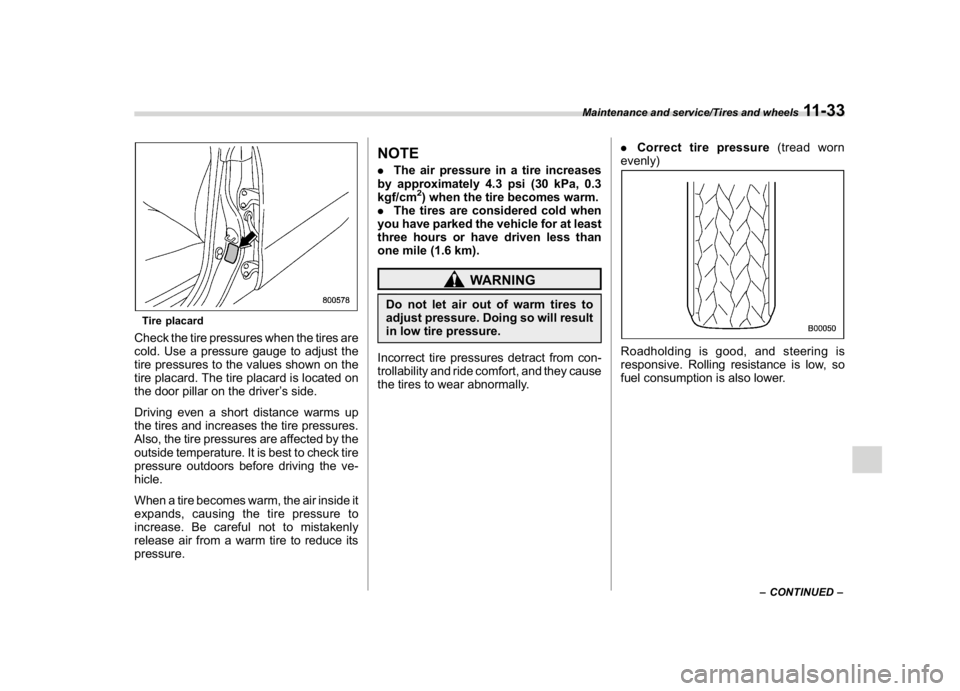
Tire placardCheck the tire pressures when the tires are
cold. Use a pressure gauge to adjust the
tire pressures to the values shown on the
tire placard. The tire placard is located on
the door pillar on the driver’s side.
Driving even a short distance warms up
the tires and increases the tire pressures.
Also, the tire pressures are affected by the
outside temperature. It is best to check tire
pressure outdoors before driving the ve-
hicle.
When a tire becomes warm, the air inside it
expands, causing the tire pressure to
increase. Be careful not to mistakenly
release air from a warm tire to reduce its
pressure.
NOTE.The air pressure in a tire increases
by approximately 4.3 psi (30 kPa, 0.3
kgf/cm
2) when the tire becomes warm.
.The tires are considered cold when
you have parked the vehicle for at least
three hours or have driven less than
one mile (1.6 km).
WARNING
Do not let air out of warm tires to
adjust pressure. Doing so will result
in low tire pressure.
Incorrect tire pressures detract from con-
trollability and ride comfort, and they cause
the tires to wear abnormally..Correct tire pressure(tread worn
evenly)
Roadholding is good, and steering is
responsive. Rolling resistance is low, so
fuel consumption is also lower.
–CONTINUED–
Maintenance and service/Tires and wheels
11-33
11
Page 553 of 578

(578,1)
北米Model "A1700BE-B" EDITED: 2017/ 10/ 11
.
Extra load tire
A tire designed to operate at higher
loads and higher inflation pressure
than the corresponding standard
tire..
Groove
The space between two adjacent
tread ribs..
Innerliner
The layer(s) forming the inside sur-
face of a tubeless tire that contains
the inflating medium within the tire..
Innerliner separation
The parting of the innerliner from
cord material in the carcass..
Intended outboard sidewall(1)
The sidewall that contains a
whitewall, bears white lettering
or bears manufacturer, brand,
and/or model name molding that
is higher or deeper than the
same molding on the other side-
wall of the tire, or
(2)
The outward facing sidewall
of an asymmetrical tire that has a
particular side that must always
face outward when mounting ona vehicle.
.
Light truck (LT) tire
A tire designated by its manufac-
turer as primarily intended for use
on lightweight trucks or multipur-
pose passenger vehicles..
Load rating
The maximum load that a tire is
rated to carry for a given inflation
pressure..
Maximum inflation pressure
The maximum cold inflation pres-
sure to which a tire may be inflated..
Maximum load rating
The load rating for a tire at the
maximum permissible inflation
pressure for that tire..
Maximum loaded vehicle weight
The sum of:
(a)
Curb weight
(b)
Accessory weight
(c)
Vehicle capacity weight
(d)
Production options weight
.
Maximum permissible inflation
pressure
The maximum cold inflation pres-
sure to which a tire may be inflated.
.
Measuring rim
The rim on which a tire is fitted for
physical dimension requirements..
Normal occupant weight
150 lbs (68 kg) times the number of
occupants specified in the second
column of Table 1 that is appended
to the end of this section..
Occupant distribution
Distribution of occupants in a vehi-
cle as specified in the third column
of Table 1 that is appended to the
end of this section..
Open splice
Any parting at any junction of tread,
sidewall, or innerliner that extends
to cord material..
Outer diameter
The overall diameter of an inflated
new tire..
Overall width
The linear distance between the
exteriors of the sidewalls of an
inflated tire, including elevations
due to labeling, decorations, or
protective bands or ribs.
Consumer information and Reporting safety defects/Tire information
13-6
Page 554 of 578

(579,1)
北米Model "A1700BE-B" EDITED: 2017/ 10/ 11
.
Passenger car tire
A tire intended for use on passen-
ger cars, multipurpose passenger
vehicles, and trucks, that have a
gross vehicle weight rating (GVWR)
of 10,000 lbs (4,535 kg) or less..
Ply
A layer of rubber-coated parallel
cords..
Ply separation
A parting of rubber compound
between adjacent plies..
Pneumatic tire
A mechanical device made of rub-
ber, chemicals, fabric and steel or
other materials, that, when
mounted on an automotive wheel,
provides the traction and contains
the gas or fluid that sustains the
load..
Production options weight
The combined weight of those
installed regular production options
weighing over 5.1 lbs (2.3 kg) in
excess of those standard items
which they replace, not previously
considered in curb weight or acces-sory weight, including heavy duty
brakes, ride levelers, roof rack,
heavy duty battery, and special trim.
.
Radial ply tire
A pneumatic tire in which the ply
cords that extend to the beads are
laid at substantially 90 degrees to
the centerline of the tread..
Recommended inflation pres-
sure
The cold inflation pressure recom-
mended by a vehicle manufacturer..
Reinforced tire
A tire designed to operate at higher
loads and at higher inflation pres-
sures than the corresponding stan-
dard tire..
Rim
A metal support for a tire or a tire
and tube assembly upon which the
tire beads are seated..
Rim diameter
Nominal diameter of the bead seat..
Rim size designation
Rim diameter and width.
.
Rim type designation
The industry of manufacturer’s des-
ignation for a rim by style or code..
Rim width
Nominal distance between rim
flanges..
Section width
The linear distance between the
exteriors of the sidewalls of an
inflated tire, excluding elevations
due to labeling, decoration, or pro-
tective bands..
Sidewall
That portion of a tire between the
tread and bead..
Sidewall separation
The parting of the rubber compound
from the cord material in the side-
wall..
Test rim
The rim on which a tire is fitted for
testing, and it may be any rim listed
as appropriate for use with that tire..
Tread
That portion of a tire that comes into
contact with the road.
–CONTINUED–
Consumer information and Reporting safety defects/Tire information
13-7
13
Page 563 of 578
(588,1)
北米Model "A1700BE-B" EDITED: 2017/ 10/ 11
grade C corresponds to a level of
performance which all passenger
car tires must meet under the
Federal Motor Vehicle Safety Stan-
dard No. 109. Grades B and A
represent higher levels of perfor-
mance on the laboratory test wheel
than the minimum required by law.
WARNING
The temperature grade for this
tire is established for a tire that
is properly inflated and not
overloaded. Excessive speed,
underinflation, or excessive
loading, either separately or
in combination, can cause
heat buildup and possible tire
failure.
Reporting safety defects
(U.S.A.)If you believe that your vehicle has
a defect which could cause a crash
or could cause injury or death, you
should immediately inform the Na-
tional Highway Traffic Safety Ad-
ministration (NHTSA) in addition to
notifying Subaru of America, Inc.
If NHTSA receives similar com-
plaints, it may open an investiga-
tion, and if it finds that a safety
defect exists in a group of vehicles,
it may order a recall and remedy
campaign. However, NHTSA can-
not become involved in individual
problems between you, your deal-
er, or Subaru of America, Inc. To
contact NHTSA, you may call the
Vehicle Safety Hotline toll-free at
1-888-327-4236 (TTY: 1-800-424-
9153); go to http://www.safercar.
gov; or write to: Administrator,
NHTSA, 1200 New Jersey Ave-
nue, SE, West Building, Washing-ton, DC 20590. You can also
obtain other information about mo-
tor vehicle safety from http://www.
safercar.gov.
Consumer information and Reporting safety defects/Reporting safety defects (U.S.A.)
13-16