2018 SUBARU WRX torque
[x] Cancel search: torquePage 377 of 578

(390,1)
北米Model "A1700BE-B" EDITED: 2017/ 10/ 11
3. Remove the grip portion of the screw-
driver.4. While depressing the brake pedal,
insert a screwdriver into the hole, press
the shift lock release button using a
screwdriver, and then move the selectlever.
If the select lever does not move after
performing the above procedure, the shift
lock system may be malfunctioning. Con-
tact a SUBARU dealer for an inspection as
soon as possible.
&Driving tips
NOTEIf the accelerator and brake pedals are
depressed at the same time, driving
torque may be restrained. This is not a
malfunction.
.Always apply the foot or parking brake
when the vehicle is stopped in the“D”or
“R”position.
.Make sure to apply the parking brake
when parking your vehicle. Do not hold the
vehicle with only the mechanical friction of
the transmission.
.Do not keep the vehicle in a stationary
position on an uphill grade by using the“D”
position. Use the brake instead.
.The engine may, on rare occasions,
knock when the vehicle rapidly acceler-
ates or rapidly pulls away from a standstill.
This phenomenon does not indicate a
malfunction.
SI-DRIVE (if equipped)SI-DRIVE (SUBARU Intelligent Drive)
works to maximize engine performance,
control and efficiency.
This system consists of three modes:
.Intelligent (I) mode
.Sport (S) mode
.Sport Sharp (S#) mode
By adjusting the SI-DRIVE selector, the
character of the power unit changes.&Intelligent (I) mode!For smooth, efficient performance
drivingThe Intelligent (I) mode provides well-
balanced performance with greater fuel
Starting and operating/SI-DRIVE
7-28
Page 388 of 578
(401,1)
北米Model "A1700BE-B" EDITED: 2017/ 10/ 11
system unable to operate correctly.&Vehicle Dynamics Control
system monitorRefer to“Vehicle Dynamics Control warn-
ing light/Vehicle Dynamics Control opera-
tion indicator light”F3-26 and“Vehicle
Dynamics Control OFF indicator light/
Traction mode indicator light /”F3-27.&Vehicle Dynamics Control
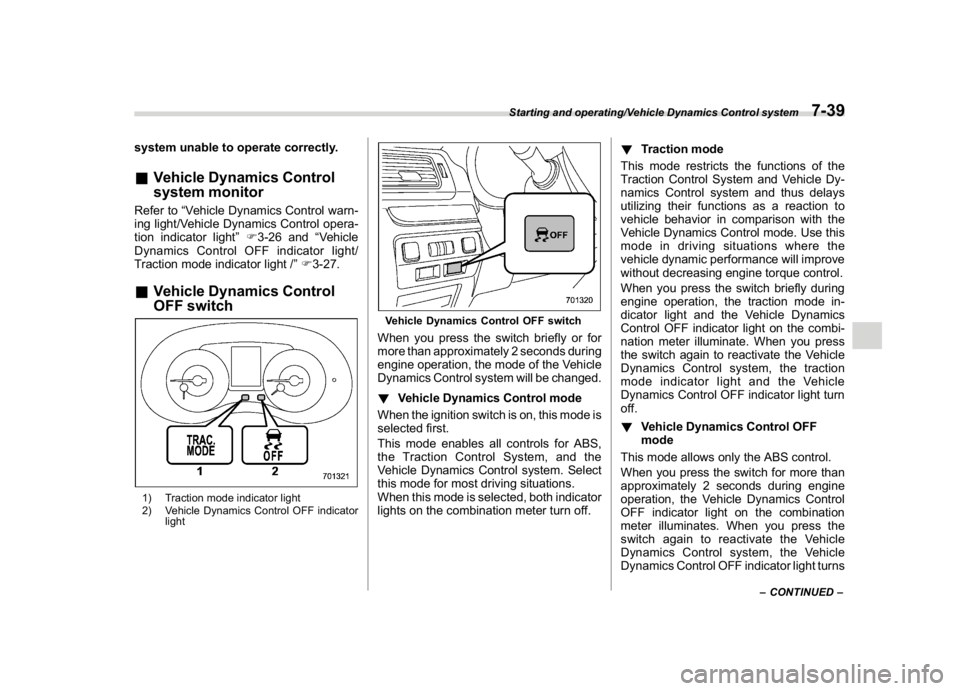
OFF switch1) Traction mode indicator light
2) Vehicle Dynamics Control OFF indicator
light
Vehicle Dynamics Control OFF switchWhen you press the switch briefly or for
more than approximately 2 seconds during
engine operation, the mode of the Vehicle
Dynamics Control system will be changed.
!Vehicle Dynamics Control mode
When the ignition switch is on, this mode is
selected first.
This mode enables all controls for ABS,
the Traction Control System, and the
Vehicle Dynamics Control system. Select
this mode for most driving situations.
When this mode is selected, both indicator
lights on the combination meter turn off.!Traction mode
This mode restricts the functions of the
Traction Control System and Vehicle Dy-
namics Control system and thus delays
utilizing their functions as a reaction to
vehicle behavior in comparison with the
Vehicle Dynamics Control mode. Use this
mode in driving situations where the
vehicle dynamic performance will improve
without decreasing engine torque control.
When you press the switch briefly during
engine operation, the traction mode in-
dicator light and the Vehicle Dynamics
Control OFF indicator light on the combi-
nation meter illuminate. When you press
the switch again to reactivate the Vehicle
Dynamics Control system, the traction
mode indicator light and the Vehicle
Dynamics Control OFF indicator light turn
off.
!Vehicle Dynamics Control OFF
mode
This mode allows only the ABS control.
When you press the switch for more than
approximately 2 seconds during engine
operation, the Vehicle Dynamics Control
OFF indicator light on the combination
meter illuminates. When you press the
switch again to reactivate the Vehicle
Dynamics Control system, the Vehicle
Dynamics Control OFF indicator light turns
–CONTINUED–
Starting and operating/Vehicle Dynamics Control system
7-39
7
Page 421 of 578

(434,1)
北米Model "A1700BE-B" EDITED: 2017/ 10/ 11
Medium and close proximity alert (ap-
proaching the object and approaching
closer to the object)
1) Orange: 20 to 28 inches (50 to 70 cm)
2) Yellow: 28 to 35 inches (70 to 90 cm)
Closest proximity alert (too close to the
object)
1) Red: 20 inches (50 cm) or lessWhen an object is detected in the rever-
sing direction, the range of detected object
will be shown on the multi-function display
(color LCD).
A warning alarm will sound and, depend-
ing on the speed, either torque control to
generate engine braking or automatic
braking will be applied.!Object close behind warning
Automatic braking warningIf the vehicle continues to go in reverse,
the system may determine the risk of
collision with the object. In this case, short
warning beeps or continuous warning
beeps will sound and either strong auto-
matic braking or torque control will be
applied to prevent collision.
At this time, a warning message is also
displayed on the combination meter dis-
play (color LCD).
Starting and operating/Reverse Automatic Braking System
7-72
Page 440 of 578
(455,1)
北米Model "A1700BE-B" EDITED: 2017/ 10/ 11
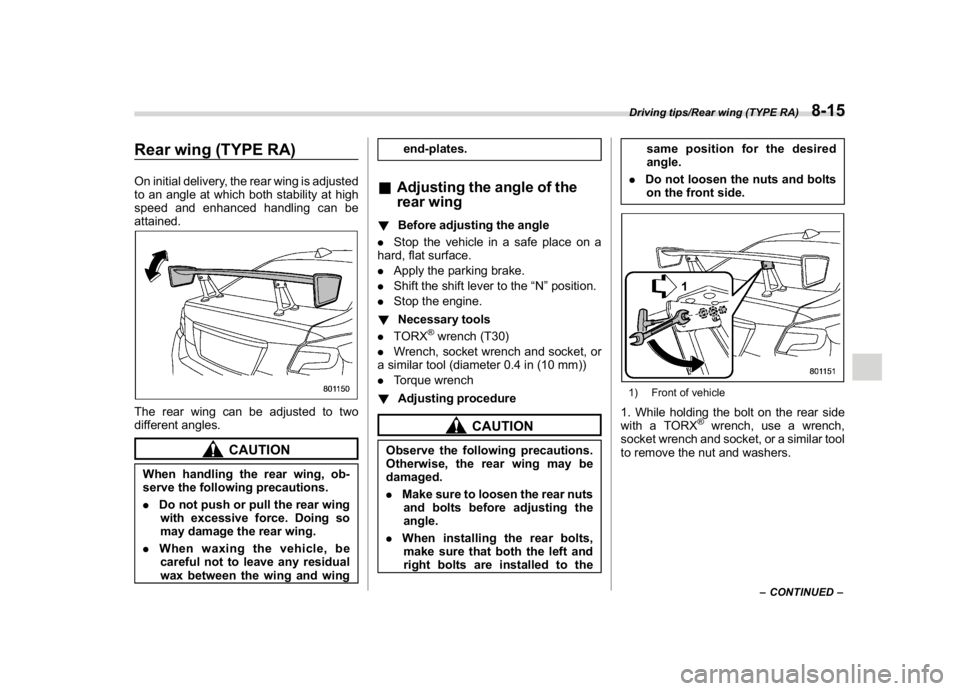
Rear wing (TYPE RA)On initial delivery, the rear wing is adjusted
to an angle at which both stability at high
speed and enhanced handling can be
attained.The rear wing can be adjusted to two
different angles.
CAUTION
When handling the rear wing, ob-
serve the following precautions.
.Do not push or pull the rear wing
with excessive force. Doing so
may damage the rear wing.
.When waxing the vehicle, be
careful not to leave any residual
wax between the wing and wingend-plates.
&Adjusting the angle of the
rear wing!Before adjusting the angle
.Stop the vehicle in a safe place on a
hard, flat surface.
.Apply the parking brake.
.Shift the shift lever to the“N”position.
.Stop the engine.
!Necessary tools
.TORX
®wrench (T30)
.Wrench, socket wrench and socket, or
a similar tool (diameter 0.4 in (10 mm))
.Torque wrench
!Adjusting procedure
CAUTION
Observe the following precautions.
Otherwise, the rear wing may be
damaged.
.Make sure to loosen the rear nuts
and bolts before adjusting the
angle.
.When installing the rear bolts,
make sure that both the left and
right bolts are installed to thesame position for the desired
angle.
.Do not loosen the nuts and bolts
on the front side.
1) Front of vehicle1. While holding the bolt on the rear side
with a TORX
®
wrench, use a wrench,
socket wrench and socket, or a similar tool
to remove the nut and washers.
–CONTINUED–
Driving tips/Rear wing (TYPE RA)
8-15
8
Page 441 of 578
(456,1)
北米Model "A1700BE-B" EDITED: 2017/ 10/ 11
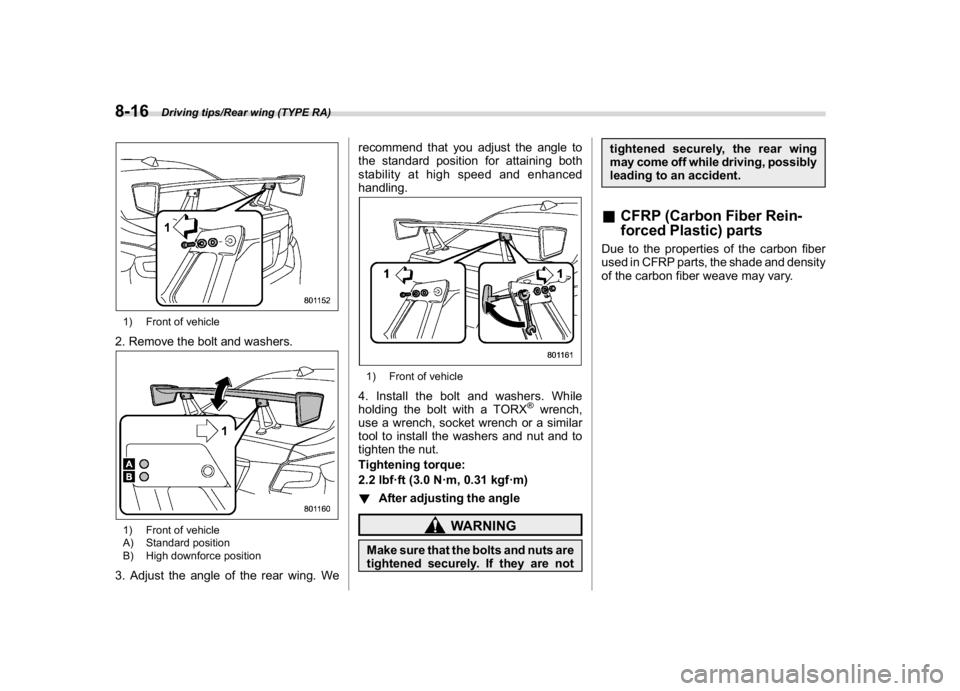
1) Front of vehicle2. Remove the bolt and washers.1) Front of vehicle
A) Standard position
B) High downforce position3. Adjust the angle of the rear wing. Werecommend that you adjust the angle to
the standard position for attaining both
stability at high speed and enhanced
handling.
1) Front of vehicle4. Install the bolt and washers. While
holding the bolt with a TORX
®wrench,
use a wrench, socket wrench or a similar
tool to install the washers and nut and to
tighten the nut.
Tightening torque:
2.2 lbf·ft (3.0 N·m, 0.31 kgf·m)
!After adjusting the angle
WARNING
Make sure that the bolts and nuts are
tightened securely. If they are nottightened securely, the rear wing
may come off while driving, possibly
leading to an accident.
&CFRP (Carbon Fiber Rein-
forced Plastic) partsDue to the properties of the carbon fiber
used in CFRP parts, the shade and density
of the carbon fiber weave may vary.
Driving tips/Rear wing (TYPE RA)
8-16
Page 444 of 578

(461,1)
北米Model "A1700BE-B" EDITED: 2017/ 10/ 11
may occur.
The temporary spare tire is smaller and
lighter than a conventional tire and is
designed for emergency use only. Re-
move the temporary spare tire and re-
install the conventional tire as soon as
possible because the spare tire is de-
signed only for temporary use.
Check the inflation pressure of the tem-
porary spare tire periodically to keep the
tire ready for use. For the correct tire
pressure, refer to“Temporary spare tires”
F12-9.
When using the temporary spare tire, note
the following.
.Drive with caution when temporary
spare tire is fitted. Avoid hard acceleration
and braking, or fast cornering, as control of
the vehicle may be lost.
.Do not exceed 50 mph (80 km/h).
.Do not put a tire chain on the temporary
spare tire. Because of the smaller tire size,
a tire chain will not fit properly.
.Do not use two or more temporary
spare tires at the same time.
.Do not drive over obstacles. This tire
has a smaller diameter, so road clearance
is reduced.
1) Tread wear indicator bar
2) Indicator location mark.When the wear indicator appears on
the tread, replace the tire.
.The temporary spare tire must be used
only on a rear wheel. If a front wheel tire
gets punctured, replace the wheel with a
rear wheel and install the temporary spare
tire in place of the removed rear wheel.
.Always set the driver’s control center
differential to the manual mode and adjust
the initial LSD torque to the minimum.
Maintenance toolsYour vehicle is equipped with the following
maintenance tools.
.Jack
.Jack handle
.Screwdriver
.Towing hook (eye bolt)
.Wheel nut wrench
–CONTINUED–
In case of emergency/Maintenance tools
9-3
9
Page 449 of 578
(466,1)
北米Model "A1700BE-B" EDITED: 2017/ 10/ 11
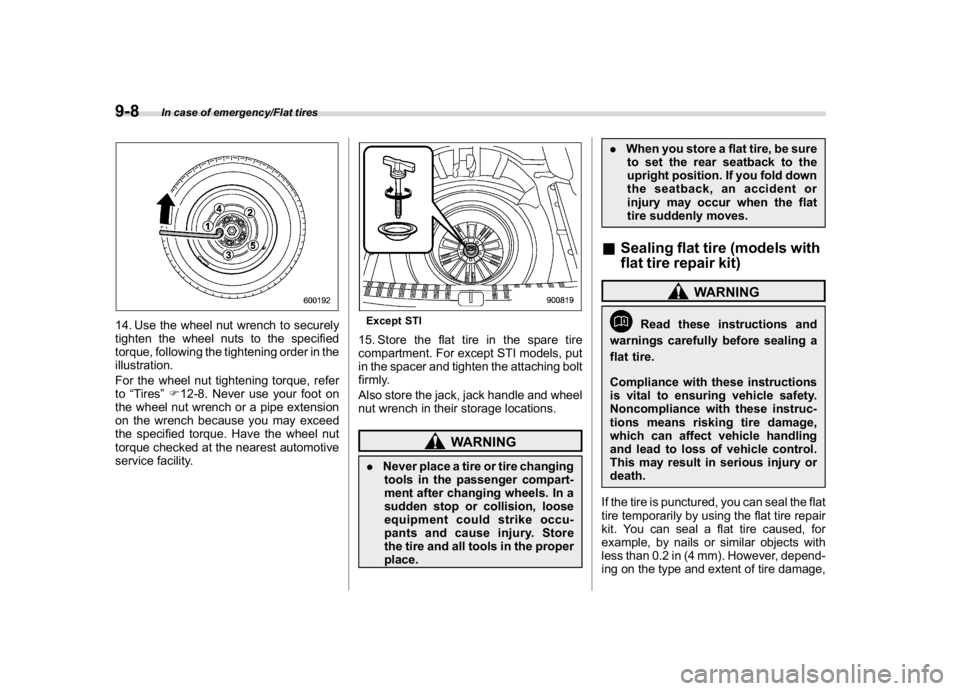
14. Use the wheel nut wrench to securely
tighten the wheel nuts to the specified
torque, following the tightening order in the
illustration.
For the wheel nut tightening torque, refer
to“Tires”F12-8. Never use your foot on
the wheel nut wrench or a pipe extension
on the wrench because you may exceed
the specified torque. Have the wheel nut
torque checked at the nearest automotive
service facility.
Except STI15. Store the flat tire in the spare tire
compartment. For except STI models, put
in the spacer and tighten the attaching bolt
firmly.
Also store the jack, jack handle and wheel
nut wrench in their storage locations.
WARNING
.Never place a tire or tire changing
tools in the passenger compart-
ment after changing wheels. In a
sudden stop or collision, loose
equipment could strike occu-
pants and cause injury. Store
the tire and all tools in the proper
place..When you store a flat tire, be sure
to set the rear seatback to the
upright position. If you fold down
the seatback, an accident or
injury may occur when the flat
tire suddenly moves.
&Sealing flat tire (models with
flat tire repair kit)
WARNING
Read these instructions and
warnings carefully before sealing a
flat tire.
Compliance with these instructions
is vital to ensuring vehicle safety.
Noncompliance with these instruc-
tions means risking tire damage,
which can affect vehicle handling
and lead to loss of vehicle control.
This may result in serious injury or
death.
If the tire is punctured, you can seal the flat
tire temporarily by using the flat tire repair
kit. You can seal a flat tire caused, for
example, by nails or similar objects with
less than 0.2 in (4 mm). However, depend-
ing on the type and extent of tire damage,
In case of emergency/Flat tires
9-8
Page 514 of 578
(535,1)
北米Model "A1700BE-B" EDITED: 2017/ 10/ 11
WARNING
.When replacing or installing
tire(s), all four tires must be the
same for the following items.
(a) Size
(b) Circumference
(c) Speed symbol
(d) Load index
(e) Construction
(f) Manufacturer
(g) Brand (tread pattern)
(h) Degrees of wear
For items (a) to (d), you must
obey the specification that is
printed on the tire placard. The
tire placard is located on the
driver’s door pillar.
If all four tires are not the same in
items (a) to (h), there is a possi-
bility that it may lead to serious
mechanical damage to the drive
train of your car and affect the
following factors.
—Ride
—Handling
—Braking—Speedometer/Odometer
calibration
—Clearance between the body
and the tires
It also may be dangerous and
lead to loss of vehicle control,
and it can lead to an accident.
.Use only radial tires. Do not use
radial tires together with belted
bias tires and/or bias-ply tires.
Doing so can dangerously re-
duce controllability, resulting in
an accident.
&Wheel replacementWhen replacing wheels due, for example,
to damage, make sure the replacement
wheels match the specifications of the
wheels that are fitted as standard equip-
ment. Replacement wheels are available
from SUBARU dealers.
WARNING
Use only those wheels that are
specified for your vehicle. Wheels
not meeting specifications could
interfere with brake caliper opera-
tion and may cause the tires to rub
against the wheel well housing dur-ing turns. The resulting loss of
vehicle control could lead to an
accident.
NOTEWhen any of the wheels are removed
and replaced for tire rotation or to
change a flat tire, always check the
tightness of the wheel nuts after driving
approximately 600 miles (1,000 km). If
any nut is loose, tighten it to the
specified torque.
Maintenance and service/Tires and wheels
11-37
11