2018 SUBARU WRX tire type
[x] Cancel search: tire typePage 435 of 578

(450,1)
北米Model "A1700BE-B" EDITED: 2017/ 10/ 11
tion, brand and load range and you should
never mix radial, belted bias or bias tires
since this may result in dangerous hand-
ling characteristics. When you choose a
tire, make sure that there is enough
clearance between the tire and vehicle
body.
Remember to drive with care at all times
regardless of the type of tires on your
vehicle.&Tire chains
CAUTION
You cannot use tire chains on your
vehicle because of the lack of clear-
ance between the tires and vehicle
body.NOTEEven though you cannot use tire
chains, use of another type of traction
device (such as spring chains) may be
acceptable if use on your vehicle is
recommended by the device manufac-
turer, taking into account tire size and
road conditions. Follow the device
manufacturer’s instructions, especially
regarding maximum vehicle speed.
To help avoid damage to your vehicle,drive slowly, readjust or remove the
device if it is contacting your vehicle,
and do not spin your wheels. Damage
caused to your vehicle by use of a
traction device is not covered under
warranty.
Make certain that any traction device
you use is an SAE class S device, and
use it on the front wheels only. Always
use the utmost care when driving with a
traction device. Overconfidence be-
cause you are using a traction device
could easily lead to a serious accident.
&Rocking the vehicleIf you must rock the vehicle to free it from
snow, sand, or mud, depress the accel-
erator pedal slightly and move the shift
lever/select lever back and forth between
“1”/“D”and“R”repeatedly. Do not race the
engine. For the best possible traction,
avoid spinning the wheels when trying to
free the vehicle.
When the road surface is extremely
slippery, you can obtain better traction by
starting the vehicle with the transmission in
2nd than in 1st (MT models and CVT
models).
If your vehicle is a CVT model, for
information about holding the transmissionin the 2nd position, refer to“Selection of
manual mode”F7-25.
Driving tips/Winter driving
8-10
Page 449 of 578
(466,1)
北米Model "A1700BE-B" EDITED: 2017/ 10/ 11
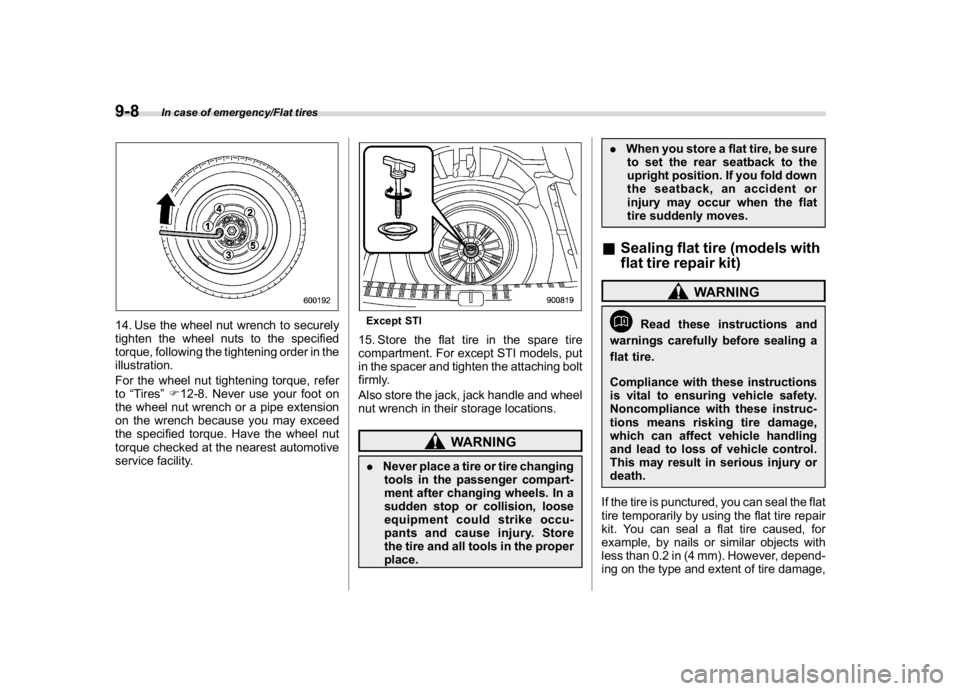
14. Use the wheel nut wrench to securely
tighten the wheel nuts to the specified
torque, following the tightening order in the
illustration.
For the wheel nut tightening torque, refer
to“Tires”F12-8. Never use your foot on
the wheel nut wrench or a pipe extension
on the wrench because you may exceed
the specified torque. Have the wheel nut
torque checked at the nearest automotive
service facility.
Except STI15. Store the flat tire in the spare tire
compartment. For except STI models, put
in the spacer and tighten the attaching bolt
firmly.
Also store the jack, jack handle and wheel
nut wrench in their storage locations.
WARNING
.Never place a tire or tire changing
tools in the passenger compart-
ment after changing wheels. In a
sudden stop or collision, loose
equipment could strike occu-
pants and cause injury. Store
the tire and all tools in the proper
place..When you store a flat tire, be sure
to set the rear seatback to the
upright position. If you fold down
the seatback, an accident or
injury may occur when the flat
tire suddenly moves.
&Sealing flat tire (models with
flat tire repair kit)
WARNING
Read these instructions and
warnings carefully before sealing a
flat tire.
Compliance with these instructions
is vital to ensuring vehicle safety.
Noncompliance with these instruc-
tions means risking tire damage,
which can affect vehicle handling
and lead to loss of vehicle control.
This may result in serious injury or
death.
If the tire is punctured, you can seal the flat
tire temporarily by using the flat tire repair
kit. You can seal a flat tire caused, for
example, by nails or similar objects with
less than 0.2 in (4 mm). However, depend-
ing on the type and extent of tire damage,
In case of emergency/Flat tires
9-8
Page 479 of 578

(500,1)
北米Model "A1700BE-B" EDITED: 2017/ 10/ 11
Parking brake stroke (models without
electronic parking brake system)................... 11-30
Tires and wheels................................................. 11-30
Types of tires...................................................... 11-30
Tire pressure monitoring system (TPMS)
(if equipped)..................................................... 11-30
Tire inspection.................................................... 11-32
Tire pressures and wear...................................... 11-32
Wheel balance.................................................... 11-34
Wear indicators................................................... 11-35
Rotational direction of tires................................. 11-35
Tire rotation........................................................ 11-36
Tire replacement................................................. 11-36
Wheel replacement............................................. 11-37
Alloy wheels........................................................ 11-38
Windshield washer fluid..................................... 11-38
Replacement of wiper blades............................ 11-39
Windshield wiper blade assembly........................ 11-40
Windshield wiper blade rubber............................ 11-40
Battery................................................................. 11-41Fuses....................................................................11-42
Installation of accessories..................................11-44
Replacing bulbs...................................................11-44
Headlights (models with LED headlights)............ 11-44
High beam headlight
(models without LED headlights)..................... 11-44
Low beam headlight*, front side marker light,
parking light* and front turn signal light*......... 11-46
Front turn signal light
(models with LED headlights).......................... 11-48
Front fog light
(models with the LED front fog light)............... 11-48
Front fog light (models without the LED front
fog light) (if equipped)..................................... 11-49
Rear combination lights...................................... 11-49
License plate light.............................................. 11-50
Other bulbs........................................................ 11-51
Replacing battery................................................11-51
Safety precautions.............................................. 11-51
Replacing battery of access key fob................... 11-52
Replacing transmitter battery.............................. 11-53
Maintenance and service
Page 483 of 578

(504,1)
北米Model "A1700BE-B" EDITED: 2017/ 10/ 11
Maintenance tipsSome clips and fender linings must be
removed before replacing the air cleaner
elements or specific bulbs.&Removing and reinstalling
clips!Removing clips
There are several types of clips used for
your vehicle.
!Type A clips1. Turn the clips counterclockwise using
a flat-head screwdriver until the center
portion of the clip is raised.
2. Remove the clips with a flat-head
screwdriver using leverage.3. Remove the entire clip by pulling it up.
!Type B clips
!Type C clips
1. Pull out the center portion of the clipusing a flat-head screwdriver as shown in
the illustration.
2. Pull the protruded center portion to
remove the entire body of the clip.
!Type D clips
1. Turn the clip counterclockwise using a
Phillips screwdriver until the center portion
of the clip is raised.
2. Remove the entire clip by pulling it up.
Maintenance and service/Maintenance tips
11-6
Page 484 of 578

(505,1)
北米Model "A1700BE-B" EDITED: 2017/ 10/ 11
!Type E clips
1. Push the center portion of the clip
using a Phillips screwdriver until the clip is
raised.
2. Remove the entire clip by pulling it up.!Type F clips
1. Pull out the head of the clip using a flat-
head screwdriver as shown in the illustra-
tion.
2. Remove the entire clip by pulling it up.!Reinstalling clips
!Type A clips
!Type B clips
–CONTINUED–
Maintenance and service/Maintenance tips
11-7
11
Page 507 of 578

(528,1)
北米Model "A1700BE-B" EDITED: 2017/ 10/ 11
Parking brake stroke (models
without electronic parking
brake system)Check the parking brake stroke according
to the maintenance schedule in the“War-
ranty and Maintenance Booklet”.
When the parking brake is properly ad-
justed, braking power is fully applied by
pulling the lever up 7 to 8 notches gently
but firmly (approximately 45 lbf [200 N,
20.4 kgf]). If the parking brake lever stroke
is not within the specified range, have the
brake system checked and adjusted at
your SUBARU dealer.
Tires and wheels&Types of tiresYou should be familiar with type of tires
present on your vehicle.
!All season tires
All season tires are designed to provide an
adequate measure of traction, handling
and braking performance in year-round
driving including snowy and icy road
conditions. However all season tires do
not offer as much traction performance as
winter (snow) tires in heavy or loose snow
or on icy roads.
All season tires are identified by“ALL
SEASON”and/or“M+S”(Mud & Snow) on
the tire sidewall.
!Summer tires
Summer tires are high-speed capability
tires best suited for highway driving under
dry conditions.
Summer tires are inadequate for driving on
slippery roads such as on snow-covered or
icy roads.
If you drive your vehicle on snow-covered
or icy roads, we strongly recommend the
use of winter (snow) tires.
When installing winter tires, be sure to
replace all four tires.!Winter (snow) tires
Winter tires are best suited for driving on
snow-covered and icy roads. However
winter tires do not perform as well as
summer tires and all season tires on roads
other than snow-covered and icy roads.
&Tire pressure monitoring
system (TPMS) (if equipped)The tire pressure monitoring system pro-
vides the driver with a warning message by
sending a signal from a sensor that is
installed in each wheel when tire pressure
is severely low. The tire pressure monitor-
ing system will activate only when the
vehicle is driven. Also, this system may not
react immediately to a sudden drop in tire
pressure (for example, a blow-out caused
by running over a sharp object).
Maintenance and service/Parking brake stroke (models without electronic parking brake system)
11-30
Page 509 of 578

(530,1)
北米Model "A1700BE-B" EDITED: 2017/ 10/ 11
WARNING
If the low tire pressure warning light
does not illuminate briefly after the
ignition switch is turned ON or the
light illuminates steadily after blink-
ing for approximately one minute,
you should have your Tire Pressure
Monitoring System checked at a
SUBARU dealer as soon as possi-
ble.
If this light illuminates while driving,
never brake suddenly. Instead, per-
form the following procedure. Other-
wise an accident involving serious
vehicle damage and serious perso-
nal injury could occur.
1) Keep driving straight ahead while
gradually reducing speed.
2) Slowly pull off the road to a safe
place.
If this light still illuminates while
driving after adjusting the tire pres-
sure, a tire may have significant
damage and a fast leak that causes
the tire to lose air rapidly. If you have
a flat tire, refer to“Flat tires”F9-5.
When a spare tire is mounted or a
wheel rim is replaced without the
original pressure sensor/transmitter
being transferred, the low tire pres-sure warning light will illuminate
steadily after blinking for approxi-
mately one minute. This indicates
the TPMS is unable to monitor all
four road wheels. Contact your
SUBARU dealer as soon as possible
for tire and sensor replacement and/
or system resetting. If the light
illuminates steadily after blinking
for approximately one minute,
promptly contact a SUBARU dealer
to have the system inspected.
&Tire inspectionCheck on a daily basis that the tires are
free from serious damage, nails, and
stones. At the same time, check the tires
for abnormal wear.
Contact your SUBARU dealer immediately
if you find any problem.NOTE.When the wheels and tires strike
curbs or are subjected to harsh treat-
ment as when the vehicle is driven on a
rough surface, they can suffer damage
that cannot be seen with the naked eye.
This type of damage does not become
evident until time has passed. Try not to
drive over curbs, potholes or on other
rough surfaces. If doing so is unavoid-able, keep the vehicle’s speed down to
a walking pace or less, and approach
the curbs as squarely as possible. Also,
make sure the tires are not pressed
against the curb when you park the
vehicle.
.If you feel unusual vibration while
driving or find it difficult to steer the
vehicle in a straight line, one of the tires
and/or wheels may be damaged. Drive
slowly to the nearest authorized
SUBARU dealer and have the vehicle
inspected.
&Tire pressures and wearMaintaining the correct tire pressures
helps to maximize the tires’service lives
and is essential for good running perfor-
mance. Check and, if necessary, adjust
the pressure of each tire (including the
spare) at least once a month (for example,
during a fuel stop) and before any long
journey.
Maintenance and service/Tires and wheels
11-32
Page 515 of 578

(536,1)
北米Model "A1700BE-B" EDITED: 2017/ 10/ 11
Alloy wheelsAlloy wheels can be scratched and da-
maged easily. Handle them carefully to
maintain their appearance, performance,
and safety.
.When any of the wheels are removed
and replaced for tire rotation or to change a
flat tire, always check the tightness of the
wheel nuts after driving approximately 600
miles (1,000 km). If any nut is loose,
tighten it to the specified torque.
.Never apply oil to the threaded parts,
wheel nuts, or tapered surface of the
wheel.
.Never let the wheel rub against sharp
protrusions or curbs.
.When wheel nuts, balance weights, or
the center cap is replaced, be sure to
replace them with genuine SUBARU parts
designed for alloy wheels.
Windshield washer fluid
CAUTION
Never use engine coolant as washer
fluid because it could cause paint
damage.Windshield washer fluid warning in-
dicator
When there is only a small amount of
washer fluid remaining, the windshield
washer fluid warning indicator will illumi-
nate. When this occurs, refill the washer
fluid as follows.
Remove the washer tank filler cap, then
add windshield washer fluid until it reaches
the“FULL”mark on the tank. If windshield
washer fluid is unavailable use clean
water.
In areas where water freezes in winter, use
an anti-freeze type windshield washer
fluid. SUBARU Windshield Washer Fluid
contains 58.5% methyl alcohol and 41.5%
surfactant, by volume. Its freezing tem-
perature varies according to how much it is
diluted, as indicated in the following table.
Maintenance and service/Alloy wheels
11-38