2018 SUBARU WRX roof
[x] Cancel search: roofPage 84 of 578

(85,1)
北米Model "A1700BE-B" EDITED: 2017/ 10/ 11
!Examples of the types of acci-
dents in which the driver’s/dri-
ver’s and front passenger’s SRS
frontal airbag(s) are not de-
signed to deploy in most cases
The driver’s and front passenger’s SRSfrontal airbags are not designed to deploy
in most of the following cases.
.If the vehicle is struck from the side or
from behind
.If the vehicle rolls onto its side or roof
.If the vehicle is involved in a low-speed
frontal collision
1) First impact
2) Second impactIn an accident where the vehicle is
impacted more than once, the driver’s
and/or front passenger’s SRS frontal
airbag(s) will deploy only once on the first
impact.
Example: In the case of a double collision,
first with another vehicle, then against a
concrete wall in immediate succession,once either or both of the driver’s and front
passenger’s SRS frontal airbags is/are
activated on the first impact, it/they will
not be activated on the second impact.
&SRS side airbag and SRS
curtain airbag!SRS side airbag
The SRS side airbag is stored in the door
side of each front seat seatback, which
bears an“SRS AIRBAG”label.
Inamoderatetoseveresideimpact
collision, the SRS side airbag on the
impacted side of the vehicle deploys
between the occupant and the door panel
and supplements the seatbelt by reducing
the impact on the occupant’s chest and
waist. The SRS side airbag operates only
for front seat occupants.
–CONTINUED–
Seat, seatbelt and SRS airbags/*SRS airbag (Supplemental Restraint System airbag)
1-53
1
Page 85 of 578

(86,1)
北米Model "A1700BE-B" EDITED: 2017/ 10/ 11
!SRS curtain airbag
Your vehicle is equipped with a SUBARU
SRS curtain airbag system that complies
with the Federal Motor Vehicle Safety
Standard (FMVSS) No. 226.
The SRS curtain airbag on each side of the
cabin is stored in the roof side (between
the front pillar and a point over the rear
seat). An“SRS AIRBAG”mark is located
at the top of each center pillar.
Inamoderatetoseveresideimpact
collision, the SRS curtain airbag on the
impacted side of the vehicle deploys
between the occupant and the side win-
dow and supplements the seatbelt by
reducing the impact on the occupant’s
head.
In a rollover, SRS curtain airbags on both
sides of the vehicle deploy between the
occupant and the side window and supple-
ment the seatbelt by reducing the impact to
the occupant’s head.
In an offset frontal collision, SRS curtain
airbags on both sides of the vehicle deploy
between the occupant and the side win-
dow and supplement the seatbelt by
reducing the impact to the occupant’s
head.!Operation
The SRS side airbag and SRS curtain
airbag can function only when the ignition
switch is in the“ON”position.
The following airbags deploy indepen-
dently of each other since each has its
own impact sensor.
.Driver’s SRS side airbag
.Front passenger’s SRS side airbag
.SRS curtain airbag (right-hand side)
.SRS curtain airbag (left-hand side)
Therefore, they may not both deploy in the
same accident. Also, the SRS side airbag
and SRS curtain airbag deploys indepen-
dently of the driver’s and front passenger’s
SRS frontal airbags in the steering wheel
and instrument panel.
An impact sensor, which senses impact
force, is located in each of the following
locations.
.In the left and right front doors
.In the left and right center pillars
.In the left and right rear wheel houses
.Under the rear center seat
.On both sides of the radiator panel
(frontal impact sensor)
The rollover sensor and frontal impact
sensor are located inside the airbagcontrol module, which is located under
the center of the instrument panel.
Seat, seatbelt and SRS airbags/*SRS airbag (Supplemental Restraint System airbag)
1-54
Page 87 of 578

(88,1)
北米Model "A1700BE-B" EDITED: 2017/ 10/ 11
!In case of frontal collision
The SRS curtain airbags are designed to
deploy in the following cases.
.When the driver’s SRS frontal airbag
deploys in a frontal collision
.When the driver’s and front passen-
ger’s SRS frontal airbags deploy in a
frontal collision
.When the system determines that the
collision is an offset frontal collision
The SRS curtain airbags are basically
designed not to deploy in the following
cases.
.When the SRS frontal airbags do not
deploy
.When the system determines that the
collision is other than an offset frontal
collision
!After deployment
After the deployment, the SRS side airbag
immediately starts to deflate. The time
required from detection of an impact to
deflation of an SRS side airbag after
deployment is shorter than the blink of an
eye.
The SRS curtain airbag remains inflated
for a while following deployment then
slowly deflates.
The SRS side airbag and SRS curtainairbag deploy even when no one occupies
the seat on the side on which an impact is
applied.
When the SRS side airbag and SRS
curtain airbag deploy, a sudden, fairly loud
inflation noise will be heard and some
smoke will be released. These occur-
rences are a normal result of the deploy-
ment. This smoke does not indicate a fire
in the vehicle.
CAUTION
Do not touch the SRS side airbag
system components around the
front seat seatback with bare hands
right after deployment. Doing so can
cause burns because the compo-
nents can be very hot as a result of
deployment.
After deployment, do not touch any
part of the SRS curtain airbag sys-
tem (from the front pillar to the part
of the roof side over the rear seat).
Doing so can cause burns because
the components can be very hot as a
result of deployment.
!Example of the type of accident
The SRS side airbag and SRS curtain
airbag are designed as follows:.to deploy in the event of an accident
involving a moderate to severe side impact
collision
.to function on a one-time-only basis.
The SRS side airbag and SRS curtain
airbag are not designed to deploy in the
following cases:
.in most lesser side impact
.in most frontal or most rear impacts
(because the SRS side airbag and SRS
curtain airbag deployment would not pro-
tect the occupant in those situations.)
The SRS curtain airbags are also de-
signed to deploy when the vehicle is in an
extremely inclined state such as during a
rollover. They are not designed to deploy in
most lesser inclined state.
The SRS side airbag and SRS curtain
airbag deployment depend on the level of
force experienced in the passenger com-
partment during a side impact collision.
That level differs from one type of collision
to another, and it may have no bearing on
the visible damage done to the vehicle
itself.
Seat, seatbelt and SRS airbags/*SRS airbag (Supplemental Restraint System airbag)
1-56
Page 89 of 578

(90,1)
北米Model "A1700BE-B" EDITED: 2017/ 10/ 11
!Examples of the types of accidents in which the SRS curtain airbag will most
likely deploy.
1) The vehicle is involved in a severe side
impact near the front seat or the rear seat.
2) The vehicle rolls onto its side or the roof.
3) The angle of vehicle tip-up is marginal or
the skidding vehicle’s tires hit a curbstone
laterally.
4) An offset frontal collision that is severe
enough to deploy the front airbag.
Seat, seatbelt and SRS airbags/*SRS airbag (Supplemental Restraint System airbag)
1-58
Page 91 of 578

(92,1)
北米Model "A1700BE-B" EDITED: 2017/ 10/ 11
!Examples of the types of accidents in which the SRS side airbag is unlikely to
deploy.
1) The vehicle is involved in an oblique side-
on impact.
2) The vehicle is involved in a side-on
impact in an area outside the vicinity of
the passenger compartment.
3) The vehicle strikes a telephone pole or
similar object.
4) The vehicle is involved in a side-on
impact from a motorcycle.
5) The vehicle rolls onto its side or the roof.There are many types of collisions which
might not necessarily require the SRS side
airbag deployment. In the event of acci-
dents like those illustrated, the SRS side
airbag may not deploy depending on the
level of accident forces involved.
Seat, seatbelt and SRS airbags/*SRS airbag (Supplemental Restraint System airbag)
1-60
Page 95 of 578

(96,1)
北米Model "A1700BE-B" EDITED: 2017/ 10/ 11
CAUTION
If you need service or repair in areas
indicated in the following list, have
the work performed by an author-
ized SUBARU dealer. The SRS air-
bag control module, impact sensors
and airbag modules are stored in
these areas.
.Under the center of the instru-
ment panel
.On both the right and left sides at
the front of the vehicle
.Steering wheel and column and
nearby areas
.Bottom of the steering column
and nearby areas
.Top of the dashboard on front
passenger’s side and nearby
areas
.Each front seat and nearby area
.Inside each center pillar
.Inside each front door
.In each roof side (from the front
pillar to a point over the rear seat)
.Between the rear seat cushion
and rear wheel house on each
side
.Under the rear center seatIn the event that the SRS airbag is
deployed, replacement of the system
should be performed only by an author-
ized SUBARU dealer. When the compo-
nents of the SRS airbag system are
replaced, use only genuine SUBARU
parts.
NOTEIn the following cases, contact your
SUBARU dealer as soon as possible.
.The front part of the vehicle was
involved in an accident in which only
the driver’s SRS frontal airbag or both
driver’s and front passenger’sSRS
frontal airbags did not deploy.
.The pad of the steering wheel, the
cover over the front passenger’s SRS
frontal airbag, or either roof side (from
the front pillar to a point over the rear
seat) is scratched, cracked, or other-
wise damaged.
.The center pillar, front door, rear
wheel house or rear sub frame, or an
area near these parts, was involved in
an accident in which the SRS side
airbag and SRS curtain airbag did not
deploy.
.The fabric or leather of either the
front seatback and seat cushion is cut,
frayed, or otherwise damaged.
.The rear part of the vehicle wasinvolved in an accident.
&Precautions against vehicle
modification
WARNING
To avoid accidental activation of the
system or rendering the system
inoperative, which may result in
serious injury, no modifications
should be made to any components
or wiring of the SRS airbag system.
This includes following modifica-
tions.
.Installation of custom steering
wheels
.Attachment of additional trim ma-
terials to the dashboard
.Installation of custom seats
.Replacement of seat fabric or
leather
.Installation of additional fabric or
leather on the front seat
.Attachment of a hands-free mi-
crophone or any other accessory
to a front pillar, a center pillar, a
rear pillar, the windshield, a side
window, an assist grip, or any
other cabin surface that would be
Seat, seatbelt and SRS airbags/*SRS airbag (Supplemental Restraint System airbag)
1-64
Page 98 of 578

(101,1)
北米Model "A1700BE-B" EDITED: 2017/ 10/ 11
Keys.........................................................................2-2
Models without“keyless access with push-button
start system”....................................................... 2-2
Models with“keyless access with push-button
start system”....................................................... 2-2
Key number plate................................................... 2-3
Door locks...............................................................2-4
Locking and unlocking from the outside................. 2-4
Locking and unlocking from the inside................... 2-5
Battery drainage prevention function...................... 2-6
Power door lockingswitches................................2-7
Key lock-in prevention function.............................. 2-7
Keyless access with push-button start system
(if equipped).........................................................2-8
Safety precautions................................................. 2-8
Locking and unlocking by holding the access key
fob......................................................................2-10
Unlock using PIN Code Access.............................2-12
Power saving function..........................................2-13
Selecting audible signal operation.........................2-14
Warning chimes and warning indicator..................2-14
Disabling keyless access function.........................2-14
When access key fob does not operate properly ... 2-16
Replacing battery of access key fob......................2-16
Replacing access key fob.....................................2-16
Certification for keyless access with push-button
start system........................................................2-16
Tips......................................................................2-17
Remote keyless entrysystem.............................2-18
Locking the doors................................................2-19
Unlocking the doors.............................................2-19
Opening the trunk lid............................................2-20
Vehicle finder function..........................................2-20
Sounding a panic alarm........................................2-20
Selecting audible signal operation (models
without“keyless access with push-button start
system”)............................................................2-20
Replacing the battery............................................2-21
Replacing lost transmitters...................................2-21
Certification for Remote keyless entry system.......2-21
Anti-theft system..................................................2-22
Immobilizer...........................................................2-22
Alarm system.......................................................2-24
Child safety locks.................................................2-31
Windows................................................................2-31
Power window operation by driver........................2-32
Power window operation by passengers...............2-34
Off delay function.................................................2-35
Initialization of power window ...............................2-35
Trunk lid................................................................2-35
To open and close the trunk lid from outside........2-36
To open the trunk lid from inside..........................2-36
Internal trunk lid release handle............................2-36
Moonroof (if equipped).........................................2-38
Moonroof switches...............................................2-39
Sun shade............................................................2-40
Keys and doors
2
Page 103 of 578
(106,1)
北米Model "A1700BE-B" EDITED: 2017/ 10/ 11
WARNING
Keep all doors locked when you
drive, especially when small chil-
dren are in your vehicle.
Along with the proper use of seat-
belts and child restraints, locking
the doors reduces the chance of
being thrown out of the vehicle in an
accident.
It also helps prevent passengers
from falling out by preventing a door
from being accidentally opened, and
intruders from unexpectedly open-
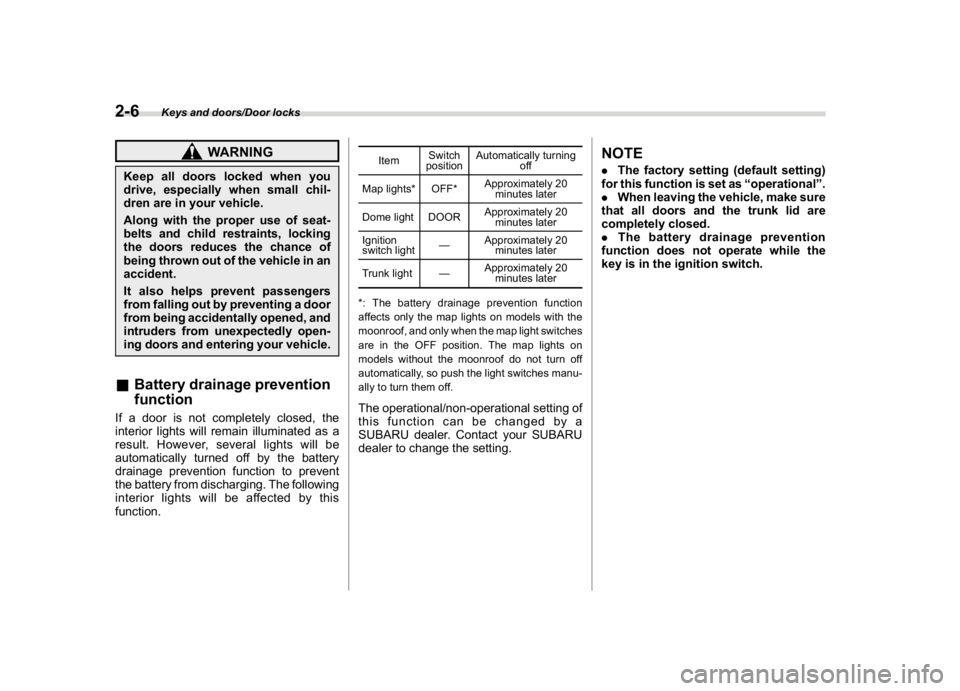
ing doors and entering your vehicle.&Battery drainage prevention
functionIf a door is not completely closed, the
interior lights will remain illuminated as a
result. However, several lights will be
automatically turned off by the battery
drainage prevention function to prevent
the battery from discharging. The following
interior lights will be affected by this
function.
ItemSwitch
positionAutomatically turning
off
Map lights* OFF*Approximately 20
minutes later
Dome light DOORApproximately 20
minutes later
Ignition
switch light—Approximately 20
minutes later
Trunk light—Approximately 20
minutes later
*: The battery drainage prevention function
affects only the map lights on models with the
moonroof, and only when the map light switches
are in the OFF position. The map lights on
models without the moonroof do not turn off
automatically, so push the light switches manu-
ally to turn them off.
The operational/non-operational setting of
this function can be changed by a
SUBARU dealer. Contact your SUBARU
dealer to change the setting.
NOTE.The factory setting (default setting)
for this function is set as“operational”.
.When leaving the vehicle, make sure
that all doors and the trunk lid are
completely closed.
.The battery drainage prevention
function does not operate while the
key is in the ignition switch.
Keys and doors/Door locks
2-6