2018 SUBARU WRX jump start
[x] Cancel search: jump startPage 158 of 578

(163,1)
北米Model "A1700BE-B" EDITED: 2017/ 10/ 11
.The warning light illuminates while
driving, but it turns off immediately and
remains off.
When driving with an insufficient battery
voltage such as when the engine is jump
started, the ABS warning light may illumi-
nate. This is due to the low battery voltage
and does not indicate a malfunction. When
the battery becomes fully charged, the
light will turn off.&Brake system
warning light
WARNING
.Driving with the brake system
warning light on is dangerous.
This indicates your brake system
may not be working properly. If
the light remains illuminated,
have the brakes inspected by a
SUBARU dealer immediately.
.If at all in doubt about whether the
brakes are operating properly, do
not drive the vehicle. Have your
vehicle towed to the nearest
SUBARU dealer for repair.
.For models with the electronic
parking brake: If the brake sys-
tem warning light illuminates, the
electronic parking brake systemmay be malfunctioning. Immedi-
ately stop your vehicle in a safe
location, use tire stops under the
tires to prevent the vehicle from
moving and contact your
SUBARU dealer. For details, refer
to“Electronic parking brake
(models with electronic parking
brake system)”F7-43.
NOTEFor models with the electronic parking
brake:
.Even if the brake system warning
light illuminates, if the warning light
behavior is as described in the follow-
ing examples, the electronic parking
brake system is not malfunctioning.
–The warning light turns off when
the electronic parking brake is ap-
plied or released.
–The warning light turns off when
the ignition switch is turned to the
“ON”position again.
.The brake system warning light may
illuminate immediately after the engine
is started. However, it is not malfunc-
tioning if the warning light turns off
after the electronic parking brake is
released.
.The brake system warning light mayilluminate after the electronic parking
brake is frequently applied and re-
leased. However, the electronic parking
brake system is not malfunctioning if
the light turns off for a short period of
time.
.When the engine is started while the
electronic parking brake is applied/
released, the system may judge an
abnormal situation and the warning
light may illuminate. If the warning light
illuminates, turn the ignition switch
once to the“LOCK/OFF”position and
then restart the engine. Then, apply/
release the electronic parking brake. If
the warning light turns off, the system
will be restored.
This light has the following functions.
!Parking brake indicator (models
without electronic parking brake
system)
This light illuminates with the parking
brake applied while the ignition switch is
in the“ON”position. It turns off when the
parking brake is fully released.
–CONTINUED–
Instruments and controls/Warning and indicator lights
3-21
3
Page 372 of 578

(385,1)
北米Model "A1700BE-B" EDITED: 2017/ 10/ 11
Continuously variable trans-
missionThe continuously variable transmission is
electronically controlled and provides an
infinite number of forward speeds and 1
reverse speed. It also has a manual mode.
WARNING
Do not shift from the“P”or“N”
position into the“D”or“R”position
while depressing the accelerator
pedal. This may cause the vehicle
to jump forward or backward.
CAUTION
.Observe the following precau-
tions. Otherwise, the transmis-
sion could be damaged.
–Shift into the“P”or“R”posi-
tion only after the vehicle has
completely stopped.
–Do not shift from the“D”
position into the“R”position
or vice versa until the vehicle
has completely stopped.
.Do not race the engine for more
than 5 seconds in any position
except the“N”or“P”positionwhen the brake is applied or
when chocks are used in the
wheels. This may cause the
transmission fluid to overheat.
.Never move the vehicle as fol-
lows. Doing so may result in an
unexpected accident or malfunc-
tion.
–Moving rearward by inertia
with the select lever set in a
forward driving position.
–Moving forward by inertia with
the select lever set in the“R”
position.
.When parking the vehicle, first
securely apply the parking brake
and then place the select lever in
the“P”position. Do not park for a
long time with the select lever in
any other position as doing so
could result in a dead battery.
NOTE.When the engine coolant tempera-
ture is still low, the transmission will
upshift to higher engine speeds than
when the coolant temperature is suffi-
ciently high in order to shorten the
warm-up time and improve driveability.
The gearshift timing will automaticallyshift to the normal timing after the
engine has warmed up.
.Immediately after transmission fluid
is replaced, you may feel that the
transmission operation is somewhat
unusual. This results from invalidation
of data which the on-board computer
has collected and stored in memory to
allow the transmission to shift at the
most appropriate times for the current
condition of your vehicle. Optimized
shifting will be restored as the vehicle
continues to be driven for a while.
.When driving under continuous hea-
vy load conditions such as when climb-
ing a long, steep hill, the engine speed
or the vehicle speed may automatically
be reduced. This is not a malfunction.
This phenomenon results from the
engine control function maintaining
the cooling performance of the vehicle.
The engine and vehicle speed will
return to a normal speed when the
engine is able to maintain the optimum
cooling performance after the heavy
load decreases. Take extremely care
when driving under a heavy load.
.The continuously variable transmis-
sion is a chain type system that pro-
vides superior transmission efficiency
for maximum fuel economy. At times,
depending on varying driving condi-
tions, a chain operating noise may be
–CONTINUED–
Starting and operating/Continuously variable transmission
7-23
7
Page 431 of 578

(446,1)
北米Model "A1700BE-B" EDITED: 2017/ 10/ 11
conditions than a two wheel drive vehicle.
There is little difference in handling, how-
ever, during extremely sharp turns or
sudden braking. Therefore, when driving
down a slope or turning corners, be sure to
reduce your speed and maintain an ample
distance from other vehicles.
.Always check the cold tire pressure
before starting to drive. The recommended
tire pressure is provided on the tire
placard, which is located under the door
latch on the driver’s side.
.Frequent driving of an AWD vehicle
under hard-driving conditions such as
steep hills or dusty roads will necessitate
more frequent replacement of the follow-
ing items than that specified in the“War-
ranty and Maintenance Booklet”.
–Engine oil
–Brake fluid
–Rear differential gear oil
–Manual transmission oil (MT mod-
els)
–Continuously variable transmission
fluid (CVT models)
–Front differential gear oil (CVT
models)
.There are some precautions that you
must observe when towing your vehicle.
For detailed information, refer to“Towing”
F9-21.
Driving precautionWater entering the engine air intake or the
exhaust pipe or water splashing onto
electrical parts may damage your vehicle
and may cause it to stall. Never attempt to
drive through rushing water; regardless of
its depth, it can wash away the ground
from under your tires, resulting in possible
loss of traction and even vehicle rollover.
Winter driving&Operation during cold weath-
erCarry some emergency equipment, such
as a window scraper, a bag of sand, flares,
a small shovel and jumper cables.
Check the battery and cables. Cold tem-
peratures reduce battery capacity. The
battery must be in good condition to
provide enough power for cold winter
starts.
It normally takes longer to start the engine
in very cold weather conditions. Use an
engine oil of a proper grade and viscosity
for cold weather. Using heavy summer oil
will make it harder to start the engine.
Keep the door locks from freezing by
squirting them with deicer or glycerin.
Forcing a frozen door open may damage
or separate the rubber weather strips
around the door. If the door is frozen, use
hot water to melt the ice, and afterwards
thoroughly wipe the water away.
Use a windshield washer fluid that con-
tains an antifreeze solution. Do not use
engine antifreeze or other substitutes
because they may damage the paint of
the vehicle.
Driving tips/Driving precaution
8-6
Page 442 of 578

(459,1)
北米Model "A1700BE-B" EDITED: 2017/ 10/ 11
If you park your vehicle in case of an
emergency............................................................9-2
Temporary spare tire(if equipped)........................9-2
Maintenance tools...................................................9-3
Models with flat tire repair kit................................. 9-4
Models without flat tire repair kit............................ 9-4
Flat tires...................................................................9-5
Changing a flat tire................................................ 9-5
Sealing flat tire (models with flat tire repair kit)...... 9-8
Tire pressure monitoring system (TPMS)
(U.S.-spec. models).............................................9-17
Jump starting........................................................9-18
How to jump start.................................................9-18
Engine overheating...............................................9-20
If steam is coming from the engine
compartment......................................................9-20
If no steam is coming from the engine
compartment......................................................9-20
Towing...................................................................9-21
Towing and tie-down hooks/holes.........................9-21
Using a flat-bed truck...........................................9-24
Towing with all wheels on the ground...................9-25
Electronic parking brake–if the electronic
parking brake cannot be released (models
with electronic parking brakesystem)............9-25
Access key fob–if access key fob does not
operate properly................................................9-26
Locking and unlocking.........................................9-26
Switching power status........................................9-26
Starting engine.....................................................9-27
Moonroof (if equipped)–if the moonroof
does not close...................................................9-28
If your vehicle is involvedin an accident...........9-28
In case of emergency
9
Page 459 of 578
(476,1)
北米Model "A1700BE-B" EDITED: 2017/ 10/ 11
Jump starting
WARNING
.Battery fluid is SULFURIC ACID.
Do not let it come in contact with
the eyes, skin, clothing or the
vehicle.
If battery fluid gets on you, thor-
oughly flush the exposed area
with water immediately. Get med-
ical help if the fluid has entered
your eyes.
If battery fluid is accidentally
swallowed, immediately drink a
large amount of milk or water,
and obtain immediate medical
help.
Keep everyone including chil-
dren away from the battery.
.The gas generated by a battery
explodes if a flame or spark is
brought near it. Do not smoke or
light a match while jump starting.
.Never attempt jump starting if the
discharged battery is frozen. It
could cause the battery to burst
or explode.
.Whenever working on or around a
battery, always wear suitable eyeprotectors, and remove metal
objects such as rings, bands or
other metal jewelry.
.Be sure the jumper cables and
clamps on them do not have
loose or missing insulation.
Do not jump start unless cables
in suitable condition are avail-
able.
.A running engine can be danger-
ous. Keep your fingers, hands,
clothing, hair and tools away
from the cooling fan, belts and
any other moving engine parts.
Removing rings, watches and
ties is advisable.
.Jump starting is dangerous if it
done incorrectly. If you are un-
sure about the proper procedure
for jump starting, consult a com-
petent mechanic.
When your vehicle does not start due to a
run down (discharged) battery, the vehicle
may be jump started by connecting your
battery to another battery (called the
booster battery) with jumper cables.
&How to jump start1. Make sure the booster battery is 12
volts and the negative terminal is
grounded.
2. If the booster battery is in another
vehicle, do not let the two vehicles touch.
3. Turn off all unnecessary lights and
accessories.
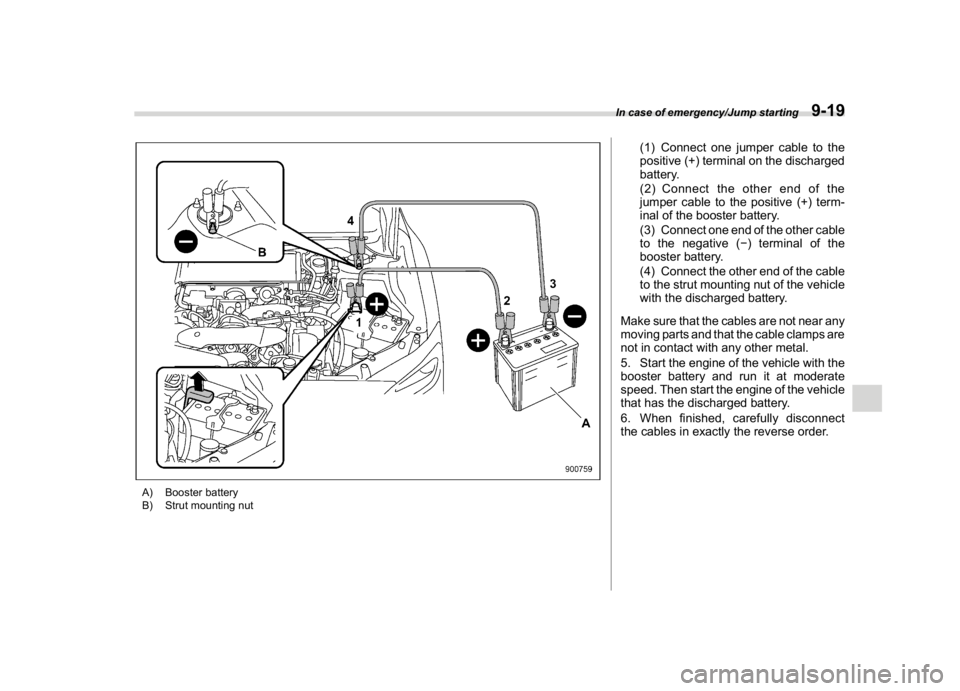
4. Connect the jumper cables exactly in
the sequence illustrated.
In case of emergency/Jump starting
9-18
Page 460 of 578
(477,1)
北米Model "A1700BE-B" EDITED: 2017/ 10/ 11
A) Booster battery
B) Strut mounting nut
(1) Connect one jumper cable to the
positive (+) terminal on the discharged
battery.
(2) Connect the other end of the
jumper cable to the positive (+) term-
inal of the booster battery.
(3) Connect one end of the other cable
to the negative () terminal of the
booster battery.
(4) Connect the other end of the cable
to the strut mounting nut of the vehicle
with the discharged battery.
Make sure that the cables are not near any
moving parts and that the cable clamps are
not in contact with any other metal.
5. Start the engine of the vehicle with the
booster battery and run it at moderate
speed. Then start the engine of the vehicle
that has the discharged battery.
6. When finished, carefully disconnect
the cables in exactly the reverse order.
In case of emergency/Jump starting
9-19
9