2018 SUBARU WRX roof
[x] Cancel search: roofPage 141 of 578
(146,1)
北米Model "A1700BE-B" EDITED: 2017/ 10/ 11
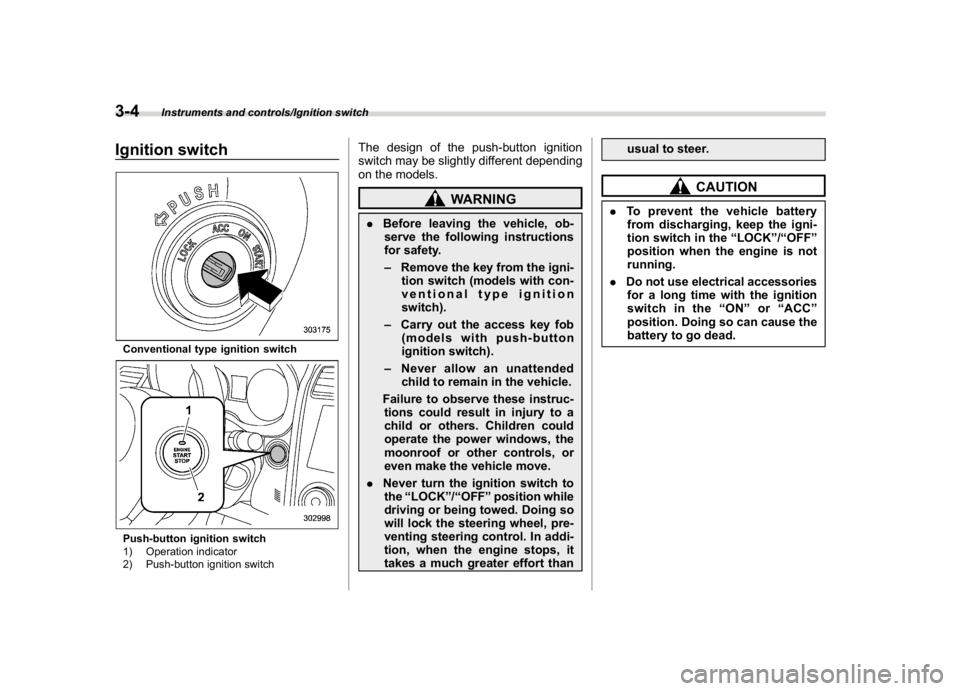
Ignition switchConventional type ignition switchPush-button ignition switch
1) Operation indicator
2) Push-button ignition switch
The design of the push-button ignition
switch may be slightly different depending
on the models.
WARNING
.Before leaving the vehicle, ob-
serve the following instructions
for safety.
–Remove the key from the igni-
tion switch (models with con-
ventional type ignition
switch).
–Carry out the access key fob
(models with push-button
ignition switch).
–Never allow an unattended
child to remain in the vehicle.
Failure to observe these instruc-
tions could result in injury to a
child or others. Children could
operate the power windows, the
moonroof or other controls, or
even make the vehicle move.
.Never turn the ignition switch to
the“LOCK”/“OFF”position while
driving or being towed. Doing so
will lock the steering wheel, pre-
venting steering control. In addi-
tion, when the engine stops, it
takes a much greater effort thanusual to steer.
CAUTION
.To prevent the vehicle battery
from discharging, keep the igni-
tion switch in the“LOCK”/“OFF”
position when the engine is not
running.
.Do not use electrical accessories
for a long time with the ignition
switch in the“ON”or“ACC”
position. Doing so can cause the
battery to go dead.
Instruments and controls/Ignition switch
3-4
Page 236 of 578

(245,1)
北米Model "A1700BE-B" EDITED: 2017/ 10/ 11
Antenna...................................................................5-2
Roof antenna......................................................... 5-2
Audio set.................................................................5-2
Base display audio set (if equipped)....................... 5-3
SUBARU STARLINK
TM
7.0 Multimedia Plus audio
set (U.S. spec. models only, if equipped).............. 5-5
Tips for operating the audio/visual system............. 5-6
Basic information before use................................5-14
Basic operation.....................................................5-17
Unit settings.........................................................5-18
SUBARU STARLINK (if equipped)..........................5-25
AM/FM radio.........................................................5-27
SiriusXM Satellite Radio (if equipped)....................5-36
aha
TM
by HARMAN................................................5-42
Pandora®(if equipped)..........................................5-48
CD ........................................................................5-51
USB memory........................................................5-53
iPod......................................................................5-54
Bluetooth audio....................................................5-56
AUX ......................................................................5-59
Steering switches foraudio.................................5-61Bluetooth
®settings..............................................5-64
Regulatory information.........................................5-64
Registering/connecting Bluetooth
®device.............5-64
Setting Bluetooth details.......................................5-67
Hands-free phone system....................................5-69
Control screen......................................................5-70
Registering/connecting a Bluetooth phone ............5-71
Using the phone switch/microphone.....................5-71
How to change the hands-free phone system........5-72
Making a call........................................................5-72
Receiving a call....................................................5-75
Talking on the phone............................................5-76
Phone settings.....................................................5-77
Voice commandsystem.......................................5-79
Using the voice command system........................5-79
Voice command system operation.........................5-81
Command list.......................................................5-83
What to doif.........................................................5-87
Troubleshooting...................................................5-87
Appendix...............................................................5-91
Certification..........................................................5-91
Certification for the Hands-free system.................5-91
Certification for Mexico models.............................5-92
Audio
5
Page 237 of 578

(246,1)
北米Model "A1700BE-B" EDITED: 2017/ 10/ 11
Antenna&Roof antennaThe shark-fin type roof antenna is installed
in the center at the rear of the roof.
Audio setYour vehicle may be equipped with one of
the following audio sets. Refer to the
pages indicated in this section for operat-
ing details.
CAUTION
.Always consult your SUBARU
dealer before installing a citizen
band radio or other transmitting
device in your vehicle. Such
devices may cause the electronic
control system to malfunction if
they are incorrectly installed or if
they are not suited for the vehi-
cle.
.To prevent the battery from being
discharged, do not leave the
audio/visual system on when the
engine is not running.NOTE.If a cell phone is placed near the
audio set, it may cause the audio set to
emit noise when the phone receives
calls. This noise does not indicate an
audio set malfunction. Note that a cell
phone should not be placed near the
audio set..Some functions may not be available
depending on the market and specifi-
cations of your vehicle.
.The images shown in this Owner’s
Manual are sample images. The actual
images may vary depending on the
market and specifications of your ve-
hicle.
Audio/Antenna
5-2
Page 241 of 578

(250,1)
北米Model "A1700BE-B" EDITED: 2017/ 10/ 11
&Tips for operating the audio/
visual system
CAUTION
To avoid damage to the audio/visual
system:
.Be careful not to spill beverages
over the audio/visual system.
.Do not put anything other than an
appropriate disc into the disc
slot.NOTEThe use of a cell phone inside or near
the vehicle may cause a noise from the
speakers of the audio/visual system
which you are listening to. However,
this does not indicate a malfunction.
!Radio
Usually, a problem with radio reception
does not mean there is a problem with the
radio—it is just the normal result of
conditions outside the vehicle.
For example, nearby buildings and terrain
can interfere with FM reception. Power
lines or phone wires can interfere with AM
signals. And of course, radio signals have
a limited range. The farther the vehicle isfrom a station, the weaker its signal will be.
In addition, reception conditions change
constantly as the vehicle moves.
Here, some common reception problems
that probably do not indicate a problem
with the radio are described.
!FM
Fading and drifting stations: Generally, the
effective range of FM is about 25 miles (40
km). Once outside this range, you may
notice fading and drifting, which increase
with the distance from the radio transmit-
ter. They are often accompanied by
distortion.
Multi-path: FM signals are reflective, mak-
ing it possible for 2 signals to reach the
vehicle’s antenna at the same time. If this
happens, the signals will cancel each other
out, causing a momentary flutter or loss of
reception.
Static and fluttering: These occur when
signals are blocked by buildings, trees or
other large objects. Increasing the bass
level may reduce static and fluttering.
Station swapping: If the FM signal being
listened to is interrupted or weakened, and
there is another strong station nearby on
the FM band, the radio may tune in the
second station until the original signal can
be picked up again.!AM
Fading: AM broadcasts are reflected by
the upper atmosphere—especially at
night. These reflected signals can interfere
with those received directly from the radio
station, causing the radio station to sound
alternately strong and weak.
Station interference: When a reflected
signal and a signal received directly from
a radio station are very nearly the same
frequency, they can interfere with each
other, making it difficult to hear the broad-
cast.
Static: AM is easily affected by external
sources of electrical noise, such as high
tension power lines, lightening or electrical
motors. This results in static.
!SiriusXM (if equipped)
.Cargo loaded on the roof luggage
carrier, especially metal objects, may
adversely affect the reception of SiriusXM
Satellite Radio.
.Alternation or modifications carried out
without appropriate authorization may in-
validate the user’s right to operate the
equipment.
Audio/Audio set
5-6
Page 304 of 578
(313,1)
北米Model "A1700BE-B" EDITED: 2017/ 10/ 11
Hands-free phone systemThe hands-free system enables calls to be
made and received without having to take
your hands off the steering wheel.
This system supports Bluetooth. Bluetooth
is a wireless data system that enables cell
phones to be used without being con-
nected by a cable or placed in a cradle.
The operating procedure of the phone is
explained here.
WARNING
.While driving, do not use a cell
phone or connect the Bluetooth
phone. Doing so may result in
loss of control of your vehicle
and cause an accident or serious
injury.
.Your audio unit is fitted with
Bluetooth antennas. People with
implantable cardiac pacemakers,
cardiac resynchronization ther-
apy-pacemakers or implantable
cardioverter defibrillators should
maintain a reasonable distance
between themselves and the
Bluetooth antennas. The radio
waves may affect the operation
of such devices..Before using Bluetooth devices,
users of any electrical medical
device other than implantable
cardiac pacemakers, cardiac re-
synchronization therapy-pace-
makers or implantable cardiover-
ter defibrillators should consult
the manufacturer of the device
for information about its opera-
tion under the influence of radio
waves. Radio waves could have
unexpected effects on the opera-
tion of such medical devices.
CAUTION
Do not leave your cell phone in the
vehicle. The temperature inside may
rise to a level that could damage the
phone.NOTE.If your cell phone does not support
Bluetooth, this system cannot function.
.In the following conditions, the sys-
tem may not function:
–The cell phone is turned off.
–The current position is outside
the communication area.
–The cell phone is not connected.
–The cell phone has a low battery..When using the hands free function
and other Bluetooth functions at the
same time, the following problems may
occur:
–The Bluetooth connection may
be cut.
–Noise may be heard when playing
back voice with the Bluetooth func-
tion.
.The other party’s voice will be heard
from the front speakers. The audio/
visual system will be muted during
phone calls or when hands-free voice
commands are used.
.Talk alternately with the other party
on the phone. If both parties speak at
the same time, the other party may not
hear what has been said. (This is not a
malfunction.)
.Keep call volume down. Otherwise,
the other party’s voice may be audible
outside the vehicle and voice echo may
increase. When talking on the phone,
speak clearly towards the microphone.
.The other party may not hear you
clearly when:
–Driving on an unpaved road.
(Making excessive traffic noise.)
–Driving at high speeds.
–The moonroof or windows are
open.
–The air conditioning vents are
–CONTINUED–
Audio/Hands-free phone system
5-69
5
Page 315 of 578
(324,1)
北米Model "A1700BE-B" EDITED: 2017/ 10/ 11
Action Function
PressStart the voice com-
mand system.
Press and holdCancel voice recogni-
tion.
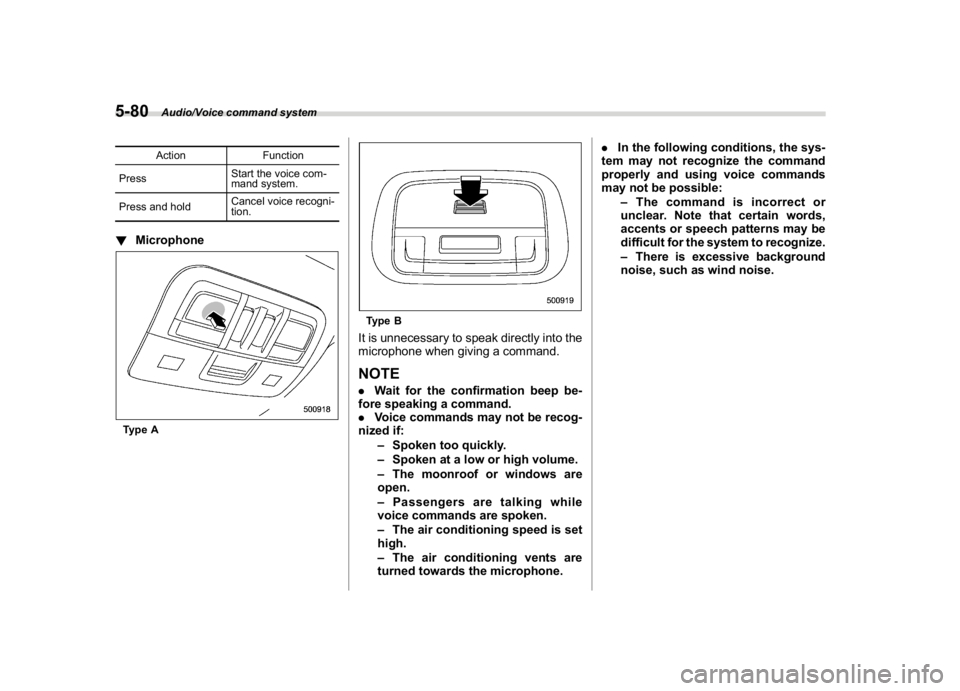
!MicrophoneType A
Type BIt is unnecessary to speak directly into the
microphone when giving a command.NOTE.Wait for the confirmation beep be-
fore speaking a command.
.Voice commands may not be recog-
nized if:
–Spoken too quickly.
–Spoken at a low or high volume.
–The moonroof or windows are
open.
–Passengers are talking while
voice commands are spoken.
–The air conditioning speed is set
high.
–The air conditioning vents are
turned towards the microphone..In the following conditions, the sys-
tem may not recognize the command
properly and using voice commands
may not be possible:
–The command is incorrect or
unclear. Note that certain words,
accents or speech patterns may be
difficult for the system to recognize.
–There is excessive background
noise, such as wind noise.
Audio/Voice command system
5-80
Page 349 of 578

(360,1)
北米Model "A1700BE-B" EDITED: 2017/ 10/ 11
.The camera unit is a waterproof
structure. Do not attempt to re-
move, disassemble or modify the
unit.
.Do not rub strongly or polish the
camera lens with a hard brush or
abrasive compounds. The lens
may be scratched resulting in an
adverse effect to the camera
image.
.The camera lens is made of glass
or plastic. Do not allow any
organic solvent, body wax, oil
film remover or glass coating
agent to become attached on the
lens surface. If any becomes
attached, remove it immediately.
.Do not expose the camera lens to
any sudden temperature change,
for example, spraying hot water
on it in cold weather.
.Do not apply the water jet of a
high pressure washer to the cam-
era or the surrounding area when
cleaning the vehicle. The impact
by the strong water pressure may
cause the camera to come off.
Also, water may enter inside the
camera and cause a malfunction.
.If the camera is exposed to any
impact, it may lead to malfunctionof the camera. Have the camera
inspected by your SUBARU deal-
er as soon as possible.
.Do not use a steam cleaner under
any circumstances. Some types
of steam cleaners inject hot
steam.
.The camera surface may be da-
maged by a flying stone.
NOTEIf the camera lens is contaminated, no
sharp image is available. When the
camera is contaminated with water
drops, snow or mud, wash it with water
and wipe away any moisture with a soft
cloth. If it heavily gets dirty, wash it with
a neutral detergent.
Interior equipment/Front View Monitor
6-22
Page 426 of 578

(441,1)
北米Model "A1700BE-B" EDITED: 2017/ 10/ 11
New vehicle break-in driving–the first 1,000
miles (1,600 km)...................................................8-2
Fuel economy hints................................................8-2
Engine exhaust gas (carbonmonoxide)............... 8-2
Catalytic converter..................................................8-3
Periodic inspections...............................................8-4
Driving in foreigncountries...................................8-4
Driving tips for AWD models.................................8-5
Driving precaution..................................................8-6
Winter driving..........................................................8-6
Operation during cold weather............................... 8-6
Driving on snowy and icy roads............................. 8-8
Corrosion protection.............................................. 8-9Snow tires..............................................................8-9
Tire chains...........................................................8-10
Rocking the vehicle..............................................8-10
Loading your vehicle.............................................8-11
Vehicle capacity weight........................................8-12
GVWR and GAWR (Gross Vehicle Weight Rating
and Gross Axle Weight Rating)..........................8-12
Precautions for TYPE RA......................................8-13
Roof molding and crossbar (if equipped)..............8-13
Trailer towing........................................................8-14
Rear wing (TYPERA)...........................................8-15
Adjusting the angle of the rear wing.....................8-15
CFRP (Carbon Fiber Reinforced Plastic) parts.......8-16
Driving tips
8