2018 SUBARU WRX ignition
[x] Cancel search: ignitionPage 408 of 578

(421,1)
北米Model "A1700BE-B" EDITED: 2017/ 10/ 11
reversing the vehicle.Example 2
1) The detection range of the radar sensors
C) Vehicle that may be detectedNOTEThe system may detect that a vehicle
(C) is passing in front of your vehicle.
Always be sure to check the surround-
ings with your eyes when reversing the
vehicle.
&System operation!Operating conditions
The BSD/RCTA will operate when all of the
following conditions are met.
.The ignition switch is in the“ON”
position.
.The BSD/RCTA warning indicator and
BSD/RCTA OFF indicator are turned off.
.The vehicle speed is above 7 mph (12
km/h) (except when reversing).
.The shift lever/select lever is in the“R”
position (RCTA only).
The BSD/RCTA will not operate in the
following situations.
.The BSD/RCTA OFF indicator is on.
.The vehicle speed is below 6 mph (10
km/h) even when the BSD/RCTA OFF
indicator remains off (except when rever-
sing).NOTE.When a malfunction occurs in the
system (including the BSD/RCTA ap-
proach indicator light), the BSD/RCTA
will stop operating and the BSD/RCTA
warning indicator will appear.
.If the BSD/RCTA warning indicator
appears, exercise proper caution. For
details, refer to“BSD/RCTA warning
indicator”F7-62..In the following cases, the BSD/
RCTA will temporarily stop operating
(or may stop operating) and the BSD/
RCTA warning indicator will appear.
–When the radar sensor becomes
significantly misaligned (If the or-
ientation of the radar sensor is
shifted for any reason, readjust-
ment is required. Have the sensor
adjusted at a SUBARU dealer.)
–When a large amount of snow or
ice sticks to the rear bumper sur-
face around the radar sensors
–When the vehicle is driven on a
snow-covered road or in an envir-
onment in which there are no ob-
jects around (such as in a desert) for
a prolonged period of time
–When the temperature around the
radar sensors increases exces-
sively due to long driving on uphill
grades in the summer, etc.
–When the temperature around the
radar sensors becomes extremely
low
–When the vehicle battery voltage
lowers
–When the vehicle voltage ex-
ceeds the battery voltage rating
The BSD/RCTA will resume opera-
tion once these conditions are cor-
–CONTINUED–
Starting and operating/BSD/RCTA
7-59
7
Page 412 of 578

(425,1)
北米Model "A1700BE-B" EDITED: 2017/ 10/ 11
!System malfunction indicatorSystem malfunction indicator
1) At first, this message will appear
2) Then this message will appearThis indicator appears when a malfunction
occurs in the system. Contact a SUBARU
dealer and have the system inspected.
&BSD/RCTA OFF switchBSD/RCTA OFF switchBSD/RCTA OFF indicatorPress the BSD/RCTA OFF switch to
deactivate the BSD/RCTA. Then the
BSD/RCTA OFF indicator light will appearon the combination meter display (color
LCD).
Press the switch again to activate the BSD/
RCTA. The BSD/RCTA OFF indicator
disappears.
NOTE.In the following cases, press the
BSD/RCTA OFF switch to deactivate
the system. The system may not oper-
ate properly due to blocked radar
waves.
–When a bicycle carrier or other
item is fitted to the rear of the
vehicle
–When using a chassis dynam-
ometer or free roller device, etc.
–When running the engine and
making the wheels rotate while
lifting up the vehicle
.If you turn the ignition switch to the
“LOCK”/“OFF”position, the last known
status of the system is maintained. For
example, if you turn the ignition switch
to the“LOCK”/“OFF”position with the
BSD/RCTA deactivated, the BSD/RCTA
remains deactivated the next time you
turn the ignition switch to the“ON”
position.
–CONTINUED–
Starting and operating/BSD/RCTA
7-63
7
Page 416 of 578

(429,1)
北米Model "A1700BE-B" EDITED: 2017/ 10/ 11
not disclose or provide the acquired
data to any other third party except
under the following conditions.
–The vehicle owner has given his/
her consent.
–The disclosure/provision is
based on a court order or other
legally enforceable request.
–Data that has been modified so
that the user and vehicle cannot be
identified is provided to a research
institution for statistical processing
or similar purposes.
&Reverse Automatic Braking
System overviewThe system detects objects using sonar
sensors installed in the rear bumper. If the
system determines a possible collision
with an object in the reversing direction,
automatic deceleration will be activated.
Also, beeping sounds will activate. If the
vehicle is further reversed, automatic hard
braking will be applied and a continuous
beeping sound will activate.!Detecting range
1) Detecting range (width): Approximately 6
in (15 cm) outside of the vehicle width
2) Range that the system cannot detect:
Approximately 20 in (50 cm) behind the
rear of the vehicle
3) Detecting range (length): Approximately
5 ft (1.5 m) from the rear of the vehicle
WARNING
If your vehicle is trapped on a rail-
road crossing and you are trying to
escape by reversing through the
crossing gate, the system may re-
cognize the crossing gate as an
obstacle and the brakes may acti-
vate. In this case, remain calm and
either continue to depress the accel-
erator pedal or cancel the system. Tocancel the system, refer to“Cancel-
ing the Reverse Automatic Braking
system operation”F7-74.
&Operating conditionsThe Reverse Automatic Braking system
will operate when all of the following
conditions are met.1) EyeSight warning indicator
2) RAB warning indicator
3) RAB OFF indicator.Theignitionswitchisinthe“ON”
position
.The EyeSight warning indicator is off
.The RAB warning indicator is off
.HALT (RAB OFF) indicator is off
.The Reverse Automatic Braking sys-
–CONTINUED–
Starting and operating/Reverse Automatic Braking System
7-67
7
Page 428 of 578

(443,1)
北米Model "A1700BE-B" EDITED: 2017/ 10/ 11
exhaust fumes are entering the
vehicle, have the problem
checked and corrected as soon
as possible. If you must drive
under these conditions, drive
only with all windows fully open.
.Keep the trunk lid closed while
driving to prevent exhaust gas
from entering the vehicle.
NOTEDue to the expansion and contraction
of the metals used in the manufacture
of the exhaust system, you may hear a
crackling sound coming from the ex-
haust system for a short time after the
engine has been shut off. This sound is
normal.
Catalytic converterSTIExcept STIThe catalytic converter is installed in the
exhaust system. It serves as a catalyst toreduce HC, CO and NOx in exhaust gases,
thus providing cleaner exhaust.
To avoid damage to the catalytic converter:
.Use only unleaded fuel. Even a small
amount of leaded fuel will damage the
catalytic converter.
.Never start the engine by pushing or
pulling the vehicle.
.Avoid racing the engine.
.Never turn off the ignition switch while
the vehicle is moving.
.Keep your engine tuned-up. If you feel
the engine running rough (misfiring, back-
firing or incomplete combustion), have
your vehicle checked and repaired by an
authorized SUBARU dealer.
.Do not apply undercoating or rust
prevention treatment to the heat shield of
catalytic converter and the exhaust sys-
tem.
.Do not drive with an extremely low fuel
level.
WARNING
.Avoid fire hazards. Do not drive
or park the vehicle anywhere
near flammable materials (e.g.,
grass, paper, rags or leaves),
because the catalytic converter
operates at very high tempera-
–CONTINUED–
Driving tips/Catalytic converter
8-3
8
Page 443 of 578

(460,1)
北米Model "A1700BE-B" EDITED: 2017/ 10/ 11
If you park your vehicle in
case of an emergencyUse the hazard warning flasher in day or
night to warn other drivers when you have
to park your vehicle under emergency
conditions.
Avoid stopping on the road. It is best to
safely pull off the road if a problem occurs.
You can activate the hazard warning
flasher regardless of the ignition switch
position.
Turn on the hazard warning by pushing the
hazard warning flasher switch. Turn it off
by pushing the switch again.
NOTEWhen the hazard warning flasher is on,
the turn signals do not work.
Temporary spare tire (if
equipped)
WARNING
When a spare tire is mounted or a
wheel rim is replaced without the
original pressure sensor/transmitter
being transferred, the low tire pres-
sure warning light will illuminate
steadily after blinking for approxi-
mately one minute. This indicates
the tire pressure monitoring system
(TPMS) is unable to monitor all four
road wheels. Contact your SUBARU
dealer as soon as possible for tire
and sensor replacement and/or sys-
tem resetting.
CAUTION
.Never use any temporary spare
tire other than the original. Using
other sizes may result in severe
mechanical damage to the drive
train of your vehicle.
.Always conform to the following
instructions when using the tem-
porary spare tire. Otherwise, a
seriously dangerous situation
In case of emergency/If you park your vehicle in case of an emergency
9-2
Page 455 of 578
(472,1)
北米Model "A1700BE-B" EDITED: 2017/ 10/ 11
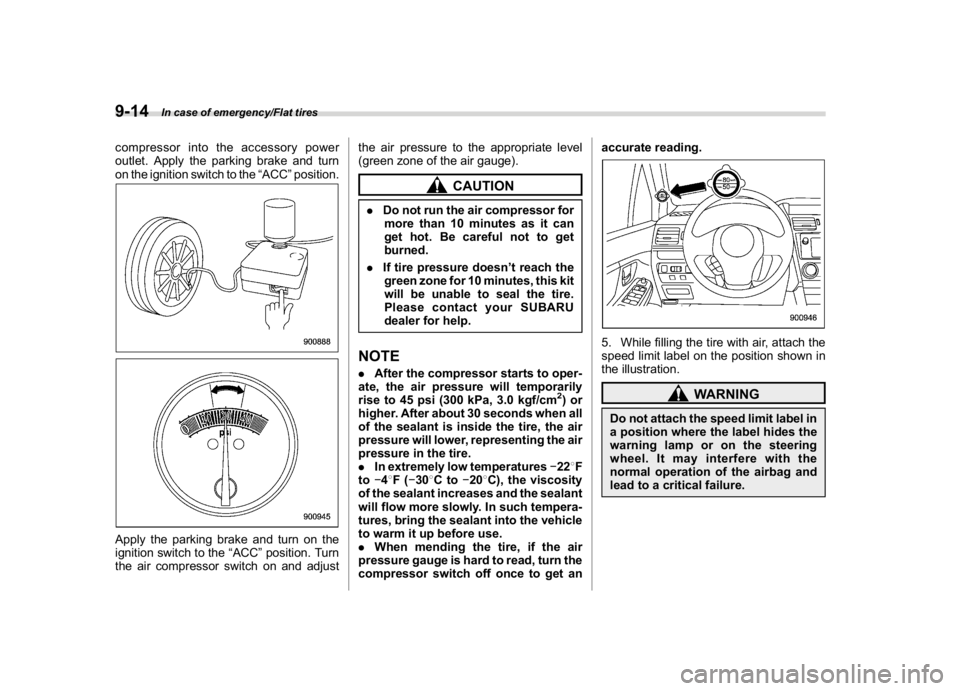
compressor into the accessory power
outlet. Apply the parking brake and turn
on the ignition switch to the“ACC”position.Apply the parking brake and turn on the
ignition switch to the“ACC”position. Turn
the air compressor switch on and adjustthe air pressure to the appropriate level
(green zone of the air gauge).
CAUTION
.Do not run the air compressor for
more than 10 minutes as it can
get hot. Be careful not to get
burned.
.If tire pressure doesn’t reach the
green zone for 10 minutes, this kit
will be unable to seal the tire.
Please contact your SUBARU
dealer for help.NOTE.After the compressor starts to oper-
ate, the air pressure will temporarily
rise to 45 psi (300 kPa, 3.0 kgf/cm
2)or
higher. After about 30 seconds when all
of the sealant is inside the tire, the air
pressure will lower, representing the air
pressure in the tire.
.In extremely low temperatures228F
to48F(308Cto208C), the viscosity
of the sealant increases and the sealant
will flow more slowly. In such tempera-
tures, bring the sealant into the vehicle
to warm it up before use.
.When mending the tire, if the air
pressure gauge is hard to read, turn the
compressor switch off once to get anaccurate reading.
5. While filling the tire with air, attach the
speed limit label on the position shown in
the illustration.
WARNING
Do not attach the speed limit label in
a position where the label hides the
warning lamp or on the steering
wheel. It may interfere with the
normal operation of the airbag and
lead to a critical failure.
In case of emergency/Flat tires
9-14
Page 466 of 578
(483,1)
北米Model "A1700BE-B" EDITED: 2017/ 10/ 11
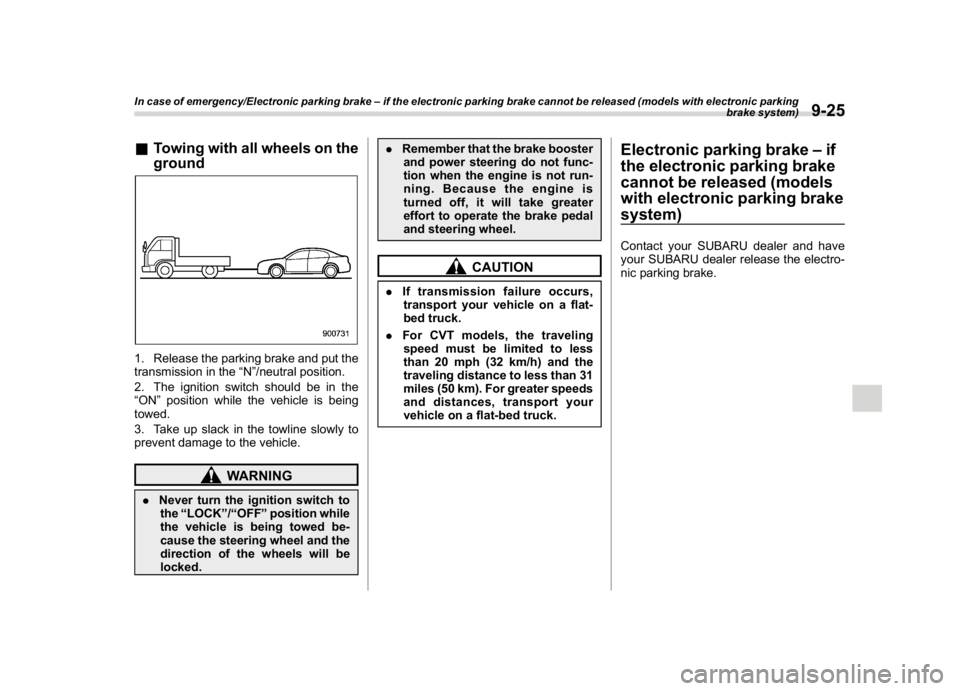
&Towing with all wheels on the
ground1. Release the parking brake and put the
transmission in the“N”/neutral position.
2. The ignition switch should be in the
“ON”position while the vehicle is being
towed.
3. Take up slack in the towline slowly to
prevent damage to the vehicle.
WARNING
.Never turn the ignition switch to
the“LOCK”/“OFF”position while
the vehicle is being towed be-
cause the steering wheel and the
direction of the wheels will be
locked..Remember that the brake booster
and power steering do not func-
tion when the engine is not run-
ning. Because the engine is
turned off, it will take greater
effort to operate the brake pedal
and steering wheel.
CAUTION
.If transmission failure occurs,
transport your vehicle on a flat-
bed truck.
.For CVT models, the traveling
speed must be limited to less
than 20 mph (32 km/h) and the
traveling distance to less than 31
miles (50 km). For greater speeds
and distances, transport your
vehicle on a flat-bed truck.
Electronic parking brake–if
the electronic parking brake
cannot be released (models
with electronic parking brake
system)Contact your SUBARU dealer and have
your SUBARU dealer release the electro-
nic parking brake.
In case of emergency/Electronic parking brake–if the electronic parking brake cannot be released (models with electronic parking
brake system)
9-25
9
Page 467 of 578
(484,1)
北米Model "A1700BE-B" EDITED: 2017/ 10/ 11
Access key fob–if access key
fob does not operate properly
CAUTION
Keep metallic objects, magnetic
sources and signal transmitters
away from the area between the
access key fob and the push-button
ignition switch. They may interfere
with the communication between
the access key fob and the push-
button ignition switch.
The following functions may be inoperable
because of strong radio signals in the
surrounding area or a low battery condition
of the access key fob.
.Locking/unlocking doors
.Switching power status
.Starting the engine
In such cases, perform the following
procedure. When the battery of the access
key fob is discharged, replace it with a new
one. Refer to“Replacing battery of access
key fob”F11-52.
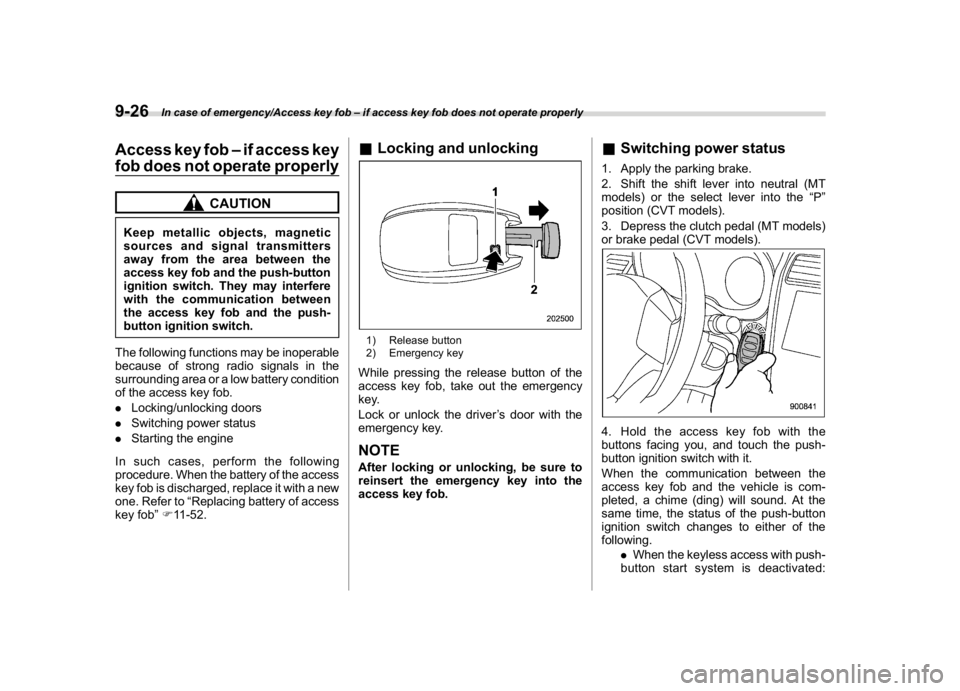
&Locking and unlocking1) Release button
2) Emergency keyWhile pressing the release button of the
access key fob, take out the emergency
key.
Lock or unlock the driver’s door with the
emergency key.NOTEAfter locking or unlocking, be sure to
reinsert the emergency key into the
access key fob.
&Switching power status1. Apply the parking brake.
2. Shift the shift lever into neutral (MT
models) or the select lever into the“P”
position (CVT models).
3. Depress the clutch pedal (MT models)
or brake pedal (CVT models).4. Hold the access key fob with the
buttons facing you, and touch the push-
button ignition switch with it.
When the communication between the
access key fob and the vehicle is com-
pleted, a chime (ding) will sound. At the
same time, the status of the push-button
ignition switch changes to either of the
following.
.When the keyless access with push-
button start system is deactivated:
In case of emergency/Access key fob–if access key fob does not operate properly
9-26