2018 SUBARU CROSSTREK Wheel bearing
[x] Cancel search: Wheel bearingPage 84 of 474
(85,1)
北米Model "A1320BE-C" EDITED: 2017/ 10/ 10
The driver’s and front passenger’s SRS
frontal airbags use dual stage inflators.
The two inflators of each airbag are
triggered either sequentially or simulta-
neously, depending on the severity of
impact, in the case of the driver’s SRS
frontal airbag and depending on the
severity of impact and the characteristic
of item(s) or person on the seat in the case
of the front passenger’s SRS frontal air-
bag.
!After deployment
After deployment, the SRS airbag imme-
diately starts to deflate so that the driver’s
vision is not obstructed and the driver’s
ability to maintain control of the vehicle is
not impaired. The time required from
detecting impact to the deflation of the
SRS airbag after deployment is shorter
than the blink of an eye.
Both when only the driver’s SRS frontal
airbag deploys and the driver’s and front
passenger’s SRS frontal airbags deploy,
the driver’s and front passenger’s seatbelt
pretensioners operate at the same time.
When the SRS airbag deploys, a sudden,
fairly loud inflation noise will be heard and
some smoke will be released. These
occurrences are a normal result of the
deployment. This smoke does not indicate
a fire in the vehicle.
CAUTION
Do not touch the SRS airbag system
components around the steering
wheel and dashboard with bare
hands right after deployment. Doing
so can cause burns because the
components can be very hot as a
result of deployment.
!Example of the type of accident
The driver’s SRS frontal airbag and front
passenger’s SRS frontal airbag are de-
signed as follows.
.to deploy in the event of an accident
involving a moderate to severe frontal
collision
.to function on a one-time-only basis
The driver’s SRS frontal airbag and front
passenger’s SRS frontal airbag are not
designed as follows.
.to deploy in most lesser frontal im-
pacts
*1
.to deploy in most side or rear impacts or
in most rollover accidents
*2
*1: Because the necessary protection can be
achieved by the seatbelt alone.
*2: Because deployment of only the driver’s
SRS frontal airbag or both the driver’s and frontpassenger’s SRS frontal airbags would not
protect the occupant in those situations.
SRS airbag deployment depends on the
level of force experienced in the passen-
ger compartment during a collision. That
level differs from one type of collision to
another, and it may have no bearing on the
visible damage done to the vehicle itself.
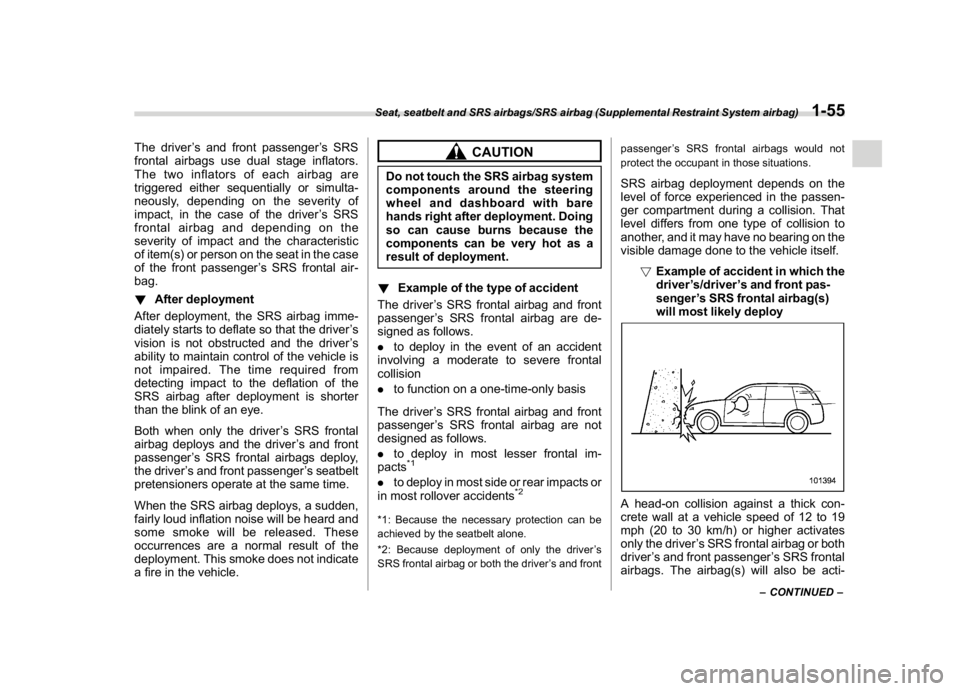
!Example of accident in which the
driver’s/driver’s and front pas-
senger’s SRS frontal airbag(s)
will most likely deployA head-on collision against a thick con-
crete wall at a vehicle speed of 12 to 19
mph (20 to 30 km/h) or higher activates
only the driver’s SRS frontal airbag or both
driver’s and front passenger’s SRS frontal
airbags. The airbag(s) will also be acti-
–CONTINUED–
Seat, seatbelt and SRS airbags/SRS airbag (Supplemental Restraint System airbag)
1-55
1
Page 344 of 474

(355,1)
北米Model "A1320BE-C" EDITED: 2017/ 10/ 10
&Warranties and maintenanceSUBARU warranties do not apply to
vehicle damage or malfunction caused by
trailer towing. If you use your vehicle to tow
a trailer, more frequent maintenance will
be required due to the additional load.
(Refer to“Maintenance schedule under
severe driving conditions”in the“Warranty
and Maintenance Booklet”.)
Under no circumstances should a trailer be
towed with a new vehicle or a vehicle with
any new powertrain component (engine,
transmission, differential, wheel bearings,
etc.) for the first 1,000 miles (1,600 km) of
driving.
&Maximum load limits
WARNING
Never exceed the maximum load
limits explained in the following.
Exceeding the maximum load limits
could cause personal injury and/or
vehicle damage.
CAUTION
.Adequate size trailer brakes are
required when the trailer and its
cargo exceed 1,000 lbs (453 kg)
total weight.
.Before towing a trailer, check the
trailer total weight, GVW, GAWs
and tongue load. Make sure the
load and its distribution in your
vehicle and trailer are acceptable.!Total trailer weight
Total trailer weightThe total trailer weight (trailer weight plus
its cargo load) must never exceed the
maximum total trailer weight in the follow-
ing table.
–CONTINUED–
Driving tips/Trailer towing
8-17
8
Page 348 of 474
(359,1)
北米Model "A1320BE-C" EDITED: 2017/ 10/ 10
equipment.
.Do not use axle-mounted hitches
as they can cause damage to the
axle housing, wheel bearings,
wheels or tires.
Do not use a trailer hitch other than
genuine SUBARU trailer hitch. A genuine
SUBARU hitch is available from your
SUBARU dealer.
&When you do not tow a trailer
CAUTION
.The housing should be kept dirt
and corrosion-free at the points
of contact. The surfaces only
require cleaning with a cloth.
Grease or other lubricants
should never be used.
.If the ball is not installed, the
plastic insert should then be
inserted for protection and to
prevent dirt.
When the ball is not used, place the ball
cap and store securely.
&Connecting a trailer!Trailer brakes
WARNING
.Adequate size trailer brakes are
required when the trailer and its
cargo exceed 1,000 lbs (453 kg)
total weight.
.Do not directly connect your
trailer’s hydraulic brake system
to the hydraulic brake system in
your vehicle. Direct connection
would cause the vehicle’s brake
performance to deteriorate and
could lead to an accident.
If your trailer’s total weight (trailer weight
plus its cargo weight) exceeds 1,000 lbs
(453 kg), the trailer is required to be
equipped with its own brake system.
Electric brakes or surge brakes are re-
commended, and must be installed prop-
erly. Check that your trailer’s brakes con-
form with Federal, state/province and/or
other applicable regulations. Your
SUBARU’s brake system is not designed
to be tapped into the trailer’s hydraulic
brake system. Please ask your SUBARU
dealer and professional trailer supplier for
more information about the trailer’s brake
system.!Trailer safety chains
WARNING
Always use safety chains between
your vehicle and the trailer. Towing
trailer without safety chains could
create a traffic safety hazard if the
trailer separates from the hitch due
to coupling damage or hitch ball
damage.
In case the trailer hitch connector or hitch
ball should break or become discon-
nected, the trailer could get loose and
create a traffic safety hazard.
For safety, always connect the towing
vehicle and trailer with trailer safety
chains. Two chains should be used in
total, one to the right side and the other to
the left side trailer tongue. Pass the chains
crossing each other under the trailer
tongue to prevent the trailer from dropping
onto the ground in case the trailer tongue
should disconnect from the hitch ball.
Allow sufficient slack in the chains taking
tight turn situations into account; however,
be careful not to let them drag on the
ground.
–CONTINUED–
Driving tips/Trailer towing
8-21
8