2018 SUBARU CROSSTREK climate control
[x] Cancel search: climate controlPage 374 of 474

(387,1)
北米Model "A1320BE-C" EDITED: 2017/ 10/ 10
Exterior care..........................................................10-2
Washing...............................................................10-2
Waxing and polishing............................................10-3
Cleaning alloy wheels...........................................10-4
Corrosion protection............................................10-4
Most common causes of corrosion.......................10-4
To help prevent corrosion.....................................10-5
Cleaning the interior.............................................10-5
Seat fabric............................................................10-5
Leather seat materials..........................................10-6
Synthetic leather upholstery.................................10-6
Seatbelt................................................................10-6
Climate control panel, audio panel, instrument
panel, console panel, and switches....................10-6
Monitor.................................................................10-7
Appearance care
10
Page 378 of 474

(391,1)
北米Model "A1320BE-C" EDITED: 2017/ 10/ 10
vehicle remains for a long time, even
though other parts of the vehicle may be
dry.
.High temperatures will cause corrosion
to parts of the vehicle which cannot dry
quickly due to lack of proper ventilation.&To help prevent corrosionWash the vehicle regularly to prevent
corrosion of the body and suspension
components. Also, wash the vehicle
promptly after driving on any of the
following surfaces.
.roads that have been salted to prevent
them from freezing in winter
.mud, sand, or gravel
.coastal roads
After the winter has ended, it is recom-
mended that the underbody be given a
very thorough washing.
Before the beginning of winter, check the
condition of underbody components, such
as the exhaust system, fuel and brake
lines, brake cables, suspension, steering
system, floor pan, and fenders. If any of
them are found to be rusted, they should
be given an appropriate rust prevention
treatment or should be replaced. Contact
your SUBARU dealer to perform this kind
of maintenance and treatment if you needassistance.
Repair chips and scratches in the paint as
soon as you find them.
Check the interior of the vehicle for water
and dirt accumulation under the floor mats
because that could cause corrosion. Oc-
casionally check under the mats to make
sure the area is dry.
Keep your garage dry. Do not park your
vehicle in a damp, poorly ventilated gar-
age. In such a garage, corrosion can be
caused by dampness. If you wash the
vehicle in the garage or put the vehicle into
the garage when wet or covered with
snow, that can cause dampness.
If your vehicle is operated in cold weather
and/or in areas where road salts and other
corrosive materials are used, the door
hinges and locks, rear gate lock, and hood
latch should be inspected and lubricated
periodically.
Cleaning the interiorUse a soft, damp cloth to clean the climate
control panel, audio equipment, instru-
ment panel, center console, combination
meter panel, and switches. (Do not use
organic solvents.)
CAUTION
Do not use sharp instruments or
window cleaner containing abra-
sives to clean the inner surface of
the rear window. They may damage
the conductors printed on the win-
dow.&Seat fabricRemove loose dirt, dust or debris with a
vacuum cleaner. If the dirt is caked on the
fabric or hard to remove with a vacuum
cleaner, use a soft brush then vacuum it.
Wipe the fabric surface with a tightly wrung
cloth and dry the seat fabric thoroughly. If
the fabric is still dirty, wipe using a solution
of mild soap and lukewarm water then dry
thoroughly.
If the stain does not come out, try a
commercially-available fabric cleaner.
Use the cleaner on a hidden place and
–CONTINUED–
Appearance care/Cleaning the interior
10-5
10
Page 379 of 474

(392,1)
北米Model "A1320BE-C" EDITED: 2017/ 10/ 10
make sure it does not affect the fabric
adversely. Use the cleaner according to its
instructions.
CAUTION
When cleaning the seat, do not use
benzine, paint thinner, or any similar
materials. Doing so could damage
the surface and cause the color to
deteriorate.&Leather seat materialsThe leather used by SUBARU is a high
quality natural product which will retain its
distinctive appearance and feel for many
years with proper care.
Allowing dust or road dirt to build up on the
surface can cause the material to become
brittle and to wear prematurely. Regular
cleaning with a soft, moist, natural fiber
cloth should be performed monthly, taking
care not to soak the leather or allow water
to penetrate the stitched seams.
A mild detergent suitable for cleaning
woolen fabrics may be used to remove
difficult dirt spots, rubbing with a soft, dry
cloth afterwards to restore the luster. If
your SUBARU is to be parked for a long
time in bright sunlight, it is recommended
that the seats and head restraints becovered, or the windows shaded, to pre-
vent fading or shrinkage.
Minor surface blemishes or bald patches
may be treated with a commercial leather
spray lacquer. You will discover that each
leather seat section will develop soft folds
or wrinkles, which is characteristic of
genuine leather.
&Synthetic leather upholsteryThe synthetic leather material used on the
SUBARU may be cleaned using mild soap
or detergent and water, after first vacuum-
ing or brushing away loose dirt. Allow the
soap to soak in for a few minutes and wipe
off with a clean, damp cloth. Commercial
foam-type cleaners suitable for synthetic
leather materials may be used when
necessary.
CAUTION
Strong cleaning agents such as
solvents, paint thinners, window
cleaner or fuel must never be used
on leather or synthetic interior ma-
terials. Doing so could damage the
surface and cause the color to
deteriorate.
&SeatbeltFor details about how to clean the seatbelt,
refer to“Seatbelt maintenance”F1-20.&Climate control panel, audio
panel, instrument panel, con-
sole panel, and switchesUse a soft, damp cloth to clean the climate
control panel, audio equipment, instru-
ment panel, center console, combination
meter panel, and switches.
CAUTION
.Do not use organic solvents such
as paint thinners or fuel, or
strong cleaning agents that con-
tain those solvents. Doing so
could damage the surface and
cause the color to deteriorate.
.Do not use chemical solvents that
contain silicone on the vehicle
audio system, electrical compo-
nents of the air-conditioner or
any switches. If silicone adheres
to these parts, it may cause
damage to electrical compo-
nents.
Appearance care/Cleaning the interior
10-6
Page 458 of 474
(475,1)
北米Model "A1320BE-C" EDITED: 2017/ 10/ 10
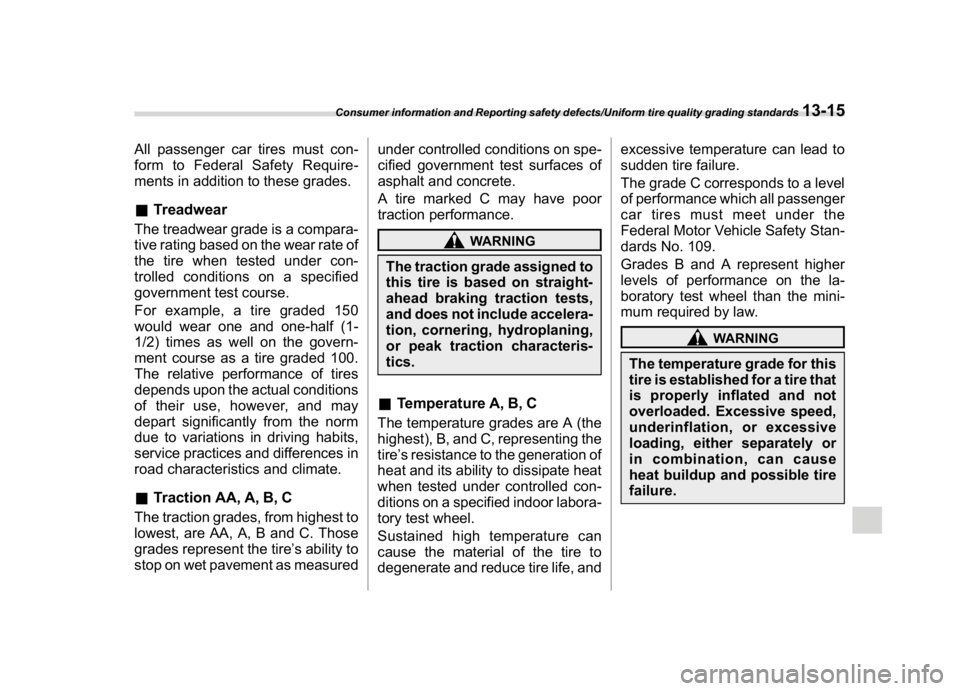
All passenger car tires must con-
form to Federal Safety Require-
ments in addition to these grades.&TreadwearThe treadwear grade is a compara-
tive rating based on the wear rate of
the tire when tested under con-
trolled conditions on a specified
government test course.
Forexample,atiregraded150
would wear one and one-half (1-
1/2) times as well on the govern-
ment course as a tire graded 100.
The relative performance of tires
depends upon the actual conditions
of their use, however, and may
depart significantly from the norm
due to variations in driving habits,
service practices and differences in
road characteristics and climate.&Traction AA, A, B, CThe traction grades, from highest to
lowest, are AA, A, B and C. Those
grades represent the tire’s ability to
stop on wet pavement as measuredunder controlled conditions on spe-
cified government test surfaces of
asphalt and concrete.
A tire marked C may have poor
traction performance.
WARNING
The traction grade assigned to
this tire is based on straight-
ahead braking traction tests,
and does not include accelera-
tion, cornering, hydroplaning,
or peak traction characteris-
tics.&Temperature A, B, CThe temperature grades are A (the
highest), B, and C, representing the
tire’s resistance to the generation of
heat and its ability to dissipate heat
when tested under controlled con-
ditions on a specified indoor labora-
tory test wheel.
Sustained high temperature can
cause the material of the tire to
degenerate and reduce tire life, andexcessive temperature can lead to
sudden tire failure.
The grade C corresponds to a level
of performance which all passenger
car tires must meet under the
Federal Motor Vehicle Safety Stan-
dards No. 109.
Grades B and A represent higher
levels of performance on the la-
boratory test wheel than the mini-
mum required by law.
WARNING
The temperature grade for this
tire is established for a tire that
is properly inflated and not
overloaded. Excessive speed,
underinflation, or excessive
loading, either separately or
in combination, can cause
heat buildup and possible tire
failure.
Consumer information and Reporting safety defects/Uniform tire quality grading standards
13-15
13