2018 SUBARU CROSSTREK Brake pad
[x] Cancel search: Brake padPage 154 of 474

(159,1)
北米Model "A1320BE-C" EDITED: 2017/ 10/ 10
&Brake system
warning light (red)This light illuminates with the parking
brake applied while the ignition switch is
in the“ON”position. It turns off when the
parking brake is fully released.
WARNING
.Driving with the brake system
warning light on is dangerous.
This indicates your brake system
may not be working properly. If
the light remains illuminated,
have the brakes inspected by a
SUBARU dealer immediately.
.If at all in doubt about whether the
brakes are operating properly, do
not drive the vehicle. Have your
vehicle towed to the nearest
SUBARU dealer for repair.
The brake system warning light has the
following functions.
!Brake fluid level warningThis light illuminates when the brake fluid
level has dropped to near the“MIN”level of
the brake fluid reservoir with the ignition
switch in the“ON”position and with the
parking brake fully released.If the brake system warning light should
illuminate while driving (with the parking
brake fully released and with the ignition
switch positioned in“ON”), it could be an
indication of leaking of brake fluid or worn
brake pads. If this occurs, immediately
stop the vehicle at the nearest safe
location and check the brake fluid level. If
the fluid level is below the“MIN”mark in
the reservoir, do not drive the vehicle.
Have the vehicle towed to the nearest
SUBARU dealer for repair.
!Electronic Brake Force Distribution
(EBD) system warning
The EBD system may be malfunctioning if
the brake system warning light
/
,
Vehicle Dynamics Control warning light
and ABS warning light
/
illuminate
simultaneously during driving.
Even if the EBD system fails, the conven-
tional braking system will still function.
However, the rear wheels will be more
prone to locking when the brakes are
applied harder than usual and the vehicle’s
motion may therefore become somewhat
harder to control.
If the brake system warning light
/
,
Vehicle Dynamics Control warning light
and ABS warning light
/
illuminate
simultaneously, take the following steps.
1. Stop the vehicle in the nearest safe, flatlocation.
2. Shut down the engine, apply the
parking brake and then restart it.
3. Fully release the parking brake.
4. Even if all the warning lights do not
come back on, the EBD system may have
a possible malfunction. Drive carefully to
the nearest SUBARU dealer and have the
system inspected.
5. If all the warning lights stay illuminated
or come back on after approximately 2
seconds, shut down the engine, apply the
parking brake and check the brake fluid
level.
.If the brake fluid level is not below the
“MIN”mark, the EBD system may be
malfunctioning. Drive carefully to the
nearest SUBARU dealer and have the
system inspected.
.If the brake fluid level is below the“MIN”
mark, DO NOT drive the vehicle. Instead,
have the vehicle towed to the nearest
SUBARU dealer for repair.
!Vacuum pressure system warning
The brake system warning light
/
will
illuminate when the vacuum pressure
sensor is malfunctioning or brake booster
pressure is decreasing.
If the brake warning light continues to
illuminate for several minutes after starting
–CONTINUED–
Instruments and controls/Warning and indicator
3-21
3
Page 258 of 474

(267,1)
北米Model "A1320BE-C" EDITED: 2017/ 10/ 10
Fuel..........................................................................7-3
Fuel requirements.................................................. 7-3
Fuel filler lid and cap............................................. 7-4
State emission testing (U.S.only).........................7-7
Preparing to drive...................................................7-8
Starting and stopping the engine
(models without push-button startsystem)...... 7-9
Starting engine...................................................... 7-9
Stopping the engine.............................................. 7-11
Starting and stopping engine
(models with push-button startsystem).......... 7-11
Safety precautions................................................ 7-11
Operating range for push-button start system....... 7-11
Starting engine..................................................... 7-11
Stopping engine....................................................7-13
When access key fob does not operate properly ... 7-14
Remote engine start system(dealer option)...... 7-14
Remote engine starter transceiver (fob) .................7-15
Alternate operation method for models with
“keyless access with push-button start
system”..............................................................7-18
Entering the vehicle while it is running via
remote start........................................................7-18
Entering the vehicle following remote engine
start shutdown....................................................7-19
Pre-heating or pre-cooling the interior of
the vehicle..........................................................7-19
Remote transmitter program
(Remote engine starter transceiver).....................7-19
System maintenance.............................................7-19
Certification for remote engine starter...................7-21
Manual transmission............................................7-21
Shifting speeds....................................................7-22
Driving tips...........................................................7-23
Continuously variable transmission...................7-24
Continuously variable transmission features.........7-24
Select lever..........................................................7-25
Selection of manual mode (if equipped)................7-26
Selection of“L”(if equipped) ................................7-28
Shift lock function................................................7-28
Driving tips...........................................................7-30
Power steering......................................................7-30
Power steering warning light ................................7-30
Power steering system features............................7-30
Braking..................................................................7-31
Braking tips..........................................................7-31
Brake system.......................................................7-31
Disc brake pad wear warning indicators................7-32
ABS (Anti-lock BrakeSystem).............................7-33
ABS self-check.....................................................7-33
ABS warning light.................................................7-33
Electronic Brake Force Distribution (EBD)
system................................................................7-34
Steps to take if EBD system malfunctions .............7-34
Vehicle Dynamics Controlsystem......................7-35
Safety precautions................................................7-35
System features....................................................7-36
Vehicle Dynamics Control system monitor ............7-37
Vehicle Dynamics Control OFF switch...................7-37
X-mode (if equipped)............................................7-38
To activate/deactivate the X-mode.........................7-39
Starting and operating
7
Page 280 of 474

(289,1)
北米Model "A1320BE-C" EDITED: 2017/ 10/ 10
Gear mph (km/h)
1st 26 (42)
2nd 52 (84)
3rd 78 (126)
4th
Legal speed limit
(Posted limit speed) 5th
6th
WARNING
When shifting down a gear, ensure
that the vehicle is not travelling at a
speed exceeding the Maximum Al-
lowable Speed for the gear which is
about to be selected. Failure to
observe this precaution can lead to
engine over-revving and this in turn
can result in engine damage.
In addition, sudden application of
engine brakes when the vehicle is
travelling on a slippery surface can
lead to wheel locking; as a conse-
quence, control of the vehicle may
be lost and the risk of an accident
increased.NOTENever exceed the posted speed limit.
&Driving tips
CAUTION
If the accelerator and brake pedals
are depressed at the same time,
driving torque may be restrained.
This is not a malfunction.
Do not drive with your foot resting on the
clutch pedal and do not use the clutch to
hold your vehicle at a standstill on an
upgrade. Either of those actions may
cause clutch damage.
Do not drive with your hand resting on the
shift lever. This may cause wear on the
transmission components.
When it is necessary to reduce vehicle
speed due to slow traffic, turning corners,
or driving up steep hills, downshift to a
lower gear before the engine starts to
labor.
On steep downgrades, downshift the
transmission to 5th, 4th, 3rd or 2nd gear
as necessary; this helps to maintain a safe
speed and to extend brake pad life.
In this way, the engine provides a braking
effect. Remember, if you“ride”(over use)
the brakes while descending a hill, they
may overheat and not work properly.The engine may, on rare occasions, knock
when the vehicle rapidly accelerates or
rapidly pulls away from a standstill. This
phenomenon is not an indication of a
problem in your vehicle.
Starting and operating/Manual transmission
7-23
7
Page 283 of 474
(292,1)
北米Model "A1320BE-C" EDITED: 2017/ 10/ 10
!N (Neutral)
This position is for restarting a stalled
engine. In this position, the transmission is
neutral, meaning that the wheels and
transmission are not locked. Therefore,
the vehicle will roll freely, even on the
slightest incline unless the parking brake
or foot brake is applied.
Avoid coasting with the transmission in
neutral. Engine braking has no effect in
this condition.
WARNING
Do not drive the vehicle with the
select lever in the“N”(neutral)
position. Engine braking has no
effect in this condition and the risk
of an accident is consequently in-
creased.
NOTEIf the select lever is in the“N”position
when you stop the engine for parking,
you may not subsequently be able to
move it to the“R”and“P”positions. If
this happens, turn the ignition switch to
the“ON”position. You will then be able
to move the select lever to the“P”
position.
!D (Drive)
This position is for normal driving. The
transmission shifts automatically and con-
tinuously into a suitable gear according to
the vehicle speed and the acceleration you
require. Also, while driving up and down a
hill, the transmission assists and controls
the driving performance and engine brak-
ing while corresponding to the road grade.
When more acceleration is required in“D”
position, depress the accelerator pedal
fully to the floor and hold that position. The
transmission will automatically downshift.
In this case, the transmission will operate
like a conventional automatic transmis-
sion. When you release the pedal, the
transmission will return to the original gear
position.
For models with manual mode, if one of the
shift paddles behind the steering wheel is
operated while driving in the“D”position,the transmission will temporarily switch to
the manual mode. In this mode, you can
shift into any gear position using the shift
paddles. For details about the manual
mode, refer to“Selection of manual mode”
F7-26. Once the vehicle speed stabilizes,
the transmission will switch from the
manual mode back to the“D”position for
normal driving.
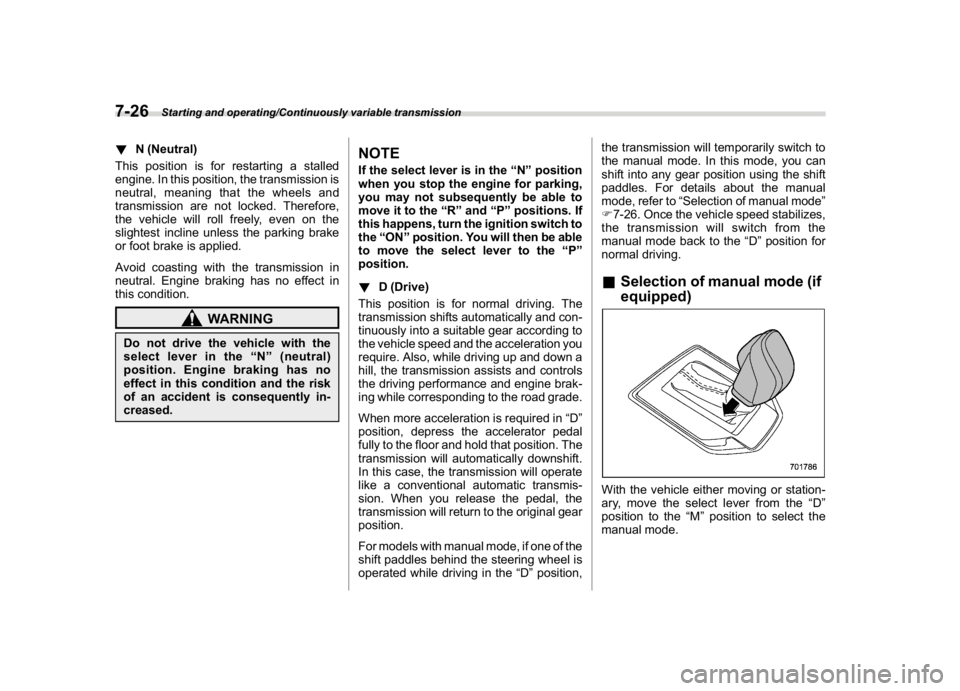
&Selection of manual mode (if
equipped)With the vehicle either moving or station-
ary, move the select lever from the“D”
position to the“M”position to select the
manual mode.
Starting and operating/Continuously variable transmission
7-26
Page 285 of 474
(294,1)
北米Model "A1320BE-C" EDITED: 2017/ 10/ 10
accidental gear shifting.NOTEPlease read the following points care-
fully and bear them in mind when using
the manual mode.
.If you attempt to shift down when the
engine speed is too high, i.e., when a
downshift would push the tachometer
needle beyond the red zone, beeps will
be emitted to warn you that the down-
shift is not possible.
.If you attempt to shift up when the
vehicle speed is too low, the transmis-
sion will not respond.
.You can perform a skip-shift (for
example, from 4th to 2nd) by operating
the shift paddle twice in rapid succes-
sion.
.The transmission automatically se-
lects 1st gear when the vehicle stops
moving.
.If the temperature of the transmis-
sion fluid becomes too high, the“AT
OIL TEMP”warning light on the combi-
nation meter will illuminate. Immedi-
ately stop the vehicle in a safe location
and let the engine idle until the warning
light turns off.
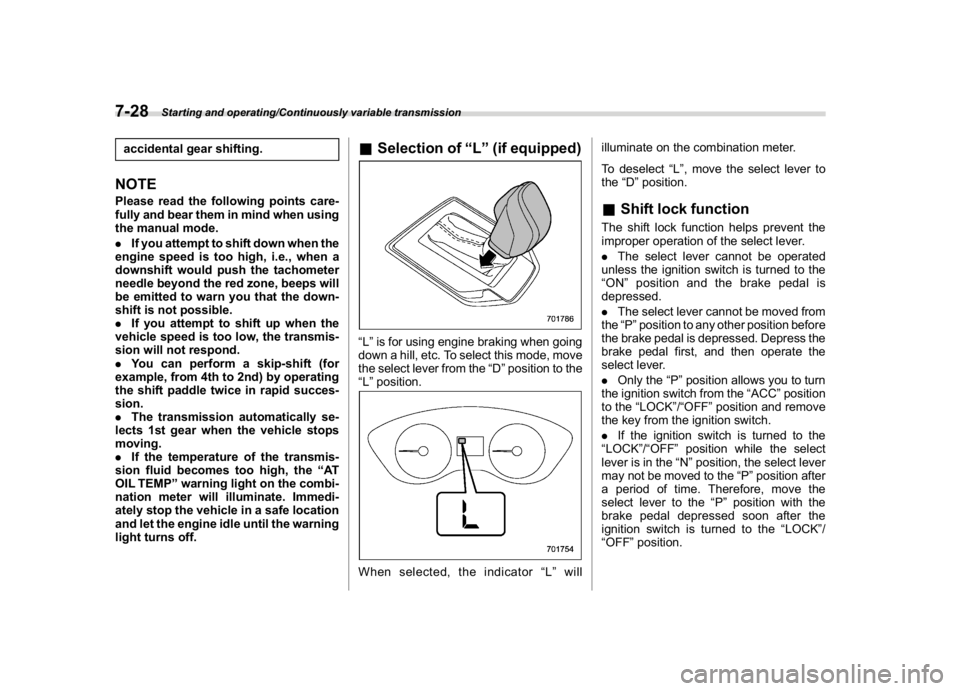
&Selection of“L”(if equipped)“L”is for using engine braking when going
down a hill, etc. To select this mode, move
the select lever from the“D”position to the
“L”position.When selected, the indicator“L”willilluminate on the combination meter.
To deselect“L”, move the select lever to
the“D”position.
&Shift lock functionThe shift lock function helps prevent the
improper operation of the select lever.
.The select lever cannot be operated
unless the ignition switch is turned to the
“ON”position and the brake pedal is
depressed.
.The select lever cannot be moved from
the“P”position to any other position before
the brake pedal is depressed. Depress the
brake pedal first, and then operate the
select lever.
.Only the“P”position allows you to turn
the ignition switch from the“ACC”position
to the“LOCK”/“OFF”position and remove
the key from the ignition switch.
.If the ignition switch is turned to the
“LOCK”/“OFF”position while the select
lever is in the“N”position, the select lever
may not be moved to the“P”position after
a period of time. Therefore, move the
select lever to the“P”position with the
brake pedal depressed soon after the
ignition switch is turned to the“LOCK”/
“OFF”position.
Starting and operating/Continuously variable transmission
7-28
Page 288 of 474
(297,1)
北米Model "A1320BE-C" EDITED: 2017/ 10/ 10
wheel is not operated for a while and
the power steering control system has
an opportunity to cool down. However,
if the power steering is operated in a
non-standard way which causes power
assist limitation to occur too frequently,
this may result in a malfunction of the
power steering control system.
Braking&Braking tips
WARNING
Never rest your foot on the brake
pedal while driving. This can cause
dangerous overheating of the
brakes and needless wear on the
brake pads and linings.
!When the brakes get wet
When driving in rain or after washing the
vehicle, the brakes may get wet. As a
result, brake stopping distance will be
longer. To dry the brakes, drive the vehicle
at a safe speed while lightly depressing the
brake pedal to heat up the brakes.
!Use of engine braking
Remember to make use of engine braking
in addition to foot braking. When descend-
ing a grade, if only the foot brake is used,
the brakes may start working improperly
because of brake fluid overheating,
caused by overheated brake pads. To help
prevent this, shift into a lower gear to get
stronger engine braking.
!Braking when a tire is punctured
Do not depress the brake pedal suddenly
when a tire is punctured. This could causea loss of control of the vehicle. Keep
driving straight ahead while gradually
reducing speed. Then slowly pull off the
road to a safe location.
&Brake system!Two separate circuits
Your vehicle has two separate circuit brake
systems. Each circuit works diagonally
across the vehicle. If one circuit of the
brake system should fail, the other half of
the system still works. If one circuit fails,
the brake pedal will go down much closer
to the floor than usual and you will need to
press it down much harder. And a much
longer distance will be needed to stop the
vehicle.
!Brake booster
The brake booster uses engine manifold
vacuum to assist braking force. Do not turn
off the engine while driving because that
will turn off the brake booster, resulting in
poor braking power.
The brakes will continue to work even
when the brake booster completely stops
functioning. If this happens, you will have
to depress the pedal much harder than
during normal braking, and the braking
distance will increase.
–CONTINUED–
Starting and operating/Braking
7-31
7
Page 289 of 474
(298,1)
北米Model "A1320BE-C" EDITED: 2017/ 10/ 10
!Supplemental booster function
when vacuum pressure fails
While the ignition switch is turned“ON”
and the engine is running, the supple-
mental booster function operates when the
brake booster performance is decreased
due to insufficient vacuum boost.
When the brake pedal is depressed while
the supplemental booster function is oper-
ating, an operation sound and brake pedal
vibration may be generated. This is not a
malfunction.
!Brake assist system
WARNING
Do not be overconfident about the
brake assist. It is not a system that
brings more braking ability to the
vehicle beyond its braking capabil-
ity. Always use the utmost care
when driving regarding vehicle
speed and safe distance.
CAUTION
When you need to brake suddenly,
continue depressing the brake pedal
strongly to bring the effect of the
brake assist.Brake assist is a driver assistance system.
It assists the brake power when the driver
cannot depress the brake pedal strongly
and the brake power is insufficient.
Brake assist generates the brake power
according to the speed at which the driver
depresses the brake pedal.
NOTEWhen you depress the brake pedal
strongly or suddenly, the following
phenomena occur. However, even
though these occur, they do not indi-
cate any malfunctions, and the brake
assist system is operating properly.
.You might feel that the brake pedal is
applied by lighter force and generates a
greater braking force.
.You might hear an ABS operating
noise from the engine compartment.
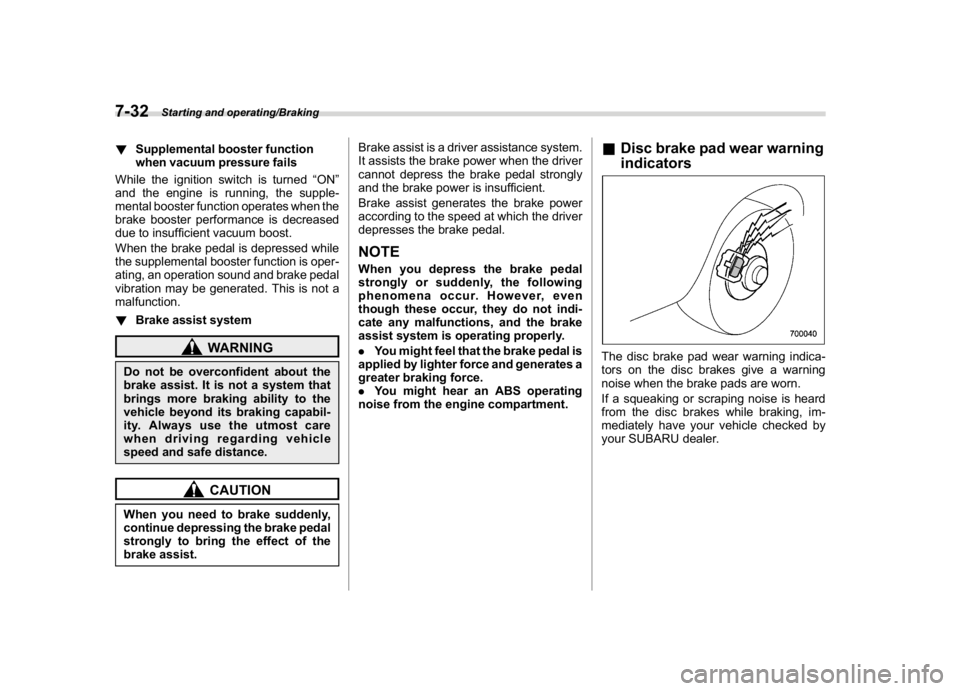
&Disc brake pad wear warning
indicatorsThe disc brake pad wear warning indica-
tors on the disc brakes give a warning
noise when the brake pads are worn.
If a squeaking or scraping noise is heard
from the disc brakes while braking, im-
mediately have your vehicle checked by
your SUBARU dealer.
Starting and operating/Braking
7-32
Page 329 of 474

(340,1)
北米Model "A1320BE-C" EDITED: 2017/ 10/ 10
New vehicle break-in driving–
the first 1,000 miles (1,600 km)The performance and long life of your
vehicle are dependent on how you handle
and care for your vehicle while it is new.
Follow these instructions during the first
1,000 miles (1,600 km):
.Do not race the engine. And do not
allow engine speed to exceed 4,000 rpm
except in an emergency.
.Do not drive at one constant engine or
vehicle speed, either fast or slow.
.Avoid starting suddenly and rapid ac-
celeration, except in an emergency.
.Avoid hard braking, except in an emer-
gency.
The same break-in procedures should be
applied to an overhauled engine, newly
mounted engine or when brake pads or
brake linings are replaced with new ones.
Fuel economy hintsThe following suggestions will help to save
fuel.
.Select the proper gear position for the
speed and road conditions.
.Avoid sudden acceleration or decelera-
tion. Always accelerate gently until you
reach the desired speed. Then try to
maintain that speed for as long as possi-
ble.
.Do not pump the accelerator and avoid
racing the engine.
.Avoid unnecessary engine idling.
.Keep the engine properly tuned.
.Keep the tires inflated to the correct
pressure shown on the tire placard, which
is located under the door latch on the
driver’s side. Low pressure will increase
tire wear and fuel consumption.
.Use the air conditioner only when
necessary.
.Keep the front and rear wheels in
proper alignment.
.Avoid carrying unnecessary luggage or
cargo.
Engine exhaust gas (carbon
monoxide)
WARNING
.Never inhale engine exhaust gas.
Engine exhaust gas contains
carbon monoxide, a colorless
and odorless gas which is dan-
gerous, or even lethal, if inhaled.
.Always properly maintain the en-
gine exhaust system to prevent
engine exhaust gas from entering
the vehicle.
.Never run the engine in a closed
space, such as a garage, except
for the brief time needed to drive
the vehicle in or out of it.
.Avoid remaining in a parked ve-
hicle for a lengthy time while the
engine is running. If that is un-
avoidable, then use the ventila-
tion fan to force fresh air into the
vehicle.
.Always keep the front ventilator
inlet grille free from snow, leaves
or other obstructions to ensure
that the ventilation system al-
ways works properly.
.If at any time you suspect that
Driving tips/New vehicle break-in driving–the first 1,000 miles (1,600 km)
8-2