2018 SUBARU CROSSTREK Brake pad
[x] Cancel search: Brake padPage 334 of 474

(345,1)
北米Model "A1320BE-C" EDITED: 2017/ 10/ 10
stops. This could create a fire hazard.
Precautions when driving under espe-
cially dangerous situations:
.If driving through water, such as when
crossing shallow streams, first check the
depth of the water and the bottom of the
stream bed for firmness and ensure that
the bed of the stream is flat. Drive slowly
and cross the stream without stopping.
The water should be shallow enough that it
does not reach the vehicle’s undercar-
riage. Water entering the engine air intake
or the exhaust pipe or water splashing onto
electrical parts may damage your vehicle
and may cause it to stall. Never attempt to
drive through rushing water; regardless of
its depth, it can wash away the ground
from under your tires, resulting in possible
loss of traction and even vehicle rollover.
.If you must rock the vehicle to free it
from sand or mud, depress the accelerator
pedal slightly and move the shift lever/
select lever back and forth between“1”/“D”
and“R”repeatedly. Do not race the
engine. For the best possible traction,
avoid spinning the wheels when trying to
free the vehicle.
.When the road surface is extremely
slippery, you can obtain better traction by
starting the vehicle with the transmission in
2nd than 1st (both for MT and CVT). For
CVT models, refer to“Selection of manualmode”F7-26.
&After driving.Always check your brakes for effective-
ness immediately after driving in sand,
mud or water. Do this by driving slowly and
stepping on the brake pedal. Repeat that
process several times to dry out the brake
discs and brake pads.
.After driving through tall grass, mud,
rocks, sand, rivers, etc., check that there is
no grass, bush, paper, rags, stones, sand,
etc. adhering to or trapped on the under-
body. Clear off any such matter from the
underbody. If the vehicle is used with these
materials trapped or adhering to the
underbody, a mechanical breakdown or
fire could occur.
.Wash the vehicle’s underbody after off-
road driving. Suspension components are
particularly prone to dirt buildup, so they
need to be washed thoroughly.
Winter driving&Operation during cold weath-
er!Maintenance
Carry some emergency equipment, such
as a window scraper, a bag of sand, flares,
a small shovel and jumper cables.
Check the battery and cables. Cold tem-
peratures reduce battery capacity. The
battery must be in good condition to
provide enough power for cold winter
starts.
It normally takes longer to start the engine
in very cold weather conditions. Use an
engine oil of a proper grade and viscosity
for cold weather. Using heavy summer oil
will make it harder to start the engine.
Keep the door locks from freezing by
squirting them with deicer or glycerin.
Forcing a frozen door open may damage
or separate the rubber weather strips
around the door. If the door is frozen, use
hot water to melt the ice, and afterwards
thoroughly wipe the water away.
Use a windshield washer fluid that con-
tains an antifreeze solution. Do not use
engine antifreeze or other substitutes
because they may damage the paint of
–CONTINUED–
Driving tips/Winter driving
8-7
8
Page 382 of 474

(395,1)
北米Model "A1320BE-C" EDITED: 2017/ 10/ 10
Maintenance schedule.......................................... 11-3
Maintenance precautions..................................... 11-3
Before checking or servicing in the engine
compartment...................................................... 11-4
When checking or servicing in the engine
compartment...................................................... 11-4
When checking or servicing in the engine
compartment while the engine is running............ 11-5
Engine hood.......................................................... 11-5
Engine compartment overview............................ 11-7
Engine oil............................................................... 11-8
Engine oil consumption........................................ 11-8
Locations of the oil level gauge, oil filler cap
and oil filter........................................................ 11-8
Checking the oil level............................................ 11-8
Changing the oil and oil filter................................ 11-9
Recommended grade and viscosity..................... 11-10
Synthetic oil........................................................ 11-10
Cooling system................................................... 11-10
Safety precautions.............................................. 11-10
Cooling fan, hose and connections..................... 11-11
Engine coolant.................................................... 11-11
Air cleaner element............................................. 11-12
Replacing the air cleaner element........................ 11-13
Spark plugs......................................................... 11-14
Recommended spark plugs................................. 11-14
Drive belts........................................................... 11-14
Manual transmission oil..................................... 11-14
Recommended grade and viscosity..................... 11-14
Continuously variable transmission fluid..........11-15
Front differential gear oil (CVT models) and
rear differential gear oil....................................11-15
Recommended grade and viscosity..................... 11-15
Brake fluid............................................................11-15
Checking the fluid level...................................... 11-15
Recommended brake fluid.................................. 11-16
Clutch fluid (MT models).....................................11-16
Checking the fluid level...................................... 11-16
Recommended clutch fluid................................. 11-17
Brake booster......................................................11-17
Brake pedal..........................................................11-18
Checking the brake pedal free play..................... 11-18
Checking the brake pedal reserve distance ......... 11-18
Clutch pedal (MT models)...................................11-18
Checking the clutch function .............................. 11-18
Checking the clutch pedal free play.................... 11-19
Hill start assist system.......................................11-19
Replacement of brake pad andlining................11-19
Breaking-in of new brake pads and linings .......... 11-20
Parking brake stroke...........................................11-20
Tires and wheels.................................................11-21
Types of tires..................................................... 11-21
Tire pressure monitoring system (TPMS)
(if equipped).................................................... 11-21
Tire inspection.................................................... 11-22
Tire pressures and wear..................................... 11-23
Wheel balance.................................................... 11-24
Wear indicators.................................................. 11-25
Maintenance and service
11
Page 399 of 474
(412,1)
北米Model "A1320BE-C" EDITED: 2017/ 10/ 10
Brake pedalCheck the brake pedal free play and
reserve distance according to the main-
tenance schedule in the“Warranty and
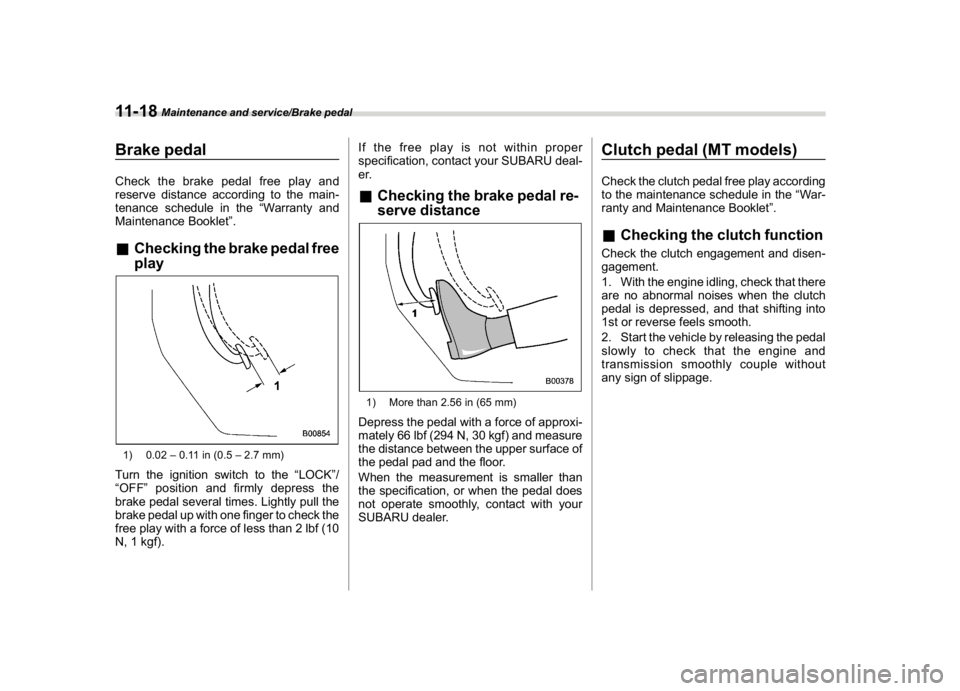
Maintenance Booklet”.&Checking the brake pedal free
play1) 0.02–0.11 in (0.5–2.7 mm)Turn the ignition switch to the“LOCK”/
“OFF”position and firmly depress the
brake pedal several times. Lightly pull the
brake pedal up with one finger to check the
free play with a force of less than 2 lbf (10
N, 1 kgf).If the free play is not within proper
specification, contact your SUBARU deal-
er.
&Checking the brake pedal re-
serve distance1) More than 2.56 in (65 mm)Depress the pedal with a force of approxi-
mately 66 lbf (294 N, 30 kgf) and measure
the distance between the upper surface of
the pedal pad and the floor.
When the measurement is smaller than
the specification, or when the pedal does
not operate smoothly, contact with your
SUBARU dealer.
Clutch pedal (MT models)Check the clutch pedal free play according
to the maintenance schedule in the“War-
ranty and Maintenance Booklet”.&Checking the clutch functionCheck the clutch engagement and disen-
gagement.
1. With the engine idling, check that there
are no abnormal noises when the clutch
pedal is depressed, and that shifting into
1st or reverse feels smooth.
2. Start the vehicle by releasing the pedal
slowly to check that the engine and
transmission smoothly couple without
any sign of slippage.
Maintenance and service/Brake pedal
11-18
Page 400 of 474

(413,1)
北米Model "A1320BE-C" EDITED: 2017/ 10/ 10
&Checking the clutch pedal
free play1) 0.16–0.43 in (4.0–11.0 mm)Lightly depress the clutch pedal down with
your finger until you feel resistance, and
check the free play.
If the free play is not within proper
specification, contact your SUBARU deal-
er.
Hill start assist systemEnsure that the Hill start assist system
operates properly under the following
circumstances.
1. Stop the vehicle on an uphill grade by
depressing the brake pedal (all models)
and clutch pedal (MT models only), with
the engine running.
2. Make sure that the vehicle does not
move backward for several seconds after
the brake pedal is released.
3. Then make sure the vehicle starts
climbing the grade by following the normal
starting procedures.
If the Hill start assist system does not
operate as described above, contact your
SUBARU dealer.
Replacement of brake pad
and liningThe disc brakes have audible wear in-
dicators on the brake pads. If the brake
pads wear close to their service limit, the
wear indicator makes a very audible
scraping noise when the brake pedal is
applied.
If you hear this scraping noise each time
you apply the brake pedal, have the brake
pads serviced by your SUBARU dealer as
soon as possible.
CAUTION
If you continue to drive despite the
scraping noise from the audible
brake pad wear indicator, it will
–CONTINUED–
Maintenance and service/Hill start assist system
11-19
11
Page 401 of 474
(414,1)
北米Model "A1320BE-C" EDITED: 2017/ 10/ 10
result in the need for costly brake
rotor repair or replacement.&Breaking-in of new brake
pads and liningsWhen replacing the brake pad or lining,
use only genuine SUBARU parts. After
replacement, the new parts must be
broken in as follows.
!Brake pad and lining
While maintaining a speed of 30 to 40 mph
(50 to 65 km/h), step on the brake pedal
lightly. Repeat this five or more times.
!Parking brake lining
1. Drive the vehicle at a speed of approxi-
mately 22 mph (35 km/h).
2. With the parking brake release button
pushed in, pull the parking brake lever
SLOWLY and GENTLY (pulling with a
force of approximately 33.7 lbf [150 N,
15.3 kgf]).
3. Drive the vehicle for approximately 220
yards (200 meters) in this condition.
4. Wait 5 to 10 minutes for the parking
brake to cool down. Repeat this proce-
dure.
5. Check the parking brake stroke. If the
parking brake stroke is out of the specified
range, adjust it by turning the adjusting nutlocated on the parking brake lever.
Parking brake stroke:
7–8 notches / 45 lbf (200 N, 20.4 kgf)
WARNING
A safe location and situation should
be selected for break-in driving.
CAUTION
Pulling the parking brake lever too
forcefully may cause the rear wheels
to lock. To avoid this, be certain to
pull the lever up slowly and gently.
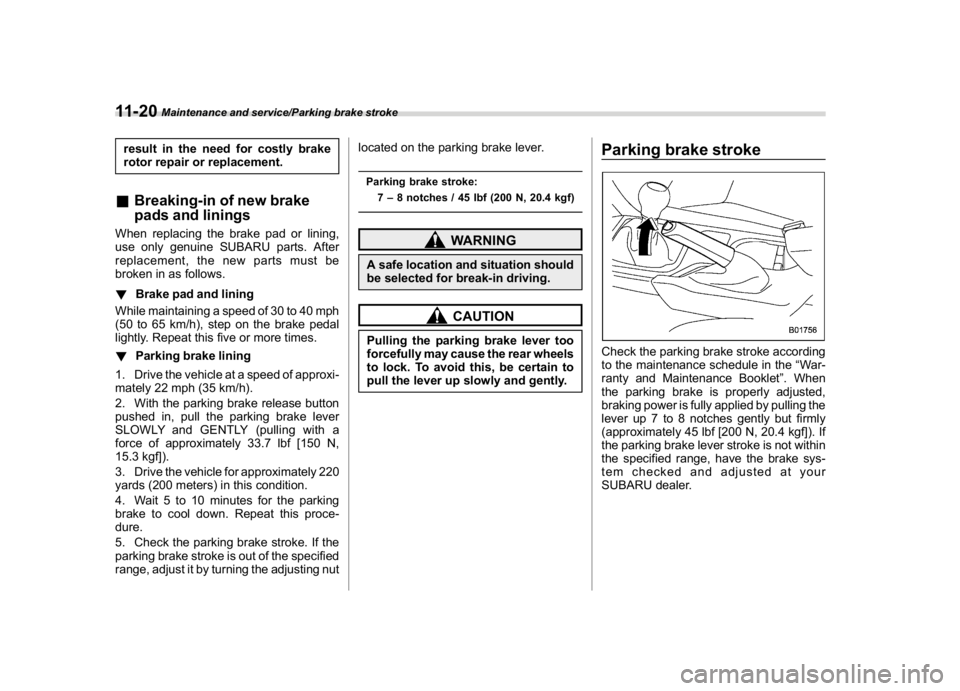
Parking brake strokeCheck the parking brake stroke according
to the maintenance schedule in the“War-
ranty and Maintenance Booklet”. When
the parking brake is properly adjusted,
braking power is fully applied by pulling the
lever up 7 to 8 notches gently but firmly
(approximately 45 lbf [200 N, 20.4 kgf]). If
the parking brake lever stroke is not within
the specified range, have the brake sys-
tem checked and adjusted at your
SUBARU dealer.
Maintenance and service/Parking brake stroke
11-20