2018 SUBARU CROSSTREK steering
[x] Cancel search: steeringPage 43 of 474
(44,1)
北米Model "A1320BE-C" EDITED: 2017/ 10/ 10
&Emergency Locking Retrac-
tor (ELR)The driver’s seatbelt has an Emergency
Locking Retractor (ELR).
The emergency locking retractor allows
normal body movement but the retractor
locks automatically during a sudden stop,
impact or if you pull the belt very quickly
out of the retractor.&Automatic Locking Retractor/
Emergency Locking Retrac-
tor (ALR/ELR)Each passenger’s seatbelt has an Auto-
matic Locking Retractor/Emergency Lock-
ing Retractor (ALR/ELR). The Automatic
Locking Retractor/Emergency Locking
Retractor normally functions as an Emer-
gency Locking Retractor (ELR). The ALR/
ELR has an additional locking mode
“Automatic Locking Retractor (ALR)
mode”intended to secure a child restraint
system. When the seatbelt is once drawn
out completely and is then retracted even
slightly, the retractor locks the seatbelt in
that position and the seatbelt cannot be
extended. As the belt is rewinding, clicks
will be heard which indicate the retractor
functions as an ALR. When the seatbelt is
retracted fully, the ALR mode is released.
When securing a child restraint system onthe rear seats by the use of the seatbelt,
the seatbelt must be changed over to the
Automatic Locking Retractor (ALR) mode.
When the child restraint system is re-
moved, make sure that the seatbelt re-
tracts fully and the retractor returned to the
Emergency Locking Retractor (ELR)
mode.
For instructions on how to convert the
retractor to the ALR mode and restore it to
the ELR mode, refer to“Installing child
restraint systems with ALR/ELR seatbelt”
F1-28.
&Seatbelt warning light
and chimeRefer to“Seatbelt warning light and chime”
F3-13.&Fastening the seatbelt!Front seatbelts
1. Adjust the seat position according to
the following procedure.
Driver’s seat:Adjust the seatback to the
upright position. Move the seat as far from
the steering wheel as practical while still
maintaining full vehicle control.
Front passenger’s seat:Adjust the seat-
back to the upright position. Move the seat
as far back as possible.2. Sit well back in the seat.
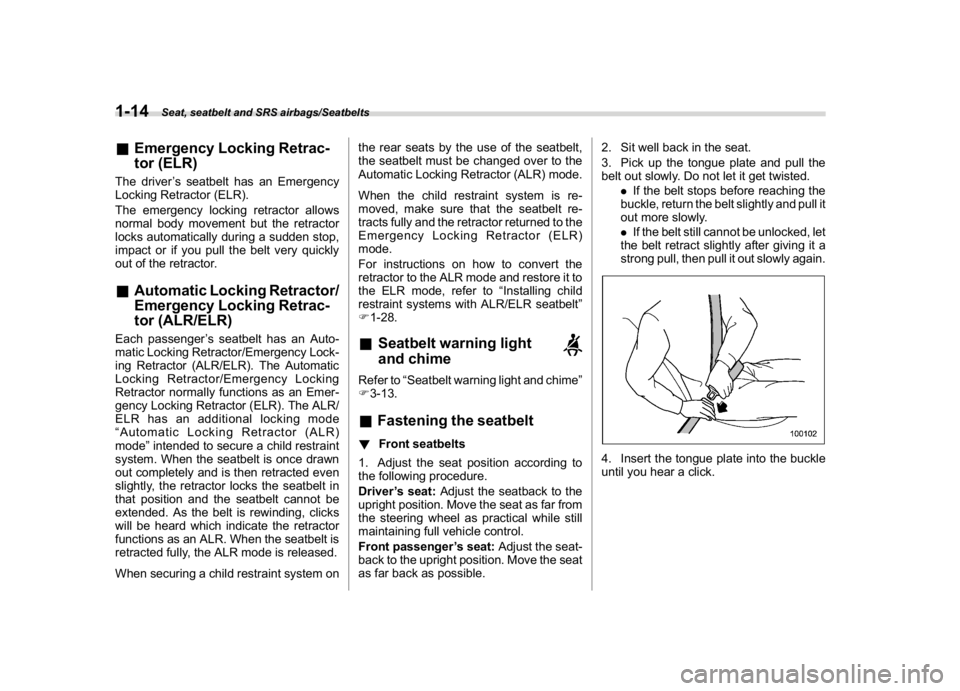
3. Pick up the tongue plate and pull the
belt out slowly. Do not let it get twisted.
.If the belt stops before reaching the
buckle, return the belt slightly and pull it
out more slowly.
.If the belt still cannot be unlocked, let
the belt retract slightly after giving it a
strong pull, then pull it out slowly again.
4. Insert the tongue plate into the buckle
until you hear a click.
Seat, seatbelt and SRS airbags/Seatbelts
1-14
Page 57 of 474
(58,1)
北米Model "A1320BE-C" EDITED: 2017/ 10/ 10
WARNING
SINCE YOUR VEHICLE IS
EQUIPPED WITH A PASSENGER’S
SRS AIRBAG, NEVER INSTALL A
FORWARD OR REARWARD FACING
CHILD SAFETY SEAT IN THE FRONT
PASSENGER’S SEAT. DOING SO
RISKS SERIOUS INJURY OR DEATH
TO THE CHILD BY PLACING THE
CHILD’S HEAD TOO CLOSE TO THE
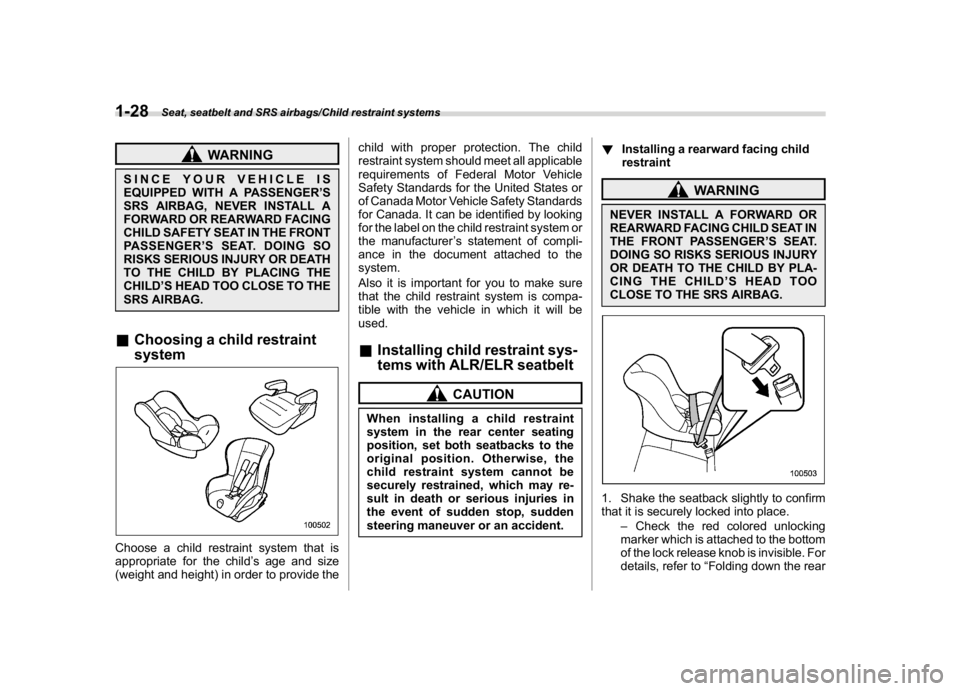
SRS AIRBAG.&Choosing a child restraint
systemChoose a child restraint system that is
appropriate for the child’s age and size
(weight and height) in order to provide thechild with proper protection. The child
restraint system should meet all applicable
requirements of Federal Motor Vehicle
Safety Standards for the United States or
of Canada Motor Vehicle Safety Standards
for Canada. It can be identified by looking
for the label on the child restraint system or
the manufacturer’s statement of compli-
ance in the document attached to the
system.
Also it is important for you to make sure
that the child restraint system is compa-
tible with the vehicle in which it will be
used.
&Installing child restraint sys-
tems with ALR/ELR seatbelt
CAUTION
When installing a child restraint
system in the rear center seating
position, set both seatbacks to the
original position. Otherwise, the
child restraint system cannot be
securely restrained, which may re-
sult in death or serious injuries in
the event of sudden stop, sudden
steering maneuver or an accident.!Installing a rearward facing child
restraint
WARNING
NEVER INSTALL A FORWARD OR
REARWARD FACING CHILD SEAT IN
THE FRONT PASSENGER’S SEAT.
DOING SO RISKS SERIOUS INJURY
OR DEATH TO THE CHILD BY PLA-
CING THE CHILD’SHEADTOO
CLOSE TO THE SRS AIRBAG.1. Shake the seatback slightly to confirm
that it is securely locked into place.
–Check the red colored unlocking
marker which is attached to the bottom
of the lock release knob is invisible. For
details, refer to“Folding down the rear
Seat, seatbelt and SRS airbags/Child restraint systems
1-28
Page 67 of 474
(68,1)
北米Model "A1320BE-C" EDITED: 2017/ 10/ 10
&General precautions regard-
ing SRS airbag system
WARNING
.To obtain maximum protection in
the event of an accident, the
driver and all passengers must
always wear seatbelts when in
the vehicle. The SRS airbag is
designed only to be a supplement
to the primary protection pro-
vided by the seatbelt. It does not
eliminate the need to fasten seat-
belts. In combination with the
seatbelts, it offers the best com-
bined protection in case of a
serious accident.
Not wearing a seatbelt increases
the chance of severe injury or
death in a crash even when the
vehicle has the SRS airbag.
For instructions and precautions
concerning the seatbelt system,
refer to“Seatbelts”F1-12.
.The SRS side airbag and SRS
curtain airbag are designed only
to be a supplement to the primary
protection provided by the seat-
belt. They do not eliminate the
need to fasten seatbelts. It is also
important to wear your seatbelt tohelp avoid injuries that can result
when an occupant is not seated
in a proper upright position.
WARNING
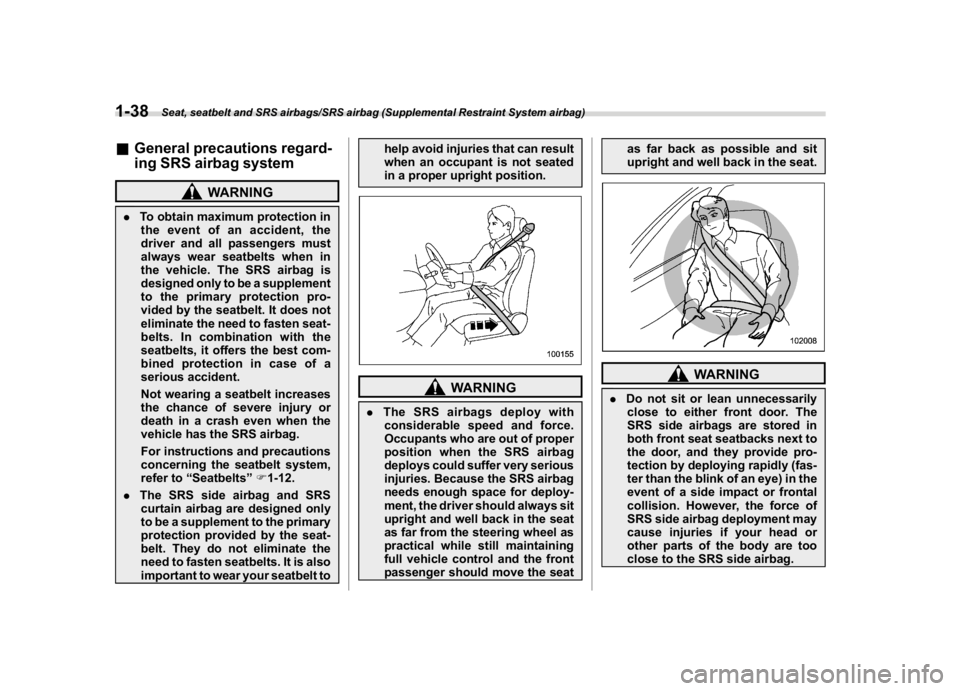
.The SRS airbags deploy with
considerable speed and force.
Occupants who are out of proper
position when the SRS airbag
deploys could suffer very serious
injuries. Because the SRS airbag
needs enough space for deploy-
ment, the driver should always sit
upright and well back in the seat
as far from the steering wheel as
practical while still maintaining
full vehicle control and the front
passenger should move the seatas far back as possible and sit
upright and well back in the seat.
WARNING
.Do not sit or lean unnecessarily
close to either front door. The
SRS side airbags are stored in
both front seat seatbacks next to
the door, and they provide pro-
tection by deploying rapidly (fas-
ter than the blink of an eye) in the
event of a side impact or frontal
collision. However, the force of
SRS side airbag deployment may
cause injuries if your head or
other parts of the body are too
close to the SRS side airbag.
Seat, seatbelt and SRS airbags/SRS airbag (Supplemental Restraint System airbag)
1-38
Page 69 of 474
(70,1)
北米Model "A1320BE-C" EDITED: 2017/ 10/ 10
of fire caused by leaking fuel. For
details about restarting of the engine,
refer to“If your vehicle is involved in an
accident”F9-20.&General precautions regard-
ing SRS airbag system for
accessories and any objects
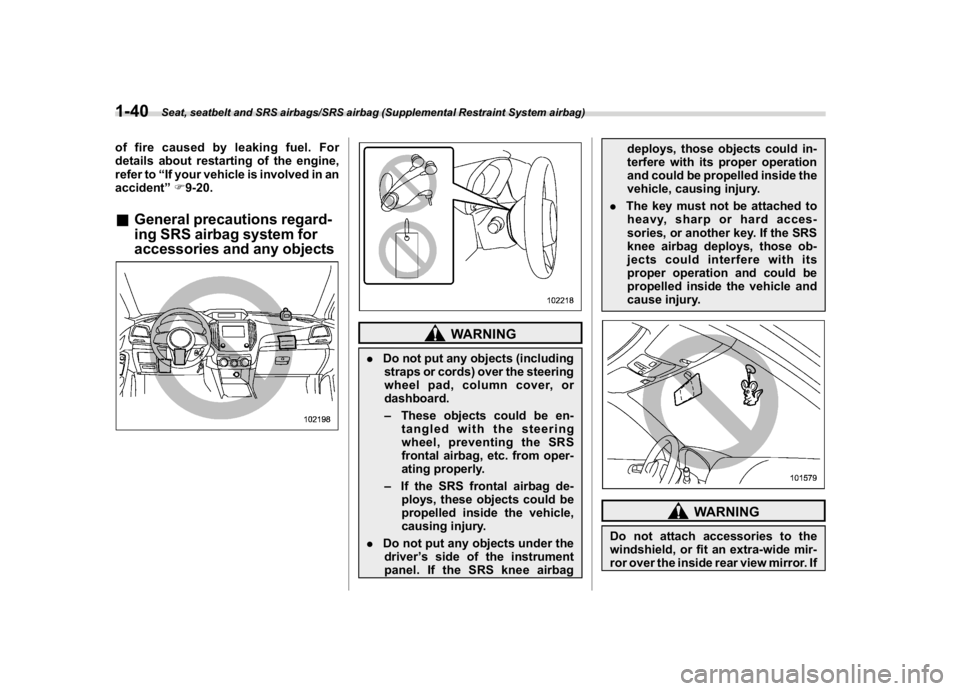
WARNING
.Do not put any objects (including
straps or cords) over the steering
wheel pad, column cover, or
dashboard.
–These objects could be en-
tangled with the steering
wheel, preventing the SRS
frontal airbag, etc. from oper-
ating properly.
–If the SRS frontal airbag de-
ploys, these objects could be
propelled inside the vehicle,
causing injury.
.Do not put any objects under the
driver’s side of the instrument
panel. If the SRS knee airbagdeploys, those objects could in-
terfere with its proper operation
and could be propelled inside the
vehicle, causing injury.
.The key must not be attached to
heavy, sharp or hard acces-
sories, or another key. If the SRS
knee airbag deploys, those ob-
jects could interfere with its
proper operation and could be
propelled inside the vehicle and
cause injury.
WARNING
Do not attach accessories to the
windshield, or fit an extra-wide mir-
ror over the inside rear view mirror. If
Seat, seatbelt and SRS airbags/SRS airbag (Supplemental Restraint System airbag)
1-40
Page 74 of 474

(75,1)
北米Model "A1320BE-C" EDITED: 2017/ 10/ 10
&Components1) Driver’s SRS frontal airbag
2) Front passenger’s SRS frontal airbag
3) SRS side airbag
4) SRS curtain airbag
5) SRS knee airbag
The SRS airbags are stowed in the
following locations.
Driver’s SRS frontal airbag: in the center
portion of the steering wheel
A“SRS AIRBAG”mark is located at the
pad of the airbag.
Front passenger’s SRS frontal airbag:
near the top of the dashboard under the
“SRS AIRBAG”mark
SRS side airbag: in the door side of each
front seat seatback which bears an“SRS
AIRBAG”label
SRS curtain airbag: in the roof side
(between the front pillar and a point behind
the rear quarter glass)
“SRS AIRBAG”marks are located at the
top of each center pillar.
SRS knee airbag: under the steering
column
A“SRS AIRBAG”mark is located at the
door of the airbag.
–CONTINUED–
Seat, seatbelt and SRS airbags/SRS airbag (Supplemental Restraint System airbag)
1-45
1
Page 84 of 474

(85,1)
北米Model "A1320BE-C" EDITED: 2017/ 10/ 10
The driver’s and front passenger’s SRS
frontal airbags use dual stage inflators.
The two inflators of each airbag are
triggered either sequentially or simulta-
neously, depending on the severity of
impact, in the case of the driver’s SRS
frontal airbag and depending on the
severity of impact and the characteristic
of item(s) or person on the seat in the case
of the front passenger’s SRS frontal air-
bag.
!After deployment
After deployment, the SRS airbag imme-
diately starts to deflate so that the driver’s
vision is not obstructed and the driver’s
ability to maintain control of the vehicle is
not impaired. The time required from
detecting impact to the deflation of the
SRS airbag after deployment is shorter
than the blink of an eye.
Both when only the driver’s SRS frontal
airbag deploys and the driver’s and front
passenger’s SRS frontal airbags deploy,
the driver’s and front passenger’s seatbelt
pretensioners operate at the same time.
When the SRS airbag deploys, a sudden,
fairly loud inflation noise will be heard and
some smoke will be released. These
occurrences are a normal result of the
deployment. This smoke does not indicate
a fire in the vehicle.
CAUTION
Do not touch the SRS airbag system
components around the steering
wheel and dashboard with bare
hands right after deployment. Doing
so can cause burns because the
components can be very hot as a
result of deployment.
!Example of the type of accident
The driver’s SRS frontal airbag and front
passenger’s SRS frontal airbag are de-
signed as follows.
.to deploy in the event of an accident
involving a moderate to severe frontal
collision
.to function on a one-time-only basis
The driver’s SRS frontal airbag and front
passenger’s SRS frontal airbag are not
designed as follows.
.to deploy in most lesser frontal im-
pacts
*1
.to deploy in most side or rear impacts or
in most rollover accidents
*2
*1: Because the necessary protection can be
achieved by the seatbelt alone.
*2: Because deployment of only the driver’s
SRS frontal airbag or both the driver’s and frontpassenger’s SRS frontal airbags would not
protect the occupant in those situations.
SRS airbag deployment depends on the
level of force experienced in the passen-
ger compartment during a collision. That
level differs from one type of collision to
another, and it may have no bearing on the
visible damage done to the vehicle itself.
!Example of accident in which the
driver’s/driver’s and front pas-
senger’s SRS frontal airbag(s)
will most likely deployA head-on collision against a thick con-
crete wall at a vehicle speed of 12 to 19
mph (20 to 30 km/h) or higher activates
only the driver’s SRS frontal airbag or both
driver’s and front passenger’s SRS frontal
airbags. The airbag(s) will also be acti-
–CONTINUED–
Seat, seatbelt and SRS airbags/SRS airbag (Supplemental Restraint System airbag)
1-55
1
Page 88 of 474

(89,1)
北米Model "A1320BE-C" EDITED: 2017/ 10/ 10
for front seat occupants.
!SRS curtain airbag
Your vehicle is equipped with a SUBARU
SRS curtain airbag system that complies
with the Federal Motor Vehicle Safety
Standard (FMVSS) No. 226.
The SRS curtain airbag on each side of the
cabin is stored in the roof side (between
the front pillar and a point over the rear
seat). An“SRS AIRBAG”mark is located
at the top of each center pillar.
Inamoderatetoseveresideimpact
collision, the SRS curtain airbag on the
impacted side of the vehicle deploys
between the occupant and the side win-
dow and supplements the seatbelt by
reducing the impact on the occupant’s
head.
In a rollover, SRS curtain airbags on both
sides of the vehicle deploy between the
occupant and the side window and supple-
ment the seatbelt by reducing the impact to
the occupant’s head.
In an offset frontal collision, SRS curtain
airbags on both sides of the vehicle deploy
between the occupant and the side win-
dow and supplement the seatbelt by
reducing the impact to the occupant’s
head and chest.!Operation
The SRS side airbag and SRS curtain
airbag can function only when the ignition
switch is in the“ON”position.
The following airbags deploy indepen-
dently of each other since each has its
own impact sensor.
.Driver’s SRS side airbag
.Front passenger’s SRS side airbag
.SRS curtain airbag (right-hand side)
.SRS curtain airbag (left-hand side)
Therefore, they may not both deploy in the
same accident. Also, the SRS side airbag
and SRS curtain airbag deploys indepen-
dently of the driver’s and front passenger’s
SRS frontal airbags in the steering wheel
and instrument panel.
An impact sensor, which senses impact
force, is located in each of the following
locations.
.In the left and right front doors
.In the left and right center pillars
.In the left and right rear wheel houses
.Under the rear center seat
A rollover sensor is also located inside the
airbag control module.
–CONTINUED–
Seat, seatbelt and SRS airbags/SRS airbag (Supplemental Restraint System airbag)
1-59
1
Page 97 of 474
(98,1)
北米Model "A1320BE-C" EDITED: 2017/ 10/ 10
.Under the center of the instru-
ment panel
.On both the right and left sides at
the front of the vehicle
.Steering wheel and column and
nearby areas
.Bottom of the steering column
and nearby areas
.Top of the dashboard on front
passenger’s side and nearby
areas
.Each front seat and nearby area
.Inside each center pillar
.Inside each front door
.In each roof side (from the front
pillar to a point over the rear seat)
.Between the rear seat cushion
and rear wheel house on each
side
.Under the rear center seat
In the event that the SRS airbag is
deployed, replacement of the system
should be performed only by an author-
ized SUBARU dealer. When the compo-
nents of the SRS airbag system are
replaced, use only genuine SUBARU
parts.
NOTEIn the following cases, contact your
SUBARU dealer as soon as possible.
.The front part of the vehicle was
involved in an accident in which only
the driver’s SRS frontal airbag or both
driver’s and front passenger’sSRS
frontal airbags did not deploy.
.The pad of the steering wheel, the
cover over the front passenger’s SRS
frontal airbag, or either roof side (from
the front pillar to a point over the rear
seat) is scratched, cracked, or other-
wise damaged.
.The center pillar, front door, rear
wheel house or rear sub frame, or an
area near these parts, was involved in
an accident in which the SRS side
airbag and SRS curtain airbag did not
deploy.
.The fabric or leather of either front
seatback is cut, frayed, or otherwise
damaged.
.The rear part of the vehicle was
involved in an accident in which no
SRS airbag was deployed.
&Precautions against vehicle
modification
WARNING
To avoid accidental activation of the
system or rendering the system
inoperative, which may result in
serious injury, no modifications
should be made to any components
or wiring of the SRS airbag system.
This includes following modifica-
tions.
.Installation of custom steering
wheels
.Attachment of additional trim ma-
terials to the dashboard
.Installation of custom seats
.Replacement of seat fabric or
leather
.Installation of additional fabric or
leather on the front seat
.Attachment of a hands-free mi-
crophone or any other accessory
to a front pillar, a center pillar, a
rear pillar, the windshield, a side
window, an assist grip, or any
other cabin surface that would be
near a deploying SRS curtain
airbag.
Seat, seatbelt and SRS airbags/SRS airbag (Supplemental Restraint System airbag)
1-68