Page 229 of 332

3.33
To replace the seatback, proceed in
the reverse order to removal.
Refit the seatback and click it back into
place.
REAR BENCH SEAT (1/3)
For safety reasons, carry
out any adjustments when
the vehicle is not being
driven.
When moving the rear
seats, ensure that nothing
obstructs the anchorage
points (passenger’s arm or
leg, a pet, gravel, cloth, toys, etc.).
A
1
The configuration of the
two-seat bench with the
small seatback B pulled
down, does not allow the
central seat to be used as it would
be impossible to buckle the seat belt
(belt buckles inaccessible).
When refitting the seat-
back, make sure it is cor-
rectly locked in place.
If seat covers are fitted ,
make sure these do not prevent the
seatback latch from locking in.
Make sure that the seat belts are
positioned correctly.
Reposition the headrests.
To manually fold down the
seatbacks
Ensure that the front seats are far
enough forward.
Lower the headrests fully.
Pull the control 1 and lower the seat-
back A.
B
Page 230 of 332
3.34
To automatically fold down
the seatbacks (flat position)
Place seat belt in hook 2 to avoid dam-
aging the belt. From the boot, pulling
the control 3 enables you to automati-
cally unlock the rear bench seatbacks
to get a flat floor.
Conditions of use
– Vehicle stationary;
– tailgate open;
– rear seat belts unlocked.
Operating fault
If all user conditions have been ful-
filled and the folding action still fails to
operate, please contact an authorised
dealer.
REAR BENCH SEAT (2/3)
When moving the rear
seats, ensure that nothing
obstructs the anchorage
points (passenger’s arm or
leg, a pet, gravel, cloth, toys, etc.).
Use restriction
It is forbidden to drive with a seatback
or a front seat folded down when there
is a passenger occupying a rear seat.
For safety reasons, carry
out any adjustments when
the vehicle is not being
driven.
2
3
Page 231 of 332
3.35
Depending on the vehicle, if you lower
the rear seats armrest, there is a rear
seats heating controller on the rear
armrest.
Rear heated seats(depending on the vehicle)
With the engine running, press switch 4
(for left side of the rear seat) or switch 5
(for right side of the rear seat). The in-
dicator light on the switch lights on to
confirm that the heating has been ac-
tivated. Press the left side of the switch to select
the warmest setting or the right side of
the switch to select the average setting.
The middle position of the switch is off.
The indicator light in the switch lights
off.
The system, which has a thermostat,
decides whether heating is needed de-
pending on the position selected and
stops heating once a certain tempera-
ture has been reached.
REAR BENCH SEAT (3/3)
For safety reasons, carry
out any adjustments when
the vehicle is not being
driven.
45
Page 239 of 332
3.43
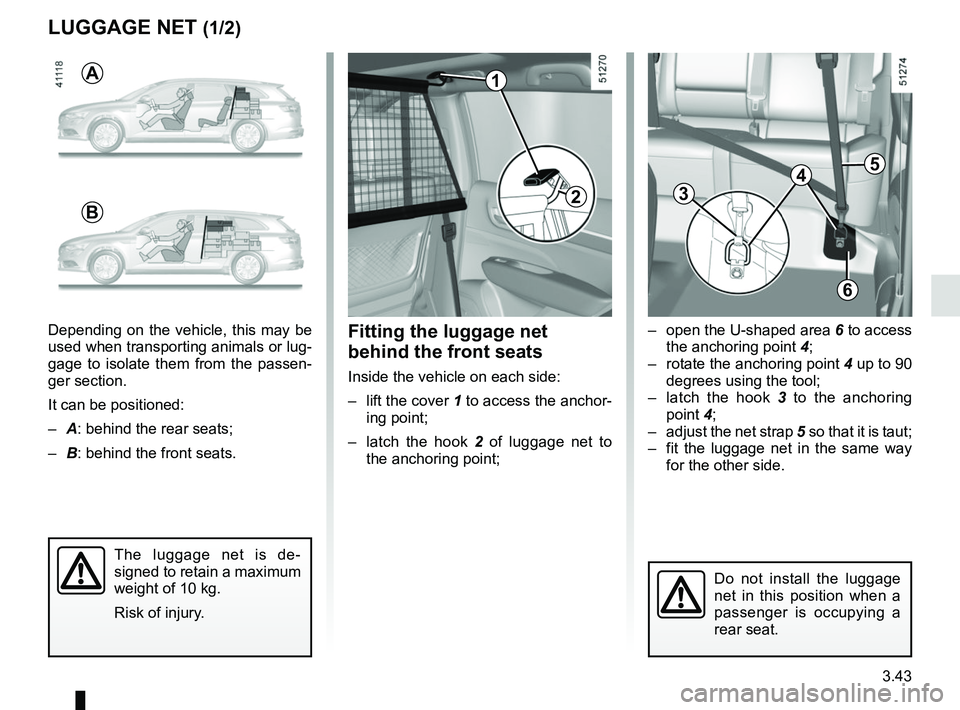
Fitting the luggage net
behind the front seats
Inside the vehicle on each side:
– lift the cover 1 to access the anchor-
ing point;
– latch the hook 2 of luggage net to
the anchoring point;
LUGGAGE NET (1/2)
– open the U-shaped area 6 to access
the anchoring point 4;
– rotate the anchoring point 4 up to 90
degrees using the tool;
– latch the hook 3 to the anchoring
point 4;
– adjust the net strap 5 so that it is taut;
– fit the luggage net in the same way for the other side.
Depending on the vehicle, this may be
used when transporting animals or lug-
gage to isolate them from the passen-
ger section.
It can be positioned:
–
A: behind the rear seats;
– B: behind the front seats.
The luggage net is de-
signed to retain a maximum
weight of 10 kg.
Risk of injury.
Do not install the luggage
net in this position when a
passenger is occupying a
rear seat.
A
B
1
2
6
4
3
5
Page 240 of 332
3.44
LUGGAGE NET (2/2)
7
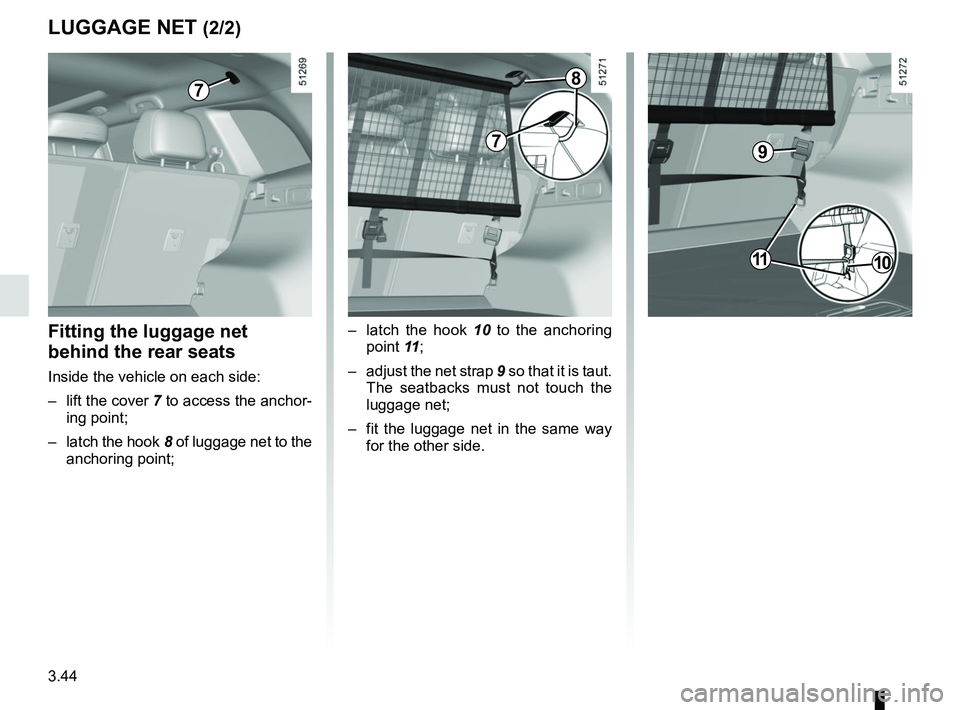
– latch the hook 10 to the anchoring point 11 ;
– adjust the net strap 9 so that it is taut. The seatbacks must not touch the
luggage net;
– fit the luggage net in the same way for the other side. Fitting the luggage net
behind the rear seats
Inside the vehicle on each side:
– lift the cover 7 to access the anchor-
ing point;
– latch the hook 8 of luggage net to the
anchoring point;
8
79
1110
Page 242 of 332

3.46
Always position the heavi-
est items directly on the
floor. Use the lashing
points 1 on the boot floor, if
these are fitted to the vehicle. The
luggage should be loaded in such a
way that no items will be thrown for-
ward and strike the occupants if the
driver has to brake suddenly. Fasten
the rear seat belts, even if the seats
are not occupied.
TRANSPORTING OBJECTS IN THE LUGGAGE COMPARTMENT
Always position the objects transported
so that the largest surface is against:
– The rear bench seatback for normal loads (example A).
– The front seatbacks with the rear
seatbacks folded down, the mobile
floor in the flat-floor position (exam-
ple B).
– The front seatbacks with the rear seatbacks folded down, the mobile
floor in the stored-away position, as is
the case for maximum loads (exam-
ple C).
If you have to place objects on the folded
seatback, it is necessary that you lower
the headrests before folding the seat-
back so that it can be folded as flat as
possible against the seat.
B
A
1
C
Page 263 of 332

4.17
Glass instrument panel(e.g.: instrument panel, clock, exterior
temperature display, radio display, mul-
timedia or multifunction display etc.)
Use a soft cloth (or cotton wool).
If this does not clean them properly,
use a soft cloth (or cotton wool) slightly
moistened with soapy water and then
wipe clean with another soft damp cloth
or cotton wool.
Finally, carefully dry off with a soft dry
cloth.
Do not use products containing alco-
hol and/or spray fluids on the area.
Seat belts
These must be kept clean.
Use products selected by our Technical
Department (Approved outlets) or
warm, soapy water and a sponge and
wipe with a dry cloth.
Detergents or dyes must not be used
under any circumstances.
INTERIOR TRIM MAINTENANCE (1/2)
Textiles (seats, door trim, etc)
Vacuum-clean the textiles regularly.
Liquid stain
Use soapy water.
Dab lightly (never rub) with a soft cloth,
rinse and remove the excess.
Solid or pasty stain
Carefully remove the excess solid or
pasty material immediately with a
spatula (working from the edges to the
centre to avoid spreading the stain).
Clean as for a liquid stain.
Special instructions for sweets or
chewing gum
Put an ice cube on the stain to solidify
it, then proceed as for a solid stain.
A well-maintained vehicle will last
longer. It is therefore recommended to
maintain the interior of the vehicle regu-
larly.
A stain should always be dealt with
swiftly.
Whatever type of stain is on the trim,
use
cold (or warm) soapy water with
natural soap.
Detergents (washing-up liquid, pow-
dered products, alcohol-based prod-
ucts) should not be used.
Use a soft cloth.
Rinse and soak up the excess.
For further recommendations for
maintaining the interior, and/or for
any unsatisfactory results, please
see an authorised dealer.
Page 305 of 332
5.41
OPERATING FAULTS (7/7)
Electrical equipmentPOSSIBLE CAUSESWHAT TO DO
Traces of condensation in the head-
lights or rear lights Traces of condensation may be a nat-
ural phenomenon caused by varia-
tions in temperature and humidity.
In this case, the traces will disappear
slowly once the lights are switched
on.
The front seat belt reminder light
comes on when the seat belts are
fastened. An object is stuck between the floor
and the seat and is disrupting the op-
eration of the sensor. Remove all objects from underneath the
front seats.