2018 RENAULT KOLEOS air vent
[x] Cancel search: air ventPage 24 of 332

1.18
EMERGENCY CALL (2/2)
Check the condition of the bat-
tery, its service life is approximately
4 years (warning light 1 lights up in
red to inform you).
Consult an approved dealer.
23
1
Manual mode
The emergency call is triggered by
pressing switch 3.
Emergency call has two modes:
– in normal mode by pressing switch 3
for more than 3 seconds;
– in panic mode by pressing switch 3
five times in less than 10 seconds.
Automatic mode
When warning light 2 is on, this indi-
cates that the automatic system is ac-
tivated.
With ignition switched on, the emer-
gency call is triggered automatically in
the event of an accident with airbag ac-
tivated. Data are transmitted to the call
centre (vehicle identification plate, time
of the call, vehicle position, direction of
the vehicle, etc).
The automatic emergency call is acti-
vated by default and can be disabled
on request of the user at an Approved
Dealer. In the event of unintended operation, it
is possible to cancel the call by press-
ing switch 3
for 2 seconds before the
call to the call centre is set up.
Once a call is established, only the call
centre can end the call.
Operating faults
In some cases, the emergency call
function may not work:
– no fault detected and phone network
unavailable;
– low battery;
– ...
When the system detects an operat-
ing fault, the warning light 1 turns red;
consult an Approved Dealer as soon as
possible.
Page 28 of 332

1.22
Heated seats
With the ignition on,
– depending on the vehicle pressing the switch 4 or 5 on the required seat for the first time activates the heating
system at maximum power.
Both integrated switch warning lights come on;
– a second press decreases the heat- ing to minimum power. One inte-
grated warning light comes on;
– pressing for the third time turns the heating off.
Ventilated seats
Ventilation seats work on the princi-
ple of absorbing and exporting the air
in the passenger compartment without
using the vehicle’s air conditioning and
heating functions. For the best perform-
ance, you are advised to use this func-
tion with air conditioning switched on. With the ignition on:
– pressing the switch
6 on the re-
quired seat for the first time activates
the ventilation system at maximum
power. Both integrated switch warn-
ing lights come on;
– a second press decreases the ven- tilation to minimum power. One inte-
grated warning light comes on;
– a third press switches off ventilation.
Note: if you switch off the engine and
restart it, the ventilation or heating func-
tion will be off.
FRONT SEATS WITH ELECTRIC CONTROLS (2/2)
4
6565
Page 33 of 332
1.27
METHODS OF RESTRAINT IN ADDITION TO THE FRONT SEAT BELTS (1/4)
Depending on the vehicle, they are
composed of:
– seat belt inertia reel pretensio-ners;
– driver and passenger’s lap belt pretensioners;
– chest-level load limiter;
– air bags for driver and front pas- senger.
These systems are designed to act in-
dependently or together when the vehi-
cle is subjected to a frontal impact.
Depending on the severity of the
impact, the system can trigger:
– seat belt locking;
– the seat belt inertia reel pretensioner (which engages to correct seat belt
slack);
– the lap belt pretensioners to hold the occupant in his seat;
– the front airbag.
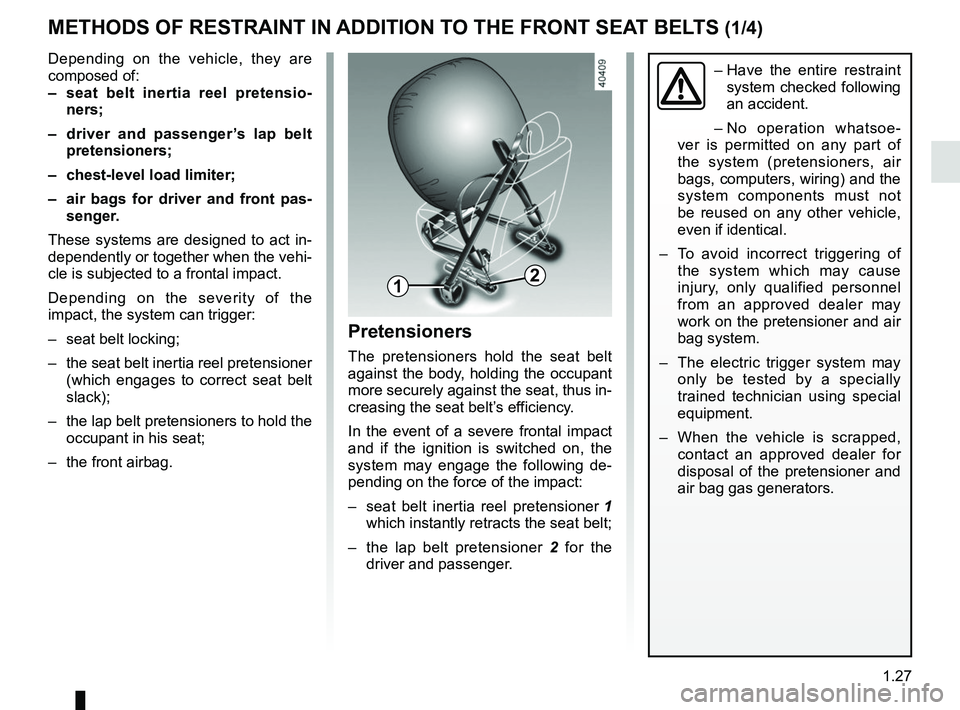
Pretensioners
The pretensioners hold the seat belt
against the body, holding the occupant
more securely against the seat, thus in-
creasing the seat belt’s efficiency.
In the event of a severe frontal impact
and if the ignition is switched on, the
system may engage the following de-
pending on the force of the impact:
– seat belt inertia reel pretensioner 1
which instantly retracts the seat belt;
– the lap belt pretensioner 2 for the
driver and passenger.
– Have the entire restraint
system checked following
an accident.
– No operation whatsoe-
ver is permitted on any part of
the system (pretensioners, air
bags, computers, wiring) and the
system components must not
be reused on any other vehicle,
even if identical.
– To avoid incorrect triggering of the system which may cause
injury, only qualified personnel
from an approved dealer may
work on the pretensioner and air
bag system.
– The electric trigger system may only be tested by a specially
trained technician using special
equipment.
– When the vehicle is scrapped, contact an approved dealer for
disposal of the pretensioner and
air bag gas generators.
12
Page 36 of 332

1.30
METHODS OF RESTRAINT IN ADDITION TO THE FRONT SEAT BELTS (4/4)
Warnings concerning the driver’s air bag
– Do not modify the steering wheel or the steering wheel boss.
– Do not cover the steering wheel boss under any circumstances.
– Do not attach any objects (badge, logo, clock, telephone holder, etc.) to the steering wheel boss.
– The steering wheel must not be removed (except by qualified personnel f\
rom our Network).
– When driving, do not sit too close to the steering wheel. Sit with your \
arms slightly bent (see the information on “Adjusting
your driving position” in Section 1). This will allow sufficient space for the air bag to deploy correctly and be fully effective.
Warnings concerning the passenger air bag
– Do not attach or glue any objects (badge, logo, clock, telephone holder\
, etc.) to the dashboard on or near the air bag.
– Do not place anything between the dashboard and the passenger (pet, umb\
rella, walking stick, parcels, etc.).
– The passenger must not put his or her feet on the dashboard or seat as t\
here is a risk that serious injuries may occur. In general, parts of the body should be kept away from the dashboard (knee\
s, hands, head, etc.).
– The devices in addition to the front passenger seat belt should be react\
ivated as soon as a child seat is removed, to ensure the protection of the passenger in the event of an impact.
A REAR-FACING CHILD SEAT MUST NOT BE FITTED TO THE FRONT PASSENGER SEAT UNLESS THE ADDITIONAL RESTRAINT SYSTEMS, I.E. THE PASSENGER AIR BAG, ARE DEACTIVATED.
(refer to the information on “Child safety: deactivating/activating \
the front passenger air bag” in Section 1)
All of the warnings below are given so that the air bag is not obstructe\
d in any way when it is inflated and also to prevent
the risk of serious injuries caused by items which may be dislodged when\
the air bag inflates.
Page 38 of 332
1.32
Side Airbags
An airbag can be fitted to each front
seat, which are deployed on the side of
the seat (door side) to protect the oc-
cupants in the case of a severe side
impact.
Curtain Airbags
These are airbag fitted along the sides
of the vehicle in the ceiling which trigger
along the front and rear door side win-
dows to protect the passengers in case
of a severe side impact.
SIDE PROTECTION DEVICES
Warning relating to the side airbag
– Fitting seat covers: seats equipped with an airbag require covers spe-
cifically designed for your vehicle. Contact an approved Dealer to find \
out
if these covers are available. The use of any covers other than those de-
signed for your vehicle (and including those designed for another vehic\
le) may
affect the operation of the airbags and reduce your protection.
– Do not place any accessories, objects or even pets between the seatback,\
the door and the internal fittings. Do not cover the seatback with any items\
such as
clothes or accessories. This may prevent the air bag from operating correctly
or cause injury when the airbag is deployed.
– No work or modification whatsoever may be carried out on the seat or int\
ernal fittings, except by qualified personnel from an approved Dealer.
Depending on the vehicle, a mark-
ing on the windscreen informs you
of the presence of additional means
of restraint (air bags, pretensioners,
etc.) in the passenger compartment.
Page 39 of 332

1.33
ADDITIONAL METHODS OF RESTRAINT
The airbag is designed to complement the action of the seat belt. Both t\
he
air bags and seat belts are integral parts of the same protection system\
.
It is therefore essential to wear seat belts at all times. If seat belts\
are not
worn, the occupants are exposed to the risk of serious injury in the eve\
nt
of an accident. It may also increase the risk of minor superficial injur\
ies occurring
when the airbag is deployed, although such minor injuries are always pos\
sible
with air bags.
If the vehicle should overturn or in the event of a rear impact, however\
severe,
the pretensioners and airbags are not always triggered. Impacts to the u\
nderside
of the vehicle, e.g. from pavements, potholes or stones, can all trigger\
these sys-
tems.
– No work or modification whatsoever may be carried out on any part of the airbag system (airbags, pretensioners, computer, wiring harness, etc.), except
by qualified Network personnel.
– To ensure that the system is in good working order and to avoid accidenta\
l trig- gering of the system which may cause injury, only qualified Network personnel
may work on the airbag system.
– As a safety precaution, have the airbag system checked if your vehicle h\
as been involved in an accident, or is stolen or broken into.
– When selling or lending the vehicle, inform the user of these points and\
hand over this handbook with the vehicle.
– When scrapping your vehicle, contact your approved Dealer for disposal o\
f the gas generator(s).
All of the warnings below are given so that the airbag is not obstructed in any
way when it is inflated and also to prevent the risk of serious injuries\
caused
by items which may be dislodged when it inflates.Operating faults
å This warning light comes on
when the engine is started and then
goes out after approximately three se-
conds.
If it does not come on when the ignition
is switched on or if it stays on, there is a
fault in the system.
Contact your approved Dealer as soon
as possible.
Your protection will be reduced until this
fault is rectified.
Page 43 of 332
1.37
Attachment using the ISOFIX
system
Authorised child seats ISOFIX are
standardised in accordance with cur-
rent regulations. If any of the five cases
below applies:
– ISOFIX universal 3-point forward- facing seat;
– ISOFIX semi-universal 2-point seat;
– Specific;
i-Size which has:
– either a belt which attaches to the third ring of the sear concerned;
– or a support leg that rests on the ve- hicle floor, compatible with the ap-
proved seat i-Size, the role of which
is to prevent the child seat from
moving in the event of a collision.
In the latter three cases check that your
child seat can be installed by consulting
the list of compatible vehicles.
Attach the child seat with the ISOFIX
locks, if these are provided. The ISOFIX
system allows quick, easy, safe fitting.
The ISOFIX system consists of 2 rings
and, in some cases, a third ring.
CHILD SAFETY: choosing a child seat mounting (1/2)
There are two ways of attaching child
seats: via the seat belt or using the
ISOFIX system.
Attachment via the seat belt
The seat belt must be adjusted to
ensure that it is effective in the event of
harsh braking or an impact.
Ensure that the strap paths indicated
by the child seat manufacturer are re-
spected.
Always check that the seat belt is cor-
rectly fastened by pulling it up, then
pulling it out fully whilst pressing on the
child seat.
Check that the seat is correctly held by
moving it from side to side and back
to front: the seat should remain firmly
fixed.
Check that the child seat has not been
installed at an angle and that it is not
resting against a window.
No modifications may be
made to the component
parts of the restraint system
(ISOFIX seat belts, seats
and their mountings) originally fitted.
The seat belt must never
be twisted or the tension
relieved. Never pass the
shoulder strap under the
arm or behind the back.
Check that the seat belt has not
been damaged by sharp edges.
If the seat belt does not operate nor-
mally, it will not protect the child.
Consult an approved dealer. Do not
use this seat until the seat belt has
been repaired.
Do not use the child seat
if it may unfasten the seat
belt restraining it: the base
of the seat must not rest on
the buckle and/or catch of the seat
belt.
Before using an ISOFIX
child seat that you pur-
chased for another vehicle,
check that its installation is
authorised. Consult the list of ve-
hicles which can be fitted with the
seat from the equipment manufac-
turer.
Page 55 of 332

1.49
CHILD SAFETY: deactivating, activating the front passenger air bag (3/3)
The passenger airbag must
only be deactivated or acti-
vated when the vehicle is
stationary.
If it is interfered with when the ve-
hicle is being driven, indicator lights
å and © will come on.
Switch the ignition off then on again
to reset the airbag in accordance
with the lock position.
2
Activating the front
passenger air bags
You should reactivate the airbags as
soon as you remove the child seat from
the front passenger seat to ensure the
protection of the front passenger in the
event of an impact.
Operating faults
It is forbidden to fit a rear-facing child
seat to the front passenger seat if the
airbags activation/deactivation system
is faulty.
Allowing any other passenger to sit in
that seat is not recommended.
Contact your approved dealer as soon
as possible.
To reactivate the airbags: with the
vehicle stopped and the ignition off,
push and turn lock 1 to the ON position.
With the ignition switched on, you must
check that the warning light
] is
out and that the warning light
comes on the display 2 after each start-
up for around 60 seconds.
The front passenger seat belt additional
restraint systems are activated.
1