2018 PEUGEOT EXPERT roof
[x] Cancel search: roofPage 179 of 416
177
Manoeuvre cautiously, at low
speed
The dimensions of your vehicle differ from
those of a light vehicle, in width, in height, as
well as in length, and some obstacles will be
more difficult to notice.
Manoeuvre slowly.
Before turning, check that there are no
obstacles at mid-height along the sides.
Before reversing, check that there are no
obstacles, particularly at high level behind the
vehicle.
Be aware of the external dimensions, if ladders
are fitted.
Load the vehicle correctly
With a load carried, the vehicle must remain
within the maximum authorised weight, the
Gross Vehicle Weight.
To avoid upsetting the balance of the vehicle,
the load should be centred and the heaviest
part placed on the floor in front of the rear
wheels.
It is inadvisable to place heavy loads on a roof
rack.
Loading also implies adherence to the
maximum load of the roof bar anchor points.
Adhere to the maximum permissible weight,
according to PEUGEOT dealer specifications.
Loads must be securely lashed down.
A load that is not properly secured inside the
vehicle may affect vehicle handling and create
a risk of accident.
Drive the vehicle in a prudent
and efficient way
Take corners gently.
Anticipate the need to brake as the stopping
distance is increased, particularly on wet or icy
roads.
Be aware of the effect of side winds on the
vehicle.
Effective eco-driving saves fuel; accelerate
progressively, anticipate the need to slow down
and adapt your speed to suit the situation.
Indicate changes of direction well in advance
so that you are seen by other road users.
Take care
The tyres must be inflated to at least the
pressures indicated on the label, even over-
inflated by 0.2 to 0.3 bar for long journeys.
If your vehicle is fitted with a drop-side back,
the height and width of the load must remain
within the overall dimensions of the vehicle.
In case of towing
Driving with a trailer places greater
demands on the towing vehicle and
requires extra care from the driver.
Distribution of loads
F Distribute the load in the trailer so that
the heaviest items are as close as possible
to the axle and the nose weight approaches
the maximum permitted without
exceeding it.
Air density decreases with altitude, thus
reducing engine performance. The maximum
towed load must be reduced by 10% for every
1,000
metres of altitude.
Please respect the maximum towable
weights.
Side wind
F Take into account the increased sensitivity to wind.
6
Driving
Page 221 of 416
219
After an impact, the function automatically
stops operating. Consult a PEUGEOT
dealer or a qualified workshop to have the
system checked.
Operating limits
In the following cases, deactivating the
system via the vehicle's configuration menu is
recommended:
-
w
hen towing a trailer or caravan,
-
w
hen a load on the roof rack extends
beyond the windscreen (for example: long
objects),
-
w
hen the vehicle is being towed, with the
engine running,
-
w
hen a "space-saver" type spare wheel is
fitted (if your vehicle has one),
-
w
hen on a rolling stand for a ser vice in a
workshop,
-
w
hen in an automatic car wash,
-
i
f the brake lamps are not working. Because of limits in the operation of the
system, it is possible that warnings are
not given, are given too late or seem
unjustified. Consequently, always stay
alert and be prepared to react at any time
to avoid an accident.
Collision Risk Alert
Depending on the degree of risk of collision
detected by the system and the alert threshold
chosen, different levels of alert can be
triggered and displayed in the instrument panel
or the head-up display.
This information also appears in the
head-up display. For more information
on the Head-up display, refer to the
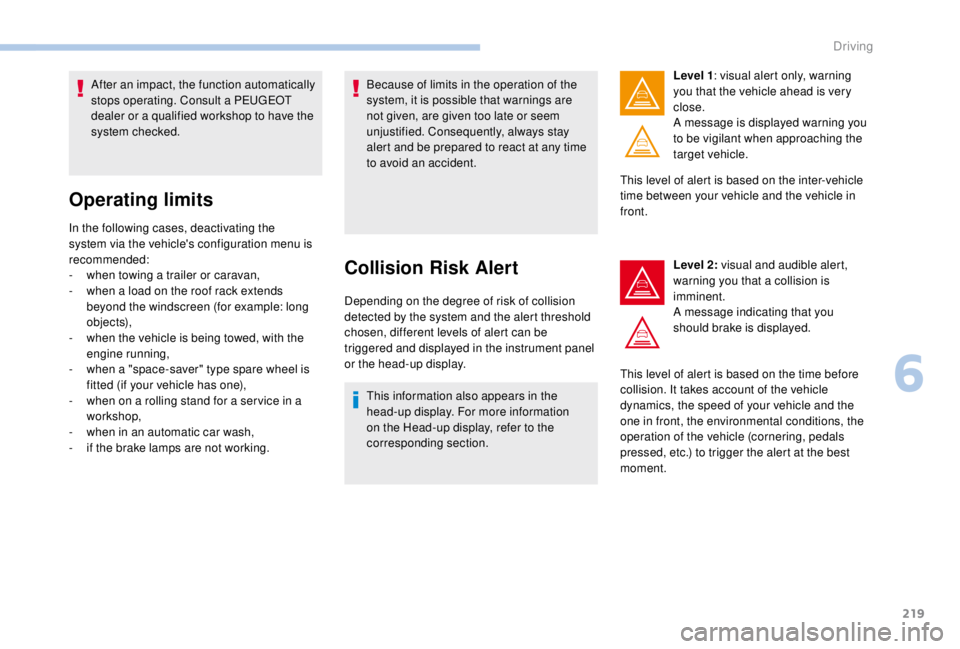
corresponding section. Level 1
: visual alert only, warning
you that the vehicle ahead is very
close.
A message is displayed warning you
to be vigilant when approaching the
target vehicle.
This level of alert is based on the inter-vehicle
time between your vehicle and the vehicle in
front.
Level 2: visual and audible alert,
warning you that a collision is
imminent.
A message indicating that you
should brake is displayed.
This level of alert is based on the time before
collision. It takes account of the vehicle
dynamics, the speed of your vehicle and the
one in front, the environmental conditions, the
operation of the vehicle (cornering, pedals
pressed, etc.) to trigger the alert at the best
moment.
6
Driving
Page 245 of 416
243
Exiting the mode
These functions will be automatically restored
the next time the vehicle is used.
In order to restore the use of these functions
immediately, start the engine and let it run:
-
f
or less than ten minutes, to use the
equipment for approximately five minutes,
-
f
or more than ten minutes, to use the
equipment for up to approximately thirty
minutes.
Let the engine run for the duration specified to
ensure that the battery charge is sufficient.
Do not repeatedly and continuously restart the
engine in order to charge the battery.
A flat battery prevents the engine from
starting.
For more information on the 12
V batter y,
refer to the corresponding section.
Load reduction mode
System which manages the use of certain
functions according to the level of charge
remaining in the battery.
When the vehicle is being driven, the load
reduction function temporarily deactivates
certain functions, such as the air conditioning,
the heated rear screen, etc.
The deactivated functions are reactivated
automatically as soon as conditions permit.
Roof bars/Roof rack
Recommendations
F D istribute the load uniformly, taking
care to avoid overloading one of the
sides.
F
A
rrange the heaviest part of the load
as close as possible to the roof.
F
L
ash the load down securely and fit a
warning flag if it overhangs the vehicle.
F
D
rive gently: the vehicle will be more
susceptible to the effects of side winds
(stability may be affected).
F
W
hen not in use, the roof bars should
be removed.
If the height exceeds 40
cm, adapt the
speed of the vehicle to the profile of the
road to avoid damaging the roof bars and
the mountings on the vehicle.
Be sure to refer to national legislation in
order to comply with the regulations for
transporting objects which are longer than
the vehicle.
7
Practical information
Page 246 of 416
244
As a safety measure and to avoid
damaging the roof, it is essential to use
the transverse bars approved for your
vehicle.
Obser ve the instructions on fitting and use
contained in the guide supplied with the
roof bars.
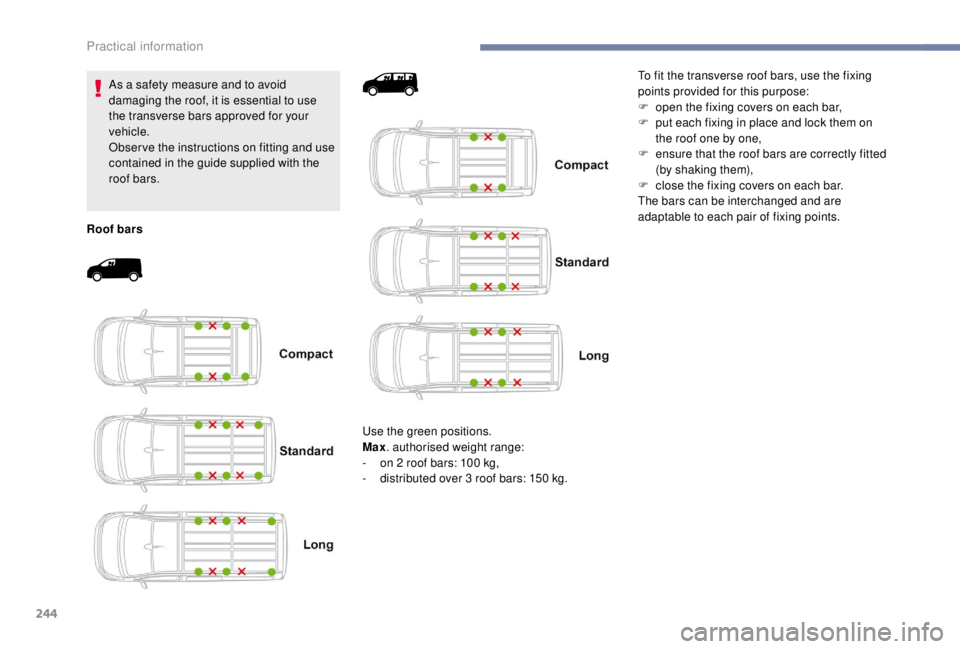
Roof bars
Use the green positions.
Max. authorised weight range:
-
o
n 2 roof bars: 100 kg,
-
d
istributed over 3 roof bars: 150 kg.To fit the transverse roof bars, use the fixing
points provided for this purpose:
F
o
pen the fixing covers on each bar,
F
p
ut each fixing in place and lock them on
the roof one by one,
F
e
nsure that the roof bars are correctly fitted
(by shaking them),
F
c
lose the fixing covers on each bar.
The bars can be interchanged and are
adaptable to each pair of fixing points.
Practical information
Page 247 of 416
245
Changing a wiper blade
Before removing a front
wiper
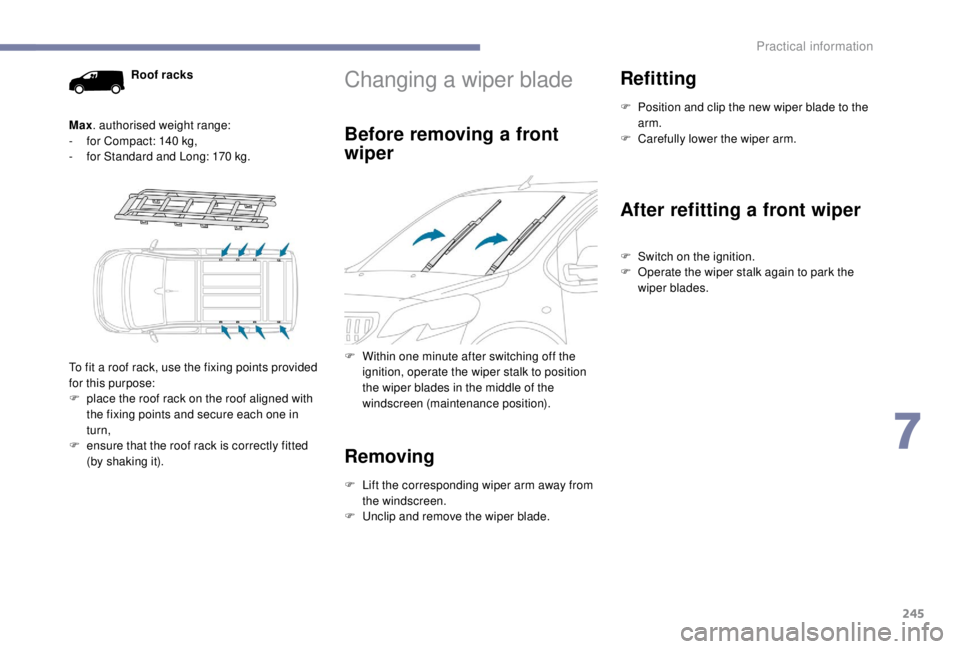
F Within one minute after switching off the ignition, operate the wiper stalk to position
the wiper blades in the middle of the
windscreen (maintenance position).
Removing
F Lift the corresponding wiper arm away from the windscreen.
F
U
nclip and remove the wiper blade.
Roof racks
Max . authorised weight range:
-
f
or Compact: 140
kg,
-
f
or Standard and Long: 170
kg.
To fit a roof rack, use the fixing points provided
for this purpose:
F
p
lace the roof rack on the roof aligned with
the fixing points and secure each one in
turn,
F
e
nsure that the roof rack is correctly fitted
(by shaking it).
Refitting
F Position and clip the new wiper blade to the arm.
F
C
arefully lower the wiper arm.
After refitting a front wiper
F Switch on the ignition.
F O perate the wiper stalk again to park the
wiper blades.
7
Practical information
Page 307 of 416
305
Identification markings
Different visible markings for the identification
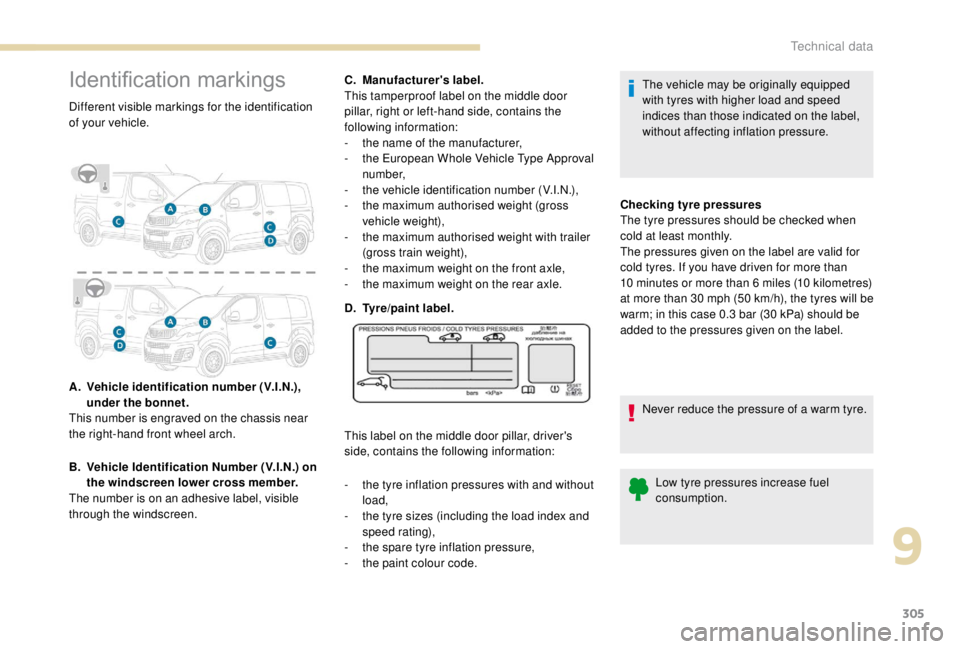
of your vehicle.
A.
V
ehicle identification number (V.I.N.),
under the bonnet.
This number is engraved on the chassis near
the right-hand front wheel arch.
B.
V
ehicle Identification Number (V.I.N.) on
the windscreen lower cross member.
The number is on an adhesive label, visible
through the windscreen. C.
M
anufacturer's label.
This tamperproof label on the middle door
pillar, right or left-hand side, contains the
following information:
-
t
he name of the manufacturer,
-
t
he European Whole Vehicle Type Approval
number,
-
t
he vehicle identification number (V.I.N.),
-
t
he maximum authorised weight (gross
vehicle weight),
-
t
he maximum authorised weight with trailer
(gross train weight),
-
t
he maximum weight on the front axle,
-
t
he maximum weight on the rear axle.
D.
T
yre/paint label.
This label on the middle door pillar, driver's
side, contains the following information:
-
t
he tyre inflation pressures with and without
load,
-
t
he tyre sizes (including the load index and
speed rating),
-
t
he spare tyre inflation pressure,
-
t
he paint colour code. The vehicle may be originally equipped
with tyres with higher load and speed
indices than those indicated on the label,
without affecting inflation pressure.
Checking tyre pressures
The tyre pressures should be checked when
cold at least monthly.
The pressures given on the label are valid for
cold tyres. If you have driven for more than
10
minutes or more than 6 miles (10 kilometres)
at more than 30
mph (50 km/h), the tyres will be
warm; in this case 0.3
bar (30 kPa) should be
added to the pressures given on the label.
Never reduce the pressure of a warm tyre.Low tyre pressures increase fuel
consumption.
9
Technical data
Page 313 of 416

5
12:13
18,5 21,5
23 °C
12:13
18,5 21,5
23 °C
12:13
18,5 21,5
23 °C
Telephone
or Connect a telephone via Bluetooth
®,
read messages and emails and send
quick messages.
Configuration
or Configure a personal profile and/
or configure the sound (balance,
ambience, etc.) and the display
(language, units, date, time, etc.).
Vehicle
or Activate, deactivate or configure
certain vehicle functions.
Voice commands
Steering mounted controls
Pressing this button activates the
voice commands function.
To ensure that voice commands are
always recognised by the system, please
observe the following recommendations:
-
s
peak in a normal tone without
breaking up words or raising your
voice,
-
a
lways wait for the "beep" (audible
signal) before speaking,
-
f
or best operation, it is recommended
that the windows and sunroof,
be closed to avoid extraneous
interference (according to version),
-
b
efore making a voice command, ask
other passengers to not speak.
.
PEUGEOT Connect Nav
Page 406 of 416
308
G
H
Gauge, fuel............................................. 237-238
Gearbox, automatic .......................18, 179, 186,
189 -193, 198 -20 0, 251
Gearbox, electronic
......179, 186, 194-200, 251
Gearbox, manual
....................18, 18 6, 18 6 -187,
198 -20 0, 19 9, 251
Gear lever, automatic gearbox
..............18 9 -19 3
Gear lever, electronic gearbox
.....................2 51
Gear lever, manual gearbox
.........................187
Gear shift indicator ~ Gear efficiency indicator
..................................... 188
Glove box
...................................................... 109
G . P. S .
.............................................................. 14
Grip control
............................................ 14 8 -15 0
Guide-me-home
..................................... 13 3 -13 4
Hazard warning lamps
..........................143, 257
Hazard warning lamps, automatic operation
....143
Headlamp adjustment
...................................137
Headlamp beam height
................................. 13
7
Headlamp dipping, automatic
.......................13 6
Electronic brake force
distribution (EBFD)
.............................. 14
5 -14 6
Emergency call
......................................
143 -14 4
Emergency braking assistance (EBA)
...... 14
5 -14 6
Emissions control system, SCR
.....................
23
Energy economy mode
.......................... 24
2-243
Engine compartment
.................................... 2
47
Engine, Diesel
........................
18, 240, 247, 257,
295-296, 298-299
Engine oil pressure
......................................... 15
Engines
......................................................... 294
Environment
............................................ 4 6, 127
ESC/ASR
................................................145 -14 6
ESC (electronic stability control)
.................... 21
E
F
Fatigue detection .......................................... 223
Filling the fuel tank ........................237-238, 240
Filter, air
........................................................ 250
Filter, oil
................
......................................... 250
Filter, particle
........................................ 250-251
Filter, passenger compartment
.....................250
Fitting a wheel
....................................... 2 6 9 -271
Fitting roof bars
..................................... 243 -244
Fittings, interior
.............................. 10
8 -109, 113
Fittings, rear
.................................................. 113
Fitting the mat
............................................... 108
Flap, fuel filler
......................................... 237-238
Flap, removable
..............................
..........94-97
Floor cab
....................................................... 282
Foglamp, rear
........................ 131, 278, 280, 282
DDAB (Digital Audio
Broadcasting) – Digital radio ............25, 9, 6 -7
Date (setting)
...................................... 38, 36, 20
Daytime running lamps
.........13 0, 132, 273 -275
Deactivating the passenger airbag ...154, 159 -16 0
Deactivation of DSC (ESC)
........................... 147
Deadlocking
.................................. 43, 50, 55 -56
Defrosting/demisting
....................... 8 6, 120 -12 2
Diagnostic system, engine
.............................. 17
D
imensions
..............................
..................... 301
Dipstick
................
............................ 30, 248-249
Direction indicators
........................ 26, 132, 273,
276 -278, 280, 282
Display, head-up
...............................
....200-201
Display screen, instrument panel
................. 188
Door pockets
...............................
.......... 108, 110
Doors
............................................................... 63
Doors, rear
................................................. 7 7-78
Doors, side-hinged
........ 5
4-56, 77-79, 278-279
Driver’s attention warning
............................. 223
Driver's door open warning
............................. 64
Driving abroad ............................................... 131
Driving time warning
..................................... 223
Dynamic stability control (DSC)
....... 21, 14 5 -15 0
Courtesy lamp, front
..............
128 -12 9, 279, 282
Courtesy lamp, rear
...............
128 -12 9, 279, 282
Courtesy lamps
......................
128 -12 9, 279, 282
Crew cab, fixed
......................................
10 6 -107
Crew cab, folding
..........................................
107
Cruise control
.................
202, 204-205, 209-211
Cruise control, adaptive
................
204 -205, 211-215, 217-218
Cruise control by speed limit recognition
...............................
...........
204-205
Cup holder
.....................................................
108Economy mode
......................................
24
2-243
Electric windows
.......................................
83-84Foglamps
......................................................
2 74
Foglamps, front
........
26, 131, 134-135, 274, 277
Foglamps, rear
.............................................. 13
1
Frequency (radio)
......................................
24-25
Fuel ................................................................ 240
Fuel consumption
......................................
36 -37
Fuel tank .......................................................... 16
Fusebox, engine compartment
.....................
287
Fuses
..................................................... 28
3-287
Alphabetical index