Page 102 of 324
100
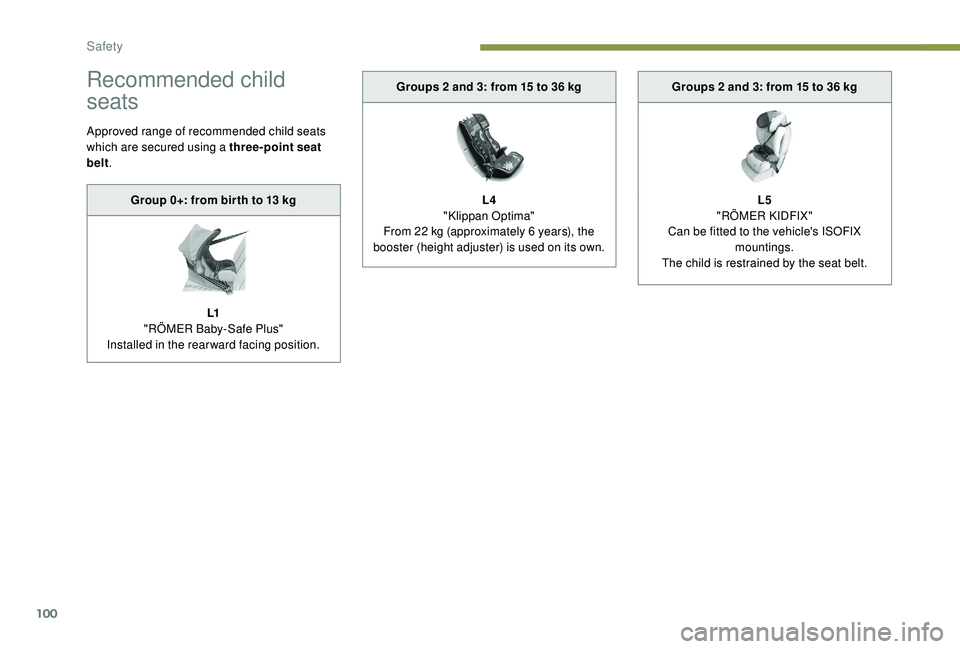
Recommended child
seats
Approved range of recommended child seats
which are secured using a three-point seat
belt.
Group 0+: from bir th to 13
kg
L1
"RÖMER Baby-Safe Plus"
Installed in the rearward facing position. Groups 2 and 3: from 15 to 36
kg
L4
"Klippan Optima"
From 22
kg (approximately 6 years), the
booster (height adjuster) is used on its own. Groups 2 and 3: from 15 to 36
kg
L5
"RÖMER KIDFIX"
Can be fitted to the vehicle's ISOFIX mountings.
The child is restrained by the seat belt.
Safety
Page 103 of 324
101
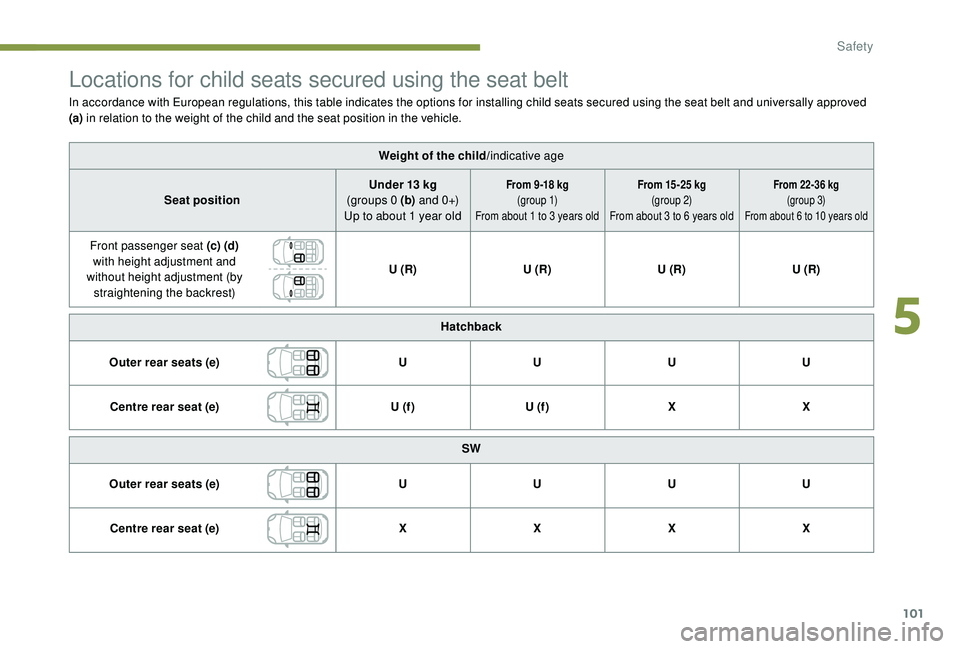
Locations for child seats secured using the seat belt
In accordance with European regulations, this table indicates the options for installing child seats secured using the seat belt and universally approved
(a) in relation to the weight of the child and the seat position in the vehicle.
Weight of the child/indicative age
Seat position Under 13
kg
(groups
0 (b) a n d 0 +)
Up to about 1 year old
From 9 -18 kg (g r o u p 1)
From about 1 to 3
years old From 15-25 kg
(group 2)
From about 3 to 6
years oldFrom 22-36 kg
( group 3)
From about 6 to 10
years old
Front passenger seat (c) (d)
with height adjustment and
without height adjustment (by straightening the backrest) U (R)
U (R)U (R)U (R)
Hatchback
Outer rear seats (e) UUUU
Centre rear seat (e) U (f )U (f ) XX
SW
Outer rear seats (e) UUUU
Centre rear seat (e) XXXX
5
Safety
Page 106 of 324
104
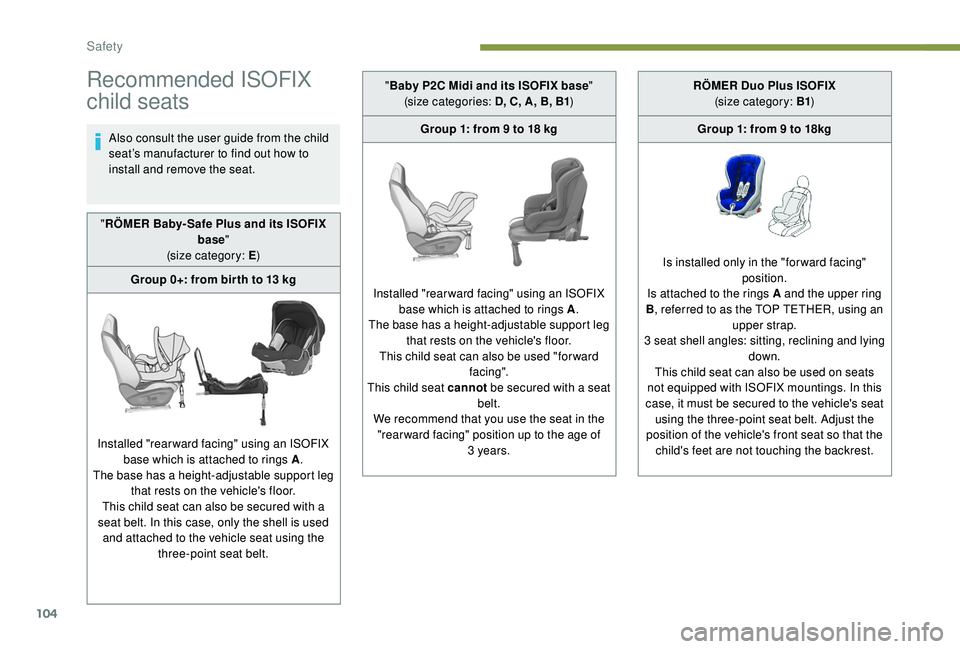
Recommended ISOFIX
child seats
Also consult the user guide from the child
seat’s manufacturer to find out how to
install and remove the seat.
" RÖMER Baby- Safe Plus and its ISOFIX
base"
(size category: E )
Group 0+: from bir th to 13
kg
Installed "rearward facing" using an ISOFIX base which is attached to rings A .
The base has a height-adjustable support leg that rests on the vehicle's floor.
This child seat can also be secured with a
seat belt. In this case, only the shell is used and attached to the vehicle seat using the three-point seat belt. "
Baby P2C Midi and its ISOFIX base "
(size categories: D, C, A, B, B1 )
Group 1: from 9 to 18 kg
Installed "rearward facing" using an ISOFIX base which is attached to rings A .
The base has a height-adjustable support leg that rests on the vehicle's floor.
This child seat can also be used "for ward fac ing".
This child seat cannot be secured with a seat
belt.
We recommend that you use the seat in the "rear ward facing" position up to the age of 3
years.RÖMER Duo Plus ISOFIX
(size category: B1 )
Group 1: from 9 to 18kg
Is installed only in the "forward facing" position.
Is attached to the rings A and the upper ring
B , referred to as the TOP TETHER, using an
upper strap.
3 seat shell angles: sitting, reclining and lying down.
This child seat can also be used on seats
not equipped with ISOFIX mountings. In this
case, it must be secured to the vehicle's seat using the three-point seat belt. Adjust the
position of the vehicle's front seat so that the child's feet are not touching the backrest.
Safety
Page 108 of 324
106
For more information on ISOFIX
mountings and child seats and the
upper strap in particular, refer to the
corresponding section.
Remove and stow the head restraint
before installing a child seat with backrest
on a passenger seat.
Refit the head restraint when the child
seat is removed.
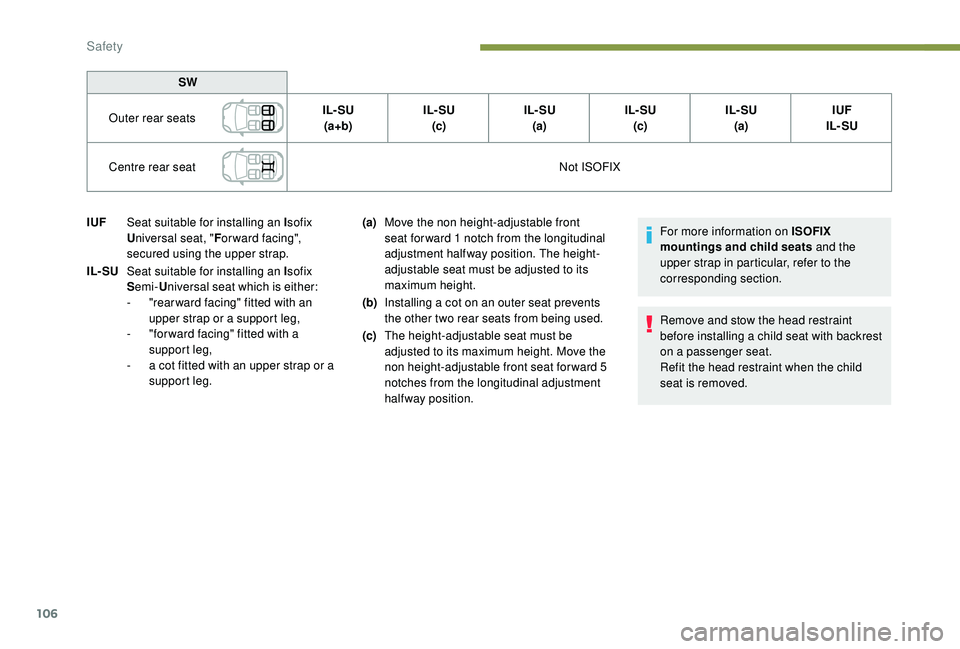
IUF
Seat suitable for installing an I sofix
U niversal seat, " For ward facing",
secured using the upper strap.
IL- SU Seat suitable for installing an I sofix
S emi- Universal seat which is either:
-
"
rear ward facing" fitted with an
upper strap or a support leg,
-
"
for ward facing" fitted with a
support leg,
-
a c
ot fitted with an upper strap or a
support leg. (a)
Move the non height-adjustable front
seat for ward 1 notch from the longitudinal
adjustment halfway position. The height-
adjustable seat must be adjusted to its
maximum height.
(b) Installing a cot on an outer seat prevents
the other two rear seats from being used.
(c) The height-adjustable seat must be
adjusted to its maximum height. Move the
non height-adjustable front seat for ward 5
notches from the longitudinal adjustment
halfway position.
SW
Outer rear seats IL- SU
(a+b) IL- SU
(c) IL- SU
(a) IL- SU
(c) IL- SU
(a) IUF
IL- SU
Centre rear seat Not ISOFIX
Safety
Page 110 of 324
108
Installing a height-adjustable (booster)
seat
The chest part of the seat belt must be
positioned on the child's shoulder without
touching the neck.
Ensure that the lap part of the seat belt
passes correctly over the child's thighs.
We recommend using a height-adjustable
(booster) seat with a backrest, equipped
with a belt guide at shoulder level.
Additional protections
To prevent accidental opening of the doors
and rear windows, use the child lock.
Take care not to open the rear windows by
more than one third.
To protect young children from the rays
of the sun, fit side blinds on the rear
windows.
As a safety precaution, do not leave:
-
a c
hild or children alone and
unattended in a vehicle,
-
a c
hild or an animal in a vehicle
which is exposed to the sun, with the
windows closed,
-
t
he keys within reach of children inside
the vehicle.
Safety
Page 112 of 324

110
F If this warning lamp and the STOP warning lamp come on,
stop the vehicle and switch off
the engine as soon as possible.
New vehicle
Do not pull a trailer before having driven at least
approximately 620
miles (1,000
kilometres).
Braking
Towing a trailer increases the braking distance.
To avoid overheating of the brakes, the use of
engine braking is recommended.
Ty r e s
F Check the tyre pressures of the towing vehicle and of the trailer, observing the
recommended pressures.
Lighting
F Check the electrical lighting and signalling on the trailer and the headlamp beam height
of your vehicle.
For more information on Headlamp
adjustment , refer to the corresponding
section. Certain driving or manoeuvring aid
functions are automatically disabled if an
approved towing system is used.
Anti-theft protection
Electronic immobiliser
The key contains an electronic chip which has
a special code. When the ignition is switched
on, this code must be recognised in order for
starting to be possible.
This electronic engine immobiliser locks the
engine management system a few minutes
after the ignition is switched off, and prevents
the engine being started by anyone who does
not have the key.
In the event of a fault, you are informed
by illumination of this warning lamp, an
audible signal and a message in the
screen.
In this case, your vehicle will not start; contact
a PEUGEOT dealer as soon as possible.
Keep safely, away from your vehicle, the
label attached to the keys given to you
when you purchased your vehicle.
Starting/Switching off the
engine, remote control
key
Place the gear lever into neutral.
Ignition switch
1.Stop position.
2. Ignition on position.
3. Starting position.
Starting with the key
The parking brake must be applied.
F
W
ith a manual gearbox, in neutral, fully
depress the clutch pedal.
F
W
ith an automatic gearbox, in mode P or N ,
fully depress the brake pedal.
Driving
Page 177 of 324
175
During use
Never release the device with a trailer or
load carrier on the towball.
Never exceed the maximum authorised
weight for the vehicle – the Gross Train
Weight or GTW.
It is essential that the maximum
authorised load be complied with on the
towing device: if it is exceeded, this device
may detach from the vehicle, which is a
serious accident risk.
Check that the trailer lamps work
c o r r e c t l y.
Before setting off, check the adjustment of
the headlamp beam height.
For more information on Headlamp
adjustment, refer to the corresponding
section.
Following use
When travelling without a trailer or load
carrier, the towball must be removed and
the blanking plug inserted in the carrier.
This measure applies particularly where
the towball might obscure visibility of the
number plate or its lighting.Blanking plug
In the event of towing, it is essential to remove
the blanking plug if your vehicle has one.
To do this, contact a PEUGEOT dealer or a
qualified workshop.
The blanking plug is located behind the
lower air intake grille.
Towing device with
quickly detachable towball
(hatchback)
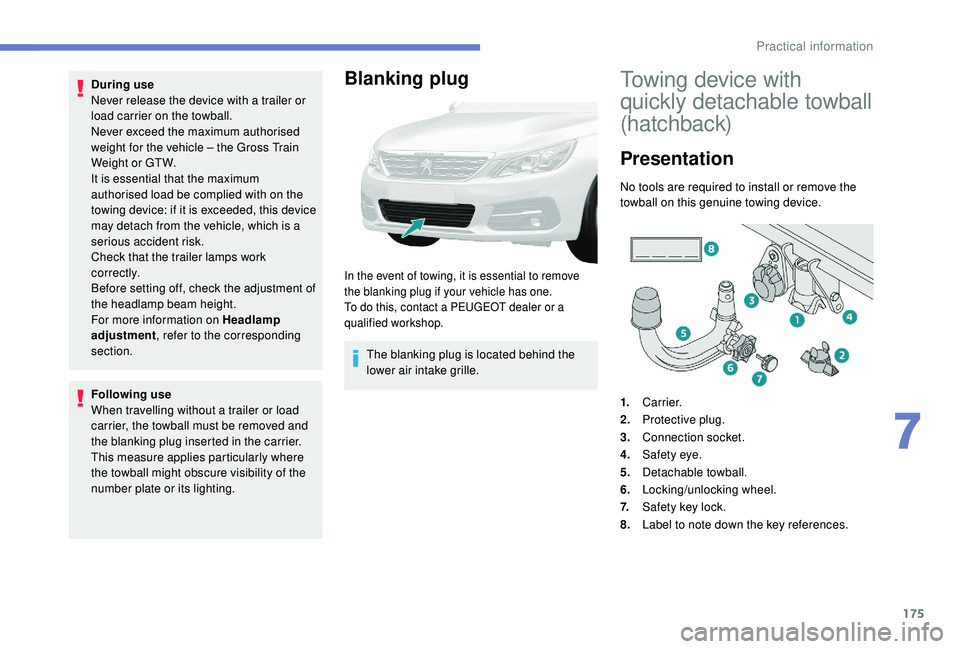
Presentation
No tools are required to install or remove the
towball on this genuine towing device.
1. Carrier.
2. Protective plug.
3. Connection socket.
4. Safety eye.
5. Detachable towball.
6. Locking/unlocking wheel.
7. Safety key lock.
8. Label to note down the key references.
7
Practical information
Page 184 of 324
182
Fitting roof bars
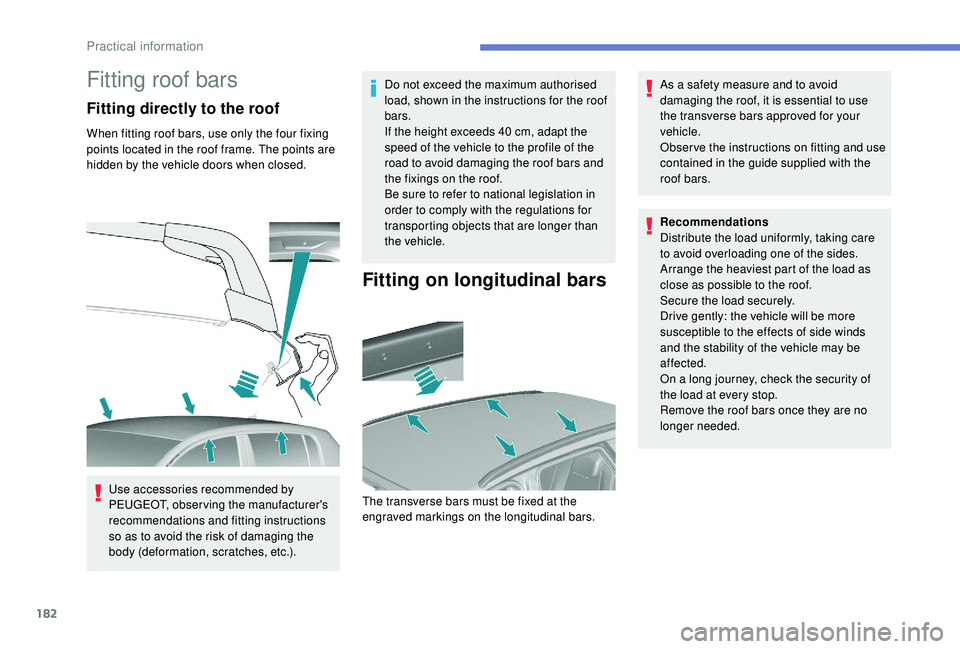
Fitting directly to the roof
When fitting roof bars, use only the four fixing
points located in the roof frame. The points are
hidden by the vehicle doors when closed.Use accessories recommended by
PEUGEOT,
observing the manufacturer's
recommendations and fitting instructions
so as to avoid the risk of damaging the
body (deformation, scratches, etc.). Do not exceed the maximum authorised
load, shown in the instructions for the roof
bars.
If the height exceeds 40
cm, adapt the
speed of the vehicle to the profile of the
road to avoid damaging the roof bars and
the fixings on the roof.
Be sure to refer to national legislation in
order to comply with the regulations for
transporting objects that are longer than
the vehicle.
Fitting on longitudinal bars
As a safety measure and to avoid
damaging the roof, it is essential to use
the transverse bars approved for your
vehicle.
Obser ve the instructions on fitting and use
contained in the guide supplied with the
roof bars.
The transverse bars must be fixed at the
engraved markings on the longitudinal bars. Recommendations
Distribute the load uniformly, taking care
to avoid overloading one of the sides.
Arrange the heaviest part of the load as
close as possible to the roof.
Secure the load securely.
Drive gently: the vehicle will be more
susceptible to the effects of side winds
and the stability of the vehicle may be
affected.
On a long journey, check the security of
the load at every stop.
Remove the roof bars once they are no
longer needed.
Practical information