2018 PEUGEOT 108 lock
[x] Cancel search: lockPage 27 of 180
25
Emergency procedure
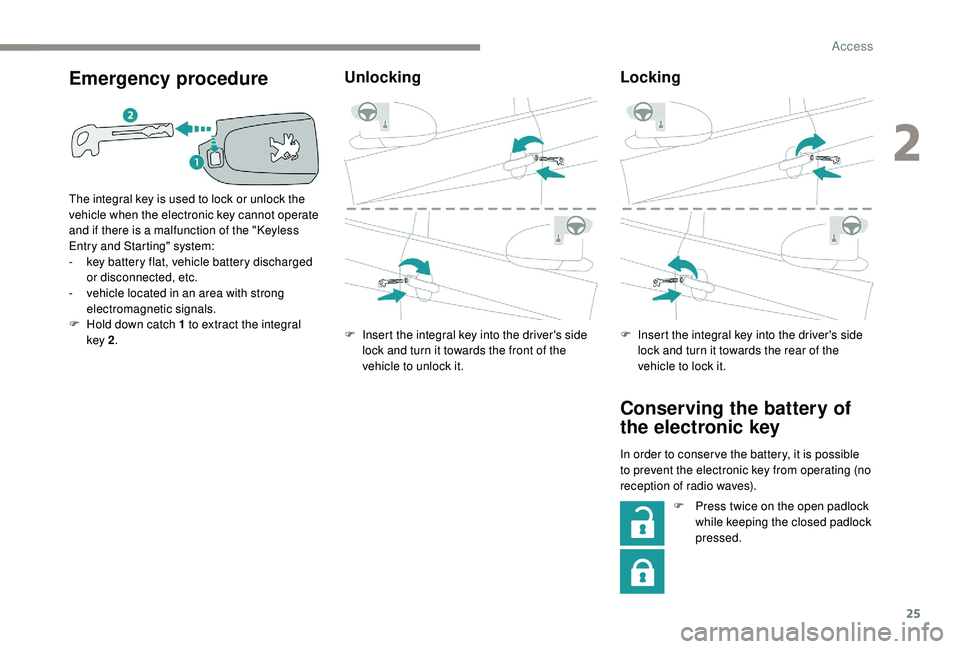
The integral key is used to lock or unlock the
vehicle when the electronic key cannot operate
and if there is a malfunction of the "
K
eyless
Entry and Starting" system:
-
k
ey battery flat, vehicle battery discharged
or disconnected, etc.
-
v
ehicle located in an area with strong
electromagnetic signals.
F
H
old down catch 1 to extract the integral
key 2 .
Unlocking
F Insert the integral key into the driver's side
lock and turn it towards the front of the
vehicle to unlock it.
Locking
F Insert the integral key into the driver's side lock and turn it towards the rear of the
vehicle to lock it.
Conserving the battery of
the electronic key
In order to conser ve the battery, it is possible
to prevent the electronic key from operating (no
reception of radio waves).
F
P
ress twice on the open padlock
while keeping the closed padlock
pressed.
2
Access
Page 28 of 180

26
Check that the light on the electronic key
flashes 4 times.
While this function is activated, the "
K
eyless
Entry and Starting" system is inoperative.
To reactivate the electronic key, press one of
the buttons (open or closed padlock).
Changing the battery of the
electronic key
Battery type: CR2032/3 volts.
I f the battery of the electronic key is
defective, this warning lamp comes
on in the instrument panel. F
F
it the new battery into its compartment
observing the original fitting direction.
F
R
eplace the protective cover.
F
C
lip the cover onto the casing.
Advice
Remote control/electronic key
These high frequency remote controls are
sensitive systems; do not handle them
while in your pocket as there is a
risk that
the vehicle may unlock without you being
aware of it.
Do not repeatedly press the buttons of
your remote control or your electronic key
when out of range and out of sight of your
vehicle. You may stop it from working.
The remote control would then have to be
reinitialised.
Locking the vehicle
Driving with the doors locked could make
it difficult for the emergency ser vices to
enter the vehicle in an emergency.
As a
safety precaution (with children on
board), remove the key from the ignition or
take the electronic key when you leave the
vehicle, even for a
short time. Lost keys, remote control, electronic
key
Visit a
PEUGEOT dealer with the vehicle's
registration certificate, your personal
identification documents and if possible,
the label bearing the key code.
The PEUGEOT dealer will be able to look
up the key code and the transponder code
required to order a new key.
Purchasing a
second-hand vehicle
Have the pairing of all of the keys in your
possession checked by a
PEUGEOT
dealer, to ensure that only your keys can
be used to open and start the vehicle.
F
U
nclip the cover using a
small screwdriver
at the cut-out.
F
R
emove the casing.
F
R
emove the protective cover from the
battery by pulling it upwards.
F
R
emove the dead battery from its
compartment.
Doors
Locking/unlocking from
inside
Access
Page 29 of 180
27
To lock /unlock a door, press/pull button A.
Vehicles without central locking
An action at button A locks/unlocks only the
door concerned.
Vehicles with central locking
An action at button A on the driver's side locks/
unlocks all the doors and the boot.
An action at button A on the passenger's side
locks/unlocks only the door concerned.
An action at the handle always allows the
door to be opened from the inside, even if
it is locked.
Door open
If a door is open, the courtesy lamp remains lit
i f the button is in this position.
Locking/unlocking and
opening the boot
With the key
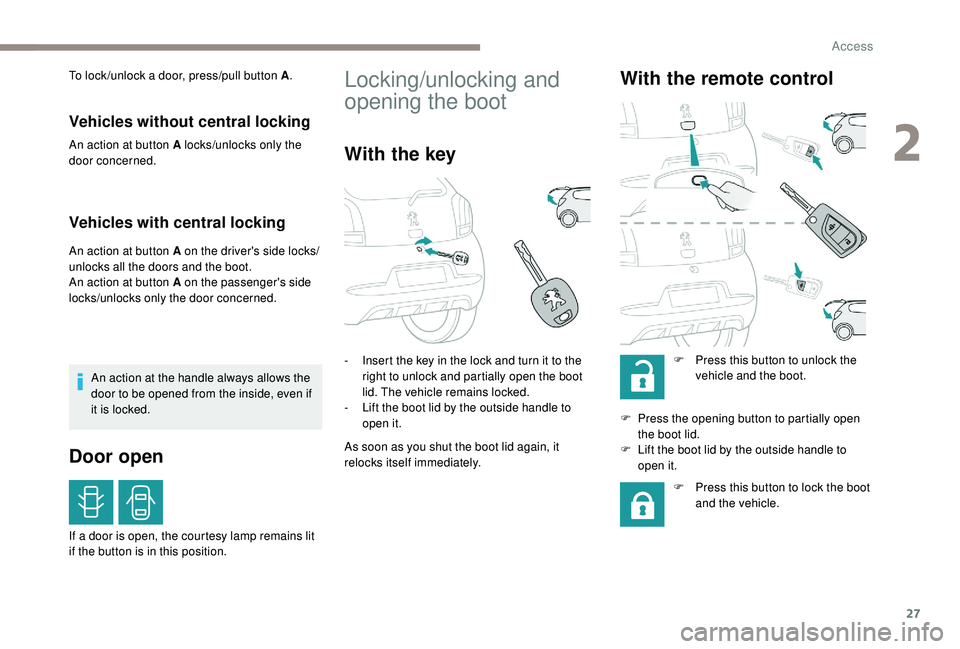
- Insert the key in the lock and turn it to the right to unlock and partially open the boot
lid. The vehicle remains locked.
-
L
ift the boot lid by the outside handle to
open it.
As soon as you shut the boot lid again, it
relocks itself immediately.
With the remote control
F Press this button to unlock the vehicle and the boot.
F
P
ress the opening button to partially open
the boot lid.
F
L
ift the boot lid by the outside handle to
open it.
F
P
ress this button to lock the boot
and the vehicle.
2
Access
Page 30 of 180

28
With the " Keyless Entry and
Starting " system
If the vehicle had previously been unlocked
using the front doors, it is not necessary to
have the electronic key on your person to use
the button for opening the boot.
F
W
ith the electronic key on your person,
press the button on the boot sill to lock it.
or
Lock the vehicle using the front doors. When closing the boot, be careful not to
slam the boot lid: guide it as it closes and
release it towards the end of its travel.
Emergency control
Measures for mechanically unlocking the boot
in the event of a
battery or central locking fault.
Unlocking
F Fold the rear seat backrest to gain access to the lock from inside the boot.
F
U
sing a screwdriver protected by a cloth,
remove the 4
retaining clips then the boot
trim.
F
M
ove the catch to the right to unlock the
boot.
Front electric windows
(Depending on version).
1. Left-hand front.
2. Right-hand front.
After switching on the ignition, press one of the
controls to open or pull it to close. The window
stops as soon as the control is released.
The driver has access to the controls for
both front windows.
The window controls are inoperative with
the ignition switched off.
The operation of closing the windows
could cause serious injuries.
Make sure that nothing obstructs the
windows from being raised, and pay
special attention to children.
F
W
ith the electronic key on your person,
press the button for opening the boot, to
unlock and partially open it.
The vehicle is also unlocked.
F
L
ift the boot lid by the outside handle to
open it.
Access
Page 32 of 180
30
Position 0:Roof completely closed.
Position 1: Stop position during automatic
closure of the roof.
Position 2: Roof completely open.
Opening
F Press briefly on the control in the opening
direction to open the roof by stages.
or
F
P
ress the control in the opening direction
and keep it pressed until the beginning
of operation, to fully open the roof. A new
press stops the roof moving.
Closing
F Press briefly on the control in the closing direction to close the roof in stages.
or
F
P
ress the control in the closing direction
and keep it pressed until the beginning of
operation to close the roof to position 1 .
Pressing it again stops the roof moving.
F
T
o close the roof completely, keep the
control pressed (between positions 1
and 0)
until the roof is heard to lock. The operation of closing the roof could
cause serious injuries: pay particular
attention to children.
If the roof does not close correctly:
-
c
heck that nothing is hindering the closure
(ignition off),
-
r
epeat the command to close (engine
running).
If the problem persists, contact a PEUGEOT
dealer or a qualified workshop.
Protecting the electric control
motors for opening and closing
the roof
During repeated opening and closing
movements of the roof, it is possible that
heating up of the electric motors no longer
allows the roof to be opened or closed. Allow
the motors to cool by not trying to move the
roof for ten minutes.
Operating fault
If there is an electrical fault, contact
a
PEUGEOT dealer or a qualified workshop.
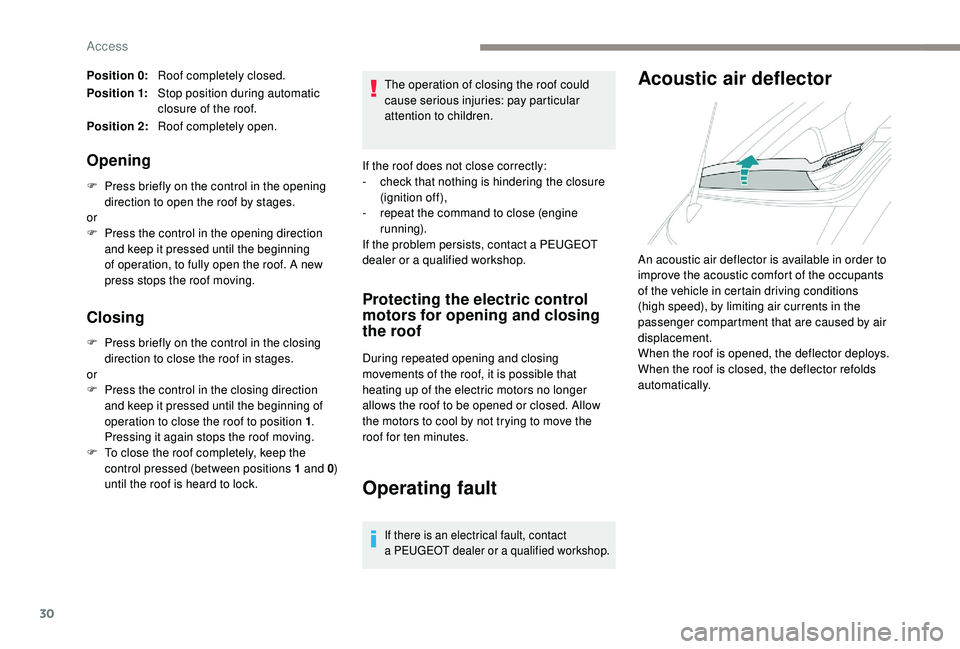
Acoustic air deflector
An acoustic air deflector is available in order to
improve the acoustic comfort of the occupants
of the vehicle in certain driving conditions
(high speed), by limiting air currents in the
passenger compartment that are caused by air
displacement.
When the roof is opened, the deflector deploys.
When the roof is closed, the deflector refolds
automatically.
Access
Page 35 of 180
33
With the engine running, the front seats can be
heated separately.
F
P
ress the switch. The indicator lamp comes
on.
F
P
ressing a
second time stops operation.
The temperature is controlled automatically.
The heated seat function is deactivated
approximately two minutes after the ignition is
switched off. To reactivate the function, switch
on the ignition and press the control again.
Switch off the heated seats as soon as
you consider it necessary, as reducing
the consumption of electrical current
reduces fuel consumption.
Do not use the function when the seat is
not occupied.
Reduce the intensity of the heating as
soon as possible.
When the seat and passenger
compartment have reached an
adequate temperature, you can stop
the function; reducing the consumption
of electrical current reduces fuel
consumption. Prolonged use at the highest setting is
not recommended for those with sensitive
skin.
There is a
risk of burns for people whose
perception of heat is impaired (illness,
taking medication, for example).
There is a
risk of overheating the system if
material with insulating properties is used,
such as cushions or seat covers.
Do not use the function:
-
i
f wearing damp clothing,
-
i
f child seats are fitted.
To avoid breaking the heating element in
the seat:
-
d
o not place heavy objects on the seat,
-
d
o not kneel or stand on the seat,
-
d
o not place sharp objects on the seat,
-
d
o not spill liquids onto the seat.
To avoid the risk of short-circuit:
-
d
o not use liquid products for cleaning
the seat,
-
n
ever use the heating function when
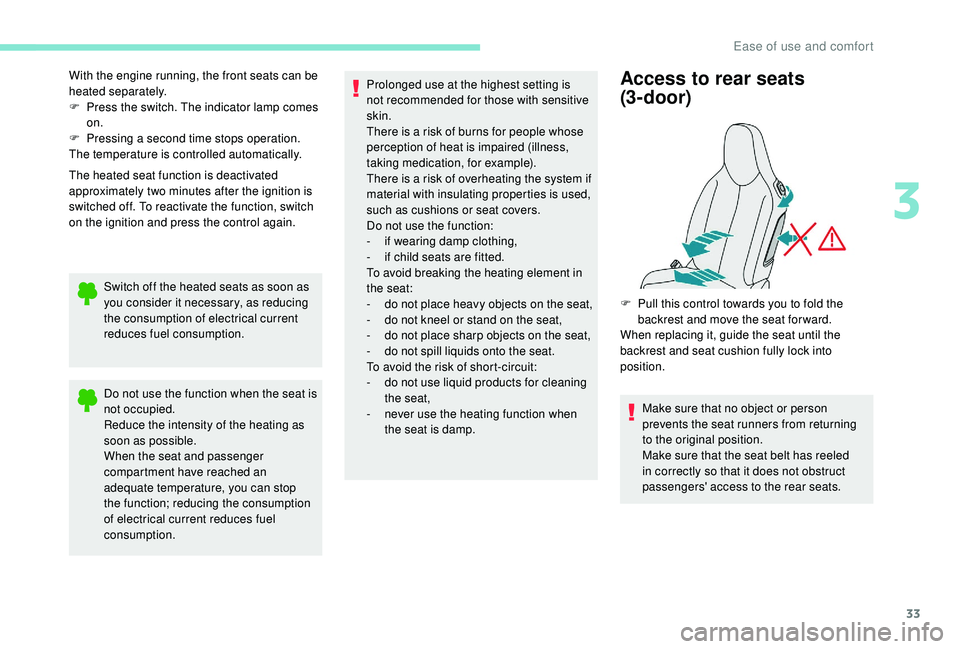
the seat is damp.Access to rear seats
(3-door)
F Pull this control towards you to fold the backrest and move the seat for ward.
When replacing it, guide the seat until the
backrest and seat cushion fully lock into
position.
Make sure that no object or person
prevents the seat runners from returning
to the original position.
Make sure that the seat belt has reeled
in correctly so that it does not obstruct
passengers' access to the rear seats.
3
Ease of use and comfort
Page 36 of 180
34
Rear seats
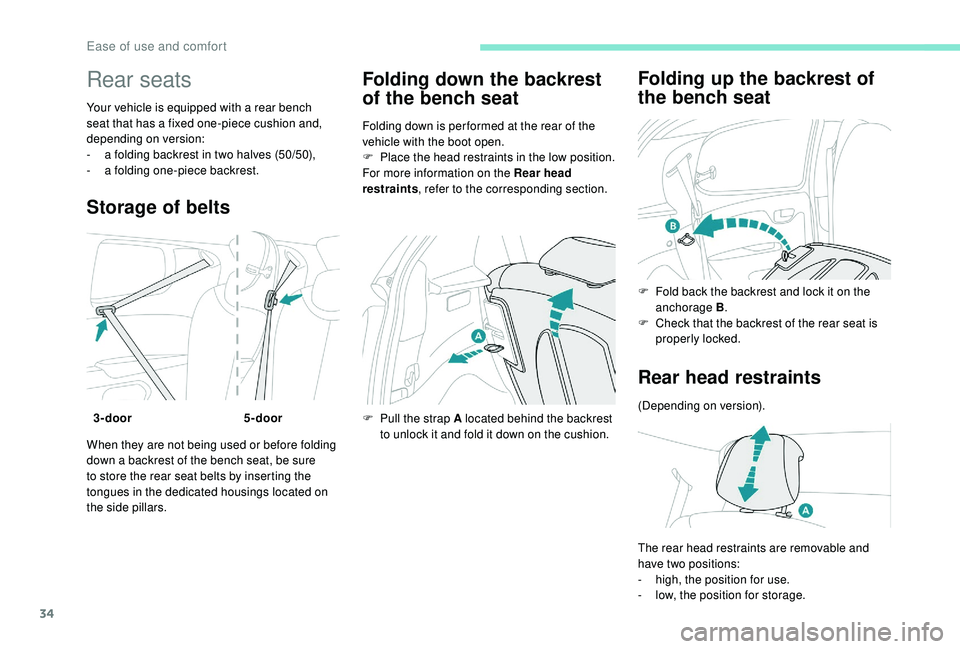
Your vehicle is equipped with a rear bench
s eat that has a fixed one-piece cushion and,
depending on version:
-
a f
olding backrest in two halves (50/50),
-
a f
olding one-piece backrest.
Storage of belts
When they are not being used or before folding
down a backrest of the bench seat, be sure
to store the rear seat belts by inserting the
tongues in the dedicated housings located on
the side pillars.
Folding down the backrest
of the bench seat
Folding down is per formed at the rear of the
vehicle with the boot open.
F
P
lace the head restraints in the low position.
For more information on the Rear head
restraints , refer to the corresponding section.
F
P
ull the strap A located behind the backrest
to unlock it and fold it down on the cushion.
Folding up the backrest of
the bench seat
3-door 5-door F
F
old back the backrest and lock it on the
anchorage B .
F
C
heck that the backrest of the rear seat is
properly locked.
Rear head restraints
(Depending on version).
The rear head restraints are removable and
have two positions:
-
h
igh, the position for use.
-
l
ow, the position for storage.
Ease of use and comfort
Page 38 of 180
36
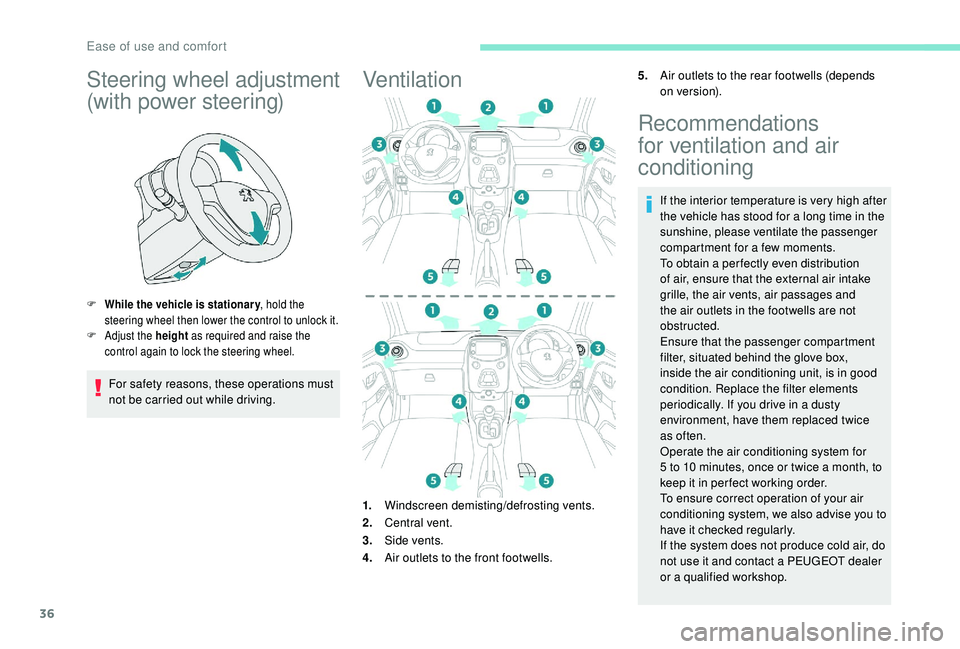
Steering wheel adjustment
(with power steering)
F While the vehicle is stationary, hold the
steering wheel then lower the control to unlock it.
F
A
djust the height as required and raise the
control again to lock the steering wheel.
For safety reasons, these operations must
not be carried out while driving.
Ventilation5. Air outlets to the rear footwells (depends
on version).
1. Windscreen demisting/defrosting vents.
2. Central vent.
3. Side vents.
4. Air outlets to the front footwells.
Recommendations
for ventilation and air
conditioning
If the interior temperature is very high after
the vehicle has stood for a
long time in the
sunshine, please ventilate the passenger
compartment for a
few moments.
To obtain a
per fectly even distribution
of air, ensure that the external air intake
grille, the air vents, air passages and
the air outlets in the footwells are not
obstructed.
Ensure that the passenger compartment
filter, situated behind the glove box,
inside the air conditioning unit, is in good
condition. Replace the filter elements
periodically. If you drive in a
dusty
environment, have them replaced twice
as often.
Operate the air conditioning system for
5
to 10 minutes, once or twice a month, to
keep it in per fect working order.
To ensure correct operation of your air
conditioning system, we also advise you to
have it checked regularly.
If the system does not produce cold air, do
not use it and contact a
PEUGEOT dealer
or a
qualified workshop.
Ease of use and comfort