2018 MERCEDES-BENZ G-CLASS engine
[x] Cancel search: enginePage 107 of 294

There is a risk of an accident.
Wear suitable footwear to ensure correct
usage of the pedals.
GWARNING
If you switch off the ignition while driving,
safety-relevant functions are only available
with limitations, or not at all. This could affect, for example, the power steering and the brake
boosting effect. You will require considerably
more effort to steer and brake. There is a risk
of an accident.
Do not switch off the ignition while driving.
GWARNING
If the parking brake has not been fully
released when driving, the parking brake can:
Roverheat and cause a fire
Rlose its hold function.
There is a risk of fire and an accident. Release
the parking brake fully before driving off.
!Warm up the engine quickly. Do not use the
engine's full performance until it has reached
operating temperature.
Only shift the automatic transmission to the
desired drive position when the vehicle is sta-
tionary.
Where possible, avoid spinning the drive
wheels when pulling away on slippery roads.
You could otherwise damage the drive train.
!Avoid high engine speeds when the engine
is cold. The engine's service life could other-
wise be significantly shortened. Do not use
the engine's full performance until it has
reached operating temperature.
!Mercedes-AMG vehicles: at low engine oil
temperatures below 68 ‡ (+20 †), the max-
imum engine speed is restricted in order to
protect the engine. To protect the engine and
maintain smooth engine operation, avoid driv-
ing at full throttle when the engine is cold.
Key positions
gTo remove the SmartKey
1Power supply for some consumers, such as
the windshield wipers
2Ignition (power supply for all consumers)
and drive position
3To start the engine
As soon as the ignition is switched on, all the
indicator lamps in the instrument cluster light
up. If an indicator lamp does not go out after
starting the engine or lights up while driving, see
(
Ypage 193).
If the SmartKey is in position gin the ignition
lock for a longer period, it can no longer be
turned in the ignition lock. The steering is then
locked. To unlock, remove the SmartKey and
reinsert it into the ignition lock.
The steering is locked when you remove the
SmartKey from the ignition lock.
XRemove the SmartKey when the engine is
switched off.
The starter battery could otherwise be dis-
charged.
If you cannot turn the SmartKey in the ignition
lock, the starter battery may not be charged
sufficiently.
XCheck the starter battery and charge it if nec-
essary (Ypage 248).
or
XJump-start the vehicle (Ypage 249).
You can only remove the SmartKey if:
Rthe SmartKey is in position gin the ignition
lock
Rthe automatic transmission selector lever is
in j
Driving105
Driving and parking
Z
Page 108 of 294
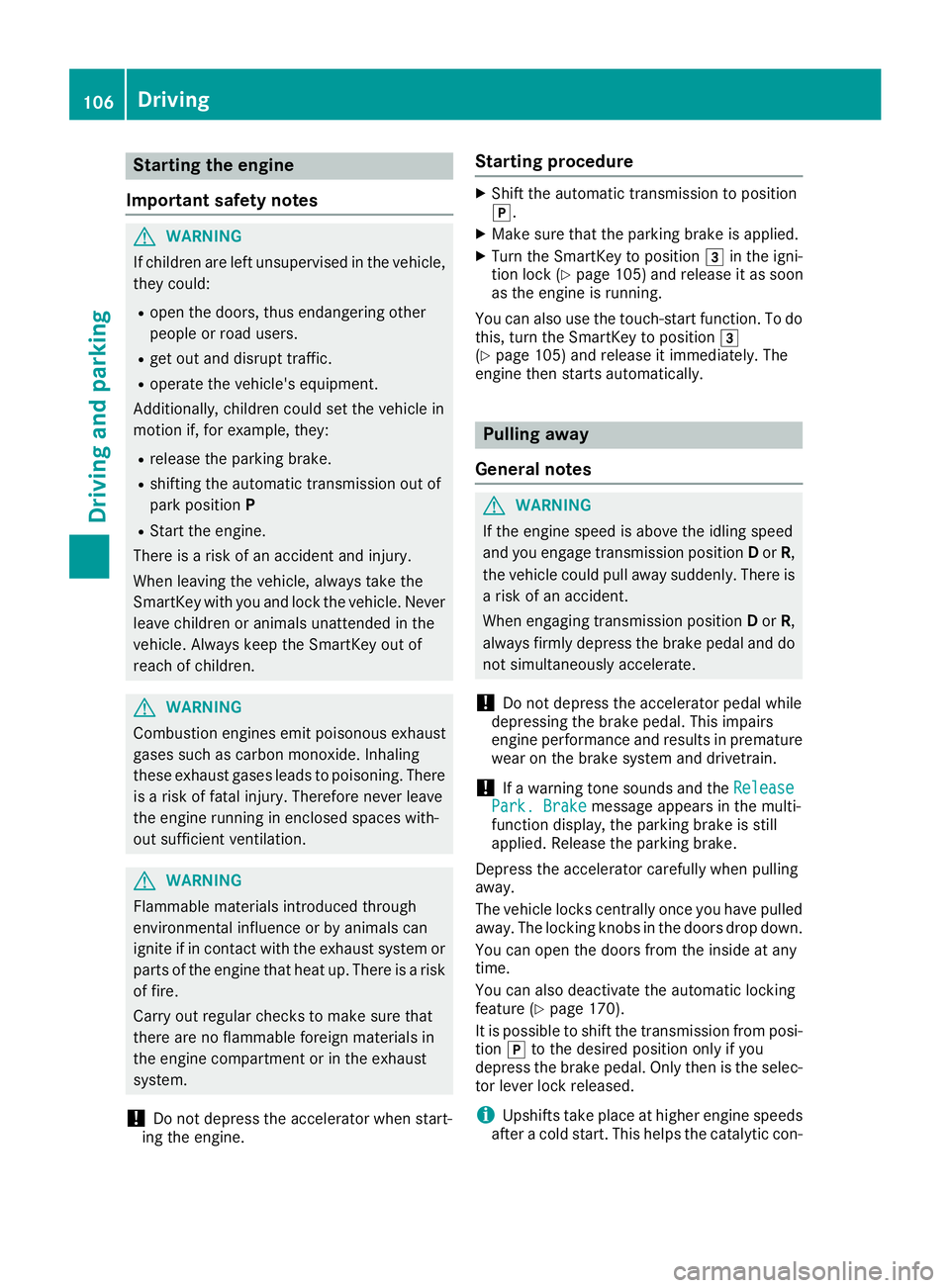
Starting the engine
Important safety notes
GWARNING
If children are left unsupervised in the vehicle,
they could:
Ropen the doors, thus endangering other
people or road users.
Rget out and disrupt traffic.
Roperate the vehicle's equipment.
Additionally, children could set the vehicle in
motion if, for example, they:
Rrelease the parking brake.
Rshifting the automatic transmission out of
park position P
RStart the engine.
There is a risk of an accident and injury.
When leaving the vehicle, always take the
SmartKey with you and lock the vehicle. Never
leave children or animals unattended in the
vehicle. Always keep the SmartKey out of
reach of children.
GWARNING
Combustion engines emit poisonous exhaust
gases such as carbon monoxide. Inhaling
these exhaust gases leads to poisoning. There
is a risk of fatal injury. Therefore never leave
the engine running in enclosed spaces with-
out sufficient ventilation.
GWARNING
Flammable materials introduced through
environmental influence or by animals can
ignite if in contact with the exhaust system or
parts of the engine that heat up. There is a risk
of fire.
Carry out regular checks to make sure that
there are no flammable foreign materials in
the engine compartment or in the exhaust
system.
!Do not depress the accelerator when start-
ing the engine.
Starting procedure
XShift the automatic transmission to position
j.
XMake sure that the parking brake is applied.
XTurn the SmartKey to position 3in the igni-
tion lock (Ypage 105) and release it as soon
as the engine is running.
You can also use the touch-start function. To do
this, turn the SmartKey to position 3
(
Ypage 105) and release it immediately. The
engine then starts automatically.
Pulling away
General notes
GWARNING
If the engine speed is above the idling speed
and you engage transmission position Dor R,
the vehicle could pull away suddenly. There is
a risk of an accident.
When engaging transmission position Dor R,
always firmly depress the brake pedal and do not simultaneously accelerate.
!Do not depress the accelerator pedal while
depressing the brake pedal. This impairs
engine performance and results in premature
wear on the brake system and drivetrain.
!If a warning tone sounds and the ReleasePark. Brakemessage appears in the multi-
function display, the parking brake is still
applied. Release the parking brake.
Depress the accelerator carefully when pulling
away.
The vehicle locks centrally once you have pulled
away. The locking knobs in the doors drop down.
You can open the doors from the inside at any
time.
You can also deactivate the automatic locking
feature (
Ypage 170).
It is possible to shift the transmission from posi-
tion jto the desired position only if you
depress the brake pedal. Only then is the selec-
tor lever lock released.
iUpshifts take place at higher engine speeds
after a cold start. This helps the catalytic con-
106Driving
Driving and parking
Page 109 of 294

verter to reach its operating temperature
more quickly.
Pulling away with a trailer
To ensure that you do not roll back when pulling
away on an uphill slope, apply the parking brake.
XDepress the brake pedal and keep it
depressed.
XShift the automatic transmission to position
hork.
iAlways wait until the shifting process is
complete before driving off.
XRelease the parking brake (Ypage 123).
XRelease the brake pedal.
XCarefully depress the accelerator pedal.
Hill start assist
Hill start assist helps you when pulling away
forward or in reverse on an uphill gradient. It
holds the vehicle for a short time after you have
removed your foot from the brake pedal. This
gives you enough time to move your foot from
the brake pedal to the accelerator pedal and to
depress it before the vehicle begins to roll.
GWARNING
After a short time, hill start assist will no lon-
ger brake your vehicle and it could roll away.
There is a risk of an accident and injury.
Therefore, quickly move your foot from the
brake pedal to the accelerator pedal. Never
leave the vehicle when it is held by hill start
assist.
Hill start assist will not function if:
Ryou are pulling away on a level road or on a
downhill gradient
Rthe transmission is in position i
Rthe parking brake is applied
RESP®is malfunctioning
ECO start/stop function
Important safety notes
GWARNING
If the engine is switched off automatically and
you exit the vehicle, the engine is restarted
automatically. The vehicle may begin moving.
There is a risk of accident and injury.
If you wish to exit the vehicle, always turn off
the ignition and secure the vehicle against
rolling away.
General notes
The ECO start/stop function switches the
engine off automatically when the vehicle stops
moving.
The engine starts automatically when the driver
wants to pull away again. The ECO start/stop
function thereby helps you to reduce the fuel
consumption and emissions of your vehicle.
The ECO start/stop function is activated each
time the engine is switched on or when you
switch the drive program (except Mercedes-
AMG vehicles).
Mercedes-AMG vehicles: the ECO start/stop
function is activated after the engine is restarted
and is only available in drive program C. When
drive program Sor Mis selected, the ECO start/
stop function is deactivated.
The system is operational if all conditions for
automatic engine switch-off have been fulfilled
(
Ypage 108) and the èsymbol is shown in
green in the multifunction display.
If not all conditions for automatic engine switch-
off are fulfilled (
Ypage 108), the èECO
symbol is shown in yellow in the multifunction
display.
If the ECO start/stop function has been man-
ually deactivated (
Ypage 108) or a malfunction
has caused the system to be deactivated, the
è ECO symbol is not displayed.
Driving107
Driving and parking
Z
Page 111 of 294
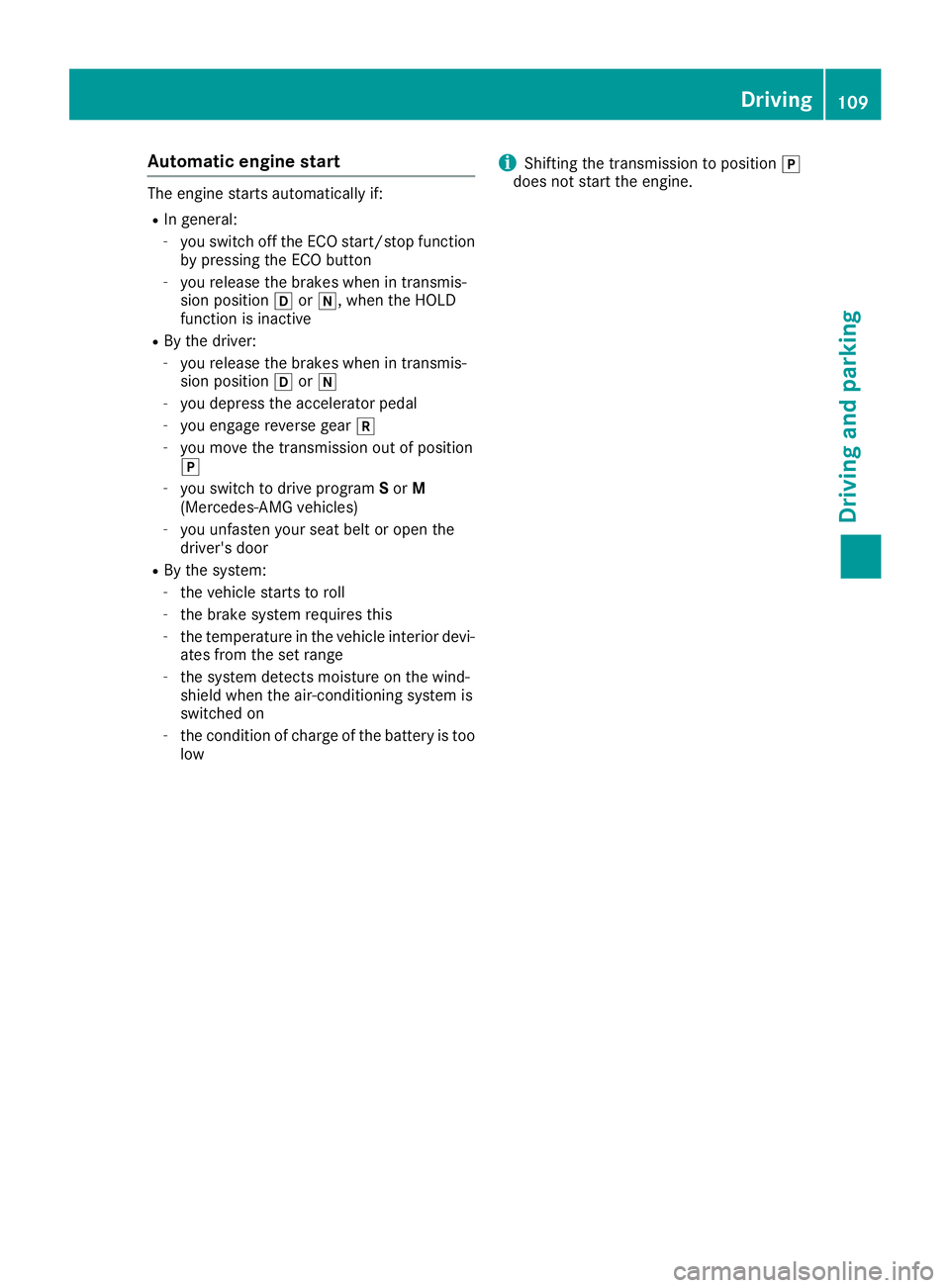
Automa tic engine start
The engin estart sautomatically if:
RIn general :
-you switch off th eECO start/sto pfunction
by pressing th eECO butto n
-you release th ebrakes when in transmis -
sion position hori, when th eHOLD
function is inactive
RBy th edriver :
-you release th ebrakes when in transmis -
sion position hori
-you depress th eaccelerato rpedal
-you engage revers egear k
-you mov eth etransmission out of position
j
-you switch to drive program Sor M
(Mercedes-AM Gvehicles)
-you unfasten your seat belt or open th e
driver's door
RBy th esystem:
-th evehicl estart sto rol l
-thebrak esystem require sthis
-th etemperature in th evehicl einterior devi-
ate sfrom th eset range
-th esystem detects moisture on th ewind-
shield when th eair-conditioning system is
switched on
-th econdition of charge of th ebattery is to o
low
iShifting th etransmission to position j
does no tstart th eengine.
Driving109
Driving and parking
Z
Page 112 of 294
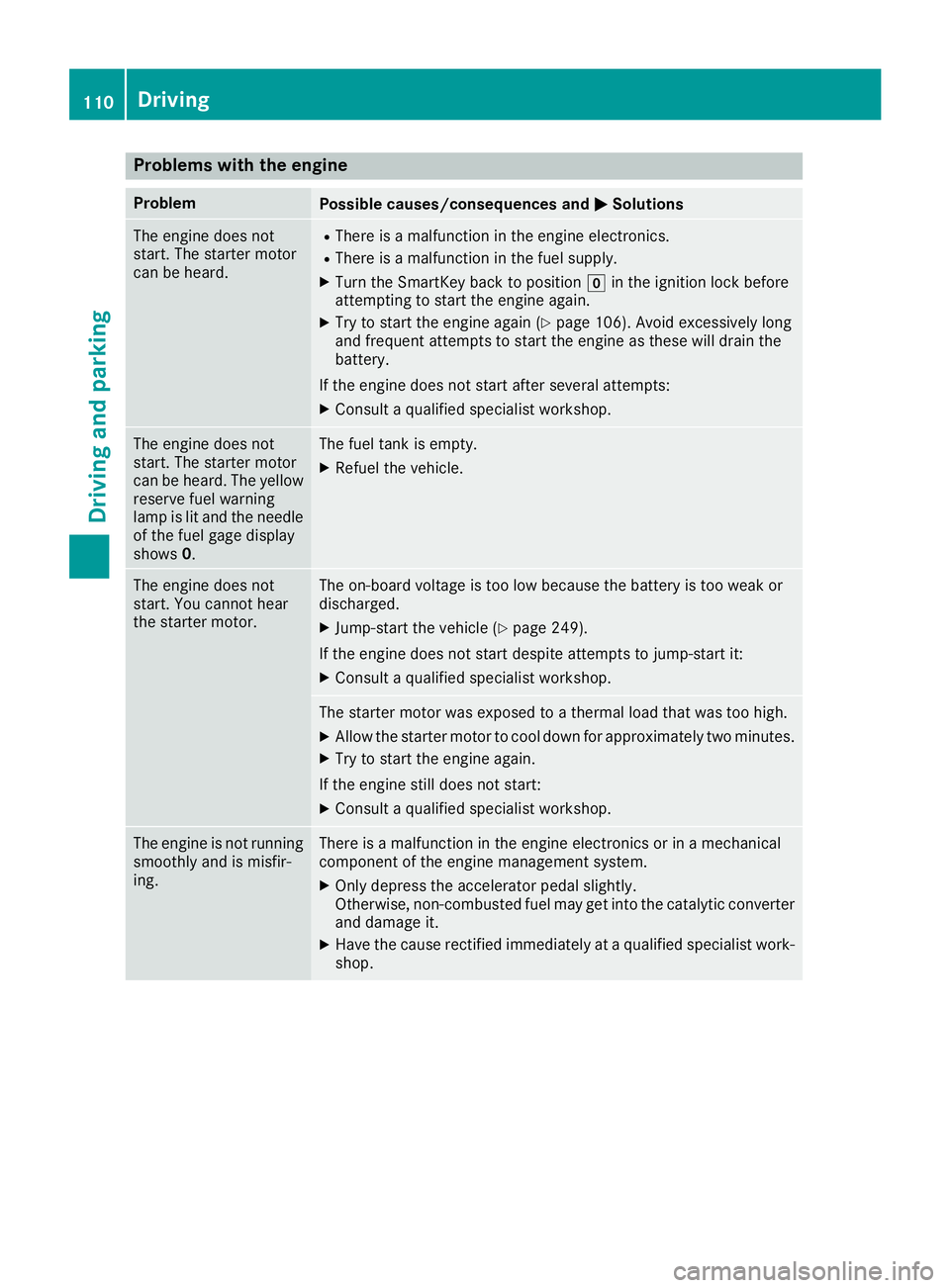
Problems with the engine
ProblemPossible causes/consequences andMSolutions
The engine does not
start. The starter motor
can be heard.RThere is a malfunction in the engine electronics.
RThere is a malfunction in the fuel supply.
XTurn the SmartKey back to positiongin the ignition lock before
attempting to start the engine again.
XTry to start the engine again (Ypage 106). Avoid excessively long
and frequent attempts to start the engine as these will drain the
battery.
If the engine does not start after several attempts:
XConsult a qualified specialist workshop.
The engine does not
start. The starter motor
can be heard. The yellow
reserve fuel warning
lamp is lit and the needle
of the fuel gage display
shows 0.The fuel tank is empty.
XRefuel the vehicle.
The engine does not
start. You cannot hear
the starter motor.The on-board voltage is too low because the battery is too weak or
discharged.
XJump-start the vehicle (Ypage 249).
If the engine does not start despite attempts to jump-start it:
XConsult a qualified specialist workshop.
The starter motor was exposed to a thermal load that was too high.
XAllow the starter motor to cool down for approximately two minutes.
XTry to start the engine again.
If the engine still does not start:
XConsult a qualified specialist workshop.
The engine is not running
smoothly and is misfir-
ing.There is a malfunction in the engine electronics or in a mechanical
component of the engine management system.
XOnly depress the accelerator pedal slightly.
Otherwise, non-combusted fuel may get into the catalytic converter
and damage it.
XHave the cause rectified immediately at a qualified specialist work-
shop.
110Driving
Driving and parking
Page 113 of 294

ProblemPossible causes/consequences andMSolutions
The coolant temperature
gauge is in the area
marked in red behind the
H. A display message
may also appear in the
multifunction display
and a warning tone may
sound.The coolant level is too low. The coolant is too hot and the engine is no
longer being cooled sufficiently.
XStop as soon as possible and allow the engine and the coolant to
cool down.
XCheck the coolant level (Ypage 234). Observe the warning notes
as you do so and add coolant if necessary.
If the coolant level is correct, the radiator fan may be faulty. The cool-
ant is too hot and the engine is no longer being cooled sufficiently.
XIf the coolant temperature is below the Hmarking, drive to the
nearest qualified specialist workshop.
XAvoid heavy loads on the engine as you do so, e.g. driving in moun-
tainous terrain and stop-and-go traffic.
Adjustable damping
General notes
With adjustable damping you can choose
between two different suspension settings.
Suspension settings
COMFcomfortable suspension setting
Sportsports suspension setting
Selecting the suspension setting
iIf you select the sports suspension setting,
the vehicle will dampen more roughly.
XPress button :.
The indicator lamp lights up. SPORTis dis-
played in the multifunction display. The sports
suspension setting is activated.
iIf you select the comfortable suspension
setting, the vehicle will dampen more softly.
XPress button ;.
The indicator lamp lights up. COMFis dis-
played in the multifunction display. The com-
fortable suspension setting is activated.
Automatic transmission
Important safety notes
GWARNING
If the engine speed is above the idling speed
and you engage transmission position Dor R,
the vehicle could pull away suddenly. There is
a risk of an accident.
When engaging transmission position Dor R,
always firmly depress the brake pedal and do not simultaneously accelerate.
GWARNING
The automatic transmission switches to neu-
tral position Nwhen you switch off the engine.
The vehicle may roll away. There is a risk of an
accident.
After switching off the engine, always switch
to parking position P. Prevent the parked vehi-
cle from rolling away by applying the parking
brake.
iBear in mind that the power transmission
between the engine and the transmission is
interrupted when the engine is switched off.
Automatic transmission111
Driving and parking
Z
Page 114 of 294

For this reason, shift the automatic transmis-
sion to jwhen the engine is switched off
and the vehicle is stationary. Apply the park-
ing brake to prevent the vehicle from rolling
away.
Selector lever
Overview of transmission positions
!If the engine speed is too high or the vehicle
is in motion, do not shift the automatic trans-
mission directly from htok, from ktoh
or directly to j.
Do not open the driver's door while the vehi-
cle is in motion. At low speeds in transmission
position hork, otherwise park position j
is engaged automatically.
The transmission could be damaged.
:B button: park position with parking lock
kReverse gear
iNeutral
hDrive
When you select a transmission position, the
selector lever subsequently returns to its origi-
nal position.
The current transmission position j,k,ior
h is shown on the transmission position dis-
play on the multifunction display.
Transmission position and drive pro-
gram display
!If the transmission position display in the
multifunction display is not working, you
should pull away carefully to check whether
the desired transmission position is engaged. Select transmission position D. Do not
restrict the shift range.
Current transmission position :and current
drive program ;appear in the multifunction
display.
The current position of the selector lever is
shown by the indicators next to the selector
lever.
The indicators light up when the SmartKey is
inserted into the ignition lock. The indicators go
out when the SmartKey is removed from the
ignition lock.
When the selector lever is in position h, you
can influence the gearshifts made by the auto-
matic transmission by:
Rrestricting the shift range
Rchanging gear yourself
Selecting park position
XMake sure that the vehicle is stationary.
XDepress the brake pedal and keep it
depressed.
XPress the Bbutton on the center console.
If you depress the brake pedal and push the
selector lever forwards or back to the first point of resistance, park position jis disengaged.
The transmission shifts to neutral i.
Engaging reverse gear
!Only move the automatic transmission to
k when the vehicle is stationary.
XMake sure that the vehicle is stationary.
XDepress the brake pedal and keep it
depressed.
XPush the selector lever forwards past the first
point of resistance.
The transmission position kis engaged.
If you engage reverse gear and the ECO start/
stop function is activated, the engine starts
automatically (
Ypage 107).
112Automatic transmission
Driving and parking
Page 115 of 294

Engaging neutral
GWARNING
If children are left unsupervised in the vehicle,
they could:
Ropen the doors, thus endangering other
people or road users.
Rget out and disrupt traffic.
Roperate the vehicle's equipment.
Additionally, children could set the vehicle in
motion if, for example, they:
Rrelease the parking brake.
Rshifting the automatic transmission out of
park position P
RStart the engine.
There is a risk of an accident and injury.
When leaving the vehicle, always take the
SmartKey with you and lock the vehicle. Never
leave children or animals unattended in the
vehicle. Always keep the SmartKey out of
reach of children.
XMake sure that the vehicle is stationary.
XDepress the brake pedal and keep it
depressed.
XDepending on the current transmission posi-
tion, press the selector lever forwards or
backwards to the first point of resistance.
The automatic transmission shifts to i.
When the engine is switched off, the automatic
transmission shifts to iautomatically.
If the vehicle is braked to a standstill in neutral
i, the ECO start/stop function switches off
the engine automatically (
Ypage 107).
Remaining in neutral
GWARNING
If children are left unsupervised in the vehicle,
they could:
Ropen the doors, thus endangering other
people or road users.
Rget out and disrupt traffic.
Roperate the vehicle's equipment.
Additionally, children could set the vehicle in
motion if, for example, they:
Rrelease the parking brake.
Rshifting the automatic transmission out of
park position P
RStart the engine.
There is a risk of an accident and injury.
When leaving the vehicle, always take the
SmartKey with you and lock the vehicle. Never
leave children or animals unattended in the
vehicle. Always keep the SmartKey out of
reach of children.
XMake sure that the vehicle is stationary.
XMake sure that the ignition is switched on.
XDepress the brake pedal and keep it
depressed.
XShift to neutral i.
XRelease the brake pedal.
XMake sure that the parking brake is released.
XSwitch off the ignition and leave the SmartKey
in the ignition lock.
Engaging the drive position
XMake sure that the vehicle is stationary.
XDepress the brake pedal and keep it
depressed.
XPush the selector lever back past the first
point of resistance.
The automatic transmission shifts to h.
If the vehicle is braked to a standstill with the
transmission in position h, the ECO start/stop
function switches off the engine automatically
(
Ypage 107).
Automatic transmission113
Driving and parking
Z