2018 MERCEDES-BENZ E-CLASS WAGON engine
[x] Cancel search: enginePage 330 of 506
&WARNING Risk of accident and injury
when opening and closing the engine
hood
When opening or closing the engine hood, it
may suddenly drop into the end position.
There is a risk of injury for an yone in the
engine hood's range of mo vement.
#Only open or close the engine hood
when there are no persons in the
engine hood's range of mo vement.
&
WARNING Danger of burn s when open‐
ing the hood
If yo u open the hood when the engine has
ove rheated or during a fire inthe engine
compartment, you could come into contact
wit h hot gases or other escaping operating
fl uids.
#Before opening the hood, allow the
engine tocool down.
#Intheeve nt of a fire inthe engine com‐
partment, keep the hood closed and
call thefire service.
&
WARNING Risk of injury duetomoving
parts
Cer tain components in the engine compart‐
ment may continue tomo veor suddenly
mo veagain even af terth e ignition has been
switched off, e.g. the cooler fan.
Make sure of thefo llowing before per form ing
ta sks in the engine compartmen t:
#Switchthe ignition off.
#Ne verto uch the danger zone sur round‐
ing moving co mponent parts, e.g. the
ro tation area of thefa n.
#Re mo vejewe lry and watches.
#Keep items of clo thing and hair away
from moving parts.
& WARNING Risk of injury fromtouching
co mp onent parts under voltage
The ignition sy stem and the fuel injection
sy stem workunder high voltage. If youto uch
co mp onent parts which are under voltage,
yo u could receive an electric shoc k.
#Neverto uch co mponent parts of the
ignition sy stem or the fuel injection sys‐
te m when the ignition is switched on.
&
WARNING Risk of burn s from hot com‐
ponent parts in the engine compartment
Cer tain component parts in the engine com‐
partment can be very hot, e.g. the engine,
th e cooler and parts of theex haust sy stem.
#Let the engine cool down and only
to uch the component parts described
as follo ws .
328
Maintenance and care
Page 331 of 506
&WARNING Risk of injury from usingthe
windshield wipers while the engine hood
is open
When the engine hood is open and the wind‐
shield wipers are set in motion, you can be
trapped bythe wiper linkage.
#Alw ays switch off the windshield wipers
and ignition before opening the engine
hood.
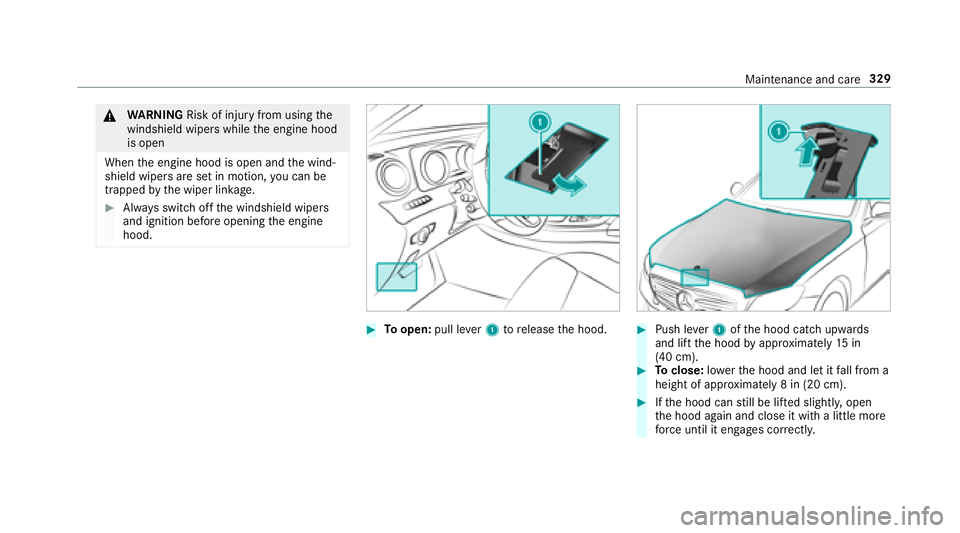
#To open: pull lever1 torelease the hood.#Push le ver1 ofthe hood catch upwards
and lift the hood byappr oximately 15in
(40 cm).
#To close: lowe rth e hood and let it fall from a
height of appr oximately 8 in (20 cm).
#Ifth e hood can still be lif ted slightl y,open
th e hood again and close it with a little more
fo rc e until it engages cor rectl y.
Maintenance and care 329
Page 332 of 506

Engine oil
Checkingthe engine oil le vel using the oil
dip stick
&
WARNING Risk of burn s from hot com‐
ponent parts in the engine compartment
Cer tain component parts in the engine com‐
partment can be very hot, e.g. the engine,
th e cooler and parts of theex haust sy stem.
#Let the engine cool down and only
to uch the component parts described
as follo ws .
Depending on the engine, the oil dipstick may be
ins talled in the engine compartment in dif fere nt
locations.
Wa iting time before checking the oil le vel:
REngine at normal operating temp erature: five
minutes.
REngine not at normal operating temp erature
(e.g. the engine was only star ted brief ly): 30
minutes.
#Pa rk theve hicle on a flat sur face.
#Re mo veoil dipstick 1and wipe off.
#Slowly slide oil dipstick 1into the guide
tube tothestop, and take it out again af ter
appr oximately thre e seconds.
ROil le vel is cor rect: oil le vel is between 2
and 3.
ROil le velto o low: oil le vel is at 3or
belo w.
ROil le velto o high: oil le vel is abo ve2.
#Ifth e oil le vel is too lo w,add 1.1 US qt (1 l) of
engine oil.
#If th e oil le vel is too high, drain off excess
engine oil. Consult a qualified specialist
wo rkshop.
Ad ding engine oil
&
WARNING Risk of burn s from hot com‐
ponent parts in the engine compartment
Cer tain component parts in the engine com‐
partment can be very hot, e.g. the engine,
th e cooler and parts of theex haust sy stem.
#Let the engine cool down and only
to uch the component parts described
as follo ws .
&
WARNING Risk offire and injury from
engine oil
If engine oil comes into con tact wi thhot
component parts in the engine compart‐
ment, it may ignite.
330 Maintenance and care
Page 333 of 506

#Make surethat no engine oil is spilled
next tothefiller opening.
#Allow the engine tocool off and thor‐
oughly clean the engine oil from compo‐
nent parts before starting theve hicle.
* NO
TEEngine damage causedbyan
incor rect oil filter, incor rect oil or addi‐
tives
#Do not use engine oils or oil filters
which do not cor respond tothe specifi‐
cations explicitly prescribed forth e
service inter vals.
#Do not alter the engine oil or oil filter in
order toachie velonger change inter vals
th an prescri bed.
#Do not use additives.
#Follow the instructions in the service
inter val display rega rding the oil
ch ange.
* NO
TEDama gecaused bytopping up too
much engine oil
Ad ding too much engine oil can cause dam‐
age tothe engine or the catalytic con verter.
#Ha ve excess engine oil remo ved at a
qu alified specialist workshop.
#Tu rn cap 1counter-clockwise and remo ve
it.
#Ad d engine oil.
#Replace cap 1and turn it clockwise as far
as it will go.
#Check the oil le vel again (→page 330).
Checking coolant le vel
&
WARNING Risk of burn s from hot com‐
ponent parts in the engine compartment
Cer tain component parts in the engine com‐
partment can be very hot, e.g. the engine,
th e cooler and parts of theex haust sy stem.
#Let the engine cool down and only
to uch the component parts described
as follo ws .
&
WARNING Danger of burn s from hot
coolant
The engine cooling sy stem is pressurized,
particularly when the engine is warm. If you
Maintenance and care 331
Page 334 of 506

openthe cap, you could bescalded byhot
coolant spr aying out.
#Let the mo tor cool down before opening
th e cap.
#When opening the cap, wearglove s and
pr otective eyew ear.
#Slowly turn the cap half a turn toallow
pressure toescape.
#Park theve hicle on a flat sur face.
#Check the coolant temp erature display in the
instrument clus ter.
The coolant temp erature must be below
15 8 °F (70 °C).
#Slowly turn cap 1counter-clockwise to
re lie ve ove rpressure.
#Continue turning cap 1counter-clockwise
and remo veit.
The coolant le vel is cor rect:
RIfth e engine is cold, up tomar ker bar 2
RIfth e engine is warm, up to0.6 in (1.5 cm)
ove r mar ker bar 2
#If necessar y,add coolant that has been
appr ovedby Mercedes-Benz.
RFurther information on coolant (→page 397)
Re filling the windshield washer sy stem
&
WARNING Risk of burn s from hot com‐
ponent parts in the engine compartment
Cer tain component parts in the engine com‐
partment can be very hot, e.g. the engine,
th e cooler and parts of theex haust sy stem.
#Let the engine cool down and only
to uch the component parts described
as follo ws .
&
WARNING Danger of burn s when open‐
ing the engine hood
If yo u open the engine hood when the engine
has overheated or during a fire inthe engine
compartment, you could come into contact
with hot gases or other escaping operating
fl uids.
#Before opening the engine hood, allow
th e engine tocool down.
#Intheeve nt of a fire inthe engine com‐
partment, keep the engine hood closed
and call thefire service.
332
Maintenance and care
Page 335 of 506
&WARNING ‑ Risk of fire and injury from
windshield washer concentrate
Wi ndshield washer concentrate is highly
fl ammable. It could ignite if it comes into
con tact wi thhot engine component parts or
th eex haust sy stem.
#Make sure that no windshield washer
concentrate spills out next tothefiller
opening.
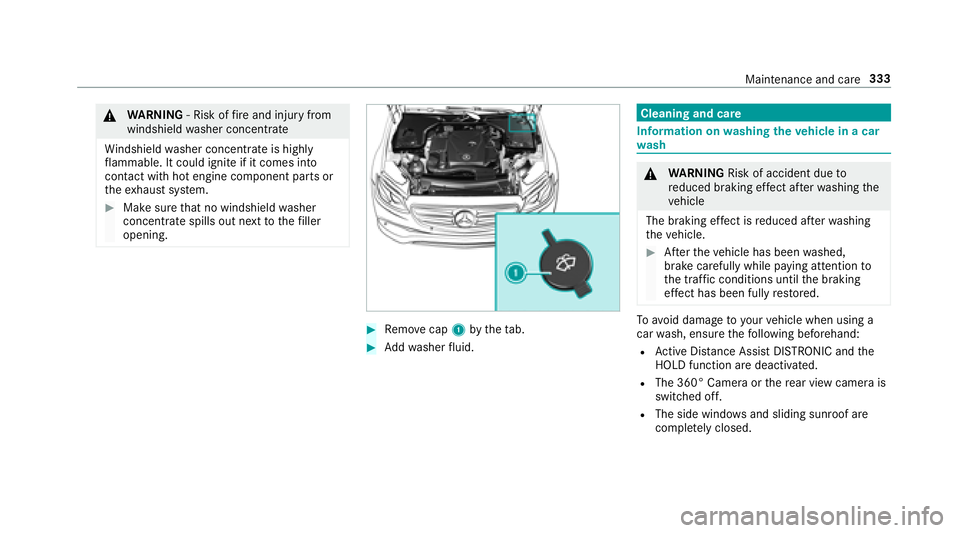
#Re mo vecap 1bytheta b.
#Ad dwa sher fluid.
Cleaning and care
Informa tiononwashing theve hicle in a car
wa sh
&
WARNING Risk of accident due to
re duced braking ef fect af terwa shing the
ve hicle
The braking ef fect is reduced af terwa shing
th eve hicle.
#Afterth eve hicle has been washed,
brake carefully while paying attention to
th e traf fic conditions until the braking
ef fect has been ful lyrestored.
To avo id damage to yourvehicle when using a
car wash, ensure thefo llowing beforehand:
RAc tive Dis tance Assist DISTRONIC and the
HOLD function are deactivated.
RThe 360° Camera or there ar view camera is
switch ed off.
RThe side windo wsand sliding sunro of are
comple tely closed.
Maintenance and care 333
Page 350 of 506
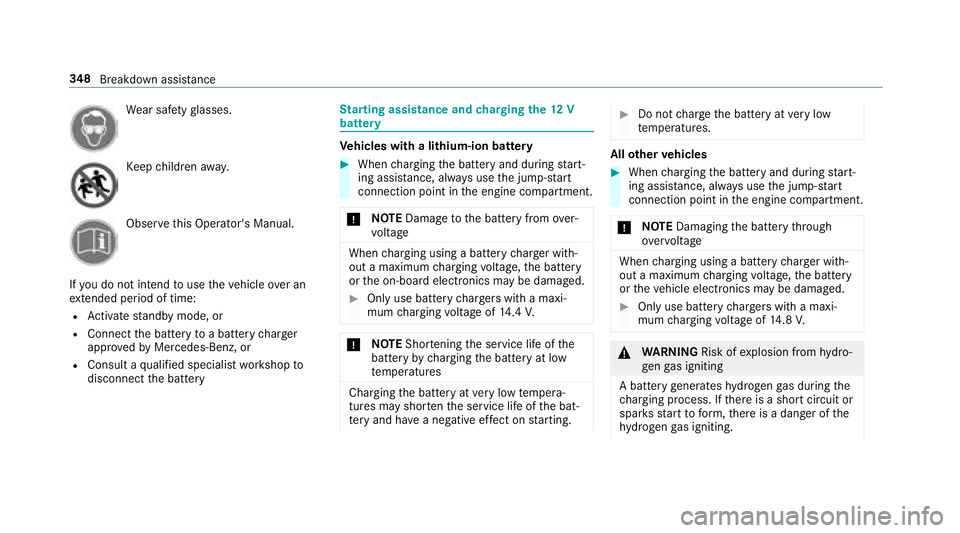
Wear saf etygl asses.
Ke ep children away.
Obser vethis Opera tor's Manual.
If yo udo not intend touse theve hicle over an
ex tended pe riod of time:
RAc tivate standby mode, or
RConnect the battery toa batte rycharge r
appr ovedby Mercedes-Benz, or
RConsult a qualified specialist workshop to
disconnect the battery
St arting assist ance andcharging the12 V
battery
Ve hicles with a lithium-ion battery
#When charging the battery and during start‐
ing assis tance, al ways use the jump-s tart
connection point in the engine compartment.
* NO
TEDama getothe battery from over‐
vo ltage
When charging using a batte rycharge r with‐
out a maximum charging voltage, the battery
or the on-board electronics may be damaged.
#Only use battery charge rs with a maxi‐
mum charging voltage of 14.4 V.
* NO
TEShor tening the service life of the
battery bycharging the battery at low
te mp eratures
Charging the battery at very low temp era‐
tures may shor tenth e service life of the bat‐
te ry and ha vea negative ef fect on starting.
#Do not charge the battery at very low
te mp eratures.
All other vehicles
#When charging the battery and during start‐
ing assis tance, al ways use the jump-s tart
connection point in the engine compartment.
* NO
TEDamaging the battery thro ugh
ove rvoltage
When charging using a batte rycharge r with‐
out a maximum charging voltage, the battery
or theve hicle electronics may be damaged.
#Only use battery charge rs with a maxi‐
mum charging voltage of 14.8 V.
&
WARNING Risk ofexplosion from hydro‐
ge nga s igniting
A battery generates hydrogen gas during the
ch arging process. If there is a short circuit or
spar ksstart toform ,th ere is a danger of the
hy drogen gas igniting.
34 8
Breakdown assis tance
Page 351 of 506

#Make surethat the positive term inal of
th e connected battery does not come
into conta ct withvehicle parts.
#Ne ver place me tal objects or tools on a
batter y.
#When connecting and disconnecting the
batter y,yo u must observ eth e descri‐
bed order forth e battery clamps.
#When giving starting assis tance, al ways
make sure that you only connect bat‐
te ry term inals with identical polarity.
#During starting assis tance, you must
observ eth e described order for con‐
necting and disconnecting the jumper
cables.
#Do not connect or disconnect the bat‐
te ry cla mp s while the engine is running.
&
WARNING Risk ofexplosion during
ch arging process and starting assis tance
During thech arging process and starting
assis tance, the battery may release an explo‐
sive gas mixture.
#Av oid fire , open flames, creating spar ks
and smoking.
#Make sure that there is suf ficient venti‐
lation du ring thech arging process and
during starting assis tance.
#Do not lean over a batter y.
Ifth e indicator/warning lamps in the instrument
clus ter do not light up at low temp eratures, it is
ve ry likely that the dischar ged battery has fro‐
zen.
& WARNING Risk ofexplosion from a fro‐
zen battery
A dischar ged battery may freeze at temp era‐
tures slightly abo veor below freezing point.
During starting assis tance or battery charg‐
ing, batte rygas may be released.
#Alw aysth aw a frozen batte ryout firs t
before charging it or per form ing start‐
ing assis tance.
The service li feof a battery that has been
th awe d may be dramatically shor tened. It is
recommended that you ha veathaw ed bat‐
te ry checked at a qualified specialist workshop.
All vehicles
* NO
TEDama gecaused bynumerous or
ex tended attem ptsto start the engine
Nume rous or extended attem ptsto start the
engine may damage the catalytic con verter
due tonon-combu sted fuel.
#Av oid numerous and extended attem pts
to start the engine.
Obser vethefo llowing points during starting
assis tance and when charging the battery:
ROnly use undamaged jumper cable/charging
cables with a suf ficient cross-section and
insula tedte rm inal clamps.
RNon- insulated parts of thete rm inal clamps
must not come into con tact wi thother me tal
parts while the jumper cable/charging cable
is connected tothe battery/jump-s tart con‐
nection point.
Breakdown assis tance 34
9