2018 MERCEDES-BENZ E-CLASS COUPE towing
[x] Cancel search: towingPage 171 of 486

RIt uses as arefere nce theve hicle in front or
th e lane markings, depending on the driven
speed.
RSt eering Pilot requiresyou as the driver, to
ke ep your hands onthesteering wheel at all
times so that you are abletointer vene at any
time tocor rect the course of theve hicle and
ke ep it in lane.
RSteering Pilot can be overridden at any time
by steering theve hicle yourself.
RIfth e sy stem de tects that there are no lane
markings, it uses theve hicle ahead as a ref‐
erence up toa speed of 80 mph (130 km/h).
RWhen the sy stem is actively steering, the
è symbol is shown in green in the multi‐
function displa y.
Sy stem limitations of Steering Pilot
St eering Pilot has a limited steering torque for
lateral guidance. In some cases, thesteering
inter vention is not suff icienttokeep theve hicle
in the lane.
If de tection of lane markings and vehicles ahead
is impaired, Steering Pilot switches topassive
mode. The sy stem pr ovides no support in this case. During
the transition from the active to
passive status, theè symbol is shown as
enlar ged and flashes yello w. Once the sy stem is
passive theè symbol is shown as gr ayinthe
multifunction displa y.
The sy stem may be impaired or may not function
in thefo llowin
g ins
tances:
RIfth ere is poor visibility, e.g. due toinsuf fi‐
cient illumination of thero ad, or due tosno w,
ra in, fog or spr ay.
RIfth ere is glare, e.g. from oncoming traf fic,
dire ct sunlight or reflection from other vehi‐
cles (e.g. if thero ad is wet).
RIfth e windshield is dirty, fogged up, damaged
or co vered, for ins tance byast icke r,in the
vicinity of the camera.
RIf no, or se veral, unclear lane markings are
present for one lane, e.g. in a construction
area.
RIf th e lane markings are wornaw ay, dark or
co vered up, e.g. bydirt or sno w.
RThe distance totheve hicle in front is too
small and the lane markings thus cannot be
de tected.
RIfth e lane markings change quickl y,e.g.
lanes branch off, cross one ano ther or
mer ge.
RThe road is nar rowand winding.
RIfth ere are highly variable shade conditions
on thero ad.
RIfth ere are obs tacles such as traffic guid‐
ance posts on the lane or projecting out into
th e lane.
The sy stem does not pr ovide assis tance in the
fo llowing conditions:
ROn very sharp bends.
RWhen towing a trailer.
RIfyo u act ively change lane without switch ing
on the turn signal indicator.
RIfyo u switch onthe turn signal indicator and
th e condit
ions for activating Active Lane
Change Assi stare not fulfilled.
Ac tivating Steering Pilot
Requ irements
RESP®must be switched on, but not inter ven‐
ing.
Driving and pa rking 16
9
Page 174 of 486

#Always deactivate the HOLD function
and secure theve hicle against rolling
aw ay before leaving theve hicle.
* NO
TEDama gefrom au tomatic braking
IfAc tive Brake Assi st, Dis tance Pilot
DISTRONIC or the HOLD function is activa‐
te d, theve hicle brakes automatically in cer‐
ta in situations.
To avo id damage totheve hicle, deactivate
th ese sy stems in thefo llowing or similar sit‐
uations:
#During towing
#In a car wash
RequirementsRThe vehicle is stationar y.
RThe driver's door is closed or the seat belt on
th e driver's side is fastened.
RThe engine is running or has been au tomati‐
cally switched off bythe ECO start/ stop
function.
RThe electric parking brake is released.
RDis tance Pilot DISTRONIC is not acti vated.
RVe hicles with automatic transmission:
The transmission is in position h,kori.
Ac tivating the HOLD function
#Dep ress the brake pedal and af ter a short
time depress fur ther until theë display
appears in the multifunction displa y.
#Release the brake pedal.
Deactivating the HOLD function
#Depress the accelerator pedal topull away.
or
#Depress the brake pedal until theë dis‐
play disappears from the multifunction dis‐
pla y.
The HOLD function is deactivated in thefo llow‐
ing situations:
RIf Dis tance Pilot DISTRONIC has been acti va‐
te d.
RVe hicles with automatic transmission:
When transmission position jis selected.
RWhen theve hicle is secured with the electric
parking brake. In
thefo llowing situations, theve hicle is held by
th e transmission position jorby the electric
parking brake:
RWhen the seat belt is unfas tened and the
driver's door is opened.
RWhen the engine is switched off.
RWhen there is a malfunction in the sy stem or
if th e po wer supp lyis insuf ficient.
DY NA MIC BODY CONT ROL
DYNA MIC BODY CONTROL has thefo llowing
ch aracteristics:
RVa riable damping characteristics
RContinual adjustment of the damping forc es
The damping characteristics adapt tothe cur rent
operating and driving situation.
The da mping is tuned individually for each wheel
and is af fected bythefo llowing factors:
RThe road sur face conditions
RThe drive program selected
RVe hicle load
17 2
Driving and pa rking
Page 318 of 486
RThe blowerfo rth eve ntilation/heating is
switched off.
RThe windshield wiper switch is in position 0.
RIn car washes with a towing mechanism: neu‐
tral iis engaged.
RThe SmartK eyis at a dis tance of at least
10 ft(3 m) away from theve hicle, otherwise
th e trunk lid could open unintentionall y.
% Remo vethewa x from the windshield and
wiper rubber af terth e car wash; this will pre‐
ve nt smearing and reduce wiper noise.
Information on using a po werwa sher
&
WARNING Risk of accident when using
high-pressure cleaning equipment wi th
ro und-s pray nozzles
The wate r jet from a round-s pray nozzle (dirt
grinder) may cause damage totires and sus‐
pension components that is not visible.
Components damaged in this wa yma yfa il
unexpec tedly.
#Do not use high-pressure cleaning
equipment wi thround-spr aynozzles to
clean your vehicle.
#Damaged tires or suspension compo‐
nents must be replaced immediatel y.
Toavo id damage to yourvehicle, obser vethefo l‐
lowing when using a po werwa sher:
RKeep the SmartK eyat least 10ft(3 m) away
from theve hicle. Otherwise the trunk lid
could open unintentionall y.
RMaintain a distance of at least 11.8 in
(30 cm) totheve hicle.
RVe hicles with deco rative foil: parts of your
ve hicle are co vered with a decorative foil.
Maintain a dis tance of at least 27.6 in
(70 cm) between thefo il-c ove red parts of the
ve hicle and the nozzle of the high pressure
cleaner. Mo vethe po werwa sher nozzle
around whilst cleaning.
RObser vethe information on the cor rect dis‐
ta nce in the equipment manufacturer's oper‐
ating instructions.
RDo not point the nozzle of the po werwa sher
directly at sensitive parts such as tires, slits,
electrical component parts, batteries, light
sources and ventilation slot s.
Washing the vehicle byhand
Obser velegal requ irements, forex ample in
some countries washing byhand is only allo wed
at specially equipped washing ba ys.
#Use a mild cleaning agent such as car sham‐
poo.
#Wa shtheve hicle with luk ewarmwate r and a
soft car sponge. While doing so, do not
ex pose theve hicle todirect sunlight.
#Hose down theve hicle carefully with water
and dry it with a leather clo th. Make sure
th at thewate r jet is not pointed directly into
th e air inlet grille.
31 6
Maintenance and care
Page 335 of 486
Whenthest arting assis tance/charging process
is compl ete:
#Fir st,re mo vethe jumper cable/charging
cable from ground point 3and the negative
pole of the donor batter y,then from positive
clamp 2and the positive pole of the donor
batter y.Begin each time with the conta cts
on your ow nve hicle firs t.
#Af terre moving the jumper cable/charging
cable, close co ver1 of positive clamp 2.Yo
u can obtain fur ther information on starting
assis tance at any qualified specialist workshop.
To w starting or towing away
Perm itted towing me thods
Mercedes-Benz recommends transporting your
ve hicle in the case of a breakdown, rath er than
to wing it away. *
NO
TEDama getotheve hicle due to tow‐
ing away incor rectly
#Obser vethe instructions and no tes on
to wing away.
Breakdown assis tance 333
Page 336 of 486
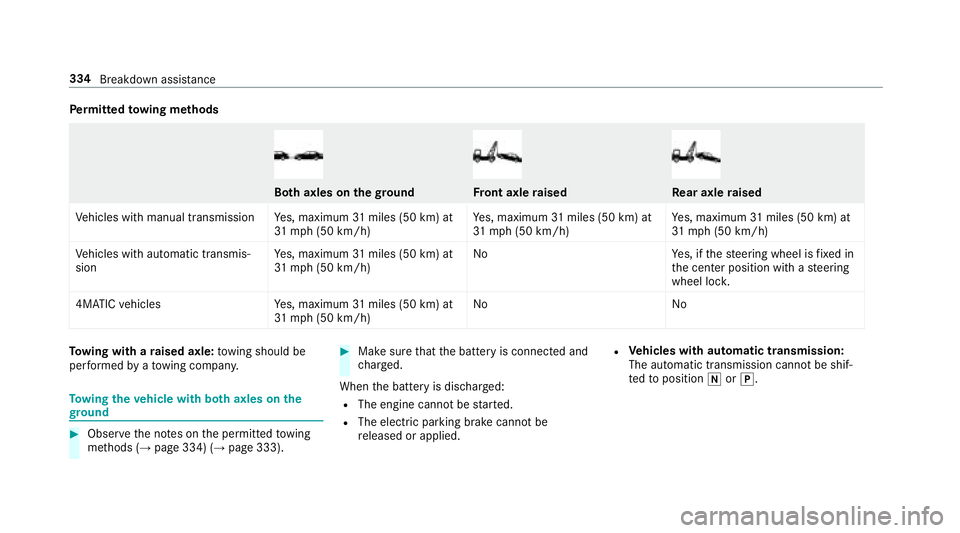
Perm itted towing me thods
Bo th axles on thegr oundFront axle raisedRe ar axle raised
Ve hicles with manual transmission Yes, maximum 31miles (50 km) at
31 mp h (50 km/h) Ye
s, maximum 31miles (50 km) at
31 mp h (50 km/h) Ye
s, maximum 31miles (50 km) at
31 mp h (50 km/h)
Ve hicles with automatic transmis‐
sion Ye
s, maximum 31miles (50 km) at
31 mp h (50 km/h) No
Yes, if thesteering wheel is fixe d in
th e center position with a steering
wheel loc k.
4MATIC vehicles Yes, maximum 31miles (50 km) at
31 mp h (50 km/h) No
No
Towing wit h araised axle: towing should be
per form ed byato wing compan y.
Towing theve hicle with bo thaxles on the
gr ound
#Obser vethe no tes on the permitted towing
me thods (→page 334) (→page 333).
#Make sure that the battery is connected and
ch arge d.
When the battery is dischar ged:
RThe engine cann otbe star ted.
RThe elect ric park ing brake cannot be
re leased or applied.
RVe hicles with automatic transmission:
The au tomatic transmission cannot be shif‐
te dto position iorj.
334
Breakdown assis tance
Page 337 of 486
%Vehicles with automatic transmission: If
th e automatic transmission cannot be shif‐
te dto position i, havetheve hicle trans‐
por tedaw ay (
→page 336). A towing vehicle
with lifting equipment is requiredforve hicle
transport.
* NO
TEDama gedue to to wing away at
exc essively high speeds or over long dis‐
ta nces
The driv etra in could be damaged when tow‐
ing at excessively high speeds or over long
dis tances.
#A towing speed of 30 mph (50 km/h)
must not be exceeded.
#Atowing dis tance of 30 miles (50 km)
must not be exceeded.
&
WARNING Risk of accident when towing
a ve hicle which is too heavy
If th eve hicle being tow- star ted or towe d
aw ay is heavier than the permissible gross
mass of your vehicle, thefo llowing situations
can occur:
RThe towing eye may become de tach ed.
RThe vehicle/trailer combination may
swer veoreve nov erturn.
#If ano ther vehicle is tow- star ted or
to we daw ay, its weight must not exceed
th e permissible gross mass of your ow n
ve hicle.
If a vehicle must be tow star ted or towe daw ay,
its weight must not exceed the permissible gross
mass of theto wing vehicle.
#Information on the permissible gross mass of
th eve hicle can be found on theve hicle iden‐
tification plate .
#Ve hicles with automatic transmission: Do
not open the driver's door or front passenger
door, otherwise the automatic transmission
automatically shifts toposition j.
#Installth eto wing eye (→page 338).
#Attach theto w bar.
* NO
TEDama gedue toincor rect connec‐
tion
#Only connect theto w rope or tow bar to
th eto wing eyes.
#Deactivate the automatic locking mechanism
(→page 62).
#Do not activate the HOLD function.
#Deactivate Active Brake Assi st(→page 159).
#Ve hicles with automatic transmission:
Shift the automatic transmission toposition
i.
#Re lease the electric parking brake.
Breakdown assis tance 335
Page 338 of 486
&WARNING Risk of accident due tolimi‐
te d saf ety-re lated functions during the
to wing process
Saf ety-re lated functions are limited or no lon‐
ge rav ailable in thefo llowing situations:
Rth e ignition is switched off.
Rthe brake sy stem or po werst eering sys‐
te m is malfunctioning.
Rth e energy supply or the on-board electri‐
cal sy stem is malfunctioning.
When your vehicle is then towe daw ay, signif‐
icantly more ef fort may be requ ired tosteer
and brake than is no rmally requ ired.
#Use a tow bar.
#Make sure that thesteering wheel can
mo vefreely, before towing theve hicle
aw ay.
* NO
TEDama gedue toexcessive tracti ve
po we r
Ifyo u pull away sharpl y,the tractive po wer
may be too high and theve hicles could be
damaged.
#Pull away slowly and smoo thly.
Loading the vehicle for transport
#Obser vethe no tes on towing away
(→page 334).
#Connect theto w bar totheto wing eyeto
load theve hicle.
#Ve hicles with automatic transmission:
Shift the automatic transmission toposition
i.
% Ve
hicles with automatic transmission:
The au tomatic transmission may be loc ked
in position jintheeve nt of damage tothe
electrics. Toshift toi, pr ovide the on-
board electrical sy stem with po wer
(
→page 330).
#Load theve hicle onto the transpor ter.
#Ve hicles with automatic transmission:
Shift the automatic transmission toposition
j.
#Use the electric parking brake tosecure the
ve hicle and pr event it from rolling away.
#Only secure theve hicle bythe wheels.
Ve hicles with ADS PLUS (Adaptive Damping
Sy stem PLUS)
&
WARNING Risk of accident when trans‐
porting vehicles with AIR BODY CON‐
TROL
The reduced damping forc es on theve hicle
being transpor ted can cause theve hicle/
trailer combination tostart toswing.
As a result, when transporting vehicles with
AIR BODY CONTROL theve hicle/trailer com‐
bination may start toskid. Consequentl y,yo u
could lose control of your vehicle.
There is a risk of accident and injur y.
336
Breakdown assis tance
Page 339 of 486
#Loadtheve hicle cor rectly onto the
transpo rter.
#Secure theve hicle on all four wheels
wit h suit abletensioning stra ps.
#Do not exceed the maximum permissi‐
ble speed of 35 mph(6 0 km/h) when
transpo rting.
* NO
TEDama getotheve hicle from secur‐
ing it incor rectly
#Af ter loading, theve hicle must be
secured at all four wheels. Otherwise,
th eve hicle could be damaged.
#A minimum dis tance of 8 in (20 cm) up
and 4 in (10 cm) down must bekept to
th e transport platform.
#Secure theve hicle on all four wheels af ter
loading. 4MATIC
vehicles/ve hicles with automatic
transmission
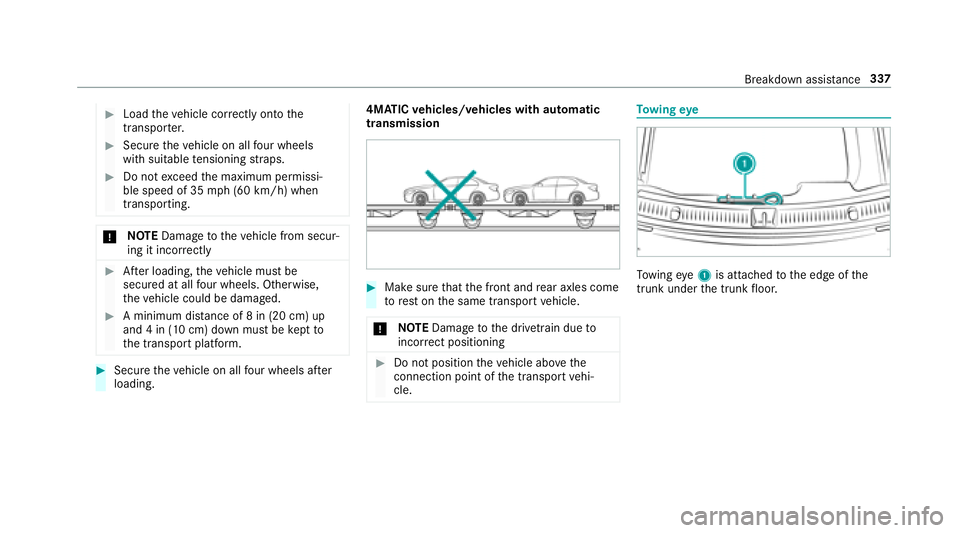
#Make sure that the front and rear axles come
to rest on the same transport vehicle.
* NO
TEDama getothe driv etra in due to
incor rect positioning
#Do not position theve hicle abo vethe
connection point of the transport vehi‐
cle.
To wing eye
Towing eye1 is attached tothe edge of the
trunk under the trunk floor.
Breakdown assis tance 337