2018 MERCEDES-BENZ CLA COUPE dimensions
[x] Cancel search: dimensionsPage 22 of 326
Traction (definition)....................... 307
Tread wear .....................................3 01
Uniform Tire Quality Grading
Standard s...................................... 301
Uniform Tire Quality Grading
Standard s(definition) .................... 306
Weari ndicator (definition) ............. 307
Wheelr im (definition) .................... 306
see Flat tire
Top Tether ............................................ 57
Tow-starting
Emergency engine starting ............ 284
Important safety notes .................. 281
Installing the towing eye. ............... 282
Removing the towing eye. ..............282
Towing atrailer
ESP
®(ElectronicS tability Pro-
gram) ............................................... 67
Towing away
Important safety guidelines ........... 281
Installing the towing eye. ............... 282
Notes for 4MATIC vehicles ............ 284
Removing the towing eye. ..............282
Transporting the vehicle ................ 283
With both axle sonthe ground ....... 283
With front axle raised ..................... 282
Towing eye ......................................... 270
Traffic reports
see also Digita lOperator's Man-
ua l..................................................2 29
Transmission
see Automatic transmission
Transmission position display
(DIRECT SELEC Tlever) ......................1 30
Transporting the vehicle .................. 283
Trim pieces (cleaning instruc-
tions) ..................................................2 67
Trip computer (on-board com-
puter) ..................................................1 80
Trip odometer
Calling up ....................................... 180
Resetting (on-board computer) ...... 181
Trunk
Emergency release .......................... 81
Emergency release button ...............8 1
Important safety notes .................... 78 Opening (automaticall
yfrom out-
side) .................................................7 9
Opening (from outside the vehi-
cle, HANDS-F REE ACCESS) ...
........... 79
Opening automaticallyf rom
inside ............................................... 80
Opening/closing (manually from
outside) ............................................ 78
Trunk lid
Display message ............................2 15
Opening dimensions ......................3 20
Trunk load (maximum) ......................320
Turn signals
Display message ............................ 202
Replacing bulbs (front) ................... 106
Switching on/off ........................... 101
Two-way radio
Frequencies ................................... 313
Installatio n..................................... 313
Transmissiono utput (maximum ).... 313
Type identification plate
see Vehicle identification plate
U
UnlockingEmergency unlocking ....................... 77
From insid ethe vehicle (central
unlocking button) .............................7 6
Upshifti ndicator (on-boardc om-
puter, Mercedes-AMG vehicles) .......188
USB devices
Connecting to the MediaI nter-
face ............................................... 236
V
Vanity mirror (in the sun visor) ........244
Vehicle
Correct use ...................................... 28
Data acquisition ............................... 29
Display message ............................ 213
Equipment ....................................... 25
Individua lsettings .......................... 186
Limited Warranty .............................2 9
Loading .......................................... 298
Locking (in an emergency) ............... 77
Locking (SmartKey) .......................... 70
20Index
Page 23 of 326

Lowering ........................................ 311
Maintenance .................................... 26
Parking foralong period. ............... 143
Pulling awa y................................... 125
Raising ........................................... 309
Reporting problems ......................... 28
Securing from rolling away ............ 309
Transporting .................................. 283
Unlocking (i nanemergency) ........... 77
Unlocking (SmartKey). ..................... 70
Vehicl edata. .................................. 320
Vehicl edata
Roof load (maximum) ..................... 320
Trunk load (maximum) ................... 320
Vehicl edimensions ........................... 320
Vehicl eemergencyl ocking ................ 77
Vehicl eidentificatio nnumber
see VIN
Vehicl eidentificatio nplate .............. 314
Vehicl etoolkit.................................. 270
Ventilation
Setting the vents ........................... 120
Video
Operating the DVD ......................... 183
see also Digital Operator's Man-
ual.................................................. 229
VIN
Seat. .............................................. 315
Type plate ...................................... 314
W
Warning and indicator lamps
ABS ................................................ 220
Active Brake Assist ........................ 227
Brakes ........................................... 219
Check Engine ................................. 224
Coolant .......................................... 225
Distance warning ........................... 227
ESP
®.............................................. 221
ESP®OFF ....................................... 222
Fue ltank ........................................ 224
Overview .......................................... 33
PASSENGER AIR BAG ...................... 41
Reserve fue l................................... 224
Restraint system ............................ 224
Seatb elt. ....................................... 218
SPORTh andling mode. .................. 222 Tire pressure monitor .................... 228
Warning triangle ................................ 270
Warranty .............................................. 25
Washer fluid
Displa ymessage ............................ 216
Weather display (COMAND)
see also Digital Operator's Man-
ual.................................................. 229
Wheel and tire combinations
Tires ............................................... 312
Wheel bolt tightenin gtorque ........... 311
Wheel chock ...................................... 309
Wheels
Changing awheel .......................... 307
Checking ........................................ 287
Cleaning ......................................... 264
Important safety notes .................. 287
Information on driving .................... 287
Interchanging/changing ................ 307
Mounting anew wheel. .................. 310
Removing awheel .......................... 310
Storing ........................................... 308
Tightening torque ........................... 311
Wheel size/tire size ....................... 312
Wheel sand tires
Changing awheel .......................... 308
Window curtai nair bag
Displa ymessage ............................ 199
Operation ......................................... 47
Windows
see Sid ewindows
Windshield
Defrosting ...................................... 117
Windshiel dwasher system
Adding washerf luid ....................... 260
Important safety notes .................. 319
Windshiel dwipers
Displa ymessage ............................ 216
Problem (malfunction) ................... 109
Replacing the wipe rblade s............ 108
Switching on/off. .......................... 107
Winter driving
Slippery roads urfaces ................... 148
Snow chains .................................. 290
Winter operation
Genera lnotes ................................ 289
Wi
nter tires
M+S tire s....................................... 289
Index21
Page 80 of 326
XPress the lockingbutton on the driver’s door
(Ypage 76).
XCheck whether the lockin gknobs on the
front-passenger door and the rear doors are
still visible. Press down the lockin gknobs by
hand, if necessary.
XClose the driver's door.
XTake the mechanical key out of the SmartKey
(Ypage 72).
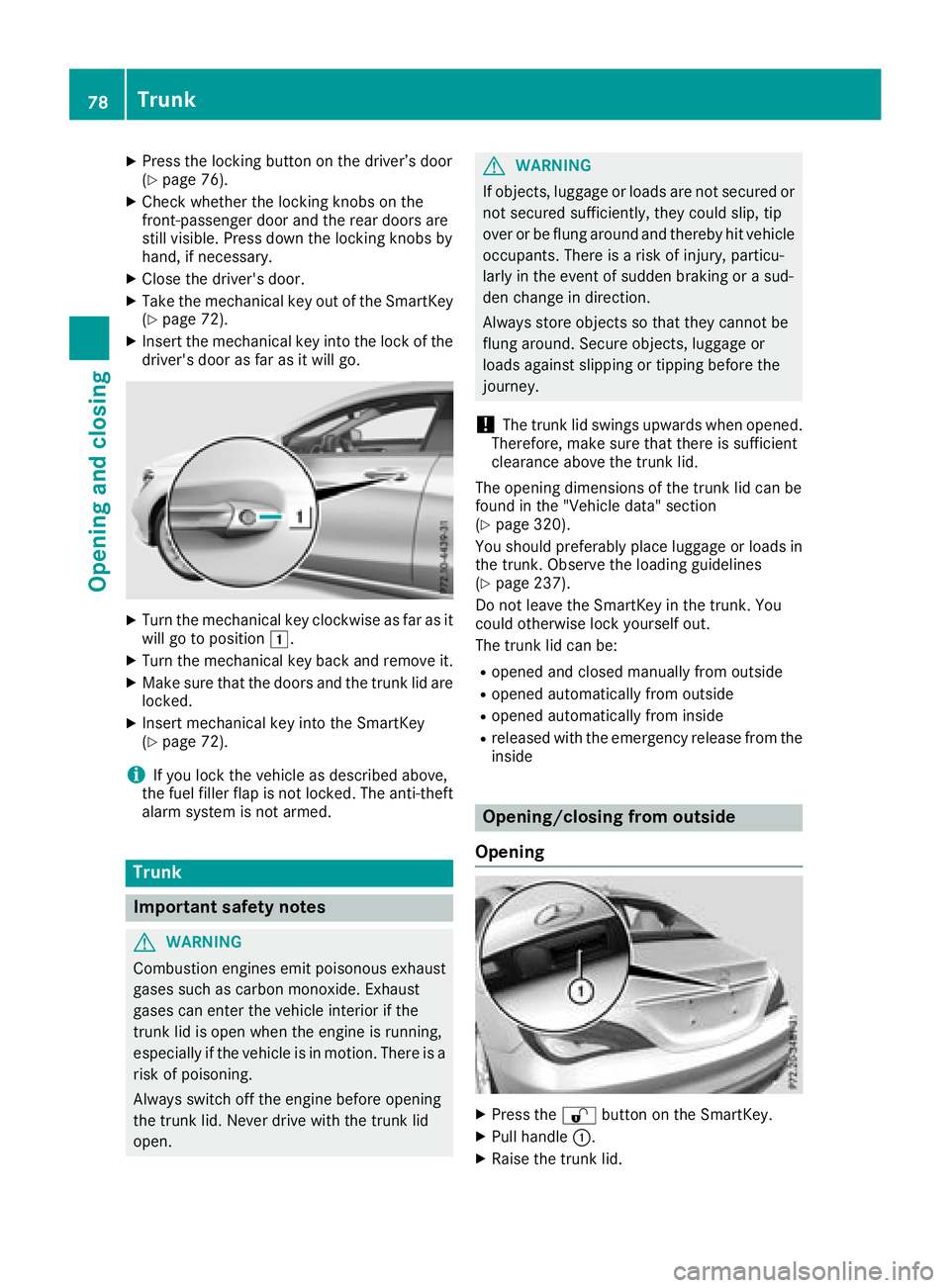
XInsert the mechanical key into the lock of the
driver's door as far as it will go.
XTurn the mechanical key clockwise as far as it
will go to position 1.
XTurn the mechanical key back and remove it.
XMake sure that the doors and the trunk lid are
locked.
XInsert mechanical key into the SmartKey
(Ypage 72).
iIf you lock the vehicle as described above,
the fuel filler flap is not locked. The anti-theft
alarm system is not armed.
Trunk
Important safety notes
GWARNING
Combustion engines emit poisonous exhaust
gases such as carbon monoxide. Exhaust
gases can enter the vehicle interior if the
trunk lid is open when the engine is running,
especially if the vehicle is in motion .There is a
risk of poisoning.
Always switch off the engine before opening
the trunk lid. Never drive with the trunk lid
open.
GWARNING
If objects, luggage or loads are not secured or
not secured sufficiently, they could slip, tip
over or be flung around and thereby hit vehicle
occupants. There is arisk of injury, particu-
larly in the event of sudden braking or asud-
den change in direction.
Always store object ssothat they cannot be
flung around. Secure objects, luggage or
loads against slipping or tipping before the
journey.
!The trunk lid swings upwards when opened.
Therefore, make sure that there is sufficient
clearance above the trunk lid.
The opening dimensions of the trunk lid can be
found in the "Vehicle data" section
(
Ypage 320).
You should preferably place luggage or loads in
the trunk .Observe the loading guidelines
(
Ypage 237).
Do not leave the SmartKey in the trunk .You
could otherwise lock yourself out.
The trunk lid can be:
Ropened and closed manually from outside
Ropened automatically from outside
Ropened automatically from inside
Rreleased with the emergencyr elease from the
inside
Opening/closing from outside
Opening
XPress the %button on the SmartKey.
XPull handle :.
XRaise the trunk lid.
78Trunk
Opening and closing
Page 81 of 326
Closing
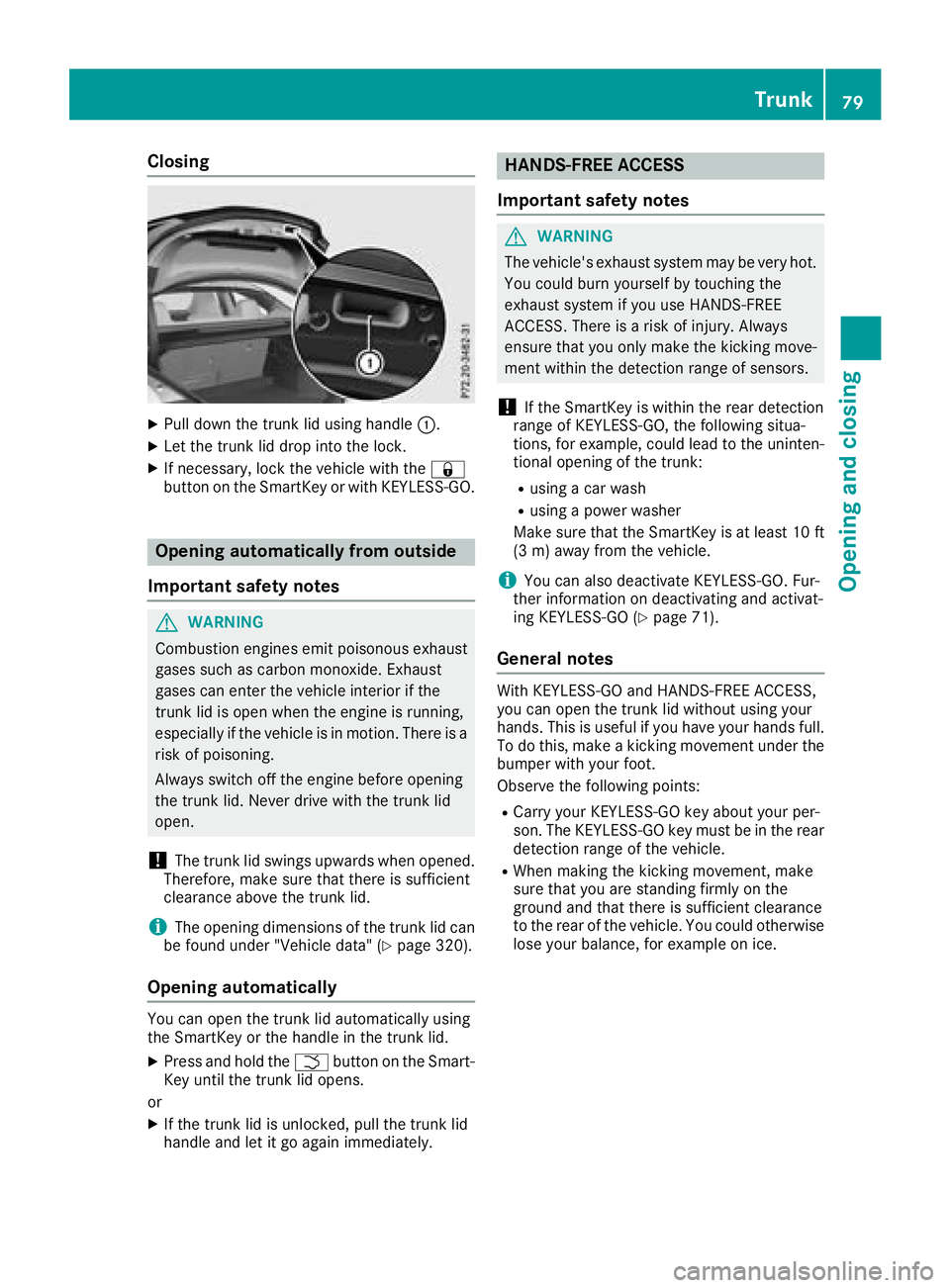
XPull down thetrunk lid usingh andle:.
XLet thetrunk lid dro pintot he lock.
XIf necessary, lockt hevehicle witht he&
butto nont heSmartKey or withK EYLESS-GO.
Opening automatically from outside
Important safety notes
GWARNING
Combustion engines emit poisonous exhaust
gases suchasc arbon monoxide. Exhaust
gases can ente rthe vehicle interiorift he
trunk lid is open when th eengineisr unning,
especiall yifthevehicle is in motion.T hereisa
ris kofp oisoning.
Always switch off th eengineb efore opening
th et runk lid. Never driv ewitht hetrunk lid
open.
!The trunk lid swings upward swhen opened.
Therefore, mak esure that there is sufficient
clearance abovet hetrunk lid.
iThe opening dimensionsoft hetrunk lid can
be foun dunde r"Vehicle data" (Ypage 320).
Opening automatically
You can open th etrunk lid automaticall yusing
th eS martKey or th ehandle in th etrunk lid.
XPress and hold the Fbuttonont heSmart-
Key until th etrunk lid opens.
or
XIf th etrunk lid is unlocked, pull th etrunk lid
handle and let it go again immediately.
HANDS-FREE ACCESS
Important safety notes
GWARNING
The vehicle's exhaust system may be ver yhot.
You coul dburn yourself by touching the
exhaust system if you use HANDS-FREE
ACCESS .Thereisar iskofi njury. Always
ensure that you only mak ethe kickin gmove-
men twithin th edetection range of sensors.
!If th eSmartKey is within th erear detection
range of KEYLESS-GO ,the followings itua-
tions ,for example ,coul dlead to th euninten-
tional opening of th etrunk:
Rusingac ar wash
Rusingap ower washer
Makes ure that th eSmartKey is at least 10 ft
(3 m) away from th evehicle.
iYou can also deactivate KEYLESS-GO .Fur-
ther informatio nondeactivatin gand activat-
ing KEYLESS-GO (
Ypage 71).
General notes
WithK EYLESS-GO and HANDS-FRE EACCESS,
you can open th etrunk lid without usingy our
hands. This is useful if you have your hands full. To do this, mak eakickingmovement unde rthe
bumpe rwithy our foot.
Observ ethe followingp oints:
RCarryyour KEYLESS-GO ke yabout your per-
son.T he KEYLESS-GO ke ymust be in th erear
detection range of th evehicle.
RWhen making th ekickin gmovement ,make
sure that you are standing firmly on the
ground and that there is sufficient clearance
to th erear of th evehicle .You coul dotherwise
lose your balance, for example on ice.
Trunk79
Opening and closing
Z
Page 82 of 326
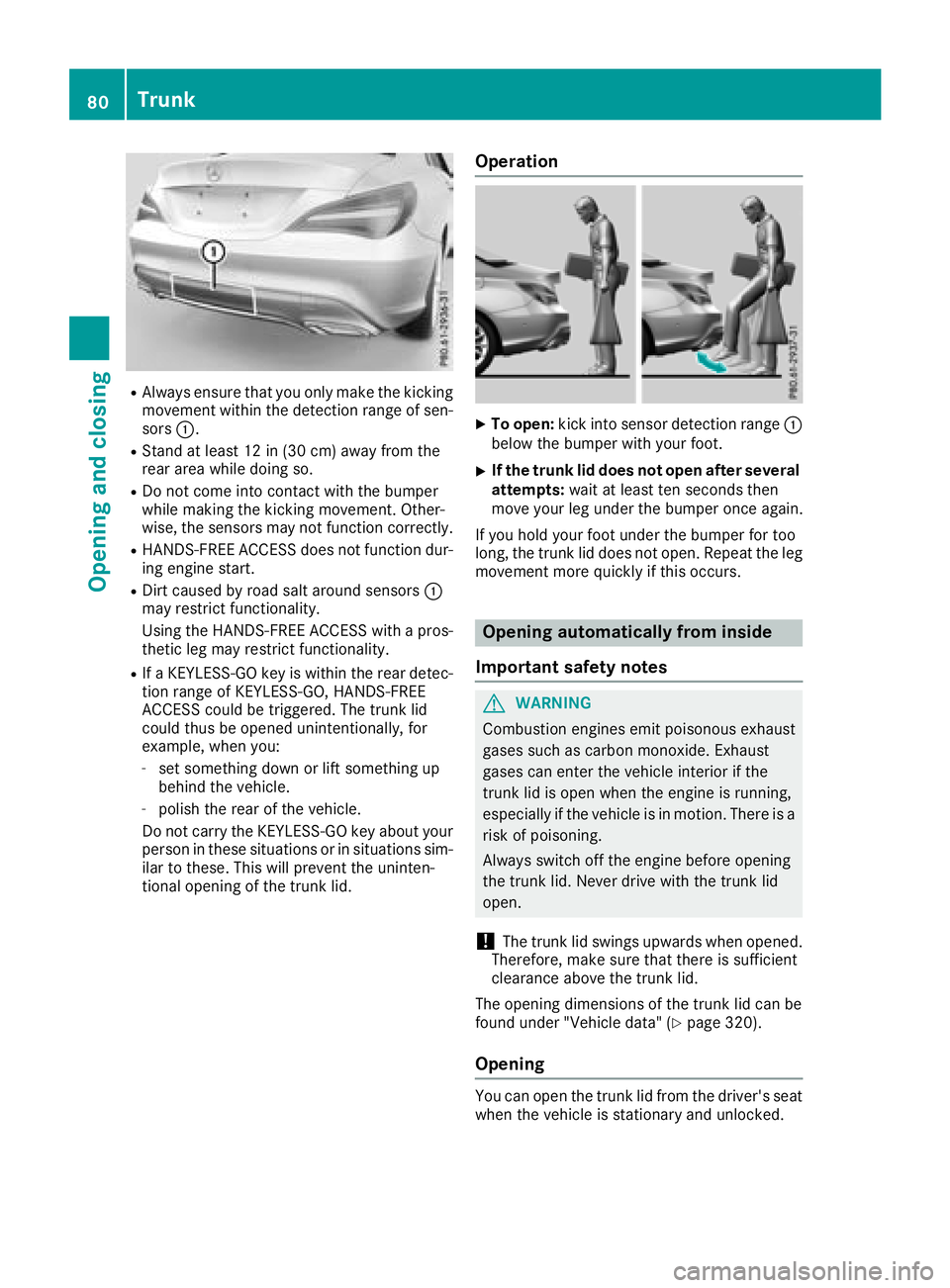
RAlwaysensure thaty ouonlym aket he kicking
movement withint he detection range of sen-
sors :.
RStand at leas t12in(30 cm)awa yfrom the
rea rareaw hile doing so.
RDo not come into contact with the bumper
whilemaking the kicking movement. Other-
wise, the sensors mayn ot functioncorrectly.
RHANDS-FREE ACCESS does not functio ndur-
ing engine start.
RDirt caused by roads alta round sensors :
mayr estrict functionality.
Using the HANDS-FREE ACCESS with apros-
theti cleg mayr estrict functionality.
RIfaK EYLESS-GO key is withint he reardetec-
tio nr ange of KEYLESS-GO ,HANDS-FREE
ACCESS could be triggered .The trun klid
could thusbeo penedu nintentionally, for
example, when you:
-set something down or lift something up
behind the vehicle.
-polish the rea rofthe vehicle.
Do not carry the KEYLESS-GO key abouty our
personint hesesituations or in situations sim-
ilar to these. Thi swillp revent the uninten-
tional opening of the trun klid.
Operation
XTo open: kick into sensor detection range :
belo wthe bumpe rwithy ourfoot.
XIf the trunk li ddoesn otope nafters everal
attempts: wait at leas tten secondst hen
move your le gunder the bumpe ronce again.
If yo uholdy ourfootu nder the bumpe rfor too
long, the trun klid does not open. Repeat the leg
movement more quickl yifthiso ccurs.
Opening automaticall yfrom inside
Important safety notes
GWARNING
Combustion engine semitp oiso nousexhaust
gases such as carbo nmonoxide. Exhaust
gases can entert he vehicleinterio rifthe
trun klid is open when the engine is running,
especially if the vehicl eisinmotion. There is a
ris kofp oisoning.
Alway sswitch off the engine before opening
the trun klid.N ever drive with the trun klid
open.
!The trun klid swing supwar ds when opened.
Therefore,m akes uret hatt hereiss ufficient
clearance above the trun klid.
The opening dimensions of the trun klid can be
found under "Vehicle data" (
Ypage 320).
Opening
Yo uc an open the trun klid from the driver's seat
when the vehicl eisstationar yand unlocked.
80Trunk
Opening and closing
Page 83 of 326
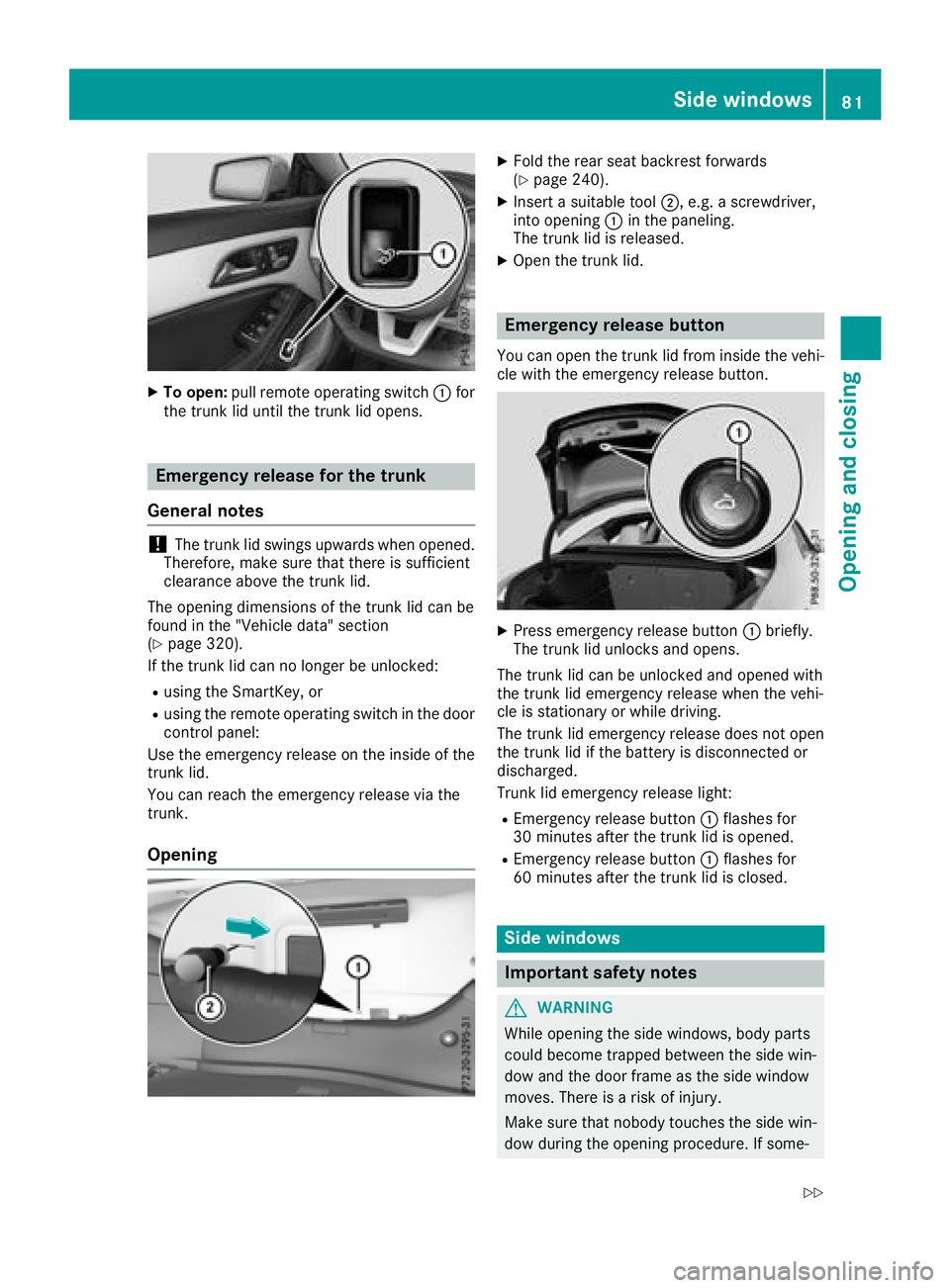
XTo open:pull remote operating switch :for
the trunk li duntilthe trunk li dopens.
Emergencyr eleasefor the trunk
General notes
!The trunk li dswing su pwar ds when opened.
Therefore, make sure thatt hereiss ufficient
clearance above the trunk lid.
The opening dimensions of the trunk li dcan be
found in the "Vehicle data" section
(
Ypage 320).
If the trunk li dcan no longer be unlocked:
Rusing the SmartKey ,or
Rusing the remote operating switch in the door
controlp anel:
Use the emergency release on the insid eofthe
trunk lid.
Yo uc an reach the emergency release via the
trunk.
Opening
XFoldt he rears eatb ackres tforwards
(Ypage 240).
XInsert asuitabl etool ;,e .g.as crewdriver,
into opening :in the paneling.
The trunk li disreleased.
XOpenthe trunk lid.
Emergencyr eleasebutton
Youc an open the trunk li dfrom insid ethe vehi-
cle with the emergency release button.
XPress emergency release button :briefly.
The trunk li dunlocks and opens.
The trunk li dcan be unlockeda nd openedwith
the trunk li demergency release when the vehi-
cle is stationary or whil edriving.
The trunk li demergency release does not open
the trunk li difthe battery is disconnected or
discharged.
Trunk li demergency release light:
REmergency release button :flashesf or
30 minutes afte rthe trunk li disopened.
REmergency release button :flashesf or
60 minutes afte rthe trunk li disclosed.
Side windows
Important safety notes
GWARNING
While opening the side windows ,bod yp arts
could become trappe dbetween the side win-
do wa nd the door frame as the side window
moves. There is ariskofi njury.
Make sure thatn obodytouchest he side win-
do wd uring the opening procedure. If some-
Side windows81
Opening and closing
Z
Page 309 of 326
PSI (pounds per squareinch)
Astandard unit of measure for tire pressure.
Aspect ratio
Relationship between tire height and tire width
in percent.
Tire pressure
This is pressure inside the tire applying an out-
ward force to each square inch of the tire's sur-
face. The tire pressure is specified in pounds per
square inch (psi), in kilopascal (kPa) or in bar.
The tire pressure should only be corrected when
the tires are cold.
Cold tire pressure
The tires are cold:
Rif the vehicle has been parked with the tires
out of direct sunlight for at least three hours
and
Rif the vehicle has not been driven further than
1m ile (1.6 km)
Tread
The part of the tire that comes into contact with
the road.
Bead
The tire bead ensures that the tire sits securely
on the wheel. There are several steel wires in the
bead to prevent the tire from coming loose from
the wheel rim.
Sidewall
The part of the tire between the tread and the
bead.
Weight of optional extras
The combined weight of those optional extras
that weigh more than the replaced standard
parts and more than 2.3 kg (5 lbs). These
optional extras, such as high-performance
brakes, level control, aroof rack or ahigh-per-
formanceb attery, are not included in the curb
weight and the weight of the accessories.
TIN (Tire Identification Number)
This is aunique identifier which can be used by
at ire manufacturer to identify tires, for example
for aproduct recall, and thus identify the pur-
chasers. The TIN is made up of the manufactur-
er's identity code, tire size, tire type code and
the manufacturing date.
Load bearing index
The load bearing index (also load index) is acode
that contains the maximum load bearing capa-
city of atire.
Traction
Traction is the result of friction between the tires
and the road surface.
Treadwear indicators
Narrow bars (tread wear bars) that are distrib-
uted over the tire tread. If the tire tread is level
with the bars, the wear limit of áin (1.6 mm)
has been reached.
Occupant distribution
The distribution of occupants in avehicle at their
designated seating positions.
Total load limit
Nominal load and luggage load plus 68 kg
(15 0lbs)m ultiplied by the number of seats in
the vehicle.
Changing awheel
Flat tire
The "Breakdown assistance" section
(Ypage 271) contains information and notes on
how to deal with aflat tire. Information on driv-
ing with MOExtended tires in the event of aflat
tire can be found under "MOExtended tires (tires
with run-flat characteristics" (
Ypage 271).
Rotating the wheels
GWARNING
Interchanging the front and rear wheels may
severely impair the driving characteristics if
the wheels or tires have different dimensions. The wheel brakes or suspension components
may also be damaged. There is arisk of acci-
dent.
Rotate front and rear wheels only if the wheels and tires are of the same dimensions.
!On vehicles equippedw ithatire pressure
monitor ,electronic components are located
in the wheel.
Changing awheel307
Wheels and tires
Z
Page 322 of 326
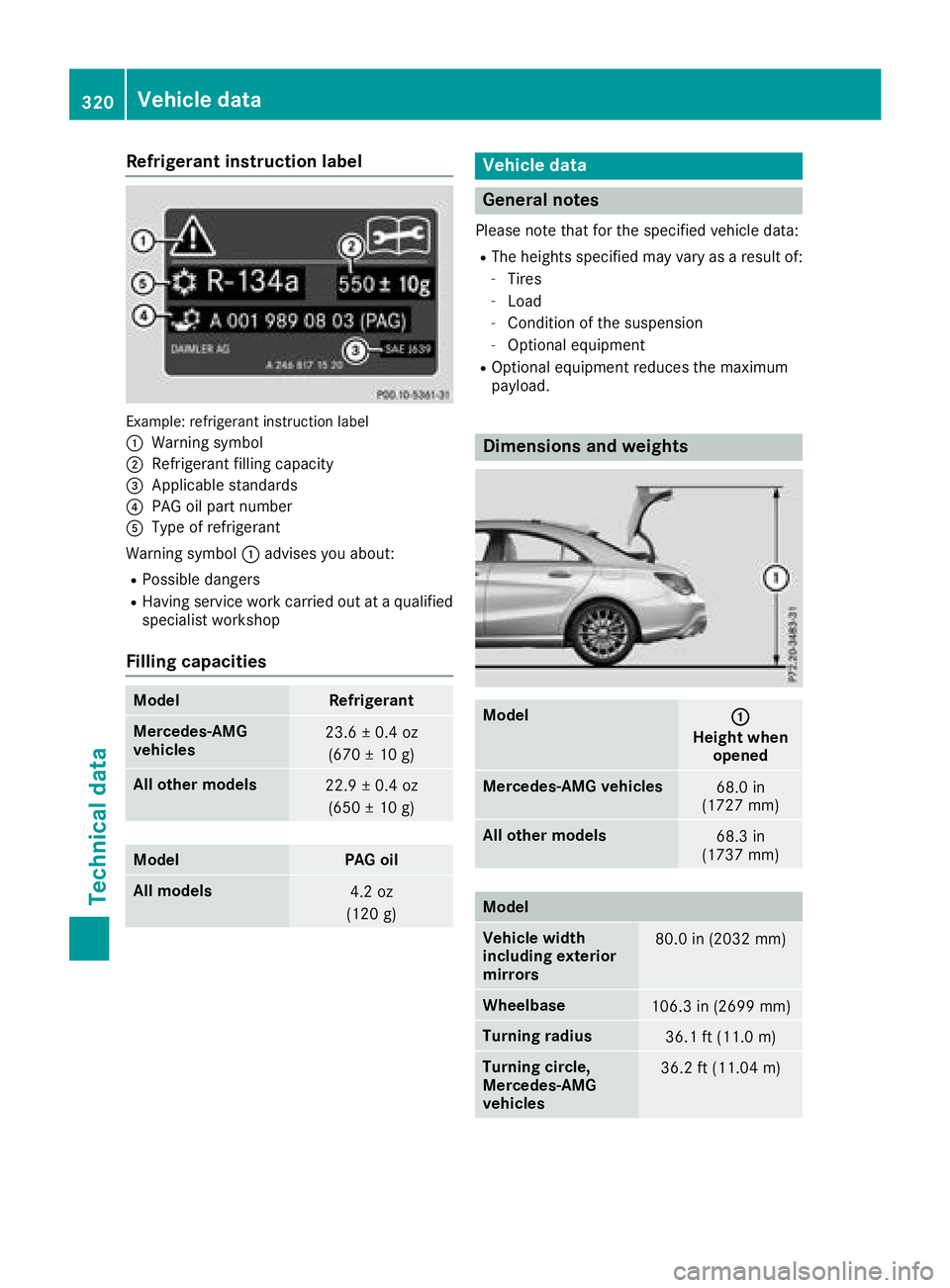
Refrigerant instructionlabel
Example:refrigerant instruction label
:
Warning symbol
;Refrigerant filling capacity
=Applicabl estandards
?PAG oilp artn umber
AType of refrigerant
Warning symbol :advises yo uabout :
RPossible dangers
RHaving service work carrie doutataq uali fied
specialist workshop
Fillin gcapacities
ModelRefrigerant
Mercedes ‑AMG
vehicles23.6 ±0.4 oz
(670 ±10g )
Allo the rm odels22.9 ±0.4 oz
(650 ±10g )
ModelPAG oil
All models4.2 oz
(120 g)
Vehicle data
General notes
Please note that for the specified vehicled ata:
RThe heights specified may vary asaresul tof:
-Tires
-Load
-Condition of the suspension
-Optionale quipment
ROptionalequipment reduces the maximum
payload.
Dimensions and weights
Model:
Height when opened
Mercedes‑AM Gvehicles68.0 in
(1727 mm)
All other models68.3 in
(1737 mm)
Model
Vehicle width
including exterior
mirrors80.0 in (2032 mm)
Wheelbase106.3 in (2699 mm)
Turning radius36.1 ft (11.0 m)
Turning circle,
Mercedes-AMG
vehicles36.2 ft (11.04 m)
320Vehicle data
Technical data