2018 MERCEDES-BENZ CLA COUPE Guide
[x] Cancel search: GuidePage 55 of 326

and to have any malfunctioningair bags
repaired. This will help to makes ure theair bags
continue to perform their protective function for
th ev ehicle occupant sintheeventofac rash.
GWARNING
Emergenc yTensioning Devices that have
deployed pyrotechnically are no longer opera-
tional and are unabl etoperform their inten-
ded protective function.T his posesan
increased risk of injury or even fatal injury.
Hav epyrotechnically triggered Emergency
Tensioning Devices replaced immediately at a
qualified specialist workshop.
If Emergenc yTensioning Devices are triggered
or air bags are deployed, you will hear abang,
and asmall amountofp owder may also be
released. The 6restraint system warning
lamp lightsu p.
Only in rar ecases will th ebang affect your hear-
ing .The powder that is released generally does
no tconstitut eahealthh azard, but it may cause
short-term breathingd ifficulties in peoplewith
asthma or other respiratory problems.P rovided
it is safe to do so, you shouldl eave thevehicle
immediately or open th ewindow in orde rtopre-
ven tbreathingd ifficulties.
Air bags and pyrotechnic Emergenc yTensioning
Devices (ETDs )contain perchlorate material,
whichm ay require special handlinga nd regard
for th eenvironment. National guidelines must
be observed durin gdisposal. In California, see
www.dtsc.ca.gov/HazardousWaste/
Perchlorate/index.cfm .
Method of operation
During thefirst stage of acollision,t herestraint
system control unit evaluates important physi-
cal datar elating to vehicle deceleratio noraccel-
eration,s uchas:
Rduration
Rdirection
Rintensity
Based on th eevaluation of this data, the
restraint system control unit triggerst heEmer-
gency Tensioning Devices durin gafrontal or
rear collision. An Emergenc
yTensioning Devic ecan only be
triggered, if:
Rth ei gnition is switched on
Rthec omponent softherestraint system are
operational. You can fin dfurther information
unde r"Restrain tsystem warning lamp"
(
Ypage 41)
Rth es eat belt buckle tongue has engaged in
th eb elt buckle of th erespectiv efront seat
The Emergenc yTensioning Devices in th erear
compartmenta re triggered independently of the
locks tatus of th eseat belts.
If th erestraint system control unit detect sa
mores evere accident, further component sof
th er estraint system are activated independ-
ently of each other in certain frontal collision
situations:
RFronta ir bags as well as driver'sa nd front-
passenger knee bags
RWindow curtain air bag, if th esystem deter-
mines that deploymen tcan offer additional
protection to that provided by th eseat belt
The front-passenger fronta ir bag is activated or
deactivate ddependingont he
person on t
he
front-passenger seat.T he front-passenger front
air bag can only deployinana ccidentifthe
PASSENGER AI RBAG OFFi ndicator lamp is off.
Observ ethe informatio nonthePASSENGER AIR
BA Gindicator lamps (
Ypage 41).
Your vehicle has two-stag efront air bags. In the
first deploymen tstage, th efront air bag is filled
with propellantg as. The frontair bag is fully
deployed with th emaximum amountofp ropel-
lant gas if asecondd eploymen tthreshold is
reached within afew milliseconds.
The activation threshold of th eEme rgenc yTen-
sioning Devices and th eair bags is determined
by evaluating th erateofv ehicle deceleratio nor
acceleratio nwhicho ccurs at various points in
th ev ehicle .This process is pre-emptive in
nature. Deployment shouldt akep lace in good
tim eatt hestart of th ecollision.
The rat eofvehicle deceleratio noracceleration
and th edirection of th eforce are essentially
determine dby:
Rthed istribution of forces durin gthe collision
Rthec ollision angle
Rthed eformatio ncharacteristics of th evehicle
Rthec haracteristics of th eobject with which
th ev ehicle has collided
Factors whichc an only be seen and measured
after acollision has occurre ddonotplay adeci-
Occupant safety53
Safety
Z
Page 57 of 326
GWARNING
If you leave children unsupervised in the vehi-
cle, they coul dset it in motion by, for example:
Rrelease the parking brake.
Rshift the automatic transmission out of the
parking position P.
Rstart the engine.
In addition, they may operate vehiclee quip-
ment and become trapped. There is arisk of
an accident and injury.
When leaving the vehicle, alway stake the
SmartKey with you and lock the vehicle. Never
leave children unsupervised in the vehicle.
GWARNING
If persons, particularl ychildren are subjected
to prolonged exposure to extreme heato r
cold, there is arisk of injury ,possibly even
fatal .Never leave children unattended in the
vehicle.
GWARNING
If the child restraint system is subjected to
direct sunlight, parts may get very hot. Chil-
dren may burn themselves on these parts,
particularl yonthe metal parts of the child
restraint system. There is arisk of injury.
If you leave the vehicle, taking the child with
you ,alway sensure that the child restraint
system is not exposedtod irect sunlight. Pro-
tect it with ablanket, for example. If the child
restraint system has been exposedtod irect
sunlight, let it cool downb efore securing the
child in it. Never leave children unattended in
the vehicle.
Always ensure that all vehicleo ccupants have
their seat belts fastened correctly and are sitting
properly.P articular attention must be pai dto
children.
Observe the safety notes on the seat belt
(
Ypage4 2) and the notes on correct use of seat
belts (Ypage4 3).
Ab ooster seat may be necessary to achieve
propers eat beltp ositioning for children over
41 lbs (18 kg )until they reach aheight where a three-point seat beltc
an be properly fastened
without abooster seat.
Special seatbelt retractor
GWARNING
If the seat beltisr eleased while driving, the
child restraint system wil lnolonger be
secure dproperly.T he special seat beltr etrac-
tor is disableda nd the inertia real draw sina
portion of the seat belt. The seat beltc annot
be immediatel yrefastened. There is an
increased risk of injury ,possibly even fatal.
Stop the vehiclei mmediately, paying atten-
tion to road and traffic conditions. Reactivate
the special seat beltr etractor and secure the
child restraint system properly.
All seat belts in the vehicle, except the driver's
seat belt, are equipped with aspecial seat belt
retractor. When activated, the special seat belt
retractor ensure sthat the seat beltc annot
slacken once the child seat is secured.
Installing achild restraint system:
XMake sure you observe the child restraint
system manufacturer's installation instruc-
tions.
XPul lthe seat belts moothly from the belto ut-
let.
XEngage seat beltt ongue in beltbuckle.
Activating the special seat beltr etractor:
XPullthe seat belto ut fullyand let the inertia
reel retract it again.
Whilet he seat beltisr etracting, you should
hear aratcheting sound .The special seat belt
retractor is enabled.
XPush the child restraint system downsot hat
the seat beltist ight and does not loosen.
Removing the child restraint system and deac-
tivating the special seat beltr etractor:
XMake sure you observe the child restraint
system manufacturer's installation instruc-
tions.
XPress the release button of the seat belt
buckle and guide the seat beltt ongue back
toward sthe belts ash guide.
The special seat beltr etractor is deactivated.
Children in the vehicle55
Safety
Z
Page 58 of 326
Child restraint system
The use of seat beltsand child restraint systems
is required by law in:
Rall 50 states
Rth eU .S.t erri tories
RtheD istrict of Columbia
Rall Canadian provinces
If you install arearward-facing child restraint
system on th ecente rrear seat,t herear arm rest
must be folded back as far as possible.
You can obtain further informatio nabout the
correc tchild restraint system from any author-
ize dM ercedes-Ben zCenter.
GWARNING
If th echild restraint system is installed incor-
rectly on asuitable seat,itc annotprotect as
intended. The child canno tthe nber estrained
in th eevent of an accident, heavyb raking or
suddenc hanges of direction.T hereisan
increased ris kofinjury, possibly eve nfatal.
Makes ure that you observ ethe child restraint
system manufacturer'si nstallationinstruc-
tions and th enotes on use. Pleasee nsure,
that th ebase of th echild restraint system is
always restin gcompletely on th eseat cush-
ion.N ever placeo bjects, e.g.cushions, under
or behindt hechild restraint system. Only use
child restraint systems witht heoriginal cover
designe dfor them. Only replace damaged
covers withg enuine covers.
GWARNING
If th echild restraint system is installed incor-
rectly or is no tsecured, it can com eloosei n
th ee vent of an accident, heavyb raking or a
suddenc hang eind irection.T he child
restraint system coul dbethrown about,s trik-
ing vehicle occupants. Thereisani ncreased
ris kofi njury, possibly eve nfatal.
Always install child restraint systems prop-
erly, eve niftheya re no tbeingu sed. Make
sure that you observ ethe child restraint sys-
te mm anufacturer'si nstallationinstructions.
You will fin dfurther informatio nonstowing
objects, luggageorl oads under"Loading guide-
lines" (
Ypage 237).
GWARNING
Child restraint systems or their securin gsys-
tems whichh ave been damaged or subjected
to aload in an accidentc an no longer protect
as intended. The child canno tthe nb e
restraine dintheevent of an accident, heavy
braking or suddenc hanges of direction.T here
is an increased ris kofinjury, possibly even
fatal.
Replacec hild restraint systems whichh ave
been damaged or subjected to aload in an
accidentass oon as possible. Hav ethe secur-
ing systems on th echild restraint system
checked at aqualified specialist workshop,
before you install achild restraint system
again.
The securin gsystems of child restraint systems
are:
Rth es eat belt system
RtheL ATCH-type (ISOFIX) securin grings
RtheT op Tether anchorages
If it is absolutely necessary to carry achild on
th ef ront-pa ssenger seat,bes ure to observethe
informatio nonthe"Occupan tClassification
Syste m(OCS)" (
Ypage 47) .Therey ou will also
fin dinformatio nondeactivatin gthe front-
passenger fronta ir bag.
All child restraint systems must mee tthe fol-
lowings tandards:
RU.S. Federal Motor Vehicle SafetyS tandards
21 3a nd 225
RCanadian Motor Vehicle SafetyS tandards
21 3a nd 210.2
Confirmation that th echild restraint system cor-
responds to th estandards can be foun donan
ins truc
tion label on th
echild restraint system.
This confirmation can also be foun dintheinstal-
lation instructionst hata re included witht he
child restraint system.
Observ ethe warning labels in th evehicle inte-
rior and on th echild restraint system.
56Children in th evehicle
Safety
Page 61 of 326
Rearward-facingchild restraint system
If it is absolutely necessary to install arearward-
facing child restraint system on the front-
passenger seat, always make sure that the
front-passenger front ai rbag is deactivated.
Only if the PASSENGER AIR BAG OFF indicator
lamp is permanently li t(
Ypage 41)ist he front-
passenger front ai rbag deactivated.
Alway sobserve the child restraint system man-
ufacturer's installation and operating instruc-
tions.
Forward-facing child restraint system
If it is absolutely necessary to install aforward-
facing child restraint system on the front-
passenger seat, always move the front-
passenger seata sfar back as possible .Fully
retract the seatc ushionlen gth. The entir ebase
of the child restraint system mus talway sresto n
the seatc ushionofthe front-passenger seat.
The backrest of the child restraint system must
li easf lata sp ossible against the backrest of the
front-passenger seat. The child restraint system
mus tnot touch the rooforbes ubjecte dtoal oad
by the headr estraint. Adjust the angle of the
seatb ackrest and the headr estraint position
accordingly .Alway smake sure that the shoul-
der bel tstrapisc orrectly routed from the vehi-
cle bel toutlet to the shoulder bel tguide on the
child restraint system. The shoulder bel tstrap
mus tberouted forward and dow nfrom the vehi-
cle bel toutlet. If necessary, adjust the vehicle
bel toutlet and the front-passenger seata ccord-
ingly.
Alway sobserve the child restraint system man-
ufacturer's installation and operating instruc-
tions.
Child-proof locks
Important safety notes
GWARNING
If children are traveling in the vehicle, they
could:
Rope ndoors, thuse ndangering otherp eople
or roadu sers
Rexitt he vehicl eand be caught by oncoming
traffic
Roperate vehicl eequipment and become
trapped
There is ariskofana ccident and injury.
Alway sactivate the child-proof locks and
overrid efeature if children are traveling in the
vehicle. Whenl eaving the vehicle, always take
the key with yo uand lock the vehicle. Never
leave children unattende dinthe vehicle.
Overrid efeature for:
Rthe reard oors (Ypage 60)
Rthe rearsidew indow s(Ypage 60)
GWARNING
If yo ulea ve children unsupervised in the vehi-
cle ,they could set it in motion by ,for example:
Rrelease the parking brake.
Rshift the automatic transmissio noutof the
parking position P.
Rstartthe engine.
In addition, they may operate vehicl eequip-
ment and become trapped .There is arisko f
an accident and injury.
Whenl eaving the vehicle, always take the
SmartKey with yo uand lock the vehicle. Never
leave children unsupervised in the vehicle.
GWARNING
If persons,p articularly children are subjected
to prolonged exposure to extreme heato r
cold, there is ariskofi njury, possibly even
fatal. Neverl eave children unattende dinthe
vehicle.
Childrenint he vehicle59
Safety
Z
Page 75 of 326
SmartKey battery
Important safety notes
GWARNING
Batteries contain toxic and corrosive substan- ces. If batteries are swallowed, it can result in
severe health problems. There is arisk of fatal
injury.
Keep batteries out of the reach of children. If
ab attery is swallowed, seek medical attention
immediately.
The SmartKey batteries contain perchlorate
material, which may require special handling
and regard for the environment. National guide-
lines must be observed during disposal. In Cal-
ifornia, see www.dtsc.ca.gov/
HazardousWaste/Perchlorate/index.cfm.
Mercedes-Benz recommends that you have the
battery replaced at aqualified specialist work-
shop.
Checking the battery
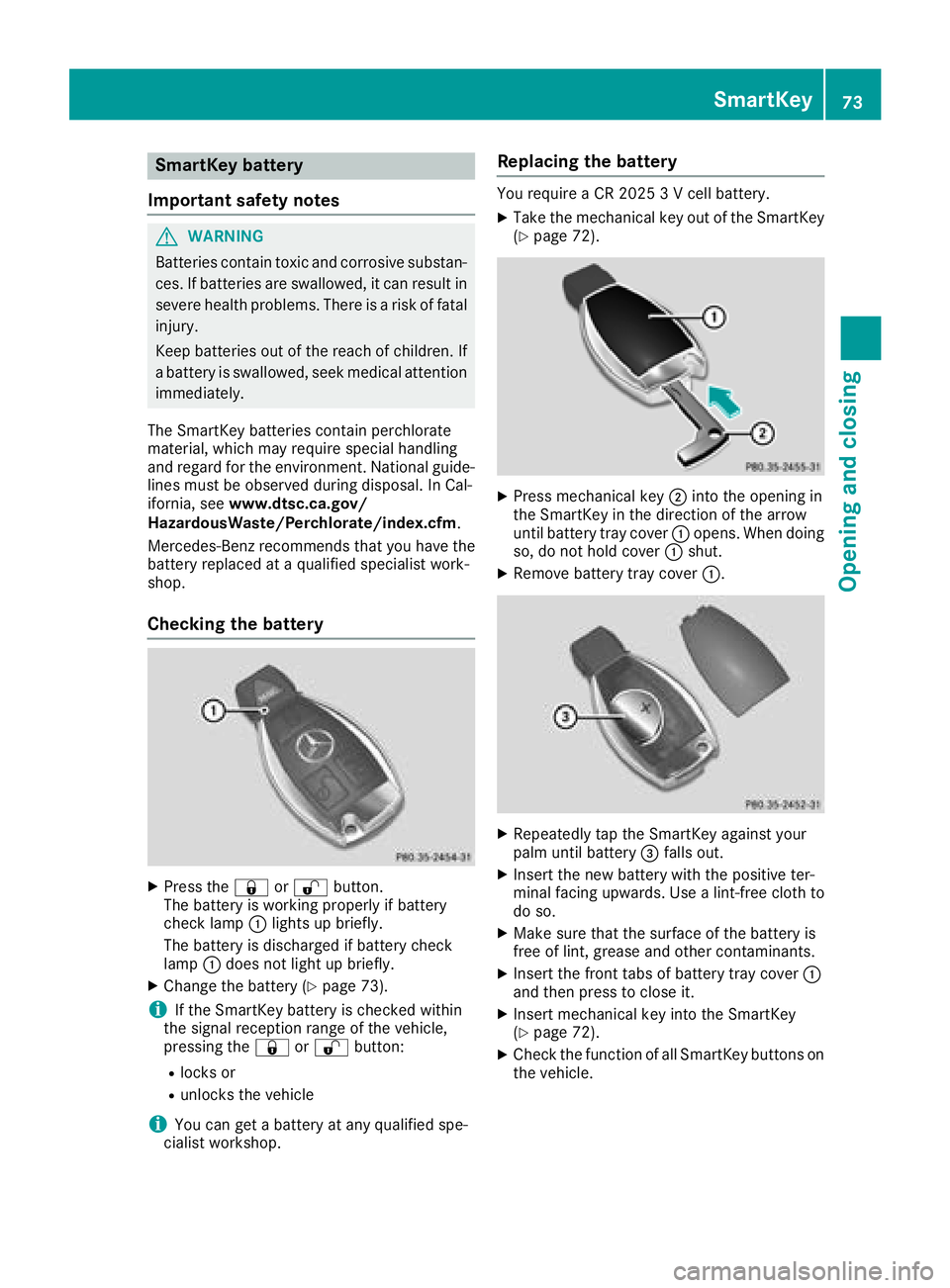
XPress the &or% button.
The battery is working properly if battery
check lamp :lights up briefly.
The battery is discharged if battery check
lamp :does not light up briefly.
XChange the battery (Ypage 73).
iIf the SmartKey battery is checked within
the signal reception range of the vehicle,
pressing the &or% button:
Rlocks or
Runlocks the vehicle
iYou can get abattery at any qualified spe-
cialist workshop.
Replacing the battery
You require aCR20253Vc ell battery.
XTake the mechanical key out of the SmartKey
(Ypage 72).
XPress mechanical key ;into the opening in
the SmartKey in the direction of the arrow
until battery tray cover :opens. When doing
so, do not hold cover :shut.
XRemove battery tray cover :.
XRepeatedly tap the SmartKey against your
palm until battery=falls out.
XInsert the new battery with the positive ter-
minal facing upwards. Use alint-free cloth to
do so.
XMake sure that the surface of the battery is
free of lint, grease and other contaminants.
XInsert the front tabs of battery tray cover :
and then press to close it.
XInsert mechanical key into the SmartKey
(Ypage 72).
XCheck the function of all SmartKey buttons on
the vehicle.
SmartKey73
Opening and closing
Z
Page 78 of 326
Doors
Important safet ynotes
GWARNING
If children are lef tunsupervised in th evehicle,
they could:
Rope nthe doors ,thu se ndangerin gother
people or road users.
Rget out and disrup ttraffic .
Roperat ethe vehicle' sequipment.
Additionally, children could set th evehicle in
motion if, fo rexample, they:
Rrelease th eparking brake .
Rshiftingthe automatic transmissio nout of
par kposition P
RStart th eengine.
There is ariskofana ccidentand injury.
Whe nleavin gthe vehicle, always take th e
SmartKey wit hyou and loc kthe vehicle. Never
leav echildren or animals unattended in th e
vehicle. Always keep th eSmartKey out of
reach of children .
You should preferably plac eluggage or load sin
th ec argo compartment. Observ ethe loadin g
guidelines (
Ypage 237).
Unlockingand opening doors from
th ei nside
!
The sid ewindows will no topen/close if th e
battery is discharged or if th esidew indows
hav eicedu p. It will then no tbepossible to
close th edoor. Do no tattemp ttoforce the
doo rclosed. You could otherwise damage th e
doo rort hesidew indow.
Whe nad ooriso pened, th esidew indow on that
sid eo pens slightly. Whe nthe doo risc losed, th e
sid ew indow close sagain .
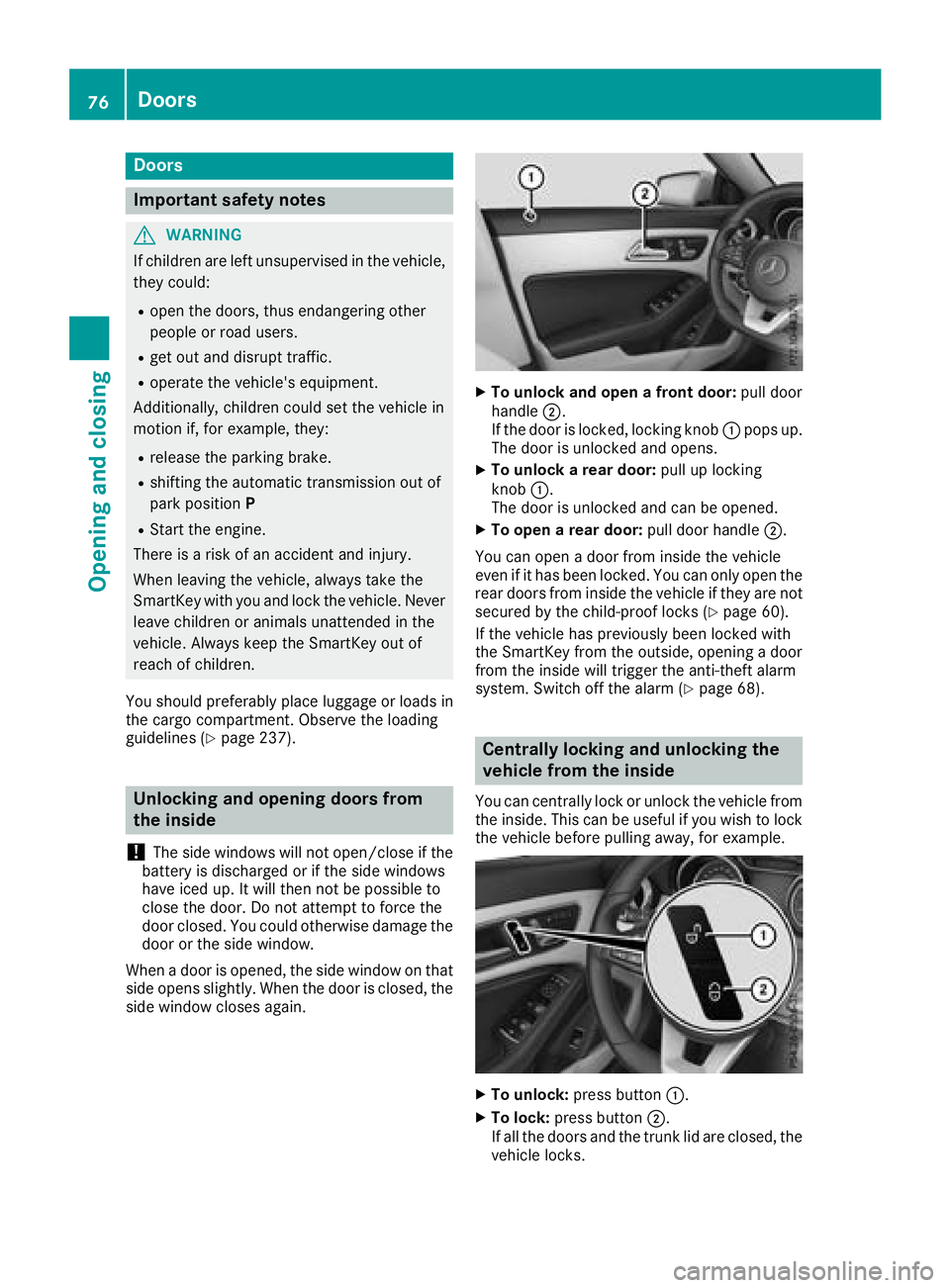
XTo unlock an dopenaf ront door: pull door
handle ;.
If th edoorisl ocked, locking knob :pop sup.
The doo risunlocke dand opens .
XTo unlock areard oor: pull up locking
knob :.
The doo risunlocke dand can be opened.
XTo ope nareard oor: pull doo rhandle ;.
You can ope nadoorfromi nsidet he vehicle
eve nifith as bee nlocked. You can only ope nthe
rea rdoors from insid ethe vehicle if they are no t
secure dbythechild-proof locks (
Ypage 60).
If th evehicle has previously bee nlocke dwith
th eS martKey from th eoutside, opening adoor
from th einsidew ill trigger th eanti-thef talarm
system. Switc hoffthea larm(
Ypage 68).
Centrally locking an dunlocking th e
vehicle from th einside
You can centrall yloc koru nlockthe vehicle from
th ei ns ide. Thi scan be useful if you wish to loc k
th ev ehicle befor epulling away, fo rexample.
XTo unlock :press butto n:.
XTo lock :press butto n;.
If all th edoors and th etrunk lid are closed, th e
vehicle locks .
76Doors
Opening andclosing
Page 80 of 326
XPress the lockingbutton on the driver’s door
(Ypage 76).
XCheck whether the lockin gknobs on the
front-passenger door and the rear doors are
still visible. Press down the lockin gknobs by
hand, if necessary.
XClose the driver's door.
XTake the mechanical key out of the SmartKey
(Ypage 72).
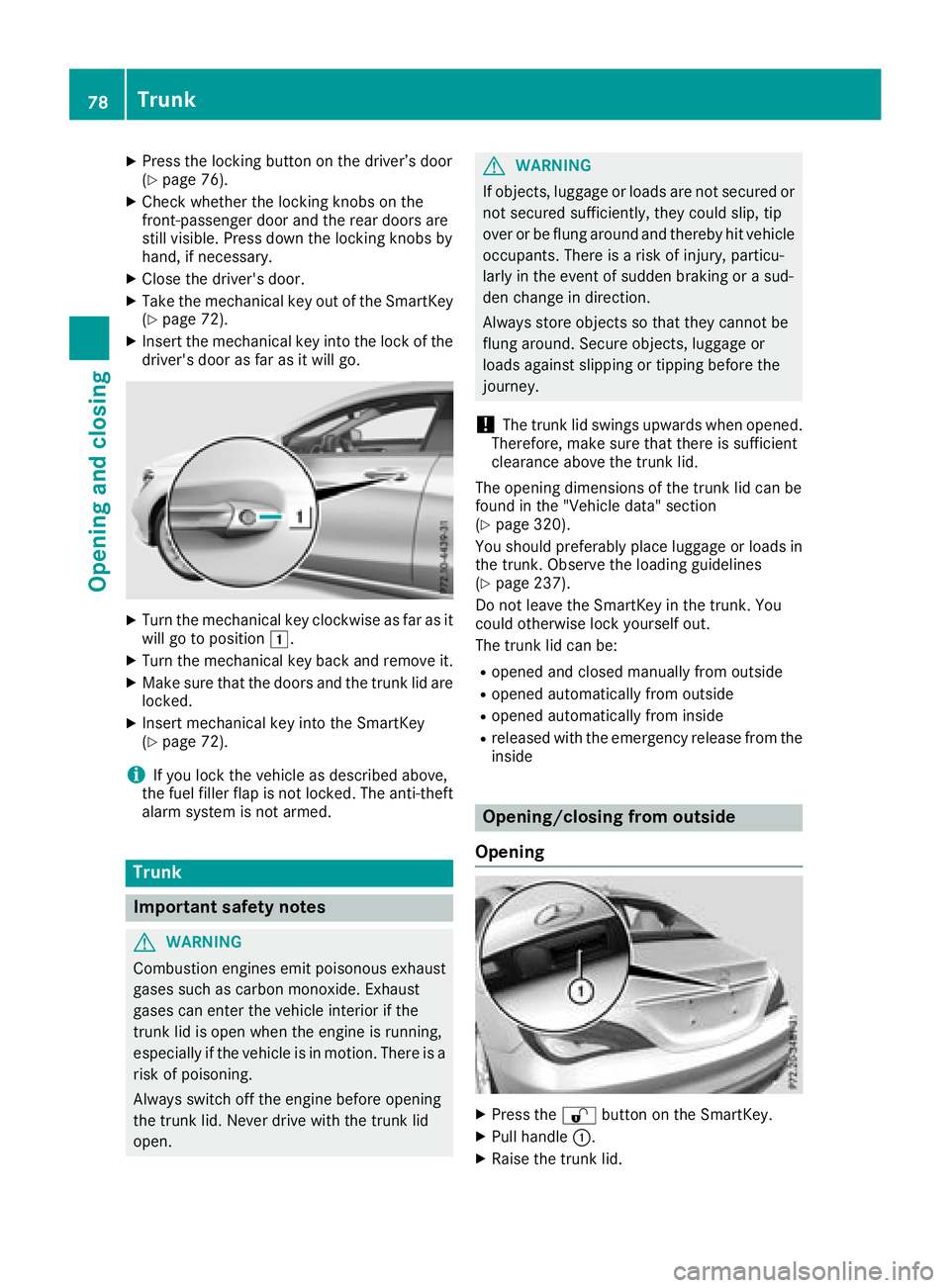
XInsert the mechanical key into the lock of the
driver's door as far as it will go.
XTurn the mechanical key clockwise as far as it
will go to position 1.
XTurn the mechanical key back and remove it.
XMake sure that the doors and the trunk lid are
locked.
XInsert mechanical key into the SmartKey
(Ypage 72).
iIf you lock the vehicle as described above,
the fuel filler flap is not locked. The anti-theft
alarm system is not armed.
Trunk
Important safety notes
GWARNING
Combustion engines emit poisonous exhaust
gases such as carbon monoxide. Exhaust
gases can enter the vehicle interior if the
trunk lid is open when the engine is running,
especially if the vehicle is in motion .There is a
risk of poisoning.
Always switch off the engine before opening
the trunk lid. Never drive with the trunk lid
open.
GWARNING
If objects, luggage or loads are not secured or
not secured sufficiently, they could slip, tip
over or be flung around and thereby hit vehicle
occupants. There is arisk of injury, particu-
larly in the event of sudden braking or asud-
den change in direction.
Always store object ssothat they cannot be
flung around. Secure objects, luggage or
loads against slipping or tipping before the
journey.
!The trunk lid swings upwards when opened.
Therefore, make sure that there is sufficient
clearance above the trunk lid.
The opening dimensions of the trunk lid can be
found in the "Vehicle data" section
(
Ypage 320).
You should preferably place luggage or loads in
the trunk .Observe the loading guidelines
(
Ypage 237).
Do not leave the SmartKey in the trunk .You
could otherwise lock yourself out.
The trunk lid can be:
Ropened and closed manually from outside
Ropened automatically from outside
Ropened automatically from inside
Rreleased with the emergencyr elease from the
inside
Opening/closing from outside
Opening
XPress the %button on the SmartKey.
XPull handle :.
XRaise the trunk lid.
78Trunk
Opening and closing
Page 87 of 326
ProblemPossible causes/consequences andMSolutions
Aside window cannot be
closed because it is
blocked by objects, e.g.
leaves in the window
guide.XRemove the objects.
XClose the side window.
As ide window cannot be
closed and you cannot
see the cause.If as ide window is obstructed during closing and reopens again
slightly:
XImmediately after the window blocks, pull the correspondings witch
again until the side window has closed.
The side window is closed with increased force.
If as ide window is obstructed again during closing and reopens again
slightly:
XImmediately after the window blocks, pull the correspondings witch
again until the side window has closed.
The side window is closed without the automatic reversing feature.
Panoramar oof with power tilt/sliding
panel
Important safety notes
In the following section, the term "sliding sun-
roof" refers to the panorama roof with power
tilt/sliding panel.
GWARNING
While opening and closing the sliding sunroof, body parts in close proximity could become
trapped. There is arisk of injury.
Make sure that no body parts are in close
proximity during the opening and closing pro-
cedures.
If somebody becomes trapped:
Rrelease the switch immediately, or
Rduring automatic operation, push the
switch briefly in any direction
The opening or closing procedure will be stop- ped.
GWARNING
If children operate the sliding sunroof they
could become trapped, particularly if they are left unsupervised. There is arisk of injury.
When leaving the vehicle, always take the
SmartKey with you and lock the vehicle. Never
leave children unsupervised in the vehicle.
GWARNING
At high speeds the raised sliding sunroof auto-
matically lowers slightly at the rear. This could
trap you or other persons. There is arisk of
injury. Make sure that nobody reaches into
the sweep of the sliding sunroof whilst the
vehicle is in motion.
If somebody becomes trapped, immediately
pull back the sliding sunroof switch. The slid-
ing sunroof lifts during opening.
!Only open the sliding sunroof if it is free of
snow and ice. Otherwise, malfunctions may
occur.
Do not allow anything to protrude from the
sliding sunroof. Otherwise, the seals could be
damaged.
!The weather can change abruptly. It could
start to rain or snow. Make sure that the slid- ing sunroof is closed when you leave the vehi-
cle. The vehicle electronics can be damaged if
water enters the vehicle interior.
iResonance noises can occur in addition to
the usual airflow noises when the sliding sun- roof is open. They are caused by minor pres-
Panoramar oof with power tilt/sliding panel85
Opening and closing
Z