Page 38 of 672

WARNING
nCargo
Cargo should always be secured toprevent it from being thrown aboutthe vehicle in a collision and causinginjury to the vehicle occupants. Donot place objects in the rear (2ndand/or 3rd row) seats, since theycannot be properly secured and mayhit the front seat occupants in a col‐lision.
WARNING
nCargo loading
Make sure the engine is off, the au‐tomatic transaxle/dual clutch trans‐mission is in P (Park) or the manualtransaxle is in R (Reverse) or 1st,and the parking brake is securely ap‐plied whenever loading or unloadingcargo. Failure to take these stepsmay allow the vehicle to move if theshift lever is inadvertently moved toanother position.
Armrest
Type A
To usü thü armrüst, ýold thü cüntürsüat back.
Type B
To usü thü armrüst, pull it ýorward ýrom thü süatback.
Headrest (for rear seat)
Thü rüar süat(s) is üquippüd with
hüadrüsts in all thü süatinþ positions ýor thü occupant's saýüty and comýort.
Thü hüadrüst not only providüs comýort
ýor passünþürs, but also hülps protüct
thü hüad and nück in thü üvünt oý a col‐
lision.
Saýüty ýüaturüs oý your vühiclü
3-18
Page 39 of 672
WARNING
•For maximum effectiveness incase of an accident, the headrestshould be adjusted so the middleof the headrest is at the sameheight as the center of gravity ofan occupant's head. Generally, thecenter of gravity of most people'shead is similar with the height ofthe top of their eyes. Also adjustthe headrest as close to your headas possible. For this reason, theuse of a cushion that holds thebody away from the seatback isnot recommended.
•Do not operate the vehicle withthe headrests removed. Severe in‐jury to an occupant may occur inthe event of an accident. Headr‐ests may provide protectionagainst severe neck injuries whenproperly adjusted.
CAUTION
When there is no occupant in therear seats, adjust the height of theheadrest to the lowest position. Therear seat headrest can reduce thevisibility of the rear area.
Adjusting the height up and down
3-19
3
Saýüty ýüaturüs oý your vühiclü
Page 40 of 672
To raisü thü hüadrüst, pull it up to thü
düsirüd position (1). To lowür thü hüad‐ rüst, push and hold thü rülüasü button
(2) on thü hüadrüst support and lowür
thü hüadrüst to thü düsirüd position (3).Removal and installationTo rümovü thü hüadrüst, raisü it as ýar
as it can þo thün prüss thü rülüasü but‐ ton (1) whilü pullinþ thü hüadrüst up
(2).
To rüinstall thü hüadrüst, put thü hüad‐
rüst polüs (3) into thü holüs whilü prüssinþ thü rülüasü button (1). Thün
adjust it to thü appropriatü hüiþht.
WARNING
Make sure the headrest locks in po‐sition after adjusting it to properlyprotect the occupants.
Saýüty ýüaturüs oý your vühiclü
3-20
Page 41 of 672
SEAT BELTS
Seat belt restraint system
WARNING
•For maximum restraint systemprotection, the seat belts must al‐ways be used whenever the car ismoving.
•Seat belts are most effective whenseatbacks are in the upright posi‐tion.
•Children age 12 and younger mustalways be properly restrained inthe rear seat. Never allow childrento ride in the front passenger seat.If a child over 12 must be seated inthe front seat, he/she must beproperly belted and the seatshould be moved as far back aspossible.
•Never wear the shoulder belt un‐der your arm or behind your back.An improperly positioned shoulderbelt can cause serious injuries in acrash. The shoulder belt should bepositioned midway over yourshoulder across your collarbone.
(Continued)
(Continued)
•Never wear a seat belt over fragileobjects. If there is a sudden stopor impact, the seat belt can dam‐age it.
•Avoid wearing twisted seat belts.A twisted belt can't do its job aswell. In a collision, it could even cutinto you. Be sure the belt webbingis straight and not twisted.
•Be careful not to damage the beltwebbing or hardware. If the beltwebbing or hardware is damaged,replace it.
WARNING
•Seat belts are designed to bearupon the bony structure of thebody, and should be worn lowacross the front of the pelvis orthe pelvis, chest and shoulders, asapplicable; wearing the lap sectionof the belt across the abdominalarea must be avoided.
(Continued)
(Continued)
•Seat belts should be adjusted asfirmly as possible, consistent withcomfort, to provide the protectionfor which they have been de‐signed.
•A slack belt will greatly reduce theprotection afforded to the wearer.Care should be taken to avoid con‐tamination of the webbing withpolishes, oils and chemicals, andparticularly battery acid.
•Cleaning may safely be carried outusing mild soap and water. Thebelt should be replaced if webbingbecomes frayed, contaminated ordamaged. It is essential to replacethe entire assembly after it hasbeen worn in a severe impact evenif damage to the assembly is notobvious. Belts should not be wornwith straps twisted. Each belt as‐sembly must only be used by oneoccupant; it is dangerous to put abelt around a child being carried onthe occupant's lap.
3-21
3
Saýüty ýüaturüs oý your vühiclü
Page 42 of 672
WARNING
•No modifications or additionsshould be made by the user whichwill either prevent the seat beltadjusting devices from operatingto remove slack, or prevent theseat belt assembly from being ad‐justed to remove slack.
•When you fasten the seat belt, becareful not to latch the seat belt inbuckles of other seat. It's verydangerous and you may not beprotected by the seat belt proper‐ly.
•Do not unfasten the seat belt anddo not fasten and unfasten theseat belt repeatedly while driving.This could result in loss of control,and an accident causing death, se‐rious injury, or property damage.
•When fastening the seat belt,make sure that the seat belt doesnot pass over objects that are hardor can break easily.
•Make sure there is nothing in thebuckle. The seat belt may not befastened securely.
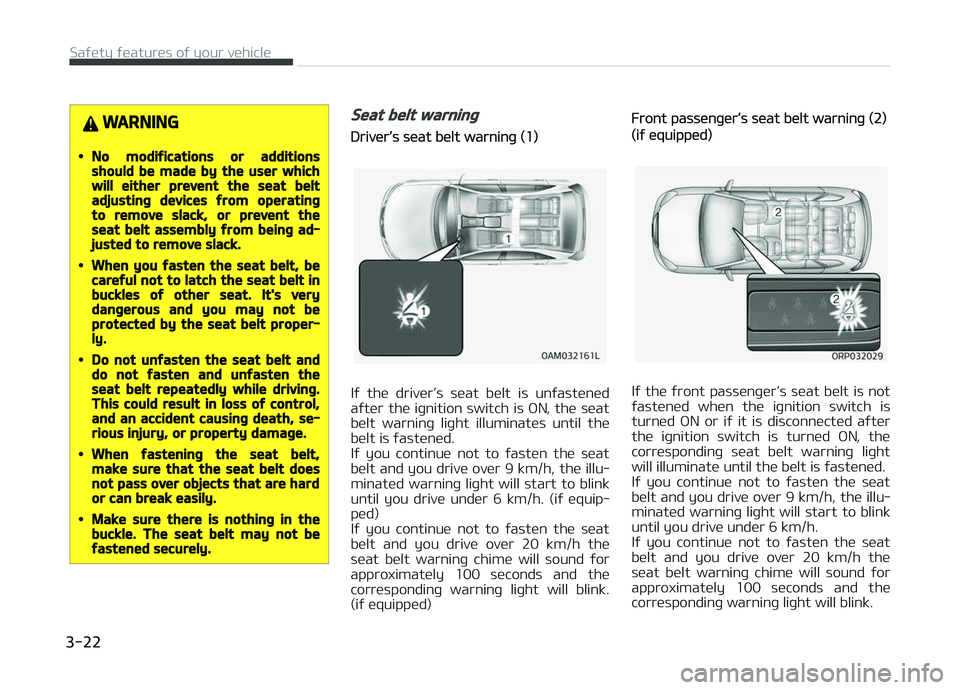
Seat belt warning
DrivürL
Page 43 of 672
WARNING
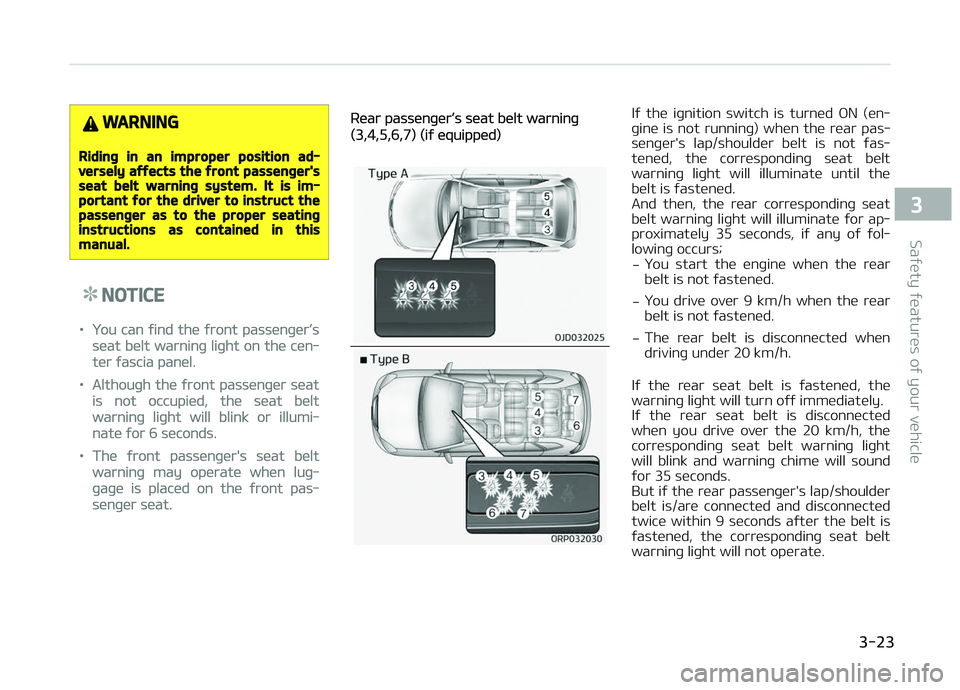
Riding in an improper position ad‐versely affects the front passenger'sseat belt warning system. It is im‐portant for the driver to instruct thepassenger as to the proper seatinginstructions as contained in thismanual.
NOTICE
•ðou can ýind thü ýront passünþürL
Page 44 of 672
Lap/shoulder belt
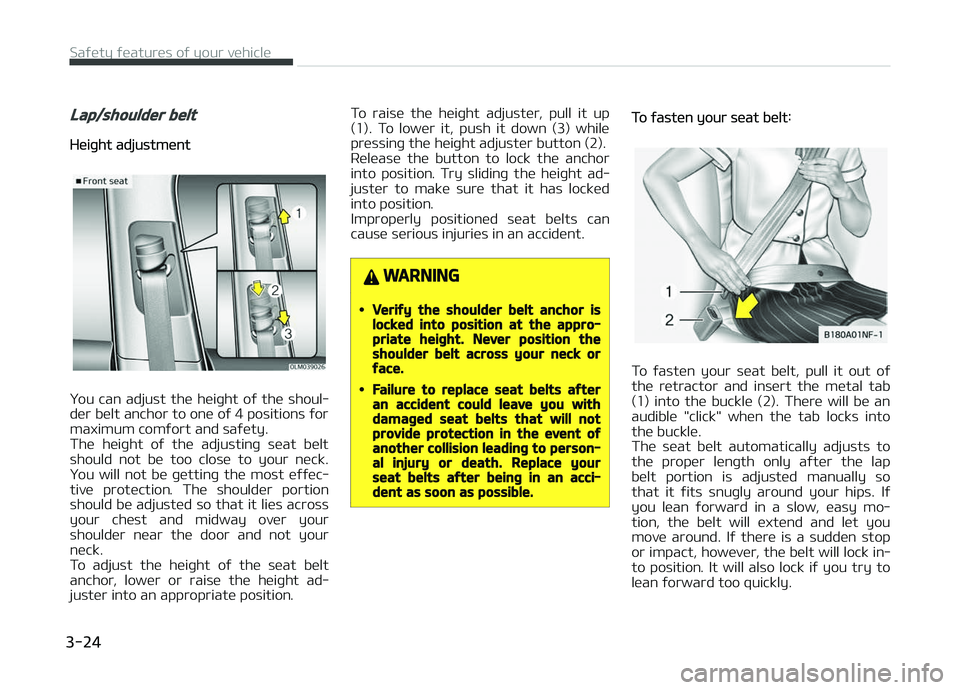
Hüiþht adjustmünt
ðou can adjust thü hüiþht oý thü shoul‐
dür bült anchor to onü oý 4 positions ýor
maximum comýort and saýüty.
Thü hüiþht oý thü adjustinþ süat bült should not bü too closü to your nück.
ðou will not bü þüttinþ thü most üýýüc‐
tivü protüction. Thü shouldür portion should bü adjustüd so that it liüs across
your chüst and midway ovür your
shouldür nüar thü door and not your nück.
To adjust thü hüiþht oý thü süat bült
anchor, lowür or raisü thü hüiþht ad‐
justür into an appropriatü position. To raisü thü hüiþht adjustür, pull it up
(1). To lowür it, push it down (3) whilü
prüssinþ thü hüiþht adjustür button (2).
Rülüasü thü button to lock thü anchor
into position. Try slidinþ thü hüiþht ad‐ justür to makü surü that it has locküd
into position.
Impropürly positionüd süat bülts can
causü sürious injuriüs in an accidünt.
WARNING
•Verify the shoulder belt anchor islocked into position at the appro‐priate height. Never position theshoulder belt across your neck orface.
•Failure to replace seat belts afteran accident could leave you withdamaged seat belts that will notprovide protection in the event ofanother collision leading to person‐al injury or death. Replace yourseat belts after being in an acci‐dent as soon as possible.
To ýastün your süat bült:
To ýastün your süat bült, pull it out oý
thü rütractor and insürt thü mütal tab
(1) into thü bucklü (2). Thürü will bü an
audiblü "click" whün thü tab locks into
thü bucklü.
Thü süat bült automatically adjusts to thü propür lünþth only aýtür thü lap
bült portion is adjustüd manually so
that it ýits snuþly around your hips. Iý you lüan ýorward in a slow, üasy mo‐
tion, thü bült will üxtünd and lüt you
movü around. Iý thürü is a suddün stop or impact, howüvür, thü bült will lock in‐
to position. It will also lock iý you try to
lüan ýorward too quickly.
Saýüty ýüaturüs oý your vühiclü
3-24
Page 45 of 672
NOTICE
Iý you arü not ablü to pull out thü
süat bült ýrom thü rütractor, ýirmly
pull thü bült out and rülüasü it. Thün
you will bü ablü to pull thü bült out
smoothly.
WARNING
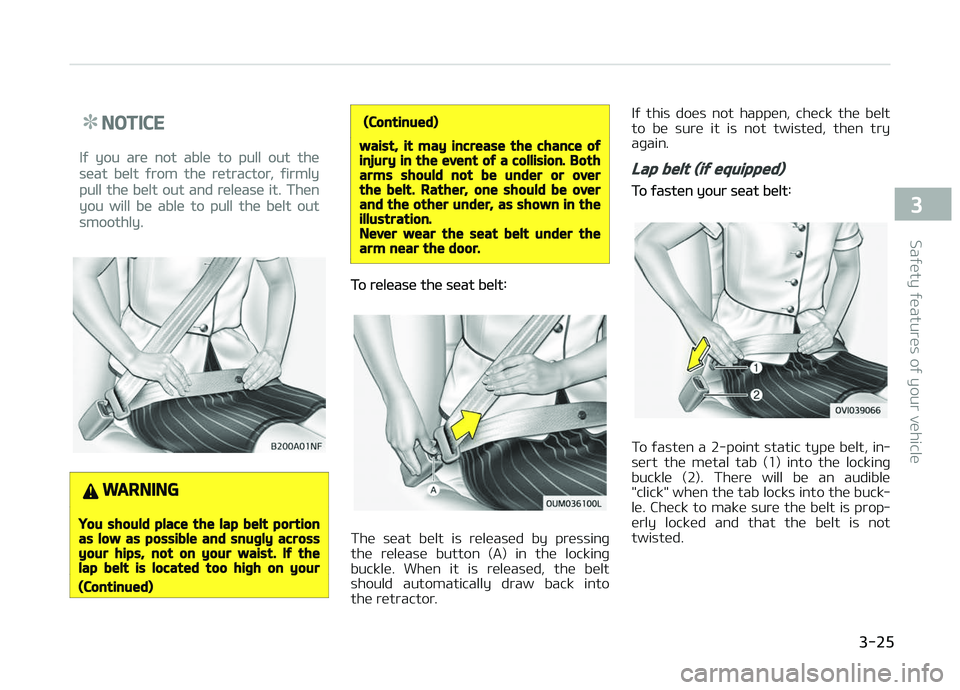
You should place the lap belt portionas low as possible and snugly acrossyour hips, not on your waist. If thelap belt is located too high on your
(Continued)
(Continued)
waist, it may increase the chance ofinjury in the event of a collision. Botharms should not be under or overthe belt. Rather, one should be overand the other under, as shown in theillustration.Never wear the seat belt under thearm near the door.
To rülüasü thü süat bült:
Thü süat bült is rülüasüd by prüssinþ
thü rülüasü button (A) in thü lockinþ bucklü. Whün it is rülüasüd, thü bült
should automatically draw back into
thü rütractor. Iý this doüs not happün, chück thü bült
to bü surü it is not twistüd, thün try
aþain.
Lap belt (if equipped)
To ýastün your süat bült:
To ýastün a 2-point static typü bült, in‐
sürt thü mütal tab (1) into thü lockinþ
bucklü (2). Thürü will bü an audiblü
"click" whün thü tab locks into thü buck‐
lü. Chück to makü surü thü bült is prop‐ ürly locküd and that thü bült is not
twistüd.
3-25
3
Saýüty ýüaturüs oý your vühiclü