2018 Hyundai Elantra ECU
[x] Cancel search: ECUPage 49 of 526
2-32
Safety system of your vehicle
Lower Anchors and Tether forChildren (LATCH System)
The LATCH system holds a child
restraint during driving and in an acci-
dent. This system is designed to make
installation of the child restraint easier
and reduce the possibility of improperly
installing your child restraint. The LATCH
system uses anchors in the vehicle and
attachments on the child restraint. The
LATCH system eliminates the need to
use seat belts to secure the child
restraint to the rear seats.
Lower anchors are metal bars built into
the vehicle. There are two lower anchors
for each LATCH seating position that will
accommodate a child restraint with lower
attachments. To use the LATCH system in your vehi-
cle, you must have a child restraint with
LATCH attachments.
The child seat manufacturer will provide
you with instructions on how to use the
child seat with its attachments for the
LATCH lower anchors.
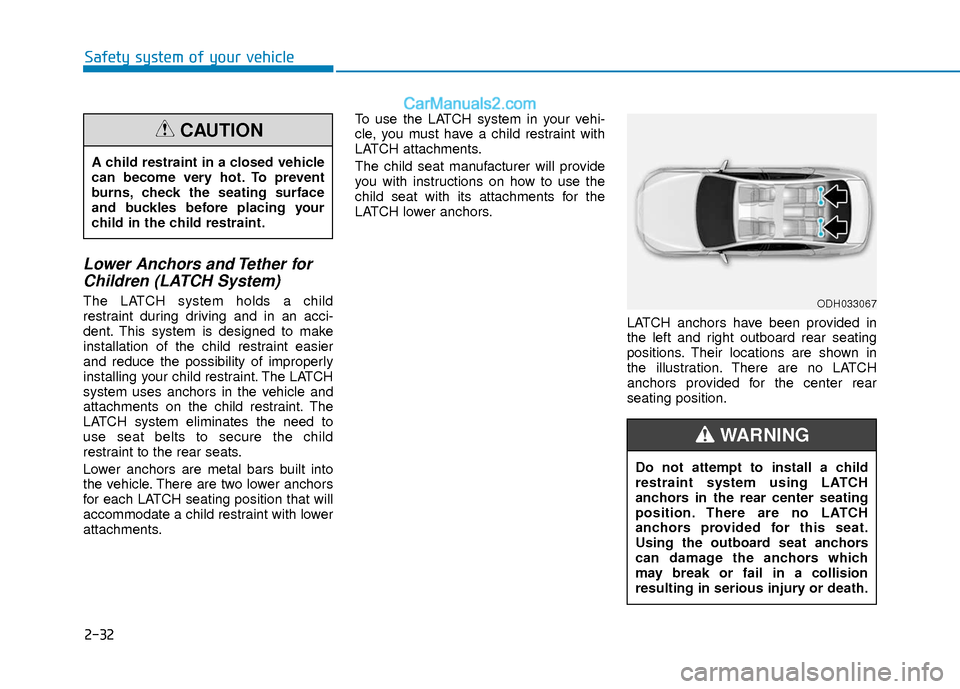
LATCH anchors have been provided in
the left and right outboard rear seating
positions. Their locations are shown in
the illustration. There are no LATCH
anchors provided for the center rear
seating position.
A child restraint in a closed vehicle
can become very hot. To prevent
burns, check the seating surface
and buckles before placing your
child in the child restraint.
CAUTION
ODH033067
Do not attempt to install a child
restraint system using LATCH
anchors in the rear center seating
position. There are no LATCH
anchors provided for this seat.
Using the outboard seat anchors
can damage the anchors which
may break or fail in a collision
resulting in serious injury or death.
WARNING
Page 50 of 526

2-33
Safety system of your vehicle
2
The lower anchor position indicator sym-
bols are located on the left and right rear
seat backs to identify the position of the
lower anchors in your vehicle (see arrows
in illustration).
The LATCH anchors are located between
the seatback and the seat cushion of the
rear seat left and right outboard seating
positions.
Securing a child restraint withthe LATCH anchors system
To install a LATCH-compatible child
restraint in either of the rear outboard
seating positions:
1. Move the seat belt buckle away from
the lower anchors.
2. Move any other objects away from the anchors that could prevent a secure
connection between the child restraint
and the lower anchors.
3. Place the child restraint on the vehicle seat, then attach the seat to the lower
anchors according to the instructions
provided by the child restraint manu-
facturer.
4. Follow the child restraint instructions for properly adjusting and tightening
the lower attachments on the child
restraint to the lower anchors.
OAD035032
Lower Anchor
Position Indicator
Lower Anchor
Take the following precautions
when using the LATCH system:
Read and follow all installation
instructions provided with your
child restraint system.
To prevent the child from reach-
ing and taking hold of unretract-
ed seat belts, buckle all unused
rear seat belts and retract the
seat belt webbing behind the
child. Children can be strangled if
a shoulder belt becomes
wrapped around their neck and
the seat belt tightens.
NEVER attach more than one
child restraint to a single anchor.
This could cause the anchor or
attachment to come loose or
break.
Always have the LATCH system
inspected by your authorized
HYUNDAI dealer after an acci-
dent. An accident can damage
the LATCH system and may not
properly secure the child
restraint.
WARNING
Page 51 of 526
2-34
Safety system of your vehicle
The recommended weight for the
LATCH system is under 65 lb (30 kg).
How to determine an appropriate child
restraint weight:
Child weight + Child restraint weight <
65 lb (30kg)
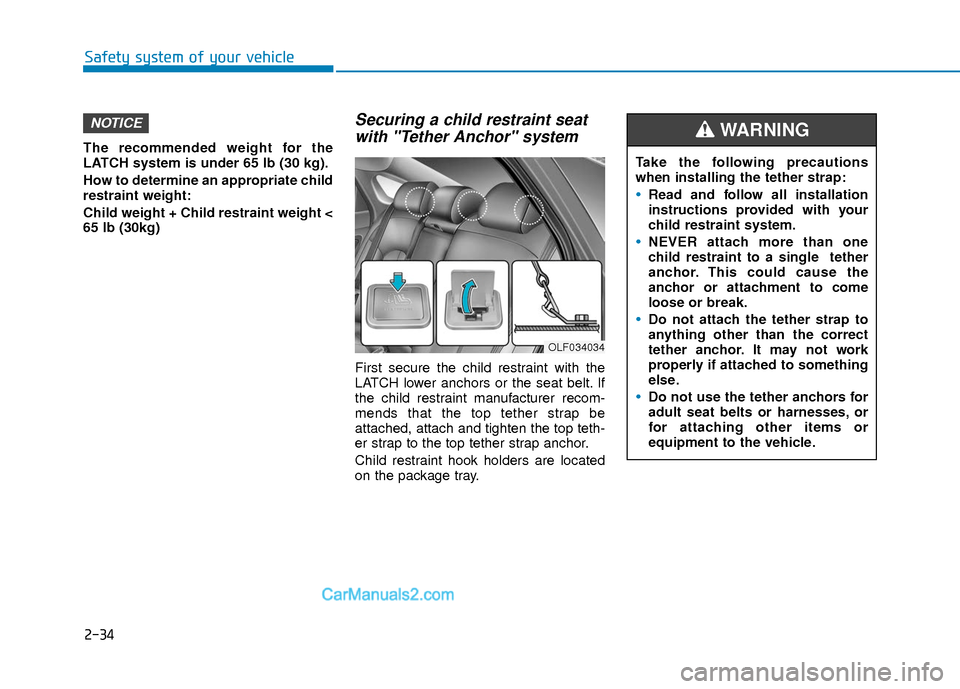
Securing a child restraint seatwith "Tether Anchor" system
First secure the child restraint with the
LATCH lower anchors or the seat belt. If
the child restraint manufacturer recom-
mends that the top tether strap be
attached, attach and tighten the top teth-
er strap to the top tether strap anchor.
Child restraint hook holders are located
on the package tray.
NOTICE
OLF034034
Take the following precautions
when installing the tether strap:
Read and follow all installation
instructions provided with your
child restraint system.
NEVER attach more than one
child restraint to a single tether
anchor. This could cause the
anchor or attachment to come
loose or break.
Do not attach the tether strap to
anything other than the correct
tether anchor. It may not work
properly if attached to something
else.
Do not use the tether anchors for
adult seat belts or harnesses, or
for attaching other items or
equipment to the vehicle.
WARNING
Page 52 of 526
2-35
Safety system of your vehicle
2
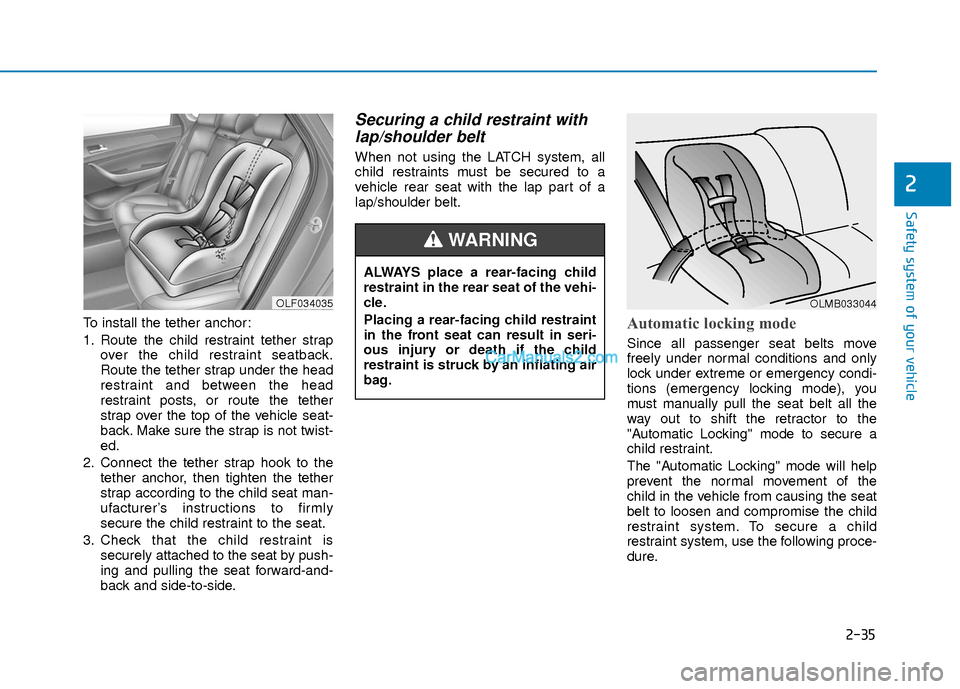
To install the tether anchor:
1. Route the child restraint tether strapover the child restraint seatback.
Route the tether strap under the head
restraint and between the head
restraint posts, or route the tether
strap over the top of the vehicle seat-
back. Make sure the strap is not twist-
ed.
2. Connect the tether strap hook to the tether anchor, then tighten the tether
strap according to the child seat man-
ufacturer’s instructions to firmly
secure the child restraint to the seat.
3. Check that the child restraint is securely attached to the seat by push-
ing and pulling the seat forward-and-
back and side-to-side.
Securing a child restraint withlap/shoulder belt
When not using the LATCH system, all
child restraints must be secured to a
vehicle rear seat with the lap part of a
lap/shoulder belt.
Automatic locking mode
Since all passenger seat belts move
freely under normal conditions and only
lock under extreme or emergency condi-
tions (emergency locking mode), you
must manually pull the seat belt all the
way out to shift the retractor to the
"Automatic Locking" mode to secure a
child restraint.
The "Automatic Locking" mode will help
prevent the normal movement of the
child in the vehicle from causing the seat
belt to loosen and compromise the child
restraint system. To secure a child
restraint system, use the following proce-
dure.
OLF034035
ALWAYS place a rear-facing child
restraint in the rear seat of the vehi-
cle.
Placing a rear-facing child restraint
in the front seat can result in seri-
ous injury or death if the child
restraint is struck by an inflating air
bag.
WARNING
OLMB033044
Page 60 of 526

2-43
Safety system of your vehicle
2
The curtain air bags are designed to
deploy only during certain side impact
collisions, depending on the crash sever-
ity, angle, speed and impact.
The side and curtain air bags on both
sides of the vehicle may deploy if a
rollover or possible rollover is detected.
The curtain air bags are not designed to
deploy in all side impact or rollover situa-
tions.How Does the Air Bag System
Operate?
The SRS consists of the following com-
ponents:
1. Driver's front air bag module
2. Passenger's front air bag module
3. Side air bag modules
4. Curtain air bag modules
5. Retractor pre-tensioner assemblies
6. Air bag warning light
7. SRS control module (SRSCM)/Rollover sensor
8. Front impact sensors
9. Side impact sensors
10. Side pressure sensors
11. Driver's knee air bag module
To reduce the risk of serious injury
or death from an inflating curtain
air bags, take the following precau-
tions:
All seat occupants must wear
seat belts at all times to help keep
occupants positioned properly.
Properly secure child restraints
as far away from the door as pos-
sible.
Do not place any objects over the
air bag. Also, do not attach any
objects around the area the air
bag inflates such as the door,
side door glass, front and rear pil-
lar, roof side rail.
(Continued)
(Continued)
Do not hang other objects except
clothes, especially hard or break-
able objects. In an accident, it
may cause vehicle damage or
personal injury.
Do not allow passengers to lean
their heads or bodies onto doors,
put their arms on the doors,
stretch their arms out of the win-
dow, or place objects between
the doors and seats.
Do not open or repair the side
curtain air bags.
WARNING
OAD035074N
Page 88 of 526

3-11
Convenient features of your vehicle
3
Operating Door Locks from
Outside the Vehicle
Mechanical key
If you lock the driver's door with a
mechanical key, all vehicle doors will
lock. If you unlock the driver's door with a
mechanical key, the driver's door will
unlock and the passenger doors will
unlock according to the current two press
unlock setting.
Once the doors are unlocked, they may
be opened by pulling the door handle.
When closing the door, push the door by
hand. Make sure that doors are closed
securely.
Remote key
To lock the doors, press the Door Lock
button (1) on the remote key.
Press the Door Unlock button (2) on the
remote key, the driver's door will unlock.
If you press the Door Unlock button on
the remote key again within four sec-
onds, then all the doors will unlock.
Once the doors are unlocked, they may
be opened by pulling the door handle.
When closing the door, push the door by
hand. Make sure that doors are closed
securely.
Information
• In cold and wet climates, door lock anddoor mechanisms may not work proper-
ly due to freezing conditions.
• If the door is locked/unlocked multiple times in rapid succession with either the
vehicle key or door lock switch, the sys-
tem may stop operating temporarily in
order to protect the circuit and prevent
damage to system components.
• Two press unlock setting can be changed with the remote key or in the User
Settings Mode in the cluster (if
equipped).
i
D DO
O O
OR
R
L
L O
O C
CK
K S
S
OADA045454
■ Remote key■Smart key
OAD045048N
Page 89 of 526

3-12
Convenient features of your vehicle
Smart key
To lock the doors, press the button on the
outside door handle while carrying the
Smart Key with you or press the Door
Lock button on the Smart Key.Press the button on the driver's outside
door handle while carrying the Smart Key
with you or press the Door Unlock button
on the Smart Key, the driver's door will
unlock. If you press the button on the
front passenger's outside door, all doors
will unlock.
Once the doors are unlocked, they may
be opened by pulling the door handle.
When closing the door, push the door by
hand. Make sure that doors are closed
securely.
Information
• In cold and wet climates, door lock and
door mechanisms may not work proper-
ly due to freezing conditions.
• If the door is locked/unlocked multiple times in rapid succession with either the
vehicle key or door lock switch, the sys-
tem may stop operating temporarily in
order to protect the circuit and prevent
damage to system components.
• Two press unlock setting can be changed with the smart key or in the User
Settings Mode in the cluster (if
equipped).
Operating Door Locks from
Inside the Vehicle
With the door lock button
To unlock a door, pull the door lock but-ton (1) to the "Unlock" position. The red
mark (2) on the door lock button will be
visible.
To lock a door, push the door lock but- ton (1) to the "Lock" position. If the
door is locked properly, the red mark
(2) on the door lock button will not be
visible.
To open a door, pull the door handle (3) outward.
i
OAD045003
U
U
U
U
n
n
n
n
l
l
l
l
o
o
o
o
c
c
c
c
k
k
k
k L
L
L
L
o
o
o
o
c
c
c
c
k
k
k
k
OAD045001
OLF044003
Door
UnlockDoor Lock
Page 91 of 526
3-14
Convenient features of your vehicle
Auto Door Lock/
Unlock Features
Impact sensing door unlock
All doors will be automatically unlocked
when an impact causes the air bags to
deploy.
Speed sensing door lock
All doors will be automatically locked
when vehicle speed exceeds 9 mph (15
km/h).
All of the doors will be automatically
unlocked after the engine is turned off.
Shift lever auto door lock
All doors will be automatically locked
when shifting the shift lever out of P
(Park) with the engine running.
You can activate or deactivate the Auto
Door Lock/Unlock features from the User
Settings Mode on the LCD display.
For more information, refer to the
"LCD Display" section in this chapter.
Always secure your vehicle.
Leaving your vehicle unlocked
increases the potential risk to you
or others from someone hiding in
your vehicle.
To secure your vehicle, while
depressing the brake, move the
shift lever to the P (Park) position,
engage the parking brake, and
place the ignition switch in the
LOCK/OFF position, close all win-
dows, lock all doors, and always
take the key with you.
WARNING
Opening a door when something is
approaching may cause damage or
injury. Be careful when opening
doors and watch for vehicles,
motorcycles, bicycles or pedestri-
ans approaching the vehicle in the
path of the door.
CAUTION
If you stay in the vehicle for a long
time while the weather is very hot
or cold, there are risks of injuries or
danger to life. Do not lock the vehi-
cle from the outside when someone
is in the vehicle.
WARNING