2018 CHRYSLER PACIFICA cooling
[x] Cancel search: coolingPage 515 of 696
Cooling System Pressure Cap
The cap must be fully tightened to prevent loss of engine
coolant (antifreeze), and to ensure that engine coolant
(antifreeze) will return to the radiator from the coolant
expansion bottle/recovery tank if so equipped.
The cap should be inspected and cleaned if there is any
accumulation of foreign material on the sealing surfaces.
WARNING!
•Do not open hot engine cooling system. Never add
engine coolant (antifreeze) when the engine is over-
heated. Do not loosen or remove the cap to cool an
overheated engine. Heat causes pressure to build up
in the cooling system. To prevent scalding or injury,
do not remove the pressure cap while the system is
hot or under pressure.
• Do not use a pressure cap other than the one speci-
fied for your vehicle. Personal injury or engine
damage may result.
Disposal Of Used Coolant
Used ethylene glycol-based coolant (antifreeze) is a regu-
lated substance requiring proper disposal. Check with your
local authorities to determine the disposal rules for your
community. To prevent ingestion by animals or children,
do not store ethylene glycol-based coolant in open contain-
ers or allow it to remain in puddles on the ground. If
ingested by a child or pet, seek emergency assistance
immediately. Clean up any ground spills immediately.
Coolant Level
The coolant expansion bottle provides a quick visual
method for determining that the coolant level is adequate.
With the engine off and cold, the level of the coolant
(antifreeze) in the bottle should be between the “MAX” and
“MIN” lines marked on the bottle.
As long as the engine operating temperature is satisfactory,
the coolant bottle need only be checked once a month.
When additional coolant (antifreeze) is needed to maintain
the proper level, it should be added to the coolant bottle.
Do not overfill.
See an authorized dealer for service.
8
SERVICING AND MAINTENANCE 513
Page 516 of 696
Points To Remember
NOTE:When the vehicle is stopped after a few miles/
kilometers of operation, you may observe vapor coming
from the front of the engine compartment. This is normally
a result of moisture from rain, snow, or high humidity
accumulating on the radiator and being vaporized when
the thermostat opens, allowing hot engine coolant (anti-
freeze) to enter the radiator.
If an examination of your engine compartment shows no
evidence of radiator or hose leaks, the vehicle may be
safely driven. The vapor will soon dissipate.
• Do not overfill the coolant expansion bottle.
• Check the coolant freeze point in the radiator and in the
coolant expansion bottle. If engine coolant (antifreeze)
needs to be added, the contents of the coolant expansion
bottle must also be protected against freezing.
• If frequent engine coolant (antifreeze) additions are
required, the cooling system should be pressure tested
for leaks.
•
Maintain engine coolant (antifreeze) concentration at a
minimum of 50% OAT coolant (conforming to MS.90032)
and distilled water for proper corrosion protection of your
engine which contains aluminum components.
• Make sure that the coolant expansion bottle overflow
hoses are not kinked or obstructed.
• Keep the front of the radiator clean. If your vehicle is
equipped with air conditioning, keep the front of the
condenser clean.
• Do not change the thermostat for Summer or Winter
operation. If replacement is ever necessary, install ONLY
the correct type thermostat. Other designs may result in
unsatisfactory engine coolant (antifreeze) performance,
poor gas mileage, and increased emissions.
Brake System
In order to assure brake system performance, all brake
system components should be inspected periodically. Refer
to the “Maintenance Plan” in this section for the proper
maintenance intervals.
WARNING!
Riding the brakes can lead to brake failure and possi-
bly a collision. Driving with your foot resting or riding
on the brake pedal can result in abnormally high brake
temperatures, excessive lining wear, and possible
brake damage. You would not have your full braking
capacity in an emergency.
514 SERVICING AND MAINTENANCE
Page 544 of 696
•Clean and protect polished metal parts by applying
protective waxes.
• Apply talcum powder to the front and rear wiper blades
and leave raised from the glass.
• Cover the vehicle with an appropriate cover taking care
not to damage the painted surface by dragging across
dirty surfaces. Do not use plastic sheeting which will not
allow the evaporation of moisture present on the surface
of the vehicle.
• Inflate the tires at a pressure of +7.25 psi (+0.5 bar)
higher than recommended on the tire placard and check
it periodically.
• Do not drain the vehicle’s cooling system.
• Whenever you leave the vehicle stationary for two
weeks or more, idle the vehicle for approximately five
minutes, with the air conditioning system on and high
fan speed. This will ensure proper lubrication of the
system, thus minimizing the possibility of damage to the
compressor when the vehicle is put back into operation.CAUTION!
Before removal of the positive and negative terminals
to the battery, wait at least a minute with ignition
switch in the OFF position and close the drivers door.
When reconnecting the positive and negative terminals
to the battery be sure the ignition switch is in the OFF
position and the drivers door is closed.
BODYWORK
Protection From Atmospheric Agents
Vehicle body care requirements vary according to geo-
graphic locations and usage. Chemicals that make roads
passable in snow and ice and those that are sprayed on trees
and road surfaces during other seasons are highly corrosive
to the metal in your vehicle. Outside parking, which
exposes your vehicle to airborne contaminants, road sur-
faces on which the vehicle is operated, extreme hot or cold
weather and other extreme conditions will have an adverse
effect on paint, metal trim, and underbody protection.
542 SERVICING AND MAINTENANCE
Page 557 of 696

FLUID CAPACITIES
U.S.Metric
Fuel (Approximate)
3.6L Engines 19 Gallons71 Liters
Engine Oil With Filter
3.6 Liter Engine (SAE 0W-20 , API
Certified) 5 quarts
4.7 liters
Cooling System*
3.6 Liter Engine (Mopar Antifreeze/
Engine Coolant 10 Year/150,000 Mile
(240,000 km) Formula) 13.1 Quarts — Standard Duty Cool-
ing
13.4 Quarts — Heavy Duty Cooling 12.4 Liters — Standard Duty Cooling
12.7 Liters — Heavy Duty Cooling
* Includes heater and coolant reservoir filled to MAX level.
FLUIDS AND LUBRICANTS
Engine
Component Fluid, Lubricant, or Genuine Part
Engine Coolant We recommend you use Mopar Antifreeze/Coolant 10
Year/150,000 Mile (240,000 km) Formula OAT (Organic
Additive Technology) or equivalent meeting the require-
ments of FCA Material Standard MS.90032.
9
TECHNICAL SPECIFICATIONS 555
Page 558 of 696

ComponentFluid, Lubricant, or Genuine Part
Engine Oil – 3.6L Engine We recommend you use API Certified SAE 0W-20 Engine
Oil, meeting the requirements of FCA Material Standard
MS-6395 such as Mopar, Pennzoil, and Shell Helix. Refer to
your engine oil filler cap for correct SAE grade.
Engine Oil Filter We recommend you use a Mopar Engine Oil Filter.
Spark Plugs We recommend you use Mopar Spark Plugs.
Fuel Selection – 3.6L Engine 87 Octane, 0-15% Ethanol (Do not use E-85).
CAUTION!
•Mixing of engine coolant (antifreeze) other than
specified Organic Additive Technology (OAT) en-
gine coolant (antifreeze), may result in engine dam-
age and may decrease corrosion protection. Organic
Additive Technology (OAT) engine coolant is differ-
ent and should not be mixed with Hybrid Organic
Additive Technology (HOAT) engine coolant (anti-
freeze) or any “globally compatible” coolant (anti-
freeze). If a non-OAT engine coolant (antifreeze) is
introduced into the cooling system in an emergency,
the cooling system will need to be drained, flushed,
and refilled with fresh OAT coolant (conforming to
(Continued)
CAUTION! (Continued)
MS.90032), by an authorized dealer as soon as pos-
sible.
• Do not use water alone or alcohol-based engine
coolant (antifreeze) products. Do not use additional
rust inhibitors or antirust products, as they may not
be compatible with the radiator engine coolant and
may plug the radiator.
• This vehicle has not been designed for use with
propylene glycol-based engine coolant (antifreeze).
Use of propylene glycol-based engine coolant (anti-
freeze) is not recommended.
556 TECHNICAL SPECIFICATIONS
Page 682 of 696

Cargo Load Floor..........................146
Cargo Tie-Downs .......................... .146
Car Washes ...............................543
Cellular Phone ............................650
Center High Mounted Stop Light ...............437
Certification Label ..........................405
Chains, Tire ............................. .538
Change Oil Indicator ........................187
Changing A Flat Tire .....................446, 517
Chart, Tire Sizing .......................... .519
Check Engine Light (Malfunction Indicator Light). . . .210
Checking Your Vehicle For Safety ...............300
Checks, Safety ............................ .300
Child Restraint ............................276
Child Restraints Booster Seats ............................280
Center Seat LATCH .......................288
Child Seat Installation ..................291, 294
How To Stow An unused ALR Seat Belt ........290
Infant And Child Restraints .................278
Lower Anchors And Tethers For Children .......282
Older Children And Child Restraints ...........279
Seating Positions ........................ .281
Using The Top Tether Anchorage .............296
Cigar Lighter ............................ .172Clean Air Gasoline
........................ .551
Cleaning Wheels ............................... .537
Climate Control ............................104
Automatic ..........................117,118
Manual ............................... .104
Rear ..............................114,126
Coat Hook ...............................167
Cold Weather Operation ..................... .310
Compact Disc (CD) Maintenance ................669
Compact Spare Tire ........................ .535
Computer, Trip/Travel .......................197
Contract, Service.......................... .674
Cooling
Pressure Cap (Radiator Cap) ............513
Cooling System ............................510
Adding Coolant (Antifreeze) .................512
Coolant Level .......................... .513
Cooling Capacity ........................ .555
Disposal Of Used Coolant ..................513
Drain, Flush, And Refill ....................511
Inspection ..........................510, 513
Points To Remember ..................... .514
Pressure Cap ............................513
Radiator Cap .......................... .513
Selection Of Coolant (Antifreeze) ..........511,555
680 INDEX
Page 684 of 696
Checking Oil Level.......................494
Compartment .......................... .493
Compartment Identification .................493
Coolant (Antifreeze) ..................... .555
Cooling ...............................510
Exhaust Gas Caution ...................301, 554
Fails To Start ............................310
Flooded, Starting ........................ .310
Fuel Requirements ........................550
Oil ...............................496, 555
Oil Filler Cap .......................... .493
Oil Filter ...............................498
Oil Selection ........................ .496, 555
Oil Synthetic ............................497
Overheating ............................479
Starting ...............................309
Engine Oil Viscosity ........................ .497
Engine Oil Viscosity Chart ....................497
Enhanced Accident Response Feature .........273, 485
Ethanol ................................. .551
Exhaust Gas Cautions ....................301, 554
Exhaust System ........................301, 508
Exterior Lighting ........................94, 435
Exterior Lights ...................94, 303, 431, 435 Filters
Air Cleaner ............................ .498
Air Conditioning .....................132, 501
Engine Oil ..........................498, 555
Engine Oil Disposal .......................498
Flashers Hazard Warning ........................ .425
Turn Signals ...................94, 207, 303, 435
Flash-To-Pass ............................94, 96
Flooded Engine Starting ..................... .310
Fluid, Brake ............................. .557
Fluid Capacities ............................555
Fluid Leaks...............................304
Fluid
Level Checks
Brake .................................515
Fluids And Lubricants .......................555
Fog Lights ..........................94, 97, 436
Fog Lights, Service ........................ .436
Fold-Flat Seats .............................48
Fold In Floor (Stow ‘n Go) Seating ...............62
Forward Collision Warning ....................230
Freeing A Stuck Vehicle ..................... .481
Front Position Light ........................ .435
Fuel ................................... .550
Additives ............................. .551
682 INDEX
Page 692 of 696
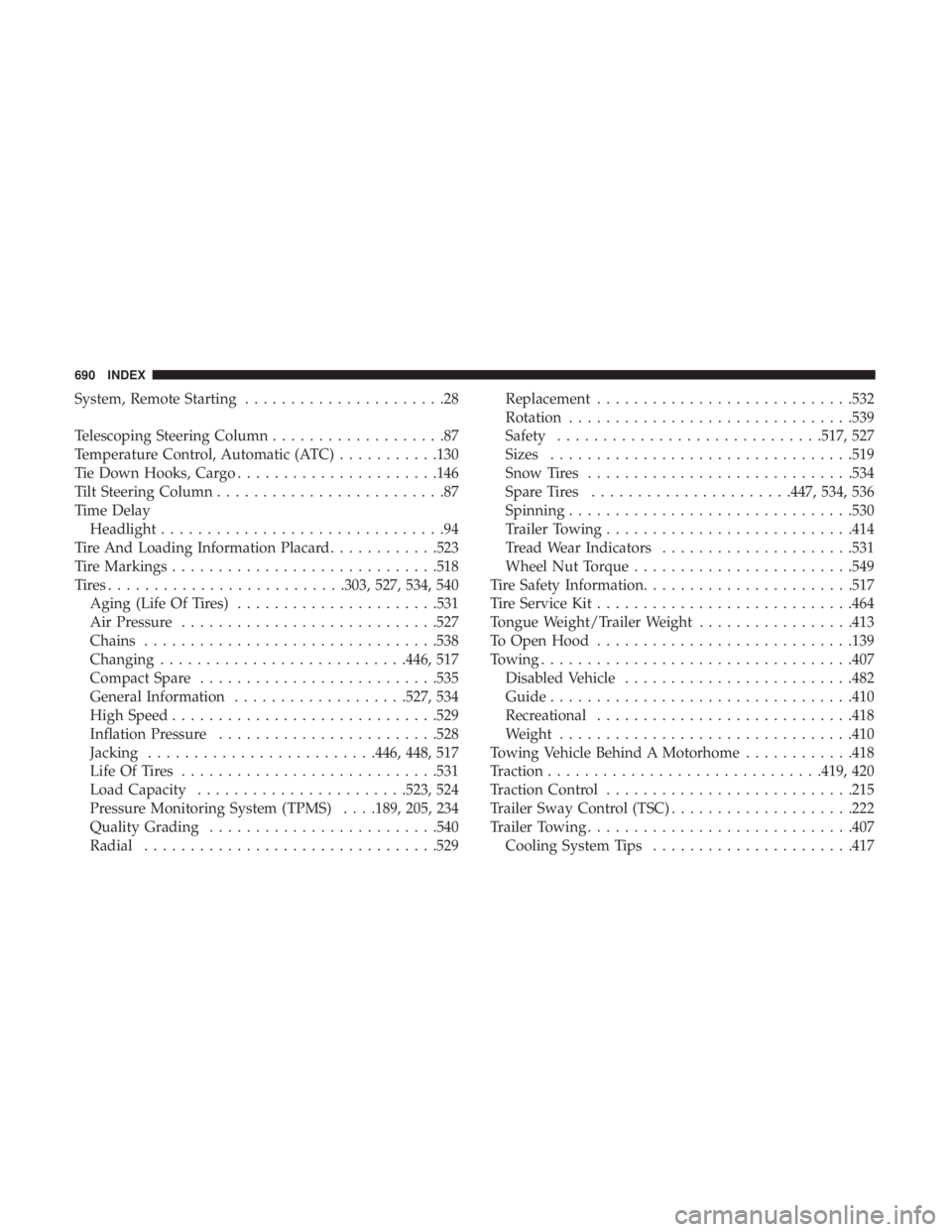
System, Remote Starting......................28
Telescoping Steering Column ...................87
Temperature Control, Automatic (ATC) ...........130
Tie Down Hooks, Cargo ..................... .146
Tilt Steering Column .........................87
Time Delay Headlight ...............................94
Tire And Loading Information Placard ............523
Tire Markings ............................ .518
Tires......................... .303, 527, 534, 540
Aging (Life Of Tires) ..................... .531
Air Pressure ............................527
Chains ............................... .538
Changing .......................... .446, 517
Compact Spare ..........................535
General Information ...................527, 534
High Speed ............................ .529
Inflation Pressure ........................528
Jacking ........................ .446, 448, 517
Life Of Tires ............................531
Load Capacity .......................523, 524
Pressure Monitoring System (TPMS) . . . .189, 205, 234
Quality Grading ........................ .540
Radial ............................... .529Replacement
............................532
Rotation ...............................539
Safety ............................ .517, 527
Sizes .................................519
Snow Tires ............................ .534
Spare Tires ..................... .447, 534, 536
Spinning ...............................530
Trailer Towing .......................... .414
Tread Wear Indicators .....................531
Wheel Nut Torque ........................549
Tire Safety Information .......................517
Tire Service Kit ............................464
Tongue Weight/Trailer Weight .................413
T o
Open Hood ............................139
Towing ................................. .407
Disabled Vehicle ........................ .482
Guide .................................410
Recreational ............................418
Weight ............................... .410
Towing Vehicle Behind A Motorhome ............418
Traction ............................. .419, 420
Traction Control .......................... .215
Trailer Sway Control (TSC) ....................222
Trailer Towing ............................ .407
Cooling System Tips ..................... .417
690 INDEX