2018 CHRYSLER PACIFICA Change battery
[x] Cancel search: Change batteryPage 312 of 696

ENGINE START/STOP Button Functions — With Driv-
er ’s Foot OFF The Brake Pedal (In PARK Or NEUTRAL
Position)
The ENGINE START/STOP button operates similar to an
ignition switch. It has three positions, OFF, ACC, and RUN.
To change the ignition positions without starting the ve-
hicle and use the accessories follow these steps:
•Starting with the ignition in the OFF position,
• Push the ENGINE START/STOP button once to place
the ignition to the ACC position (instrument cluster will
display “ACC”),
• Push the ENGINE START/STOP button a second time to
place the ignition to the RUN position (instrument
cluster will display “ON/RUN”),
• Push the ENGINE START/STOP button a third time to
return the ignition to the OFF position (instrument
cluster will display “OFF”).
Cold Weather Operation (Below –22°F Or 30°C)
To ensure reliable starting at these temperatures, use of an
externally powered electric engine block heater (available
from your authorized dealer) is recommended.
After Starting — Warming Up The Engine
The idle speed is controlled automatically and it will
decrease as the engine warms up.
If Engine Fails To Start
WARNING!
•Never pour fuel or other flammable liquid into the
throttle body air inlet opening in an attempt to start
the vehicle. This could result in flash fire causing
serious personal injury.
• Do not attempt to push or tow your vehicle to get it
started. Vehicles equipped with an automatic trans-
mission cannot be started this way. Unburned fuel
could enter the catalytic converter and once the
engine has started, ignite and damage the converter
and vehicle.
• If the vehicle has a discharged battery, booster cables
may be used to obtain a start from a booster battery
or the battery in another vehicle. This type of start
can be dangerous if done improperly. Refer to “Jump
Starting Procedure” in “In Case Of Emergency” for
further information.
310 STARTING AND OPERATING
Page 492 of 696
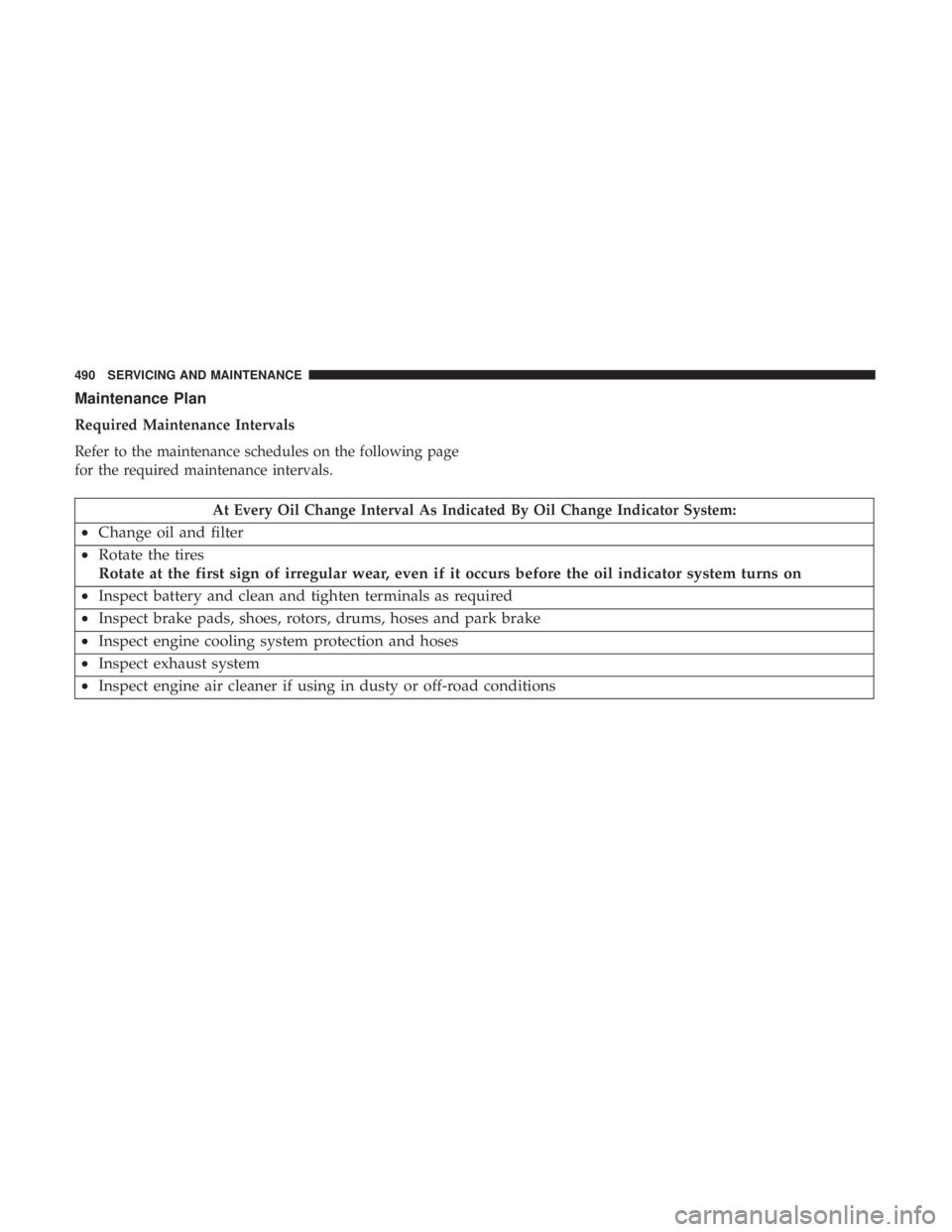
Maintenance Plan
Required Maintenance Intervals
Refer to the maintenance schedules on the following page
for the required maintenance intervals.
At Every Oil Change Interval As Indicated By Oil Change Indicator System:
•Change oil and filter
• Rotate the tires
Rotate at the first sign of irregular wear, even if it occurs before the oil indicator system turns on
• Inspect battery and clean and tighten terminals as required
• Inspect brake pads, shoes, rotors, drums, hoses and park brake
• Inspect engine cooling system protection and hoses
• Inspect exhaust system
• Inspect engine air cleaner if using in dusty or off-road conditions
490 SERVICING AND MAINTENANCE
Page 498 of 696
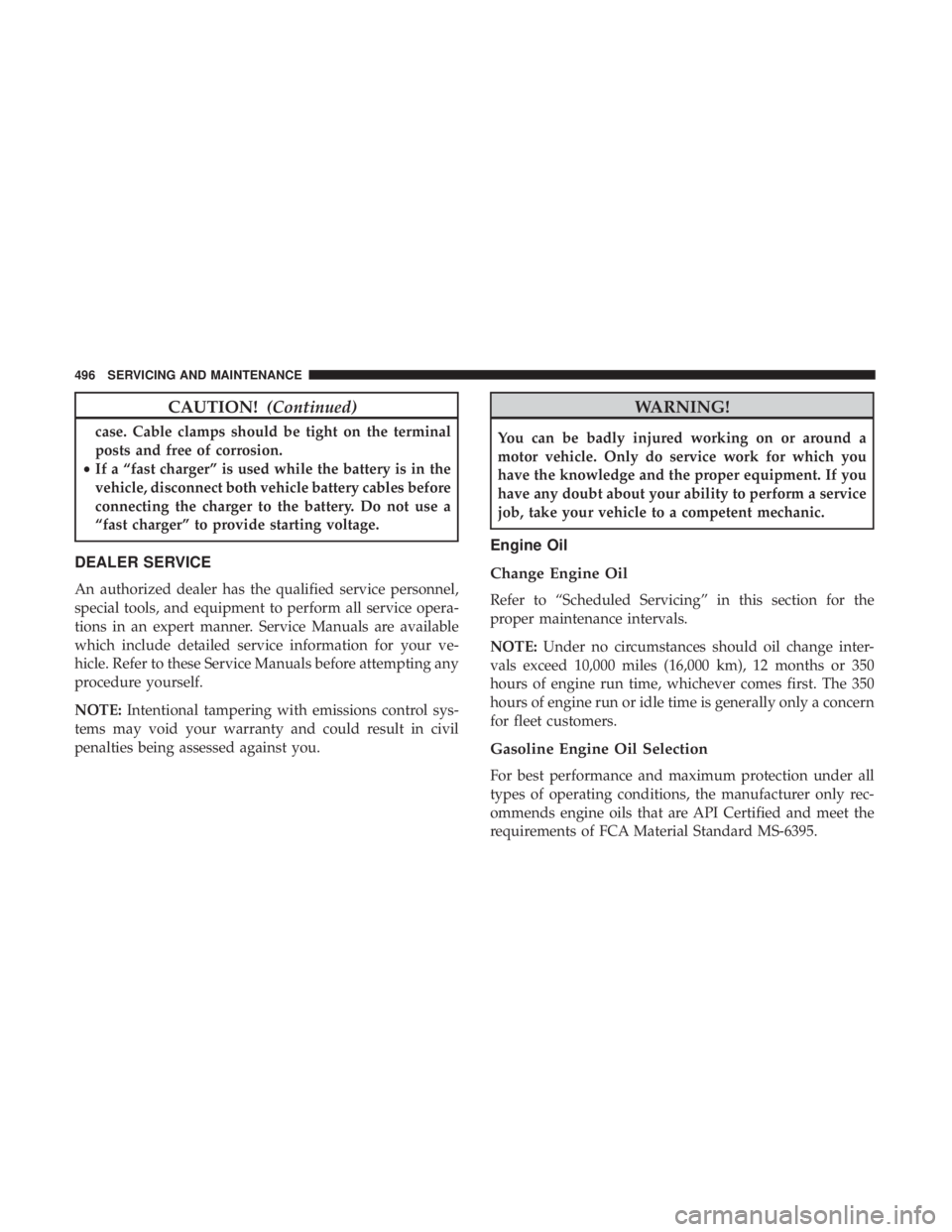
CAUTION!(Continued)
case. Cable clamps should be tight on the terminal
posts and free of corrosion.
• If a “fast charger” is used while the battery is in the
vehicle, disconnect both vehicle battery cables before
connecting the charger to the battery. Do not use a
“fast charger” to provide starting voltage.
DEALER SERVICE
An authorized dealer has the qualified service personnel,
special tools, and equipment to perform all service opera-
tions in an expert manner. Service Manuals are available
which include detailed service information for your ve-
hicle. Refer to these Service Manuals before attempting any
procedure yourself.
NOTE: Intentional tampering with emissions control sys-
tems may void your warranty and could result in civil
penalties being assessed against you.
WARNING!
You can be badly injured working on or around a
motor vehicle. Only do service work for which you
have the knowledge and the proper equipment. If you
have any doubt about your ability to perform a service
job, take your vehicle to a competent mechanic.
Engine Oil
Change Engine Oil
Refer to “Scheduled Servicing” in this section for the
proper maintenance intervals.
NOTE: Under no circumstances should oil change inter-
vals exceed 10,000 miles (16,000 km), 12 months or 350
hours of engine run time, whichever comes first. The 350
hours of engine run or idle time is generally only a concern
for fleet customers.
Gasoline Engine Oil Selection
For best performance and maximum protection under all
types of operating conditions, the manufacturer only rec-
ommends engine oils that are API Certified and meet the
requirements of FCA Material Standard MS-6395.
496 SERVICING AND MAINTENANCE
Page 681 of 696
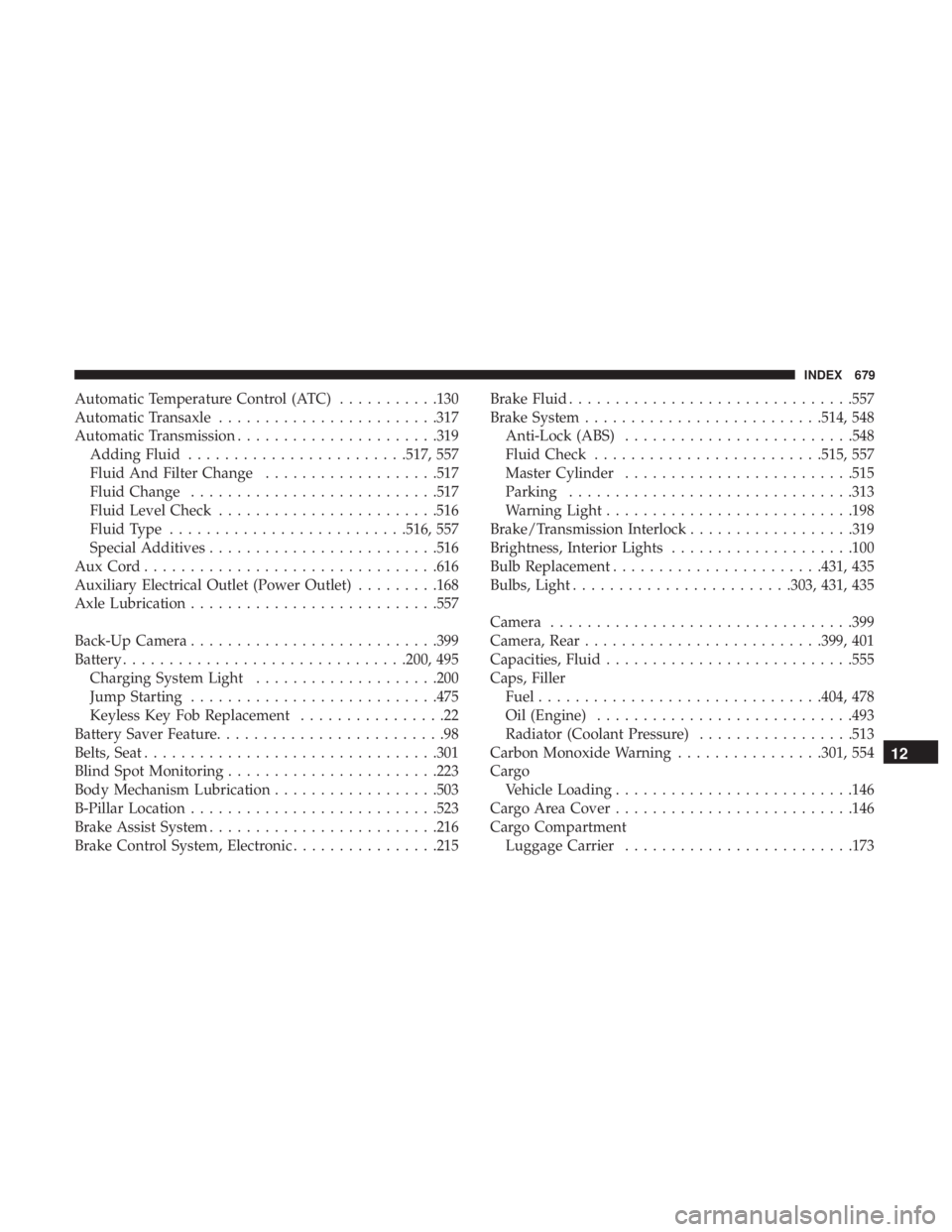
Automatic Temperature Control (ATC)...........130
Automatic Transaxle ........................317
Automatic Transmission ..................... .319
Adding Fluid ........................517, 557
Fluid And Filter Change ...................517
Fluid Change .......................... .517
Fluid Level Check ........................516
Fluid Type ..........................516, 557
Special Additives ........................ .516
AuxCord............................... .616
Auxiliary Electrical Outlet (Power Outlet) .........168
Axle Lubrication .......................... .557
Back-Up Camera .......................... .399
Battery ...............................200, 495
Charging System Light ....................200
Jump Starting .......................... .475
Keyless Key Fob Replacement ................22
Battery Saver Feature .........................98
Belts, Seat ............................... .301
Blind Spot Monitoring .......................223
Body Mechanism Lubrication ..................503
B-Pillar Location .......................... .523
Brake Assist System ........................ .216
Brake Control System, Electronic ................215Brake Fluid
...............................557
Brake System ..........................514, 548
Anti-Lock (ABS) ........................ .548
Fluid Check ........................ .515, 557
Master Cylinder ........................ .515
Parking ...............................313
Warning Light .......................... .198
Brake/Transmission Interlock ..................319
Brightness, Interior Lights ....................100
Bulb Replacement .......................431, 435
Bulbs, Light ....................... .303, 431, 435
Camera .................................399
Camera, Rear..........................399,
401
Capacities, Fluid .......................... .555
Caps, Filler Fuel ...............................404, 478
Oil (Engine) ............................493
Radiator (Coolant Pressure) .................513
Carbon Monoxide Warning ................301, 554
Cargo Vehicle Loading ..........................146
Cargo Area Cover ..........................146
Cargo Compartment Luggage Carrier ........................ .173
12
INDEX 679
Page 686 of 696

Ignition..................................26
Switch .................................26
Inside Rearview Mirror ....................89, 425
Instrument Cluster ..........................183
Descriptions ............................207
Display ...............................185
Menu Items ............................189
Instrument Panel Lens Cleaning ................545
Interior And Instrument Lights ..................98
Interior Appearance Care .....................544
Interior Lights ..............................98
Intermittent Wipers (Delay Wipers) ..............102
Introduction ................................4
Inverter Power ............................... .171
Jack Location ............................ .446
Jack Operation ........................ .446, 517
Jump Starting ............................ .475
KeyFob..................................18 Arm The System ..........................33
Disarm The Alarm ........................34
Programming Additional Key Fobs ..........24, 32
Key Fob Battery Service (Remote Keyless Entry) .....22Key Fob Programming (Remote Keyless Entry)
......24
Keys ....................................18
Replacement .............................32
Lane Change And Turn Signals .................94
Lane Change Assist .......................94, 98
LaneSense ............................... .394
Lap/Shoulder Belts ........................ .242
Latches ................................. .304
Hood .................................139
Lead Free Gasoline ........................ .550
Leaks, Fluid ............................. .304
Life Of Tires ............................. .531
Liftgate ................................. .141
Power ............................... .142
Light Bulbs .......................... .303, 435
Lighter Cigar ................................ .172
Lights .................................. .303
A i
rBag .........................198, 257, 301
Battery Saver ............................98
Brake Assist Warning ..................... .220
Brake Warning ..........................198
Bulb Replacement .....................431, 435
Center Mounted Stop ..................... .437
684 INDEX
Page 695 of 696

VEHICLES SOLD IN CANADA
With respect to any Vehicles Sold in Canada, the name
FCA US LLC shall be deemed to be deleted and the name
FCA Canada Inc. used in substitution therefore.
DRIVING AND ALCOHOL
Drunken driving is one of the most frequent causes of
accidents.
Your driving ability can be seriously impaired with blood
alcohol levels far below the legal minimum. If you are
drinking, don’t drive. Ride with a designated non-
drinking driver, call a cab, a friend, or use public trans-
portation.
WARNING!
Driving after drinking can lead to an accident.
Your perceptions are less sharp, your reflexes are
slower, and your judgment is impaired when you
have been drinking. Never drink and then drive.
This manual illustrates and describes the operation of
features and equipment that are either standard or op-
tional on this vehicle. This manual may also include a
description of features and equipment that are no longer
available or were not ordered on this vehicle. Please
disregard any features and equipment described in this
manual that are not on this vehicle.
FCA US LLC reserves the right to make changes in design
and specifications, and/or make additions to or improve-
ments to its products without imposing any obligation
upon itself to install them on products previously manu-
factured.
Copyright © 2018 FCA US LLC
INSTALLATION OF RADIO TRANSMITTING
EQUIPMENT
Special design considerations are incorporated into this
vehicle’s electronic system to provide immunity to radio
frequency signals. Mobile two-way radios and telephone
equipment must be installed properly by trained person-
nel. The following must be observed during installation.
The positive power connection should be made directly
to the battery and fused as close to the battery as possible.
The negative power connection should be made to body
sheet metal adjacent to the negative battery connection.
This connection should not be fused.
Antennas for two-way radios should be mounted on the
roof or the rear area of the vehicle. Care should be used
in mounting antennas with magnet bases. Magnets may
affect the accuracy or operation of the compass on
vehicles so equipped.
The antenna cable should be as short as practical and
routed away from the vehicle wiring when possible. Use
only fully shielded coaxial cable.
Carefully match the antenna and cable to the radio to
ensure a low Standing Wave Ratio (SWR).Mobile radio equipment with output power greater than
normal may require special precautions.
All installations should be checked for possible interfer-
ence between the communications equipment and the
vehicle’s electronic systems.
WARNING:
Operating, servicing and maintaining a
passenger vehicle or off-road highway
motor vehicle can expose you to chemicals
including engine exhaust, carbon monoxide,
phthalates, and lead, which are known to
the State of California to cause cancer and
birth defects or other reproductive harm.
To minimize exposure, avoid breathing
exhaust, do not idle the engine except as
necessary, service your vehicle in a
well-ventilated area and wear gloves or
wash your hands frequently when servicing
your vehicle. For more information go to
www.P65Warnings.ca.gov/passenger-vehicle.