2018 AUDI A5 COUPE warning
[x] Cancel search: warningPage 379 of 409

Fuses a nd bul bs
Fuse panel @ (brown) Fuse panel© (blac k)
No. Equip ment No. Equipm ent
2
Mass airflow sensor, camshaft adjust-
ment, charge air cooler pump 1 F ront seat heating
2 Windshield wipers
3 Exhaust doors, fuel injectors, radiator inlet 3 Left head light electronics
4 Vacuum pump , hot water pump, particu-
late sensor, biodiesel sensor 4 Panorama glass roof
s Left front door contro l module
5 Brake light sensor 6 Sockets
6 Engine valves, camshaft adjustment 7 Right rear door control mod ule
7
Heated oxygen sensor, mass airflow sen-8 All wheel drive
sor
8
Water pump, high pressure pump, high
pressure regulator valve
9 Hot water pump
9 Right headlight electronics
10
Windshield washer system/headlight
washer system
11 L eft rear door control module
10
Oil pressure sensor, oil temperature sen-
sor
Fu se panel @ (blac k)
11 Clutch pedal position sensor No. Equipmen t
12 Engine valves
Seat ventilation, rearv iew mirror, climate
13 Rad iator fan control system, rear climate control sys-
14 Fuel injectors
15 Ignition
coils
16 Fuel pump
1 tern controls , windsh ie ld heat ing , neck
heating, front passenger 's airbag warning
light
2 Gateway, climate control system
Fuse panel@ (red ) 3 Sound actuator/exhaust sound tuning
No. Equ ip me nt 4 Clutch pedal posit ion sensor
1 Anti-theft alarm system 5 Engine start
2 Engine control module 7 Rear USB charg ing port
3 Lumbar support 8 Homelink
4 Automatic transmission selector mecha-
nism 9 Adaptive cruise contro l
11 Video camera
5 Horn 12 Matrix LED headlight/right L ED headlight
6 Electromechan ica l park ing brake 13 Matrix LED headlight/left LED headlight
7 Gateway control module
8 Interior headl iner lights
10 Airbag control module
11 Electronic Stabilization Control (ESC)
Fuse panel © (red )
N o. Equ ipmen t
1 Ign ition co ils
12 Diagnostic connector, light/rain sensor
13 Climate control system
14 Right front door control module
lS A/C compressor
5 Engine mount
6 Automatic transmission
7 Instrument panel
8 Climate control system (blower)
10 Dynamic steering
11 Engine start
378
Page 381 of 409

Fuses a nd bul bs
Fuse panel © (brown)
3 Lumbar support
4 Audi side assist 6 Ultrasonic sensors
8 Smart module (tank)
9 Power top control modu
le
11 12 Volt battery
12 Homelink
13 Rea rview camera, per ipheral cameras
14 Right tail lights
16 Right safety belt tensioner
Fu se panel © (red )
N o. Equipm ent
1 Right neck heating
2 Sound-amplifier
3 AdBlue heating
4 Power top control modu
le
5 Trailer h itch (right light)
7 Trailer hitch
8 Trailer h itch (left light)
9 Trailer hitch (socket)
10 Sport differential
11 AdBlue heating
Bulbs
Replacing light bulbs
For your safety, we recommend that you have
your authorized Audi dealer replace any bulbs for
you.
It is becoming increasing ly more and more diff i
cult to replace vehicle light bulbs s ince in many
cases, othe r parts of the car must fi rst be re
moved before you are able to get to the bu lb .
This applies especially to the light bulbs in the
front of your car which you can only reach
through the engine compartment.
Sheet metal and bulb ho lders can have sharp
edges that can cause serious cuts, parts must be
correct ly taken apart and then properly put back
together to he lp prevent breakage of parts and
380
long term damage from water that can enter
housings that have not been properly resealed.
Fo r you r safety, we recommend that you have
you r autho rized Audi dea ler replace any bulbs for
you, since your dealer has the proper tools, the
correct bu lbs and the expertise.
Ga s di sc harg e la mp s (Xe non ligh ts):
Due to the h igh electr ical voltage, have the bulbs
rep laced by a qualified technician . Headlights
with Xenon light a re identified by the high volt
age sticker.
L ED headlight s*
LED headlights require no maintenance. Please
contact your authorized Audi dealer if a bulb
needs to be replaced.
A WARNING
Changing Xenon lamps without the necessary
equipment can cause serious personal injury.
-Bulbs are pressurized and can explode when
be ing changed. Potent ial r isk of injury!
- On veh icles equipped with gas discharge
bulbs (Xenon light) life-threatening injuries
can result from improper handling of the
high-vo ltage portions of such lamps!
-Only your authorized Audi dealer or quali
fied workshop shou ld change the bulbs in
gas discharge lamps . There are parts with
sharp edges on the openings and on the bulb holders that can cause serious cuts. If
you are uncerta in about what to do, have
the work performed by an authorized Audi
dea ler or qualified workshop. Serious per
sonal injury may result from improperly per
formed work.
(D Tips
-If you still prefer to replace the light bulbs
yourself, be aware that the engine compart
ment is a hazardous area to work
i n c:> & in
Working in the engine compartment on
page 330 .
-It is best to ask your authorized Audi dealer
whenever you want to change a bulb .
Page 382 of 409

<( a, .... N ,....
N .... 0 \0
3 a,
Emergency situations
General
This chapter is intended for trained emergency
crews and working personnel who have the nec
essary tools and equipment to perform these
operations.
Starting by pushing or
towing
CD Note
Vehicles with an automatic transmission
cannot be started by pushing or towing.
Starting with jumper
cables
If necessary, the engine can be started by con
necting it to the battery of another vehicle.
If the engine should fail to start because of a dis
charged or weak battery, the battery can be con
nected to the battery of
another vehicle, using a
pair of jumper cables to start the engine.
Jumper cables
Use only jumper cables of sufficiently large cross
section
to carry the starter current safely. Refer
to the manufacturer's specifications.
Use only jumper cables with
insulated terminal
clamps which are distinctly marked:
plus(+) cable in most cases colored red
minus(·) cable
in most cases colored black.
A WARNING
Batteries contain electricity, acid, and gas.
Any of these can cause very serious or fatal in
jury. Follow the instructions below for safe
handling of your vehicle's battery.
-Always shield your eyes and avoid leaning
over the battery whenever possible.
-A dead battery can freeze at temperatures
around 32 °F (0 °C). If the vehicle battery is
frozen, you must thaw it before connecting
the jump start cables. If you do not, this in-
Emergency situations
creases the risk of an explosion and chemi
cal burns. After jump starting the vehicle,
drive to an authorized Audi dealer or author ized Audi Service Facility immediately to
have the vehicle battery checked.
- Do not allow battery acid to contact eyes or
skin . Flush any contacted area with water
immediately.
- Improper use of a booster battery to start a
vehicle may cause an explosion .
- Vehicle batteries generate explosive gases.
Keep sparks, flame and lighted cigarettes
away from batteries.
- Do not try to jump start any vehicle with a
low acid level in the battery .
- The voltage of the booster battery must also
have a 12-Volt rating. The capacity (Ah) of
the booster battery should not be lower
than that of the discharged battery. Use of
batteries of different voltage or substantial
ly different
"A h" rating may cause an explo
sion and personal injury.
- Never charge a frozen battery. Gas trapped
in the ice may cause an explosion.
- Never charge or use a battery that has been
frozen . The battery case may have be weak
ened.
- Use of batteries of different voltage or sub
stantially different capacity (Ah) rating may
cause an explosion and injury. The capacity (Ah) of the booster battery should not be
lower than that of the discharged battery.
- Before you check anything in the engine
compartment, always read and heed all
WARNINGS
qpage 330.
CD Note
- Applying a higher voltage booster battery
will cause expensive damage to sensitive electronic components, such as control
units, relays, radio, etc.
- There must be no electrical contact between
the vehicles as otherwise current could al
ready start to flow as soon as the positive
(+) terminals are connected.
381
Page 383 of 409

Emergency situations
@ Tips
The discharged battery must be properly con
nected to the vehicle's electrical system .
When jump starting or charging the battery,
never connect the negative ground cable to
the battery negative post because the battery
manager system must be able to detect the
battery's state of charge. Always connect the
negat ive ground cable to the negative ground
pos t of the battery manager control unit.
Using the jump start
cable
Both jump start cables must be connected in the
correct order!
Fig. 302 Engin e compartme nt: co nn ectors for jump start
cables and a charger
Fig. 303 Jump starting using a battery in anot her vehicle:
@-pro vidi ng current, @-drained
The procedure desc ribed be low for connecting
jumper cables is intended to provide a jump start
for your vehicle.
Vehicle with discharged battery
... Turn off lights and accessories, move the auto
matic transmission* selector lever to N (Neu
tral) or P (Park), and set the park ing brake.
382
Connecting the positive cable (red) to the
positive terminal
... Open the red cover on the positive terminal
¢fig. 302.
1. Secure one end of the positive cable (red) to
t he jump start
pin¢ fig. 303 CD (pin under
the red cover = "pos itive") on the vehicle that
needs to be started @.
2. Secure the other end of the positive cable
(red) to the positive terminal @on the bat
tery provid ing the cur rent @.
Connecting the negative cable (black) to the
negative terminal
3. Secure one end of the negative cable (black)
to the negative terminal @ on the battery
that is providing the current @.
4. Secure the other end of the negative cable
(black) to the jump start
pin @ (hex head pin
= "negative") on the vehicle that needs to be
started @.
Starting the engine
... Start the eng ine on the vehicle providing the
jump start @and let it run at idle .
... Now start the engine on the vehicle with the
drained battery @.
... If the engine does not start, stop the starting
procedure after 10 seconds and then repeat it
after approximately 30 seconds .
... Remove the cables when the engi nes are run
ning. Remove them in reverse order from the
way they were installed.
" Close the red cover on the positive terminal.
The battery is vented to the outside to prevent
gases from enter ing the vehicle interior. Make
sure that the jumper clamps are well connected
with their
metal parts in full contact with the
battery terminals .
A WARNING
To avoid serious personal injury and damage
to the vehicle, heed all warnings and instruc
tions of the jumper cable manufacturer. If in
doubt, call for road service .
- Jumper cables must be long enough so that
the vehicles do not touch.
"'
Page 384 of 409

-When connecting jumper cables, make sure
that they cannot get caught in any moving
parts in the engine compartment.
- Do not bend over the batteries
-danger of
chem ical burns!
- The battery cell locking screws must be
tightened securely.
- Before you check anything in the engine
compartment, always read and heed all
WARNINGS
c!.> page 330.
(D Note
Improper hook-up of jumper cables can ruin
the generator.
- Always connect POSITIVE(+) to POSITIVE
( + ), and NEGATIVE(-) to NEGATIVE(-)
ground post of the battery manager contro l
unit.
- Check that all screw p lugs on the battery
cells are screwed in firmly. If not, tighten
plugs prior to connecting clamp on negative
battery terminal.
- Please note that the procedure for connect
i ng a jumper cable as described above ap
plies specifically to the case of your vehicle
being jump started. When you are giv ing a
jump start to another vehicle, do
not con
nect the negative (-) cab le to the negative
(-) terminal on the discharged battery @
c!.> fig. 303. Instead, securely connect the
negative (-) cable to either a solid me tal
component that is firm ly bolted to the en
gine block or to the engine bloc k itself. If
the battery that is be ing charged does not
vent to the outs ide, escaping battery gas
could ignite and explode!
Towing with a tow truck
General hints
Your Audi requires special handling for towing .
The following information is to be used by com
mercial tow truck operators who know how to op
erate their equipment safely.
-Never tow your Audi, towing will cause dam
age to the engine and transmission .
Emergency situations
-Never wrap the safety chains or winch cables
around the brake lines .
- To prevent unnecessar y damage, your Audi
must be transported with a flat bed truck.
- To load the vehicle on to the flat bed , use the
towing loop found in the vehicle tools and at
tach to the front or rear anchorage
¢ page 383 and ¢ page 384 .
A WARNING
--
A vehicle being towed is not safe for passen
gers. Never allow anyone to ride in a vehicle
being towed, for any reason.
Front towing loop
Only install the front towing loop when it is
needed.
Fig . 304 Front bumper : in sta lling the towing loop
The threaded opening for the towing loop is lo
cated on the right side of the front bumper.
.. Remove the towing loop from the vehicle too l
kit
¢ page 368 .
.. Press the cap inward with brief, forceful pres
sure
c!.>fig. 304 . The cap will loosen from the
bumper .
.. Insert the towing loop a ll the way into the
threaded opening and tighten it with a wheel
wrench.
.. After using, place the towing loop back in the
veh icle tool kit.
A WARNING
'"' -
If the towing loop is not tightened until it
stops when installing, the threads may be
pulled out when towing the vehicle and that
could cause an accident.
383
Page 385 of 409
Emergency situations
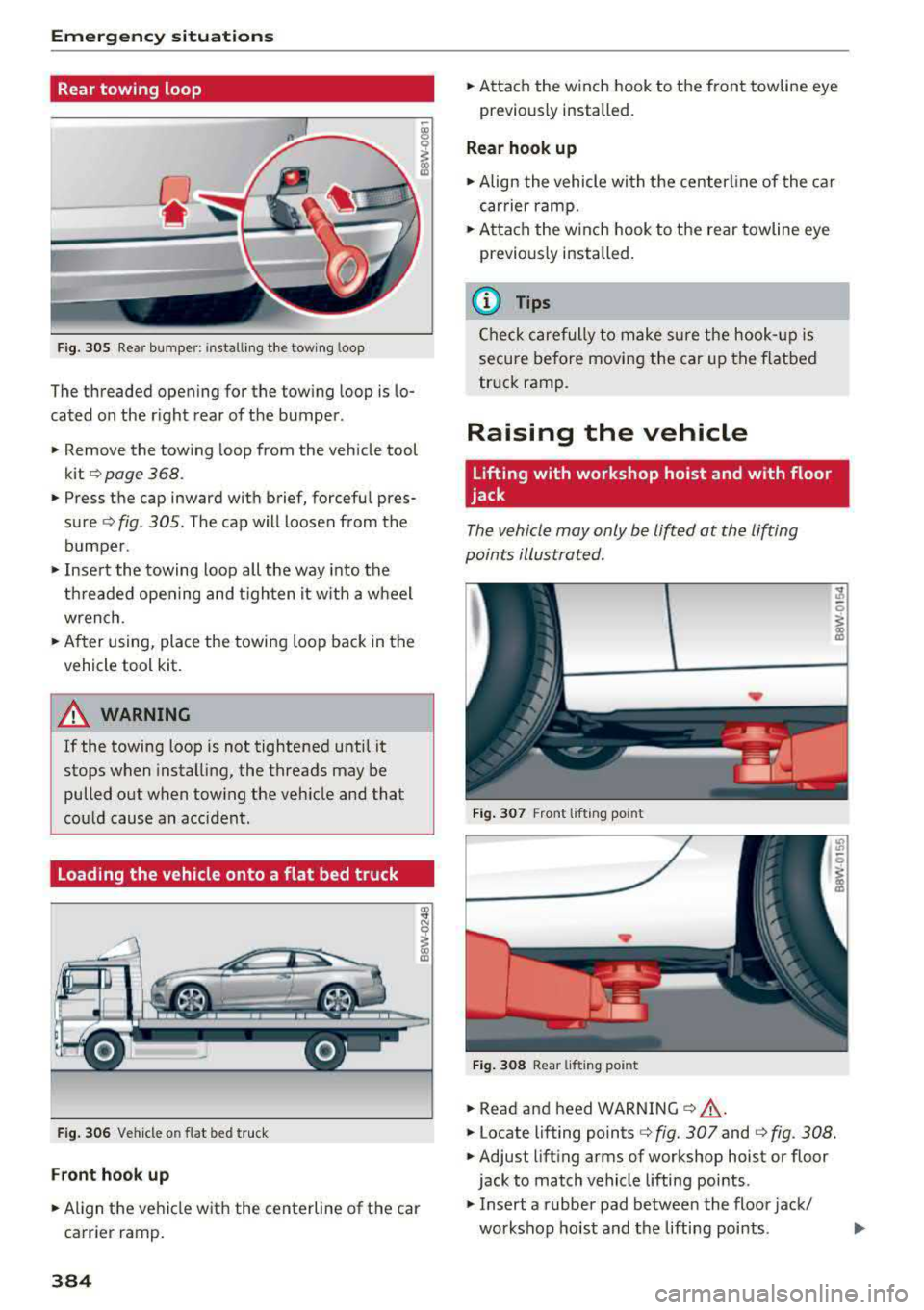
Rear towing loop
Fig. 305 Rear bumper: i nstalling the towing loop
The threaded opening for the towing loop is lo
cated on the r ight rear of the bumper.
• Remove the towing loop from the vehicle tool
kit
q page 368.
• Press the cap inward with brief, forceful pres
sure
q fig . 305. The cap will loosen from the
bumper .
• Insert the towing loop all the way into the
threaded opening and t ighten it w ith a wheel
wrench.
• After using, place the towing loop back in the
vehicle tool k it.
,& WARNING
If the towing loop is not tightened until it
stops when installing, the threads may be
pulled out when towing the veh icle and that
cou ld cause an accident.
Loading the vehicle onto a flat bed truck
F ig . 306 Vehicle o n flat bed truck
Front hook up
• Align the vehicle with the centerline of the car
carrier ramp .
384
• Attach the winch hook to the front towline eye
previously installed.
Rear hook up
• Align the vehicle with the center line of the car
carrier ramp.
• Attach the w inch hook to the rear towline eye
previously installed .
(D Tips
Check carefully to make sure the hook- up is
secure before moving the car up the flatbed
truck ramp.
Raising the vehicle
Lifting with workshop hoist and with floor
jack
The vehicle may only be lifted at the lifting
points illustrated .
Fig. 307 Front lifting point
Fig. 308 Rear lifting po int
.. Read and heed WARNING ¢ A.
• Locate lifting points q fig. 307 and q fig . 308.
• Adjust lifting arms of workshop hoist or floor
jack to match vehicle lifting poi nts .
• Insert a rubber pad between the floor jack/
workshop hoist and the lifting points .
..,.
Page 386 of 409

<( a, .... N ,....
N .... 0 \0
3 a,
If you must lift your vehicle with a floor jack to
work underneath , be sure the vehicle is safely
supported on stands intended for this purpose .
Front lifting point
The lifting p oint is loc ated on the floo r pan rein
fo rcement abou t at the same leve l as t he ja ck
mo unt ing poin t ¢
fig . 307. Do not lift the vehi
cle at the vertical sill reinforcement.
Rear lifting point
The lift ing po int is located on the ve rt ical rein
for ceme nt o f the lower s ill fo r th e on bo ar d jac k
¢fig . 30 8.
Lifting with vehicle jack
Refer to ¢ page 372 .
A WARNING
- To reduce the risk of serio us inju ry and vehi
cl e d am age.
- Always lift t he ve hicl e only at the s pecial
wo rkshop ho ist and floo r jack lift po ints il
lustrated¢
fig. 3 0 7 and ¢ fig. 308.
-Fa ilur e to li ft the vehicle at these poin ts
could cause the vehicle to ti lt or fall from
a lift if there is a chang e in vehicle weight
d istr ibut ion a nd balance. This might hap
pen, for exa mp le, when heavy co mpo
n e nts su ch as th e e ngi ne block or tra ns
m is sion are rem ove d.
- W hen removing he avy compon ents like
th ese, an chor vehicle to ho is t or add co rre
s po nding we igh ts to ma inta in t he cente r of
g ra vity. Otherwise, the vehi cle mi ght t ilt or
s lip off the hoi st, causing ser ious persona l
injury .
{U) Note
- Be aware o f the follo wing po ints b efore lift
i n g t he ve hicle:
-The vehicle should never be lifted or
jacked up from underneath the engine oil
pan, the transmission housing, the front
or rear axle or the body side members .
This could lead to serious damage.
- To avoid damage to the underbody or
chassis frame, a rubber pad must be in-
Emergency situations
serted between the floor jack and the lift
points .
- Before driving over a workshop hoist ,
check that the vehicle weight does not
exceed the permissible lifting capacity of
the hoist.
- Before driving over a workshop hoist , en
sure that there is sufficient clearance be
tween the hoist and low parts of the ve
hicle.
385
Page 387 of 409
Technical data
Technical data
Vehicle specifications
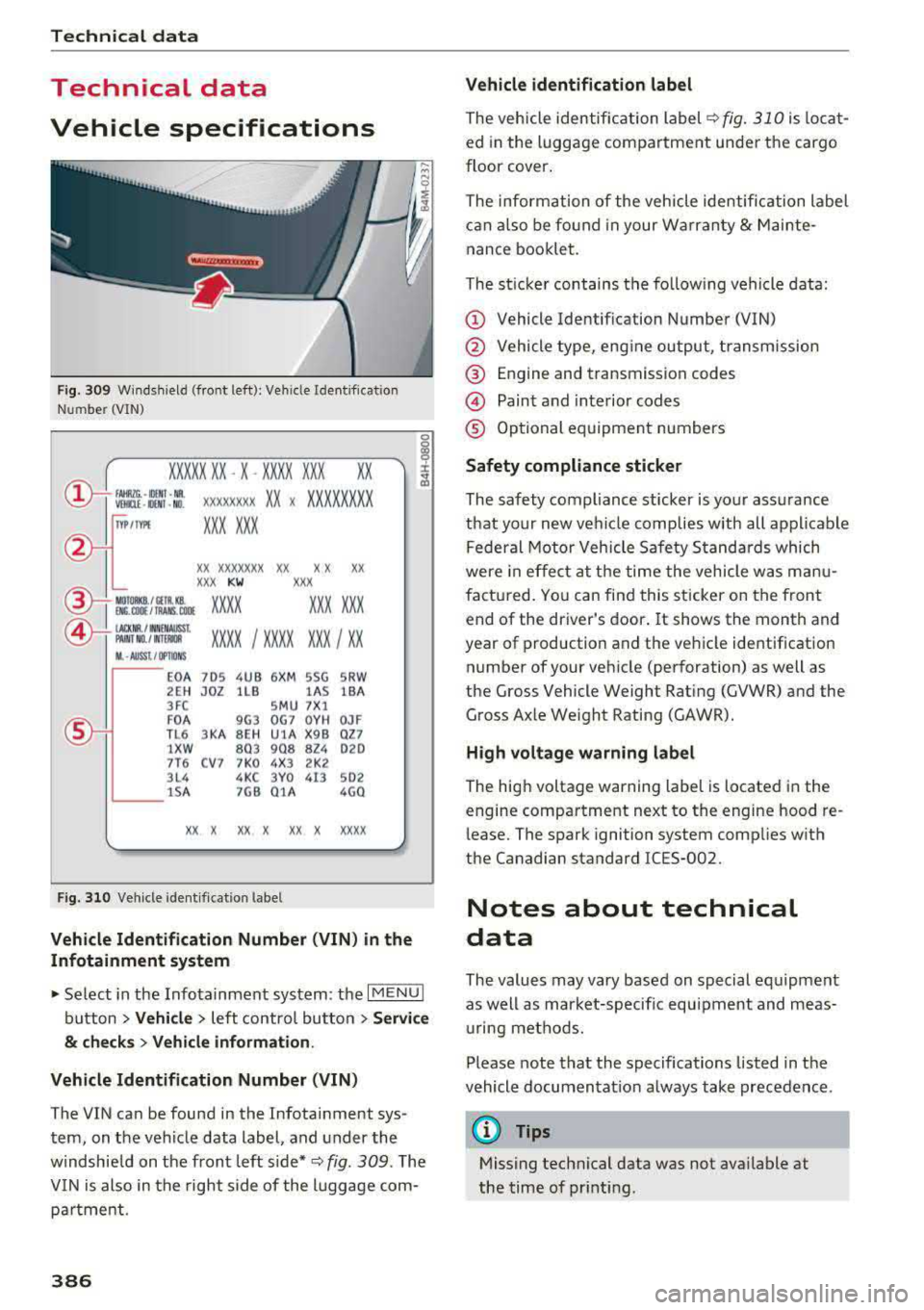
Fig. 309 Windshiel d (fro nt left) : Ve hicl e Iden tific ation
N um ber ( VIN )
XXXXX XX -X -XXXX XXX XX
@-+ ~J:~t::1 ::: xxxxxxxx xx x xxxxxxxx
I YP lf'VPE XXX XXX
XX XXXXXXX XX X X XX
XXX
KW XXX
15\_L I MOIOlll
@-+ ~~
1
:tr:~i XXXX I XXXX XXX I XX
II. -AUSST . / OPTIONS
.__ __
E0A 7D5 4UB
2EH JOZ lLB
3FC
F0 A 9G3
TL6 3 KA 8EH
lXW 803
7T6 CV7 7KO
3L4 4KC
lS A 7GB
6XM SSG
lAS
SMU 7Xl
0G7 0YH
UlA X9B
908 8Z4
4X3 2K2
3Y0 413
01A
SRW
1BA
OJF
027
020
502
4G0
XX X XX X XX X XXXX
Fig. 310 Vehi cle identification label
Vehicle Identification Number (VIN) in the
Infotainment system
~ Select in the Infotainment system: the I MENU I
button > Vehicle > left contro l button > Service
& checks> Vehicle information.
Vehicle Identification Number (VIN)
The VIN can be found in the Infotainment sys
tem, on the vehicle data label, and under the
windshield on the front left side* <=:>
fig. 309. The
VIN is also in the right side of the luggage com
partme nt.
386
Vehicle identification label
The vehicle identification label <=:> fig. 310 is locat
ed in the luggage compartment under the cargo
floor cover.
The information of the vehicle identification label
can also be found in your Warranty
& Mainte
nance booklet.
The st icker contains the follow ing vehicle data:
(D Vehicle Iden tifica tion Number (VIN)
@ Vehicle type, eng ine output, transmission
® Engine and transmission cod es
@ Paint and interior codes
® Optional equipment numbers
Safety compliance sticker
The safety compliance sticker is your assurance
that your new veh icle complies with all applicable
Federal Motor Vehicle Safety Standards which
were in effect at the time the vehicle was manu
factured. You can find this sticker on the front
e nd of the dr iver's door. It shows the month and
y ear of production and the vehicle identification
number of you r vehicle (perforation) as well as
the G ros s Vehicle Weight R ating (GVWR) and the
Gro ss Axle We ight Rating (GAWR).
H igh voltage warning label
The high voltage warn ing label is located in the
e ngine compartment next to the engine hood re
lease. The spark ignit ion system complies w ith
the Canadian s tand ard IC ES-002.
Notes about technical
data
The values may vary based on special equipment
as well as market-specific equipment and meas u ring methods.
Please note that the specifications listed in the
vehicle documentation a lways take precedence .
(D Tips
Missing technical data was not available at
the time of printing .