2018 AUDI A3 SEDAN lock
[x] Cancel search: lockPage 245 of 404

u. 00 .-< N l' N .-< 0 N > 00
System settings
Setting the date and
time
You can set the clock time manually or using the
CPS* .
.. Select : IMENUI button> Settings> left control
button >
MMI settings > Date & time.
.. Or : select : IMENUI button> Vehicle> left con-
trol button >
Vehicle settings > Date & time .
Automatic setting
When this function is switched on g, the time
and date are automatically set.
Time
Requirement: the Automatic setting must be
switched
off .
Press the control knob. You can set the Time
manually by turning and pressing the control
knob.
Date
Requirement: the Automatic setting must be
switched
off.
Press the control knob . You can set the Date
manually by turning and press ing the control
knob.
Time zone
When selecting the appropriate time zone, a
sampling of countries in this zone will be listed .
Automatic time zone*
When this function is switched on g, the time
will automatically adjust to the corresponding
time zone.
Automatic daylight saving time*
When this function is switched on g, the time
will automatically switch to daylight saving time .
Time format
If you select 24h, the clock will display, for ex
ample,
13:00 . If you select AM/PM , the clock
will disp lay, for examp le,
1:00 PM .
System settings
Date format
If you select DD.MM.YYYY , the date display will
show, for example ,
31.08.2017. If you select
MM/DD/YYYY , the date display will show, for ex
amp le,
08/31/2017. If you select YYYY-MM
DD ,
the date display will show, for example,
2017-08-31 .
MMI settings
.. Select: !MENU I button> Settings> left control
button >
MMI settings .
Language
You can change the display language as well as
the language for the voice guidance* and voice
recognition system*.
T he number of languages available depends on
the market.
Measurement units
The following measurement units can be set de
pend ing on availability:
Speed , Distance , Tem
perature , Fuel consumption , Volume , Pressure.
Tool tips
When this funct ion is switched on g, your MMI
shows you tips for input . The frequency of how
often it displays decreases with time.
Speech dialog system
Applies to : vehicles wit h voice recog nitio n system
Depend ing on veh icle equipment, the following
funct ions may be ava ilable:
Command display : when this function is switch
ed on
g, the MMI will show you the possible
commands for voice input in the respective
menu.
Short dialog : when this function is switched on
g, a shorter form of the prompts is used .
Command during voice output*: thi s function is
switched on at the factory . W hen this function is
switched on
g, you can say new commands dur-
ing announcements. You do not need to wait for
the signal tone (beep) dur ing an announcement.
When the funct ion is swi tched off
0, you need to Iii>
243
Page 252 of 404

Driving sa fety
,.. ALWAYS adjust your speed to road, traffic and
weather conditions.
,.. Take frequent breaks on long trips. Do not drive
for more than two hours at a stretch.
,.. Do NOT drive when you are tired, under pres
sure or whe n you are stressed .
A WARNING
Impaired driv ing safety inc reases the risk of
ser ious persona l inju ry and death whenever a
vehicle is being used.
Correct passenger
seating positions
Proper seating position for the driver
The proper driver sea ting po sition is impor tan t
for safe, relaxed driving .
Fig. 217 Correc t seat ing posit ion
F or your own safety and to reduce the risk of in
jury in the event of an accident, we recommend
that you adjust the driver 's seat to the following
position :
,.. Adjust the dr iver's seat so tha t you can easily
push the pedals all the way to the floor whi le
keeping your knee(s) s light ly
bent ¢ ,A.
,.. Adjust the angle of the seatback so that it is in
an upright position so that your back comes in
full contact with it when you drive.
,.. Adjust the steering wheel so that there is a dis
tance of at least 10 inches (25 cm ) between the
stee ring wheel and your breast bone
<=;> fig . 217 .
If not possib le, see you r autho rized Aud i dea l
ersh ip about adaptive equipment .
250
,.. Adjust the steering wheel so that the steering
wh eel and airbag cover points at your chest and
not at your face.
,.. Grasp the top of the steering wheel with your
elbow(s) slightly bent.
,.. F or ad justab le head rest raints: Adjust the head
restraint so t he upper edge is as even as possi
ble with the top of your head . If that is not pos
sible, t ry to adjust the head restraint so tha t it
is a s close to this pos it ion as poss ible . M ove the
he ad restraint so tha t it is as close to the back
o f the head as possible.
,.. Fasten and wear safety belts correctly
q page264 .
,.. Always keep both feet in the footwell so that
you are in contro l of the veh icle at all times .
Fo r detail ed information on how to adjust the
dr iver's seat,
see ¢ page 59.
A WARNING
Drivers who are unbelted , out of position or
too close to the airbag can be seriously in-
jured by an airbag as it unfo lds . To help re-
duce the risk of serio us pe rsonal i njury:
-Always adjust the driver's seat and the steer ing whee l so that there are at least
10 inches (25 cm) between you r breastbone
and the steering wheel.
- Always ad just the driver's seat and the
steer ing whee l so that the re are at least
4 inch es (10 cm) between the knees a nd the
lower part of the ins trumen t panel.
-Always hold t he s teering wheel on the out
side of t he steering wheel r im with yo ur
hands at the 9 o'clock and 3 o'clock posi
tions to help reduce the risk of personal in
jury if the dr iver 's airbag inflates.
-Never hold the stee ring wheel at the
12 o'clock position or with you r hands at
other positions inside the steer ing whee l
rim o r on the steering wheel hub. Holding
the steering wheel the wrong way can cause
serious injuries to the hands, arms and head
-
if the driver's airbag inflates . .,_
Page 257 of 404
LL co .... N
" N .... 0 N > co
Storing cargo correctly
Loading the luggage compartment
All luggage and other objects must be properly
stowed and secured in the luggage compart
ment.
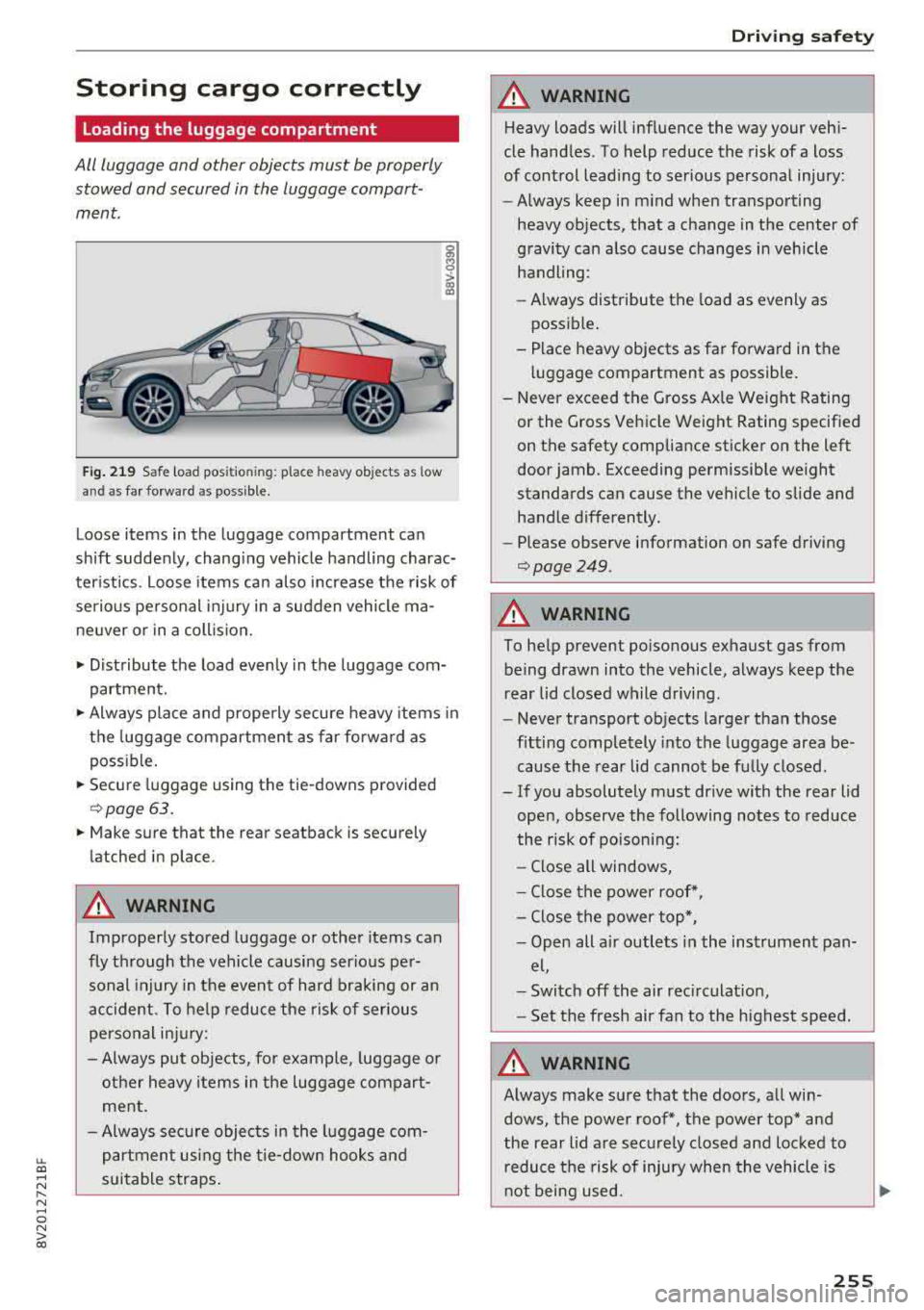
Fig . 219 Safe load pos itio ning : place heavy objects as low
an d as far forward as poss ible.
g M 0
> a, a,
Loose items in the luggage compartment can
shift suddenly, chang ing vehicle handling charac
ter istics . Loose items can also increase the risk of
serio us personal inj ury in a sudden vehicle ma
ne uver or in a coll ision.
• Distribute the load evenly in the luggage com
partment.
• Always place and properly secure heavy items in
the luggage compartment as far forward as
poss ible.
• Secure luggage using the tie-downs provided
¢ page 63.
• Make sure that the rear seatback is securely
latched in place .
A WARNING
Improperly stored luggage or other items can
fly through the vehicle causing serio us per
sonal injury in the event of hard braking or an
accident . To help reduce the risk of serious
personal injury:
- Always put objects, fo r example, luggage o r
other heavy items in the luggage compart ment.
- Always sec ure objects in the luggage com
partment using the tie-down hooks and
s u itable straps .
Driving safety
A WARNING
Heavy loads will influence the way your vehi
cle handles. To help reduce the risk of a loss
of control lead ing to serious personal injury:
- Always keep in m ind when transport ing
heavy objects, that a change in the center of
gravity can a lso cause changes in vehicle
handling :
- Always distribute the load as evenly as
possible .
- Place heavy objects as far forward in the luggage compartment as possible.
- Never exceed the Gross Ax le Weight Rating
or the G ross Vehicle Weight Rating specified
on the safety compliance sticker on the left
door jamb. Exceeding permissible we ight
standards can cause the vehicle to slide and handle differently.
- Please observe information on safe driving
¢page 249 .
A WARNING
-
To help prevent poisonous exhaust gas from
being drawn into the vehicle, always keep the
rear lid closed while driving.
- Never transport objects larger than those
fitting completely into the luggage area be
cause the rear lid cannot be fu lly closed.
- If you absolutely must dr ive with the rear lid
open, observe the following notes to reduce
the risk of poisoning:
- Close all windows,
- Close the power roof*,
- Close the power top*,
- Open alt a ir outlets i n the instrument pan-
el,
- Switch off the air rec irculat ion ,
- Set the fresh air fan to the highest speed.
A WARNING
--
Always make sure that the doors , all win
dows, the power roof*, the power top* and
the rear lid are securely closed and locked to
r educe the risk of injury when the vehicle is
n ot being used.
255
Page 258 of 404

Drivin g saf ety
- After closing the rear lid, a lways make sure
that it is properly closed and locked.
- Never leave yo ur vehicle unattended espe
c ia lly w ith the rear lid left open. A ch ild
could crawl into the ve hicle through the lug
gage compartment and close the rear lid be
coming trapped and unable to get out . Be
ing t rapped in a veh icle can lead to se rious
persona l injury.
- Never let children play in or around the veh i
cle .
- Never let passengers ride in the luggage
compartment. Ve hicle occupants m ust al
ways be prope rly rest ra ined in one of the ve
hicle's seating posi tions.
(D Tips
- A ir c irculat io n helps to reduce window fog
g ing . Stale air escapes to the outside
th rough vents i n the t rim panel. Be s ure to
k eep these slots free and open.
- The t ire pressu re must correspond to the
l oad. The tire p ressure is shown on the tire
p ressure labe l. Th e tire pressu re labe l is lo
ca ted on t he driver 's s ide B-p illar. The tir e
p ressure labe l lists the recommended cold
tire inflation pressures for the vehicle at its max imum capacity weig ht and the t ires t hat
were on your vehicle at the t ime it was man
ufactured. For recommended tire pressures
for normal load cond itions, please see chap
ter
¢ page 341.
Tie-downs
The luggage compartment is equipped with four
tie -downs to secure luggage and other items .
Use the tie-downs to secure your cargo proper ly
¢ page 255, Loading the luggage compartment.
In a col lision, the laws of p hysics mean that even
sma ller items that are loose in the vehicle will
become heavy missiles that can cause ser ious in
jury. Items in t he ve hicle possess energy which
vary with vehicle speed and the weight of the item . Veh icle speed is the most s ignificant factor .
For examp le, in a frontal collision at a speed of
30 mph (48 km/h), the forces act ing o n a 10-lb
256
(4.5 kg) object are about 20 times the normal
weight of the item . This means that the weight
of the item would s udden ly be about
200 lbs. (90 kg). You can imag ine the in juries
that a 200 lbs. (90 kg) item flying freely through
the passenger compartment could cause in a col
l is ion like t his.
A WARNING
Weak, damaged or imp roper straps used to
secure items to tie-downs can fa il dur ing hard
b raking or in a coll is ion and cause ser io us pe r
sona l injury .
- Always use s uitable mo unt ing st raps and
p roper ly sec ure i tems to the t ie -downs in
the l uggage compa rtment to help preven t
items from shifting or flying forward as dan
ge rous missi les .
- W hen the rear seat backrest is fo lded down,
a lways use s uitable mo unting straps and
properly sec ure items to the tie-downs in
the luggage compartment to help prevent items from flying forward as dangerous
m iss iles into the passenger compartment.
- Never attach a child safety seat tether strap
to a t ie-down.
-
Page 266 of 404

Safe ty belts
Safety belts
Fastening safety belts
Safety first -everybody buckle up!
F ig. 230 Belt buckle and tong ue o n the dr iver's seat
N
To prov ide max imum protection, safety belts
must always be positioned correctly on the wear
er's body .
"'Adjust the fro nt sea t and head restra int proper
ly
¢ page 59 , Front seats .
"'Make su re the seatback of the rear sea t bench
is in an upright position and secure ly latched in
place before using the
belt ¢.&_ .
"'Pull the safety belt evenly across the chest and
pelvis ¢ fig. 230, ¢ .&_.
"'Insert the tongue into the correct buckle of
you r seat until you hear it latch securely .
"' Pull on the belt to make sure that it is securely
l atched in the buck le.
Autom atic safety belt retractors
Every safety belt is equipped with an automatic
belt retractor on the shoulder belt . This feature
locks the belt when the belt is pulled out fast,
du ring hard braking and in an accident . The be lt
may a lso lock when you drive up or down a steep
h ill or th rough a sharp curve. Dur ing no rma l dr iv
i n g the bel t lets you move freely.
Safety belt pretensioners
Safety belts w ith pretensioners help to tighten
the safety belt and remove slack when the pre tensioners a re
activated ¢ page 267. The func
tion of the pretens ioner is moni to red by a w arn
ing
light¢ page 26.
264
Convertible lock ing retractor
Eve ry safe ty belt except the one on t he d river
seat is equipped with a convertib le lock ing retrac
tor that
mu st be used when the safety be lt is
used to attach a ch ild seat. Be sure to read the
i mportant information about this feature
¢ page 305 .
A WARNING
Improperly positioned safety belts can cause
serious inj ury in an
accident ¢ page 265,
Safety belt position .
- Safety belts offer optimum protection only
when the seatback is up right and belts are
properly posit ioned on the body .
- Always make sure that the rear seat back
rest to which the center rear safety belt* is
at tached is securely latched whenever the
rear cen ter safety belt is being used.
If the
b ackrest is not sec urely latche d, the passen
ger will move forward with the bac krest du r
ing sudden b raking, in a sudden maneuver
and especia lly in a crash.
-Never attach the safety belt to the buckle
for another seat. Attaching the belt to the
wrong buckle will reduce safety be lt e ffec
tiveness and can cause serio us personal in
jury.
-A passenge r who is not properly restrained
can be seriously injured by the safety belt it
self when it moves from the stronger parts
of the body into cri tical areas like the abdo
men .
- Always lock the convertible locking retractor when yo u are securing a c hild seat in the ve
h icle
~ page 307.
Page 275 of 404

LL co ..... N
" N ..... 0 N > co
-An improper ly installed child restraint can
interfere with the airbag as it deploys and
seriously injure or even kill the child
-even
with an Advanced Airbag System.
- Always carefully follow the manufacturer's
instructions provided with the child seat or
carrier .
- Always make sure that there is nothing on
the front passenger seat that will cause the capacit ive passenger detection system in
the seat to signal to the Airbag System that
the seat is occupied by a person when it is
not, or to signal that it is occupied by some
one who is heavier than the person actually
sitting on the seat. The presence of addi
tional objects could cause the passenger
front airbag to be turned on when it should be off, or could cause the airbag to work in a
way that is different from the way it would have worked without the object on the seat .
Front airbags
Description of front airbags
The airbag system can provide supplemental
protection to properly restrained front seat occu
pants.
Fig. 236 Loc ation of driver a irbag: in ste .e ring wheel
Airbag system
Fig. 237 Location of front passenger's airbag: in the in
st rum ent panel
Your vehicle is equipped with an "Advanced Air
bag System" in compliance with United States
Federal Motor Vehicle Safety Standard
(FMVSS) 208, as well as Canada Motor Vehicle
Safety Standard (CMVSS) 208 as applicable at
the time your veh icle was manufactured.
The airbag for the driver is in the steering wheel
hub
¢ fig. 236 and the airbag for the front pas
senger is in the instrument panel
¢fig . 237. The
general location of the airbags is marked "AIR
BAG ".
There is a lot you need to know about the airbags
in your vehicle . We urge you to read the detailed
information about airbags, safety belts and child
safety in this and the other chapters that make
up the owner's literature. Please be sure to heed
the WARNINGS
-they are extremely important
for your safety and the safety of your passengers,
especially infants and small children.
_& WARNING
-Never rely on airbags alone for protection .
- Even when they deploy, airbags provide only
supplemental protection.
- Airbag work most effectively when used
with properly worn safety belts.
- Therefore, always wear your safety belts and
make sure that everybody in your vehicle is
properly restrained.
- Always hold the steering wheel with both
hands on the outside of the steering wheel
rim at the 9:00 o'clock and 3:00 o'clock po
sitions to help reduce the risk of personal in-
jury if the driver's airbag inflates.
..,.
273
Page 276 of 404

Airbag syste m
-Never hold the steering whee l at the 12
o'clock pos it ion or w ith your han ds any
where inside the steering wheel or on the steering wheel hub. Holding t he steering
wheel the wrong way increases the risk of severe injury to the arms, hands, and head if
the d river a irbag deploys.
A WARNING
Objects between you and the a irbag w il l in
crease the risk of inj ury in a crash by interfer
ing w ith the way the airbag unfo lds and/or by
being pushed into you as the airbag inflates .
- Always make sure nothing is in the front air-
bag deployment zone that could be str uck
by the airbag when it inflates.
-
- Objects in the zone of a deploying airbag
can become projectiles when the airbag de
ploys and cause serious persona l injury .
- Never hold th ings in your hands or on your
lap when the vehicle is in use.
- Never place accessor ies or other objec ts
(s uch as c up ho lders, telephone brackets,
note pads, navigation systems, or things
that are large, heavy, o r bulky) on the doors;
never attach then to the doors or the wind
shield; never place them over or near or at
tach them to the area marked
,,AIRBAG" on
the steering wheel, instrument panel or the seat backrests; never p lace them between
these a reas and yo u or any other person in
the vehicle.
- Never attach objects to the w indshield
above the passenger front airbag, s uch as
accessory GPS navigation uni ts or mus ic
players . S uch objects could ca use serio us in
jury in a collision, especially when the air bags inflate.
- Never recline the front passenger seat to transport objects . Items can also move into
the deployment area of the side a irbags or
the front a irbag during breaking o r in a sud
den maneuver. Objects near the airbags can
fly dangerous ly through the passenger com
partment and cause injury, particularly
when the seat is reclined and the airbags in
flate.
274
A WARNING
A person on the front passenger seat, espe
cially infants and small ch ildren, wi ll receive
serious in juries and can even be k illed by be
ing too close to the airbag when it inflates .
- Although the Advanced Airbag System in your veh icle is designed to turn off the front
passenger airbag if an infant o r a small child
is on the fron t passenger sea t, nobody can
absolu tely guarantee tha t deployment un
de r these specia l condi tions is impossible in
all conceivable situations that may happen
during the useful life of yo ur vehicle.
- The Advanced Airbag System can dep loy in
accordance with the
,. low risk" option for 3-
and 6-year-old children under the U.S. Fed
eral Standard if a child w ith electrical capac
itance greater than the combined capac i
tance of a typical one-year o ld infant re
strained in one of the forward facing or rea r
ward-facing chi ld seats with which yo ur ve
hicle was certified is on the front passenger
seat and the o ther conditions for airbag de-
ployment are me t.
- Accident s tatisti cs have shown th at children
are generally safer in the rear seat are a than
in the front seat ing pos ition.
- For their own s afety, all ch ildren, especi ally
12 years and younger, should alw ays ride in
the back proper ly restrained for their age
and size .
Advanced front airbag system
-
Your vehicle is equipped with a front Advanced
Airbag System in compliance with United States
Federal Motor Vehicle Safety Standard 208, as
well as Canada Motor Veh icle Safety Standard
(CMVSS) 208 as applicable at the t ime your vehi
cle was manufactu red .
The front Advanced A irbag System supplements
the safety belts to provide add itiona l protect ion
for the driver 's and front passenger's heads and
upper bod ies in fronta l crashes. The a irbags in
flate only in frontal impacts when the vehicle de-
ce le ra tion is high e no ugh.
II>-
Page 300 of 404
Child sa fety
- Take the chi ld restraint off the front passen
ger seat and insta ll it proper ly at one of the
rear seat positions if the
PA SSEN GER AIR
BA G OFF
light does not stay on.
- Have the airbag system inspected by your
authorized Aud i dealer immediately.
(D Tips
The chi ld seats listed in categories A to C have
been statica lly tested by Aud i only for the Ad
vanced Airbag function.
Important safety instructions for using
child safety seats
Correct use of child safety seats substantially re
duces the risk of injury in an accident!
As the driver, you are responsible for the safety
of everybody in the vehicle, especially chi ldren:
~ A lways use the right chi ld safety seat for each
c h ild and a lways use it properly
c::> page 300.
~ Always carefully follow the child safety seat
manufacturer's instructions on how to route
the safety belt properly through the child safe
ty seat .
~ When using the vehicle safety be lt to insta ll a
c hi ld safety seat , you must first activate the
conve rtible locking retractor on the safety be lt
to prevent the child safety seat from mov ing
c::> page 305 .
~ Push the child safety seat down wit h your fu ll
weight to get the safety be lt really tight so that
the seat cannot move forward or sideways
more than one inch (2.5 cm).
~ Secure unused safety belts on the rear seat
c::> page 300 .
Always remember: Even though your vehicle is
equ ipped w ith an Advanced Airbag system, all
children, especially those 12 years and younger,
should always r ide in the back seat prope rly re
stra ined fo r th eir age and size.
_& WARNING
N ot using a c hild safety seat, usi ng the w rong
c hild safety seat or imp roper ly installing a
298
chi ld restraint increases t he risk of serious
personal injury and death.
- All vehicle occ upants and especially children
must be restra ined properly whenever rid ing
in a vehicle. An unrestrained or improperly
restrained child cou ld be injured by strik ing
the inter ior or by being ejected from the ve
h icle dur ing a sudden maneuve r o r i mpact.
An unrest rained or imprope rly rest rai ned
child is a lso at g rea ter r is k of inj ury o r death
through con ta ct w it h an infl ati ng a irbag.
- Commerc ia lly availab le child safety seats
a re requ ired to comply with U.S. Federal
Motor Vehicle S afety Standard ( FMVSS) 2 13
(in Canada CMVSS 213).
- When buying a child restra int, select one
that fits your chi ld and the vehicle .
- Only use child restra int systems that fully
contact the flat port ion of the seat cush
i o n. The ch ild restraint must not tip or
lean to e ither side . Audi does not recom
mend using child safety seats that rest on
l egs or tube -like frames. They do not p ro
v ide adequate cont act wi th t he seat.
- Always heed all lega l req uirements per
ta in ing to the inst allation and use of child
sa fe ty seats and caref ully follow the in
str uctions provided by the manufact urer
of the seat you are using .
- Never a llow children under 5 7 inc hes
( 1. 45 meters) to wear a normal safety be lt.
They must a lways be restrained by a proper
child restraint system. Otherwise, they
could sustain injuries to t he abdomen and
neck areas dur ing sudden brak ing maneu
vers or accidents .
- Never let more than one c hild occupy a chi ld
safety seat.
- Never let babies or o lder ch ildren ride in a
ve hicle w hile sitting on the lap of a nother
passenger.
- Holding a c hild in your a rms is never a s ub
stitute fo r a ch ild restraint system .
- The s tronges t person cou ld no t hold the
c hil d with the forces tha t exist in an acc i
dent. The c hild will strike the inte rior of
the ve hicle and can also be struck by the
passenger.