2018 AUDI A3 SEDAN tab area
[x] Cancel search: tab areaPage 268 of 404

Safety belts
Unfastening safety belts
Unbuckle the safety belt with the red release
button only after the vehicle has stopped .
Fig. 233 Releasing the tongue from the buckle
.,. Push the red release button on the buckle
¢
fig. 233. The belt tongue will spring out of
the buckle ¢
,&.
.. Let the belt wind up on the retractor as you
guide the belt tongue to its stowed position.
A WARNING
Never unfasten safety belt while the vehicle is
moving. Doing so will increase your risk of be
ing injured or killed.
Adjusting the safety belt latch tongue
Applies to: vehicles with adjustable latch tongue
Fig. 234 Safety belt: latch tongue cl ip (example)
.. Slide the clip so that you can easily reach the
belt latch when putting the safety belt on .
266
0 i:::; 0 ± .. a,
Adjusting safety belt height
Applies to: vehicles with safety belt height adjustment
With the aid of the safety belt height adjust
ment, the three point safety belt strap routing
can be fitted to the shoulder area, according to
body size .
Fig. 235 Safety belt heigh t adjustment for the front seats
-loop-around fittings
The shoulder belt shou ld lie as close to the center
of the collar bone as possible and shou ld fit well
on the body¢
A in Safety belt position on
page 265 .
.,. Push the loop-around fittings up q fig . 235 @,
or
.,. squeeze together the (D button, and push the
loop-a round fittings
down @.
.. Pull the belt to make sure that the upper at
tachment is properly engaged.
A WARNING
Always read and heed all WARNINGS and oth
er important information¢
page 263.
(l} Tips
With the front seats, the height adjustment
of the seat can also be used to adjust the po
sition of the safety belts.
Improperly worn safety belts
Incorrectly positioned safety belts can cause se vere injuries.
Wearing safety belts imp roper ly can cause seri-
ous injury or death. Safety belts can only work
when they are correct ly positioned on the body.
IIJ,,
Page 281 of 404
LL co .... N
" N .... 0 N > co
-Yo u will also receive serious injuries and
cou ld even be killed if you are up aga inst the
airbag or too close to it when it inflates
-
even with an Advanced Airbag 9 page 269 .
More important things to know about front
airbags
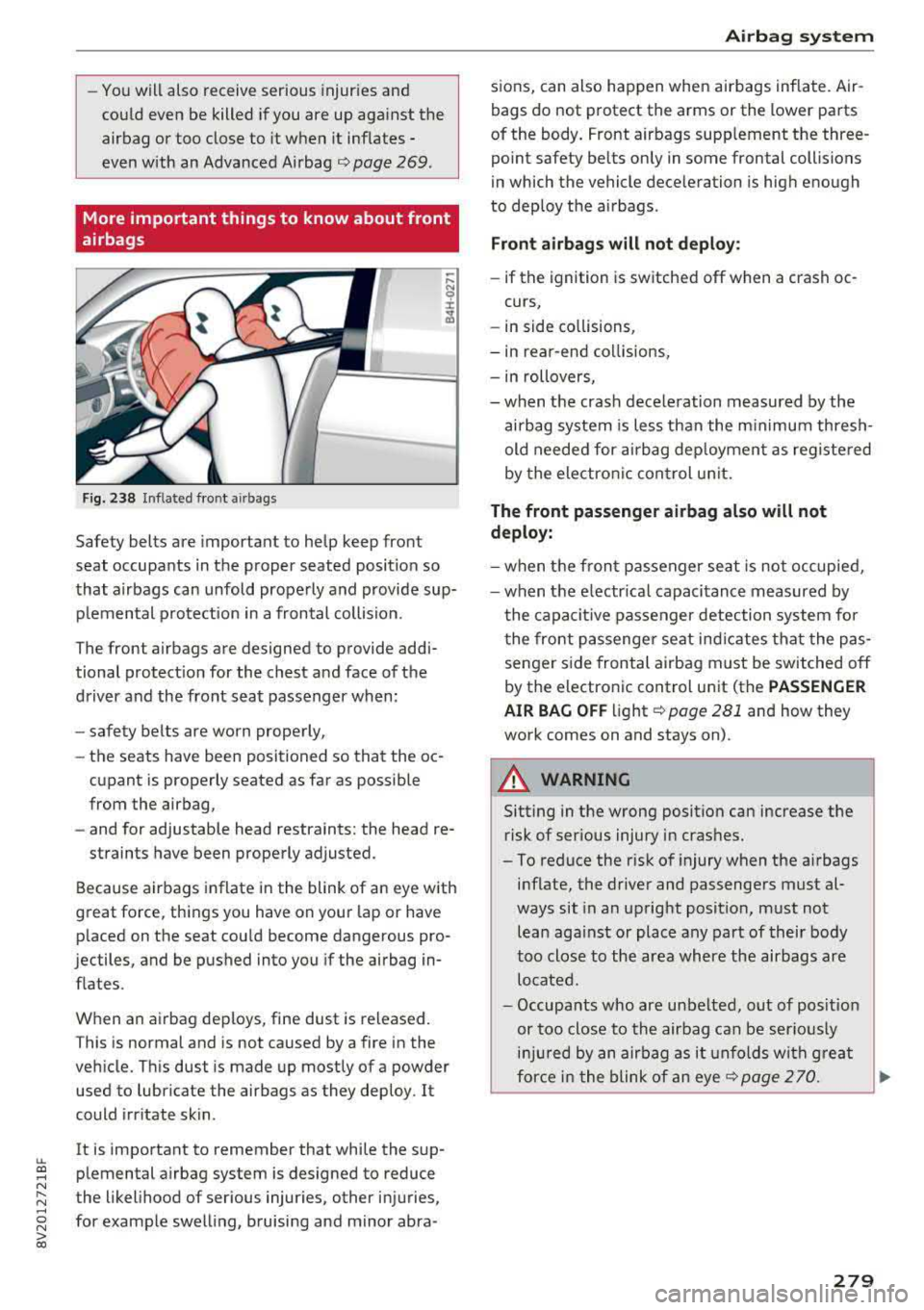
F ig. 238 Inf lated fro nt a irbags
Safety belts are important to help keep front
seat occupants in the proper seated position so
that airbags can unfold prope rly and provide sup
p lemental pro tection in a frontal collision.
The front airbags are designed to provide add i
tional protect ion for the chest and face of the
d river and the front seat passenger when:
- safety belts are worn properly,
- the seats have been positioned so that the oc -
cupant is properly seated as far as possible
from the airbag,
- and for adjustable head restraints: the head re-
straints have been properly adjusted.
Because airbags inflate in the blink of an eye with
g reat fo rce, things you have on your lap or have
p laced on the seat cou ld become dangerous pro
jectiles, and be pushed into you if the airbag in
flates .
W hen an airbag deploys, fine dust is released.
This is normal and is not caused by a fire in the
veh icle. This dust is made up mostly of a powder
used to lubricate the airbags as they deploy . It
could irr itate skin .
It is important to remember that whi le the sup
p lemental a irbag system is designed to reduce
the likelihood of ser ious injuries, other injuries,
for example swel ling, bruising and minor abra -
Airbag system
sions, can also happen when airbags inflate . Air
bags do not protect the arms or the lower parts
of the body. Front airbags supp lement the three
po int safety belts only in some frontal collisions
in which the vehicle dece leration is high enough
to dep loy the airbags .
Front airbags will not depl oy :
- if the ignition is switche d off when a crash oc-
curs,
- in side co llisions,
- in rear -end co llisions,
- in rollovers,
- when the crash decele ration measured by the
airbag system is less than the m inimum thresh
old needed for airbag dep loymen t as registe red
by the electronic con trol un it.
The front passenger airbag also w ill not
deploy:
- when the fron t passenger seat is not occupied,
- when the e lectr ica l capacitance measured by
the capacit ive passenger detection system for
t he front passenge r seat ind icates that the pas
senger side frontal airbag must be switched off
by the e lectronic control unit (the
PASSENGER
AIR BAG OFF
light c::> page 281 and how they
work comes on and stays on).
A WARNING
Sitting in the wrong position can increase the
risk of ser ious injury in crashes.
- To reduce the r isk o f injury when the airbags
inflate, the driver and passengers must al
ways sit in an upright posit ion, m ust not
lean aga inst or place any part of their body
too close to the area where the airbags are located.
- Occupants who are unbelted, out of position
or too close to the airbag can be serio usly
i n jur ed by an airbag as it unfolds with g reat
for ce in the blink of an eye
c::> page 2 70. jll,,,
279
Page 288 of 404
Airbag system
The airbag system is not a substitute for yo ur
safety belt. Rather, it is part of the overa ll occu
pant restraint system in your vehicle. Always re member that the airbag system can only help to
protect you if you are wearing your safety belt
and wear ing it properly . This is why you should
always wear your safety belt, not just because
the law req uires you to do so
q page 260, Gener
al notes.
Remember too, airbags will deploy only once and
only in ce rtain k inds of accidents
-yo ur safety
be lts are always there to offer protect ion in those
accidents in wh ich airbags a re not suppose d to
deploy or w hen they h ave already deployed, fo r
examp le when your vehicle str ikes or is str uck by
another after the firs t collision .
T his is jus t one of the reasons why an airbag is
not a subs titut e for the safety belt. The airbag
sys tem works most effec tively when used with
the safety belts. Therefore, a lways wear your
safety belts correct ly.
It is important to remember th at whi le the sup
p lemen tal knee a irbag system is des igned to re
duce the like lih ood of se rious injuries, other inju
ries, for example, swe lling, b ruising an d minor
ab rasions and friction burns can also occur when
an airbag inf lates .
The knee airbag system basically consists of :
- The elec tronic control module
- T wo infl atab le airbags (airbag a nd gas genera-
t or), one for the driver an d one fo r the fron t
passenger
- T he airbag indic ato r ligh t in the ins trumen t
pane l
The knee airbag system will not deploy:
-whe n the ignition is switched off
- in frontal collisions when the decele ration
measured by the control u nit is too low
- in s ide collisions
- in rear -end collisions
- in rollove rs
- in the eve nt o f a sys tem ma lf u nct ion (wa rning/
indicator light is on)
q page 26 .
286
A WARNING
,-
- Safety belts and the airbag system can only
provide protect io n when occupa nts ar e in
the prope r seat ing pos ition
~ page 2 79 .
-If the a irbag ind icator light ¢ page 26
comes when the veh icle is being used, have
t he system inspected immedia tely by your
author ized A udi de aler.
It is possib le th at
the air bag will i nfl at e w hen i t is no t sup
po sed to , or w ill no t in fla te w hen it sho uld .
How knee airbags work
Applies to: vehicles wi th knee airbags
The risk of injury to the leg area can be reduced
by fully inflated knee airbags.
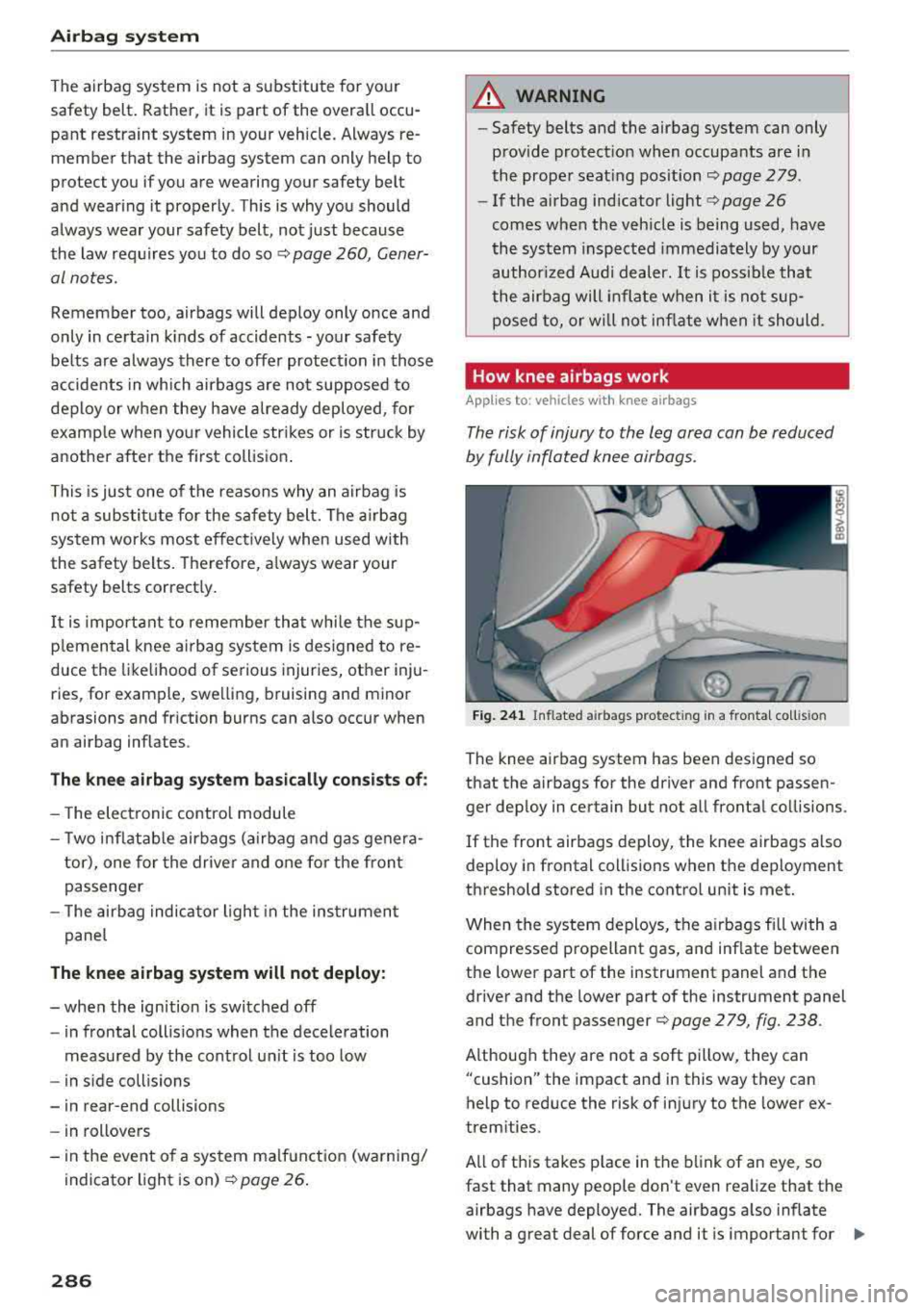
Fig. 241 Inflated a irbags protec ting in a fro nta l co llis io n
The knee airbag system has been designed so
that the airbags for the driver and front passen
ger dep loy in ce rtain but not all fronta l collisions .
If the front airbags deploy, the knee airbags also
deploy i n frontal col lisions when the dep loyment
th reshold stored in the cont rol unit is met.
When the system deploys , the a irbags f ill with a
compressed pro pellant gas, and inflate between
the lowe r part of the instrument panel and the
driver and the lower part of the instrument panel
and t he front
passenger¢ page 2 79, fig. 238 .
Althoug h they are not a soft pillow, they can
"cushion" the impact and in this way they ca n
help to red uce the risk of in jury to the lower ex
trem ities.
A ll of th is takes p lace in the b link of an eye, so
fast that many people don 't even rea lize that the
airbags have deployed. The airbags a lso inflate
with a g reat deal of force and it is important fo r
Ill-
Page 296 of 404
Child safety
Child safety
Important information
Introduction
The rear seat is generally the safest place in a
collision .
The physical principles of what happens when
your vehicle is in a crash apply also to children
¢ page 261, What happens to occupants not
wearing safety belts? .
But unlike adults and
teenagers, their muscles and bones are not fully
developed. In many respects children are at
g reater r isk of serious injury in crashes than
adults .
Because children's bodies are not fully devel
oped, they require restraint systems especially
designed for their size, weight, and body struc
ture. Many countries and all states of the United
States and provinces of Canada have laws requir
ing the use of approved child restraint systems
for infants and small children .
I n a frontal crash at a speed of 20-35 mph
(30 -56 km/h) the forces acting on a 13-pound
(6 kg) infant will be more than 20 times the
weight of the child. This means the weight of the
child would suddenly be more than 260 pounds
(120 kg) . Under these conditions, only an appro
priate child restraint properly used can reduce
the risk of serious injury. Child restraints, like
adu lt safety belts, must be used properly to be
effect ive. Used improperly, they can increase the
risk of serious injury in an accident.
All ch ildren, especially those 12 years and young
er must always ride in the back seat properly re
strained for their age and size. If you must insta ll
a child restra int on the front passenger seat in
exceptional circumstances, be sure to read and
heed the important information and warnings
¢ page 270. Infants and other chi ldren who are
properly restrained in an appropriate child re
straint that is for their si ze and age can benefit
from the protection that supplemental side air
bags provide in some kinds of crashes .
For more information please see information
provided by the:
294
- National Highway Traffic Safety Administration
(NHTSA), currently at: http://www.safe
rcar.gov (for the USA)
- Tr ansport Canada Information Centre, current-
ly at: http ://www.tc .gc.ca (for Canada)
Consult the child safety seat manufacturer's in
structions in o rder to be sure the seat is right fo r
your c hild's
size ¢ page 298, Important safety
instructions for using child safety seats .
Please
be sure to read and heed all of the important in
format ion and WARNINGS about child safety,
Advanced Airbags, and the installation of child
restraints in this chapter .
T here is a lot you need to know about the Ad
vanced Airbags in your veh icle and how they work
when infants and children in child res traints are
on the front passenger seat . Because of the large
amount of important informat ion, we cannot re
peat it all he re . We urge you to read the detailed
info rmat ion in this owner's manual about airbags
and the Advanced Airbag System in your vehicle
and the very important information about trans
porting children on the front passenger seat.
P lease be sure to heed the WARNINGS -they are
extremely important for your safety and the safe
ty of your passengers, especially infants and
small children .
A WARNING
-Accident statistics have shown that children
are generally safer in the rear seat area than
in the front seating position. Always restrain
any child age 12 and under in the rear.
- All vehicle occupants and especially children
must be restrained properly whenever riding
in a vehicle. An unrestrained or improperly
restrained child could be injured by striking
the interior or by being ejected from the ve
hicle during a sudden maneuver or impact.
An unrestrained or improperly restrained
child is a lso at greater r isk of injury or death
through contact w ith an inflating airbag.
- A suitable ch ild restraint properly installed
and used at one of the rear seating positions
provides the highest degree of protection
for infants and small children in most acci
dent situat ions.
Page 324 of 404

Checking and Filling
If the recommended engine oil is not available,
in an eme rg enc y you may add a maximum of 1
quart(! liter) of ACEA C3 or API SN engine oil
one tim e until the next oil change.
F or more information on the correct engine oil
for your vehicle, contact an authorized Audi dea l
er or authorized Audi Service Facility . Have the oil
changed by an authori zed Audi dealer o r author
ized Service Fac ility .
Audi re commend s
((#Castrol I llt/li{:t;'{g Frtw.:;-..·-..d.f'/,'JAL
Audi r ecommends using th e Lon g Lif e high
perf orm ance eng in e oil from Audi Genu in e
Parts .
Checking the engine oil level
The engine oil dipstick varies depending on the
engine type .
Fig . 268 Oil d ipsti ck: checking th e engine oil le vel (exa m
p le )
Observe the safety precaut ions ¢.& in Working
in the engine compartment on page 318 .
.. Park your vehicle on a level surface.
.. Shut the engine off when it is warm .
.. Wait approx imately two m inutes .
.. Open the hood ¢ page 320 .
.. Remove the oi l dipstick¢ page 321, fig. 267,
wipe it off with a clean cloth and insert it a ll the
way in again .
.. Remove the o il dipstick again and then read the
oil
level ¢ table on page 322.
.. Add engine oil if necessary c:> page 323.
322
Areas on the o il dipstick 9 fig . 268 .
(D If the engine oil leve l is just before the
mark ing
(D , then engine oil must be added .
See¢@.
@ Do not add engine oil.
(D Note
- T he engine o il level must not be below the
ma rking
(D , because this increases the risk
of engine damage.
- After add ing engine oil, the oil leve l must
not be above the marking @, because this
increases the risk of catalytic converter and/
or engine damage . Do not start the engine .
Contact an authorized Audi dealer or au
thorized Audi Service Facility to have excess eng ine oil extracted if necessary .
(D Tips
- The engine oil consumption may be up to
0.5 quart/600 miles (0.5 liter/1,000 km),
depending on driving style and operating
conditions. Consumpt io n may be h igher
dur ing the fi rst 3,000 mi les (5,000 km) . Be
c ause of this , the eng ine o il level must be
che cked regularly.
It is best to check each
t ime you refuel your vehicle and before long
drives .
- In order to prov ide effective l ubrication and
cooling of interna l engine components, a ll
internal combustion engines consume a cer
tain amount of oil. O il consumption varies
from engine to engine and may change sig nificantly over the life of the engine. Typi
cally, eng ines with a specif ied break-in peri
od consume more oil during the break-in pe
riod than they consume after o il consump
t ion has stabilized .
- Under normal condit ions, the rate of oil
cons umption depends on t he quality and
viscosity of the oil, the RPM (revo lutions per
mi nute) at which the engine is ope rated, the
ambien t temperature and road conditions .
Further factors are the amount of oi l dilu
tion from water condensation or fuel resi due and the oxidation level of the oil. As any
eng ine is subject to wear as m ileage builds
Ii>-
Page 325 of 404

u. 00 .-< N l' N .-< 0 N > 00
up, the oil consumption may increase over
time unti l replacement of worn components
may become necessary .
- With a ll these variab les coming into p lay,
no standard rate of oil consumption can be
estab lished or specified. There is no alterna
tive to checking the o il level regu larly and
frequently.
- If you have the impression your engine con
sumes excessive amounts of oil, we recom mend that you consult an authorized Aud i
dealer to have the cause of your concern properly d iagnosed . Keep in mind that the
accu rate measurement of oil consumption
r equ ires gre at ca re and may take some
time. An a uthorized Audi dea ler has instruc
tions about how to measure oil consump
tion acc urately.
- You can find information on engine oi l and
engine oil capacities for the USA at
www.audiusa.com/help/maintenance, or
for Canada at www.audi.ca/ca/web/en/
customer-area/ ca re-and-ma i ntena nee/ a ud
i
service-sched u les. html, or ca ll
800-822-2834.
Adding engine oil
F ig. 269 Eng ine co mpartment : engin e oil fille r open ing
cover
Obse rve the safety p recautions i::> &. in Working
in the engine compartment an page 318.
.,. T urn the eng ine off .
.,. Unscrew the cap~ for the eng ine oi l filler
opening
i::> fig. 269 .
.,. Care fully add 0.5 qua rt ( 0.5 liter) of the cor rect
o il
q page 321.
Ch eck ing and F illing
.,. Check the oi l level again a fter two minutes
i::> page 322 , Checking the engine oil level .
.,. Add a smaller amo unt of engine oil if necessa
ry. The
marking @i::>page 322, fig. 268 must
not be exceeded
i::> @ in Checking the engine oil
level on page 322 .
.,. Close the engine o il filler cap and push the d ip
stick all the way i n.
.8, WARNING
-W hen adding oil, do not let o il dr ip onto hot
e ng ine components. This in cr eases the risk
of a fire .
- You mus t se al the c ap on the o il filler open
ing correct ly so tha t oi l does not leak ou t
onto the hot engine and ex haust system
when the engine is running, beca use this is
a fire hazard.
- Always clean skin thoro ughly if it comes into
contact with engine oi l.
- Engine oil is poisonous and must be kept
out of reac h of children .
- Sto re t he engine oi l secure ly in the o rigina l
container .
(Llj) Note
You r Lim ited New Veh icle Wa rra nty does no t
cove r damage or m alfu nct io ns due to f ailure
to fo llow recommended maintenance and use
requirements as set forth in the A udi Owner's
M anua l and War ranty
& Maintenance boo klet.
- Use on ly a high quality engine oil that ex -
press ly complies with the A udi oi l quality
standard spec ified for yo ur vehicle's eng ine.
Us ing any othe r oi l can cause ser ious eng ine
damage.
- Do not mix any addit iona l lubr icants into
the engine oil. Damage caused by such add i
t ives is not covered by the wa rranty.
@ For the sake of the environment
- Oil sho uld never enter the sewer system or
come into contact with the ground .
- Pay attention to lega l req uirements when
disposing of empty o il conta iners.
323
Page 373 of 404

LL co .... N
" N .... 0 N > co
Fuses and bulbs
Fuses
Changing fuses
A fuse that has blown will have metal strips that
have burned through .
Fig. 2 96 Steering column area: cover
Fig. 297 Left s ide of the eng ine compartment: fu se cover
T h e fuses a re loca ted behind a cover in t he stee r
ing column area ¢
fig. 296 or under a cover on
the left side of the engine compartment
¢ fig. 297.
.. Switch the ignition and all e lectr ica l equipment
off.
.. Check the following table to see which fuse be
longs to the equipment
¢ page 372 .
.. Remove the cover .
.. Remove the plastic cl ip from the fuse panel
cove r in the engine
compartment¢ fig. 297 .
.. Remove the fuse using the plastic clamp .
.. Replace the burned fuse w ith an identical new
one .
.. Reinsert the cove r.
Fuses and bulbs
Fuse color identification Color Current rating
in amps
Black 1
P urple 3
Light brown 5
Brown 7.5
Red 10
Blue 15
Yellow 20
W hite or tra nspa rent 25
Green 30
O range 4 0
_& WARNING
-
Do not repair fuses and neve r rep lace a blown
f u se with one that has a higher amp rating.
This can cause damage to the e lectr ica l sys
tem and a fi re .
@) Note
If a new fuse burns out again shortly afte r you
have insta lled it, have the electrical system
chec ked as soon as poss ible by an authorized
Audi dealer or authorized Audi Service Fac ili
ty.
(D Tips
- The following table does not list fuse loca
tions that are not used.
- Some of the equipment listed in the fo llow
ing tables applies on ly to certain model ver
sions or certa in optional equipment.
371