Page 124 of 216
unlock the steering wheel adjustment
lever 1 fig. 109;
pull the steering wheel towards you
until it is in the end of travel position,
then lock it by operating lever 1;
using the Allen key, undo the two lower
screws 1 fig. 110securing the cover;
remove the trim 1 fig. 111for the
upper cover;
remove the left side trim 1 fig. 112for
the cover;
remove the lower cover 1
fig. 113detaching the clips fig. 114from
the upper cover;
107A0K0713C
108A0K0711C
109A0K0710C
110A0K0732C
111A0K0733C
112A0K0734C
122
IN AN EMERGENCY
Page 125 of 216

pull tab 1 fig. 115downwards using
one hand and with the other one remove
the key, sliding it outwards;
once the key is removed, refit the
steering column upholstery, the left side
panel for the cover and the dashboard
fusebox flap, ensuring that they are
locked in place.
40)
IMPORTANT
40)It is advisable to contact an Alfa Romeo
Dealership to have the refitting procedure
carried out. If you would like to proceed
autonomously, special attention must be
paid to the correct coupling of the retaining
clips. Otherwise, noise might be heard due to
an incorrect fastening of the lower cover
with the upper cover.
TOWING THE CAR
The tow ring provided with the car is
located in the tool box in the boot.
ATTACHING THE TOW RING
126) 127) 128)
Towing from the front
Unseat cap 1 using a screwdriver or
similar tool in the lower slot. Take care
not to damage the paint. Take tow hook
2 from its housing in the tool support and
screw it in fully on the threaded pin
(fig. 116 ).
Towing from the rear
Versions other than "VELOCE" and
without "Pack sport": unseat cap 1 using a
screwdriver or similar tool in the upper
slot. Take care not to damage the paint.
Take tow hook 2 from its housing in the
tool support and screw it in fully on the
threaded pin (fig. 117 ).
113A0K0735AC
114A0K0735BC
115A0K1207C
116A0K0623C
123
Page 126 of 216

"VELOCE" versions or versions with
"Pack sport": detach plug 1 by pressing
on the upper part, take tow hook 2 from
its housing in the tool support and screw
it in fully on the threaded pin (fig. 117 ).
WARNING
126)For versions with key without remote
control, before towing, turn the ignition key
to MAR and then to STOP without removing
it. The steering column will automatically
lock when the key is removed and the wheels
cannot be steered. Also check that the
gearbox is in neutral (on versions equipped
with automatic transmission, check that the
gear lever is in N position). For versions with
electronic key, move the ignition device to
MAR and then to STOP, without opening the
door.127)The brake servo and the
electromechanical power steering will not
work while the vehicle is being towed. You
will therefore need to apply more force on
the brake pedal and steering wheel. Do not
use flexible ropes when towing, and avoid
jerky movements. During towing, make sure
that the trailer hitch does not damage any
components it is touching. When towing the
car, you must comply with all specific traffic
regulations and adopt an appropriate
driving behaviour. Do not start the engine
while towing the car. Before tightening the
ring, clean the threaded housing thoroughly.
Make sure that the ring is fully screwed into
the housing before towing the car.
128)The front and rear tow hooks should be
used only for emergencies on the road. You
are allowed to tow the vehicle for short
distances using an appropriate device in
accordance with the highway code (a rigid
bar), to move the vehicle on the road in
readiness for towing or transport via a
breakdown vehicle. Tow hooks MUST NOT be
used to tow vehicles off the road or where
there are obstacles and/or for towing
operations using cables or other non-rigid
devices. In compliance with the above
conditions, towing must take place with the
two vehicles (one towing, the other towed)
aligned as much as possible along the same
centre line.
117A0K0898C
124
IN AN EMERGENCY
Page 128 of 216

SCHEDULED SERVICING
Correct servicing is crucial for
guaranteeing a long life for the vehicle
under the best conditions.
For this reason, Alfa Romeo has planned
a series of checks and services at fixed
distance intervals and, for
versions/markets, where provided, at
fixed time intervals, as described in the
Scheduled Servicing Plan.
Regardless of the above, it is always
necessary to carefully follow the
instructions in the Scheduled Servicing
Plan (e.g. periodically check level of
liquids, tyre pressure, etc.).
Scheduled Servicing is offered by all Alfa
Romeo Dealerships according to fixed
time or kilometres/miles intervals. If,
during each operation, in addition to the
ones scheduled, the need arises for
further replacements or repairs, these
may be carried out with the owner's
explicit agreement only. If your vehicle is
used frequently for towing, the interval
between one service operation and the
next should be reduced.IMPORTANT NOTES
Scheduled Servicing interventions are
set out by the Manufacturer. Failure to
have them carried out may invalidate the
warranty.
It is advisable to inform the Alfa Romeo
Dealership of any small operating
irregularities without waiting for the next
service.
126
SERVICING AND MAINTENANCE
Page 131 of 216

Thousands of miles9 182736455463728190
Thousands of kilometres15 30 45 60 75 90 105 120 135 150
Years12345678910
Check and, if necessary, top up the Alfa TCT gearbox control
oil level (for versions/markets, where provided)(2)
Change engine oil and replace oil filter (1.4 Turbo Petrol and
1.4 Turbo MultiAir versions)(3) (o) (●)
Change engine oil and replace oil filter (1750 Turbo Petrol
versions)(4)
Replace spark plugs (1.4 Turbo Petrol and 1.4 Turbo MultiAir
versions)(5)
Replace spark plugs (1750 Turbo Petrol versions)
Replace accessory drive belt/s(6)
Replace the toothed timing drive belt(6)
(2) Check to be carried out every year for cars on the road in countries with particularly severe climates (cold countries).
(3) If the car's annual mileage is less than 10,000 km, the engine oil and filter must be replaced every year.
(o) Recommended operations
(●) Obligatory operations
(4) The actual interval for changing engine oil and replacing the engine oil filter depends on the vehicle usage conditions and is signalled by the warning light or message in
the instrument panel. In any cases, never exceed 1 year.
(5) For 1.4 Turbo Petrol and 1.4 Turbo MultiAir versions, to guarantee correct operation and prevent serious damage to the engine, it is essential to proceed as follows:
only use spark plugs specifically certified for these engines; all spark plugs should be of the same type and brand (see the “Engine” paragraph in the “Technical
specifications” section); strictly comply with the replacement intervals in the Service Schedule. It is advisable to contact an Alfa Romeo Dealership for spark plug
replacement.
(6) Areas that are not dusty: recommended maximum mileage 120,000 km. The belt must be replaced every 6 years, regardless of distance travelled. Dustyareas and/or
demanding use of the vehicle (cold climates, town use, long periods of idling): advised maximum mileage 60,000 km. Regardless of the mileage, the beltmust be
replaced every 4 years.
129
Page 135 of 216

Thousands of miles12 24 36 48 60 72 84 96 108 120
Thousands of kilometres20 40 60 80 100 120 140 160 180 200
Years12345678910
Replace accessory drive belt/s(4)
Replace the toothed timing drive belt(4)
Replace fuel filter cartridge(5)
Replace air cleaner cartridge(6)
Change the brake fluid(7)
Replace the passenger compartment cleaner(6) (o) (●)
(4) Areas that are not dusty: recommended maximum mileage 120,000 km. The belt must be replaced every 6 years, regardless of distance travelled. Dustyareas and/or
demanding use of the vehicle (cold climates, town use, long periods of idling): advised maximum mileage 60,000 km. Regardless of the mileage, the beltmust be
replaced every 4 years.
(5) If the car runs on fuel with quality below the relevant European specification, this filter should be replaced every 20,000 km
(6) If the vehicle is used in dusty areas, this cleaner must be replaced every 20,000 km.
(7) The brake fluid replacement has to be done every two years, irrespective of the mileage.
(o) Recommended operations
(●) Obligatory operations
133
Page 136 of 216

PERIODIC CHECKS
Every 1,000 km or before long journeys,
check and, if necessary, top up the
following:
engine coolant, brake fluid and
windscreen washer fluid level;
tyre inflation pressure and condition;
operation of lighting system
(headlights, direction indicators, hazard
warning lights, etc.);
operation of screen wash/wipe system
and positioning/wear of windscreen/
rearscreen wiper blades
Check and top up, if required, the engine
oil level every 3,000 km.
IMPORTANT To find out the correct oil
quantity, always check using the dipstick.
Carry out the check with the vehicle
parked on level ground.
DEMANDING USE OF THE CAR
If the vehicle is used mainly under one of
the following conditions:
towing a trailer or caravan;
dusty roads;
short, repeated journeys (less than
7-8 km) at sub-zero outside
temperatures;
engine often idling or driving long
distances at low speeds or long periods
of inactivity;
the following checks must be carried out
more often than indicated in the
Scheduled Servicing Plan:
check front disc brake pad condition
and wear;
check cleanliness of bonnet and
luggage compartment locks, cleanliness
and lubrication of linkage;
visually inspect condition of: engine,
gearbox, transmission, pipes and hoses
(exhaust - fuel system - brakes) and
rubber elements (boots - sleeves - bushes
- etc.);
check battery charge and battery fluid
level (electrolyte);
visually inspect conditions of the
accessory drive belts;
check and, if necessary, change engine
oil and replace oil filter;
check and, if necessary, replace pollen
filter;
check and, if necessary, replace air
cleaner.
134
SERVICING AND MAINTENANCE
Page 161 of 216
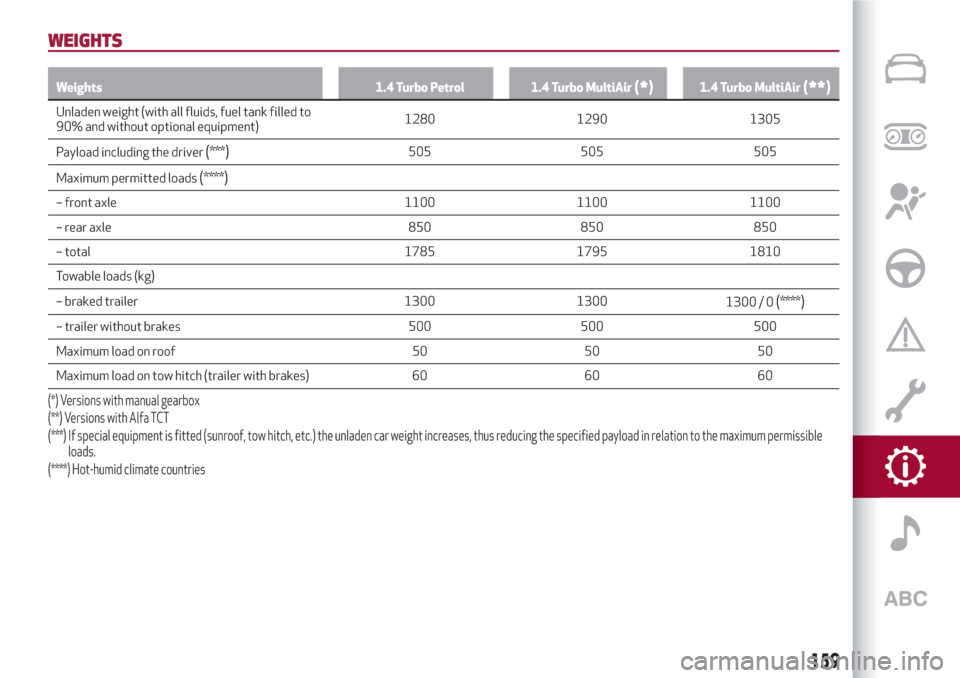
WEIGHTS
Weights 1.4 Turbo Petrol 1.4 Turbo MultiAir(*)1.4 Turbo MultiAir(**)
Unladen weight (with all fluids, fuel tank filled to
90% and without optional equipment)1280 1290 1305
Payload including the driver
(***)505 505 505
Maximum permitted loads
(****)
– front axle 1100 1100 1100
– rear axle 850 850 850
– total 1785 1795 1810
Towable loads (kg)
– braked trailer 1300 1300
1300 / 0
(****)
– trailer without brakes 500 500 500
Maximum load on roof 50 50 50
Maximum load on tow hitch (trailer with brakes) 60 60 60
(*) Versions with manual gearbox
(**) Versions with Alfa TCT
(***) If special equipment is fitted (sunroof, tow hitch, etc.) the unladen car weight increases, thus reducing the specified payload in relation to the maximum permissible
loads.
(****) Hot-humid climate countries
159