Page 532 of 594

||
MAINTENANCE AND SERVICE
530
IMPORTANT
Use Volvo genuine washer fluid or equivalent with a recommended pH of between 6 and 8,in working dilution (e.g. 1:1 with neutralwater).
IMPORTANT
Use washer fluid with antifreeze when the temperature is below freezing to avoid freez-ing in the pump, reservoir and hoses.
Volume:• Cars
with headlamp washing: 5.5 litres.
• Cars
without headlamp washing: 3.5 litres.
Related information
•Windscreen and headlamp washers (p. 150)
• Opening and closing the bonnet (p. 514)
Starter battery
The electrical system is single-pole and uses the chassis and engine casing as a conductor. The starter battery is used to start up the electri- cal system and drive the starter motor as well asother electrical equipment in the car. The starter battery should be replaced by a workshop 13
.
The car has a voltage-regulated AC alternator. The starter battery is a 12 V AGM battery, designed for the carbon dioxide reducing func-tions, Start/Stop and regenerative charging, andto support the functionality of the car's differentsystems. The service life and function of the starter battery is influenced by factors such as the number ofstarts, discharging, driving style, driving condi-tions, climatic conditions etc. • Never disconnect the starter battery when the engine is running.
• Check that the cables to the starter batteryare correctly connected and properly tight-ened.
WARNING
•
The battery can generate oxyhydrogen gas, which is highly explosive. A spark canbe formed if a jump lead is connectedincorrectly, and this can be enough forthe battery to explode.
• The battery contains sulphuric acid, whichcan cause serious burns.
• If sulphuric acid comes into contact witheyes, skin or clothing, flush with largequantities of water. If acid splashes intothe eyes - seek medical attention imme-diately.
When connecting an external starter battery orbattery charger, use the car's charging points inthe engine compartment. The battery terminalson the car's starter battery in the cargo area must not be used.
During charging, both the starter battery and the support battery are charged.
13 An authorised Volvo workshop is recommended.
Page 536 of 594

||
MAINTENANCE AND SERVICE
534
Size , L×W×H (mm) 150×90×130
Capacity (Ah) 10
AAccording to EN standard.
B Cold Cranking Amperes.
IMPORTANT
When replacing the starter battery or support battery, a battery of AGM 15
type must be fit-
ted.
NOTE
• The higher the current take-off in the car, the more the alternator must be workingand the batteries charging = Increasedfuel consumption.
• When the capacity of the starter batteryhas fallen below the lowest permissiblelevel then the Start/Stop function is dis-engaged.
Temporarily reduced Start/Stop function due to high current take-off means: •
The engine starts automatically 16
without the
driver depressing the clutch pedal (manualgearbox).
• The engine starts automatically without thedriver lifting his/her foot off the foot brakepedal (automatic gearbox).
The support battery normally requires no moreservice than the normal starter battery. A work-shop should be contacted in the event of ques-tions or problems - an authorised Volvo workshopis recommended.
IMPORTANT
If the following instruction is not observed then the Start/Stop function may temporarilycease to work after the connection of anexternal starter battery or battery charger:
• The negative battery terminal on the car's starter battery must
never be used for
connecting an external starter battery orbattery charger - only the car's negative
charging point may be used as the
grounding point.
NOTE
If the starter battery has been discharged so much that the car has no normal electricalfunctions and the engine is then jump-startedwith an external battery or a battery charger,the Start/Stop function will continue to beactivated. If the Start/Stop function thenauto-stops the engine shortly after, there is agreat risk that engine auto-start will fail dueto insufficient battery capacity, because thebattery has not had the opportunity torecharge. If the car has been jump-started, or if there is insufficient time to charge the battery with abattery charger, the recommendation is totemporarily deactivate the Start/Stop functionuntil the battery has been recharged by thecar. In an outside temperature of +15 °C, thebattery needs to be charged for at least1 hour by the car. In a lower outside tempera-ture, the charging time may increase to3-4 hours. The recommendation is to chargethe battery using an external battery charger.
Related information
• Starter battery (p. 530)
• Start/Stop (p. 396)
15
Absorbed Glass Mat.
16 Automatic starting can only take place if the gear lever is in neutral position.
Page 537 of 594
MAINTENANCE AND SERVICE
535
•
Using jump starting with another battery (p. 388)
• Symbols on the batteries (p. 533)
Fuses All electrical functions and components are pro- tected by a number of fuses in order to protectthe car's electrical system from damage by shortcircuiting or overloading.
If an electrical component or function does not work, it may be because the component's fusewas temporarily overloaded and failed. If thesame fuse fails repeatedly then there is a fault inthe circuit. Volvo recommends contacting anauthorised Volvo workshop for checking.
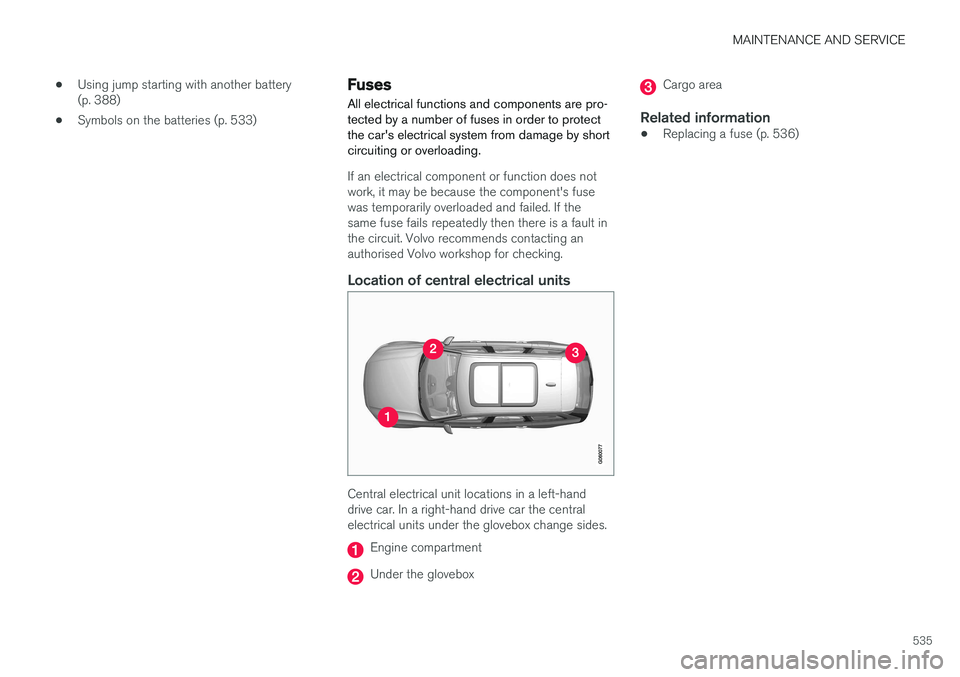
Location of central electrical units
Central electrical unit locations in a left-hand drive car. In a right-hand drive car the centralelectrical units under the glovebox change sides.
Engine compartment
Under the glovebox
Cargo area
Related information
•Replacing a fuse (p. 536)
Page 538 of 594
MAINTENANCE AND SERVICE
536
Replacing a fuse All electrical functions and components are pro- tected by a number of fuses in order to protectthe car's electrical system from damage by shortcircuiting or overloading.
Changing1. Look in the fuse diagram to locate the fuse.
2. Pull out the fuse and check from the side tosee whether the curved wire has blown.
3. If this is the case, replace it with a new fuse of the same colour and amperage.
WARNING
Never use a foreign object or a fuse with an amperage higher than that specified whenreplacing a fuse. This could cause significantdamage to the electrical system and possiblylead to fire.
Related information
• Fuses (p. 535)
• Fuses in engine compartment (p. 537)
• Fuses under glovebox (p. 542)
• Fuses in cargo area (p. 546)
Page 539 of 594
MAINTENANCE AND SERVICE
}}
537
Fuses in engine compartment
Fuses in the engine compartment protect engine and brake functions, amongst other things.
Page 542 of 594

||
MAINTENANCE AND SERVICE
* Option/accessory.
540
Function
AA
Heated windscreen
* right-hand
side 40
Parking heater
* 20
Control unit for brake system (ABS pump) 40
- -
Heated windscreen
* right-hand
side Shunt
Supplied when the ignition is switched on: Engine controlmodule; Transmission compo-nents; Electric steering servo;Central electronic module; Con-trol module for brake system 5
- -
Right-hand headlamp 7.5 Right-hand headlamp, certain variants of LED
C 15
- -
- -
Module for controlling battery engagement 5
Function
AA
Airbags 5
Left-hand headlamp 7.5 Left-hand headlamp, certain variants of LED C 15
Accelerator pedal sensor 5
Transmission control module 15
Engine Control Module (ECM) 5
- -
- -
- -
- -
Engine control module; Actuator; Throttle unit; EGR valve (diesel);Position sensor for turbo (die-sel); Valve for turbocharger (pet-rol) 20
Solenoids (petrol); Valve; Ther- mostat for engine cooling sys-tem (petrol); EGR cooling pump(diesel); Glow control module(diesel)10
Function
AA
Vacuum regulators; Valve; Valve for output pulse (diesel) 7.5
Control module for spoiler roller cover; Control module for radia-tor roller cover; Relay coils foroutput pulse (diesel) 5
- -
Lambda-sond, front; Lambda- sond, rear (petrol)
15
Solenoid for engine oil pump; Solenoid clutch A/C; Lambdasond, centre (petrol); Lambdasond, rear (diesel)15
- -
Engine Control Module (ECM) 20
Ignition coils (petrol); Spark plugs (petrol)
15
Control module for vehicle gas
*B
15*B
Fuel filter heater (diesel) 30
- -
- -
- -
Page 545 of 594
MAINTENANCE AND SERVICE
}}
543
On the inside of the cover there are tweezers that facilitate the procedure for the removal and fittingof fuses.The
fuse box in the engine compartment also
provides space for several spare fuses.
Page 547 of 594
MAINTENANCE AND SERVICE
* Option/accessory.545
Function
AA
Control module for Internet-con- nected car; Control module for tel-ematics 5
Door module in left-hand rear door 20
Audio control module (amplifier) (certain variants)
40
- -
Module for multi-band antenna 5
Modules for seat comfort (mas- sage) front
* 5
- -
Rear window wiper 15
Control module for fuel pump 15
- -
- -
Seat heating, driver's side front 15
Seat heating, passenger side front 15
Coolant pump 10
- -
Function
AA
Door module in left-hand front door 20
Control module for suspension (active chassis)
* 20
- -
Sensus control module 10
- -
- -
Door module in right-hand front door
20
- -
TV
* (certain markets) 5
Primary fuse for fuses 53 and 58 15
A
Ampere
Related information
• Replacing a fuse (p. 536)
• Fuses in engine compartment (p. 537)
• Fuses in cargo area (p. 546)