Page 203 of 672
203
SIENNA_OM_OM08007U_(U)
4-1. Before driving
4
Driving
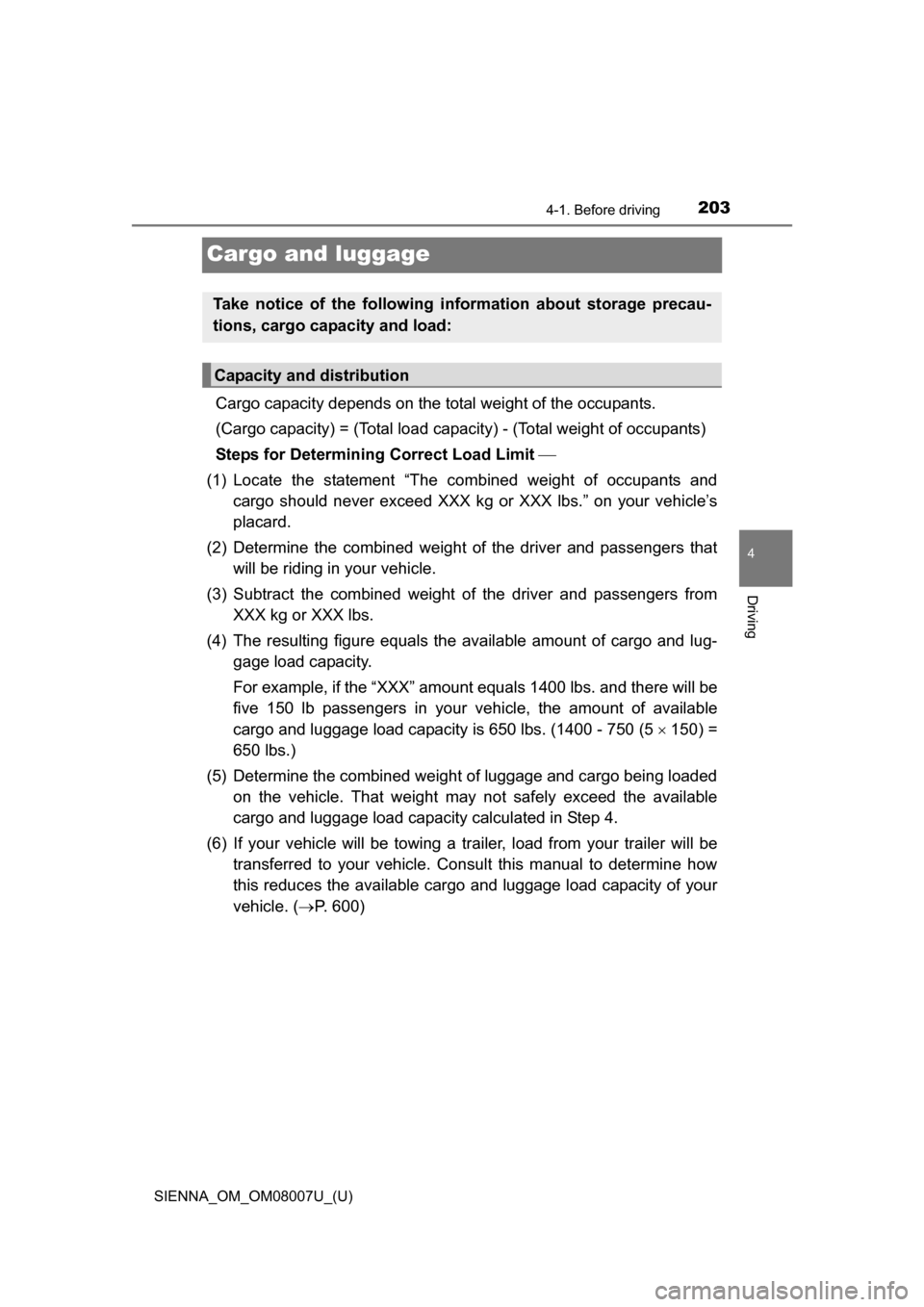
Cargo and luggage
Cargo capacity depends on the total weight of the occupants.
(Cargo capacity) = (Total load capacity) - (Total weight of occupants)
Steps for Determining Correct Load Limit
(1) Locate the statement “The combined weight of occupants and cargo should never exceed XXX kg or XXX lbs.” on your vehicle’s
placard.
(2) Determine the combined weight of the driver and passengers that will be riding in your vehicle.
(3) Subtract the combined weight of the driver and passengers from
XXX kg or XXX lbs.
(4) The resulting figure equals the available amount of cargo and lug- gage load capacity.
For example, if the “ XXX” amount equals 1400 lbs. and there will be
five 150 lb passengers in your v ehicle, the amount of available
cargo and luggage load capacity is 650 lbs. (1400 - 750 (5 150) =
650 lbs.)
(5) Determine the combined weight of luggage and cargo being loaded on the vehicle. That weight ma y not safely exceed the available
cargo and luggage load capacity calculated in Step 4.
(6) If your vehicle will be towing a tr ailer, load from your trailer will be
transferred to your vehicle. Consult this manual to determine how
this reduces the available cargo and luggage load capacity of your
vehicle. ( P. 600)
Take notice of the following information about storage precau-
tions, cargo capacity and load:
Capacity and distribution
Page 207 of 672
SIENNA_OM_OM08007U_(U)
2074-1. Before driving
4
Driving
WARNING
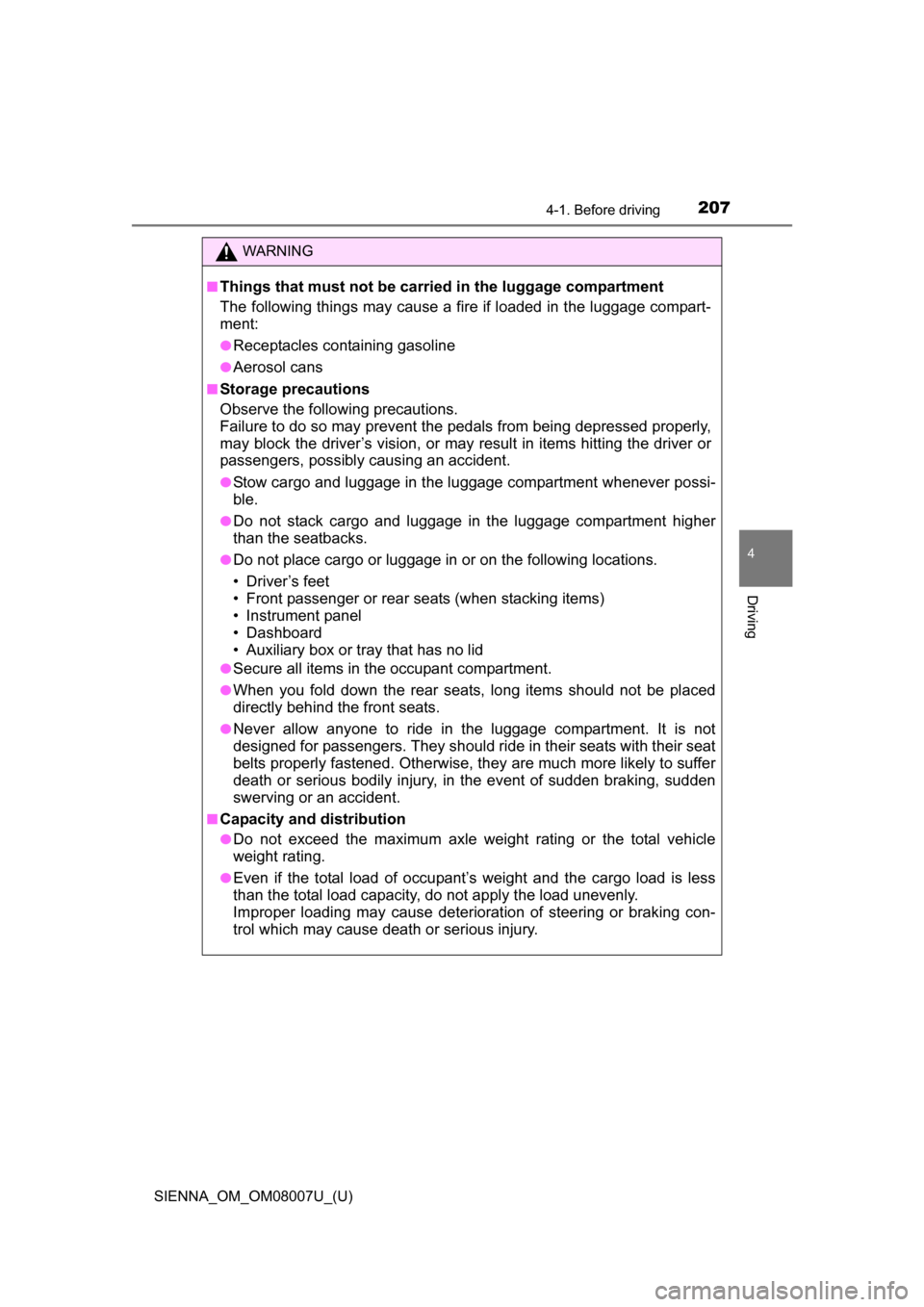
■Things that must not be carried in the luggage compartment
The following things may cause a fire if loaded in the luggage compart-
ment:
●Receptacles containing gasoline
●Aerosol cans
■Storage precautions
Observe the following precautions.
Failure to do so may prevent the pedals from being depressed properly,
may block the driver’s vision, or may result in items hitting the driver or
passengers, possibly causing an accident.
●Stow cargo and luggage in the luggage compartment whenever possi-
ble.
●Do not stack cargo and luggage in the luggage compartment higher
than the seatbacks.
●Do not place cargo or luggage in or on the following locations.
• Driver’s feet
• Front passenger or rear seats (when stacking items)
• Instrument panel
• Dashboard
• Auxiliary box or tray that has no lid
●Secure all items in the occupant compartment.
●When you fold down the rear seats, long items should not be placed
directly behind the front seats.
●Never allow anyone to ride in the luggage compartment. It is not
designed for passengers. They should ride in their seats with their seat
belts properly fastened. Otherwise, they are much more likely to suffer
death or serious bodily injury, in the event of sudden braking, sudden
swerving or an accident.
■Capacity and distribution
●Do not exceed the maximum axle weight rating or the total vehicle
weight rating.
●Even if the total load of occupant’s weight and the cargo load is less
than the total load capacity, do not apply the load unevenly.
Improper loading may cause deterioration of steering or braking con-
trol which may cause death or serious injury.
Page 209 of 672
209
SIENNA_OM_OM08007U_(U)
4-1. Before driving
4
Driving
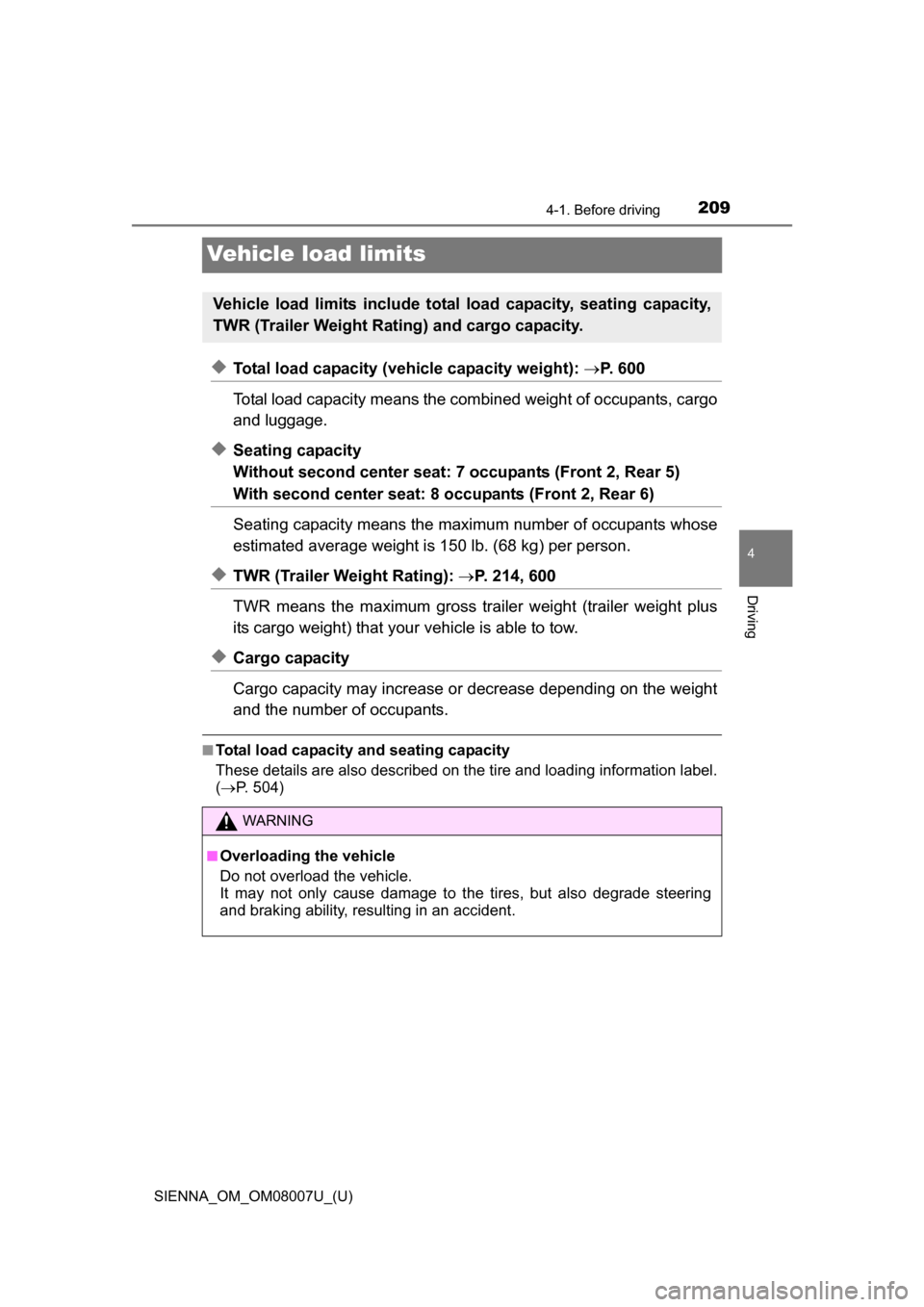
Vehicle load limits
◆Total load capacity (vehicle capacity weight): P. 6 0 0
Total load capacity means the combined weight of occupants, cargo
and luggage.
◆Seating capacity
Without second center seat: 7 occupants (Front 2, Rear 5)
With second center seat: 8 occupants (Front 2, Rear 6)
Seating capacity means the maxi mum number of occupants whose
estimated average weight is 150 lb. (68 kg) per person.
◆TWR (Trailer Weight Rating): P. 214, 600
TWR means the maximum gross trailer weight (trailer weight plus
its cargo weight) that your vehicle is able to tow.
◆Cargo capacity
Cargo capacity may increase or decrease depending on the weight
and the number of occupants.
■Total load capacity and seating capacity
These details are also described on the tire and loading information label.
( P. 504)
Vehicle load limits include total load capacity, seating capacity,
TWR (Trailer Weight Rati ng) and cargo capacity.
WARNING
■Overloading the vehicle
Do not overload the vehicle.
It may not only cause damage to the tires, but also degrade steering
and braking ability, resulting in an accident.
Page 213 of 672
SIENNA_OM_OM08007U_(U)
2134-1. Before driving
4
Driving
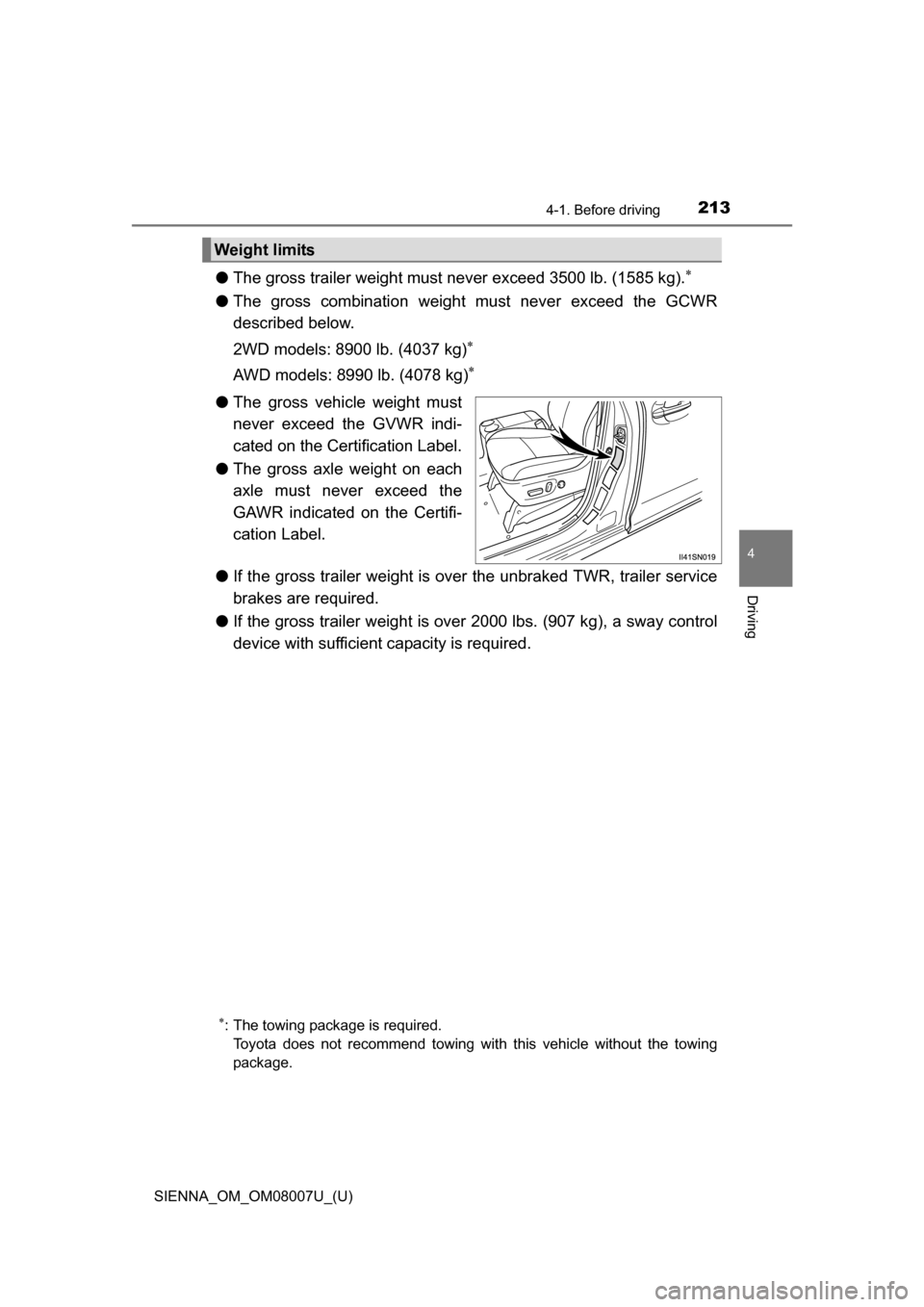
●The gross trailer weight must never exceed 3500 lb. (1585 kg).
●The gross combination weight must never exceed the GCWR
described below.
2WD models: 8900 lb. (4037 kg)
AWD models: 8990 lb. (4078 kg)
●The gross vehicle weight must
never exceed the GVWR indi-
cated on the Certification Label.
● The gross axle weight on each
axle must never exceed the
GAWR indicated on the Certifi-
cation Label.
● If the gross trailer weight is over the unbraked TWR, trailer service
brakes are required.
● If the gross trailer weight is over 2000 lbs. (907 kg), a sway control
device with sufficient capacity is required.
Weight limits
: The towing package is required. Toyota does not recommend towing with this vehicle without the towing
package.
Page 222 of 672
222
SIENNA_OM_OM08007U_(U)
4-1. Before driving
WARNING
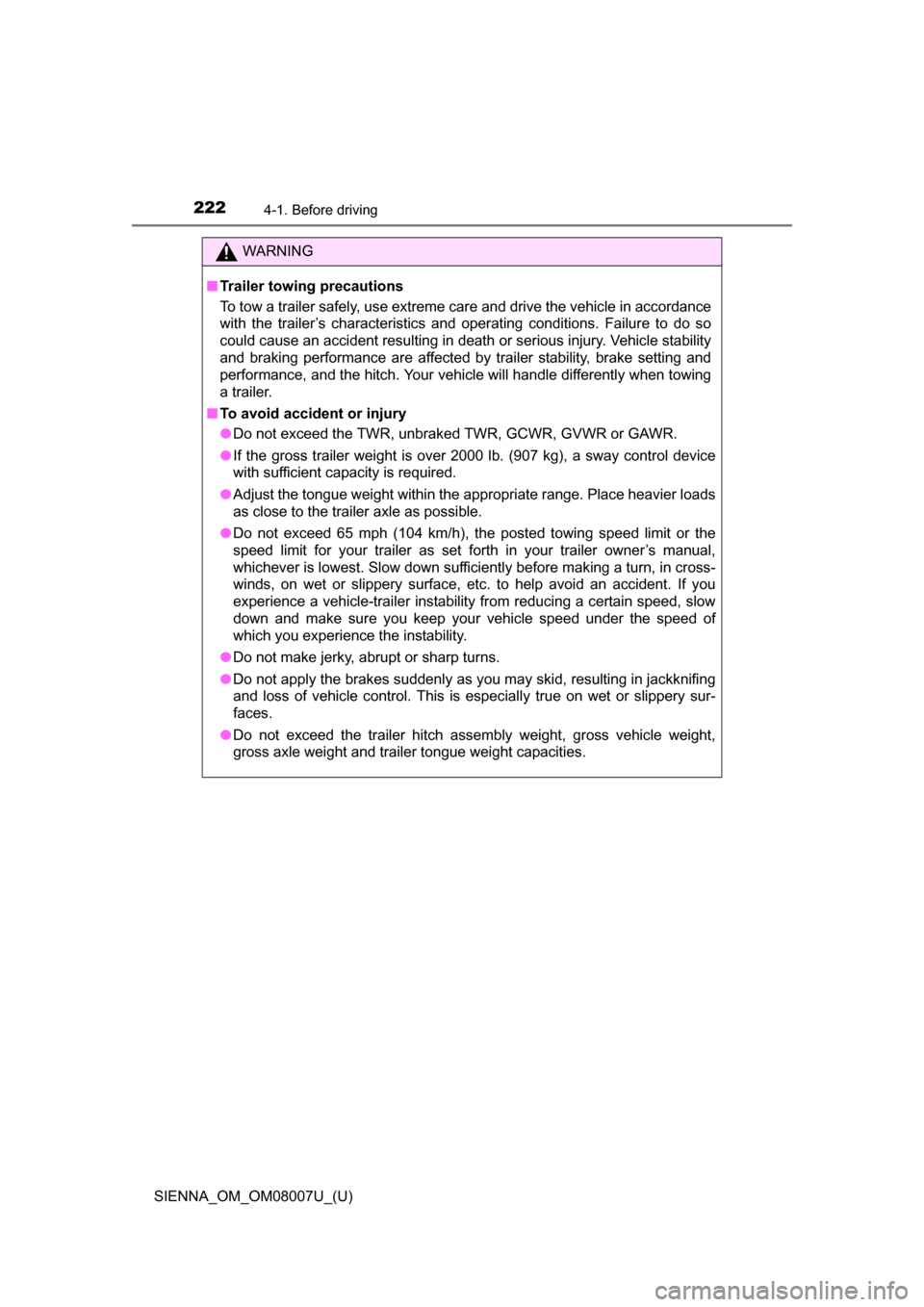
■Trailer towing precautions
To tow a trailer safely, use extreme care and drive the vehicle in accordance
with the trailer’s characteristics and operating conditions. Failure to do so
could cause an accident resulting in death or serious injury. Vehicle stability
and braking performance are affected by trailer stability, brake setting and
performance, and the hitch. Your vehi cle will handle differently when towing
a trailer.
■ To avoid accident or injury
●Do not exceed the TWR, unbraked TWR, GCWR, GVWR or GAWR.
● If the gross trailer weight is over 2000 lb. (907 kg), a sway control device
with sufficient capacity is required.
● Adjust the tongue weight within the appropriate range. Place heavier loads
as close to the trailer axle as possible.
● Do not exceed 65 mph (104 km/h), the posted towing speed limit or the
speed limit for your trailer as set forth in your trailer owner’s manual,
whichever is lowest. Slow down sufficiently before making a turn, in cross-
winds, on wet or slippery surface, etc. to help avoid an accident. If you
experience a vehicle-trailer instability from reducing a certain speed, slow
down and make sure you keep your vehicle speed under the speed of
which you experience the instability.
● Do not make jerky, abrupt or sharp turns.
● Do not apply the brakes suddenly as you may skid, resulting in jackknifing
and loss of vehicle control. This is especially true on wet or slippery sur-
faces.
● Do not exceed the trailer hitch assembly weight, gross vehicle weight,
gross axle weight and trailer tongue weight capacities.
Page 600 of 672
600
SIENNA_OM_OM08007U_(U)
9-1. Specifications
Maintenance data (fuel, oil level, etc.)
*1: Unladen vehicle
*2: The model code is indicated on the Certification Label. For details, see“Vehicle identification” below.
*3: The towing package is required.Toyota does not recommend towing with this vehicle without the towing
package.
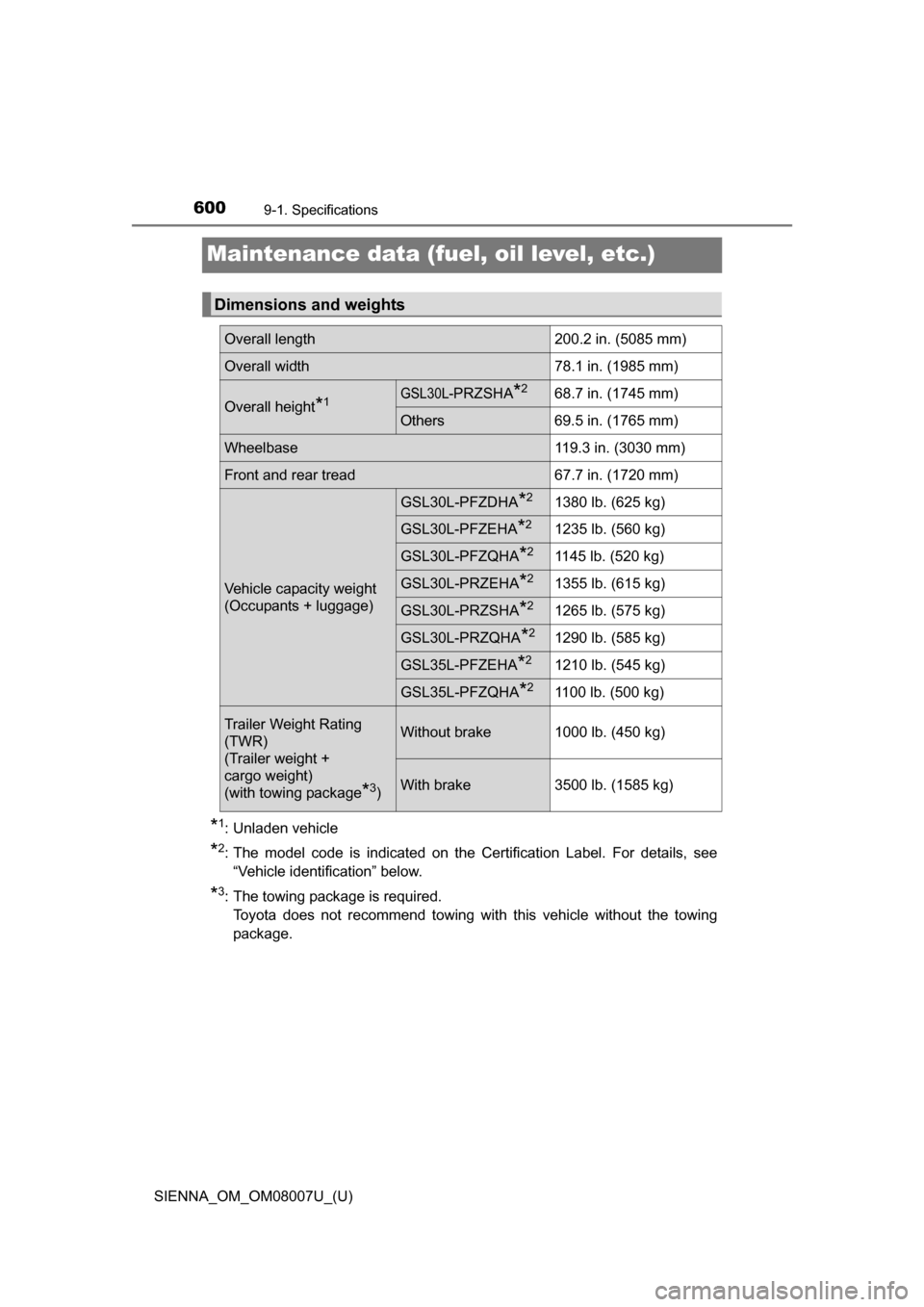
Dimensions and weights
Overall length 200.2 in. (5085 mm)
Overall width 78.1 in. (1985 mm)
Overall height*1GSL30L-PRZSHA*268.7 in. (1745 mm)
Others69.5 in. (1765 mm)
Wheelbase 119.3 in. (3030 mm)
Front and rear tread 67.7 in. (1720 mm)
Vehicle capacity weight
(Occupants + luggage)
GSL30L-PFZDHA*21380 lb. (625 kg)
GSL30L-PFZEHA*21235 lb. (560 kg)
GSL30L-PFZQHA*21145 lb. (520 kg)
GSL30L-PRZEHA*21355 lb. (615 kg)
GSL30L-PRZSHA*21265 lb. (575 kg)
GSL30L-PRZQHA*21290 lb. (585 kg)
GSL35L-PFZEHA*21210 lb. (545 kg)
GSL35L-PFZQHA*21100 lb. (500 kg)
Trailer Weight Rating
(TWR)
(Trailer weight +
cargo weight)
(with towing package
*3)
Without brake 1000 lb. (450 kg)
With brake3500 lb. (1585 kg)
Page 602 of 672
602
SIENNA_OM_OM08007U_(U)
9-1. Specifications
*: The engine oil capacity is a reference quantity to be used when changingthe engine oil. Warm up and turn off the engine, wait more than 5 minutes,
and check the oil level on the dipstick.
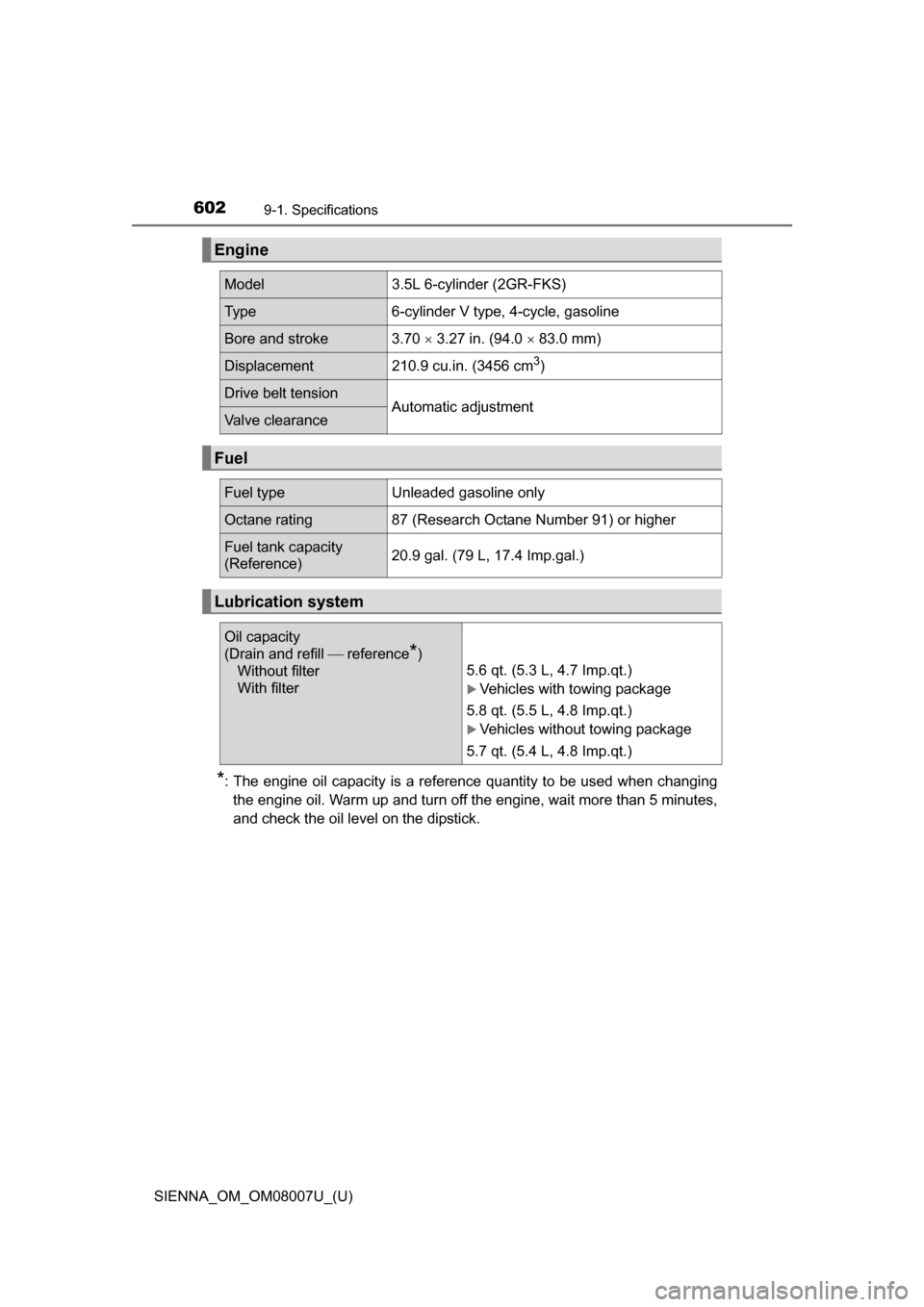
Engine
Model 3.5L 6-cylinder (2GR-FKS)
Type 6-cylinder V type, 4-cycle, gasoline
Bore and stroke 3.70 3.27 in. (94.0 83.0 mm)
Displacement 210.9 cu.in. (3456 cm3)
Drive belt tension
Automatic adjustment
Valve clearance
Fuel
Fuel type Unleaded gasoline only
Octane rating87 (Research Octane Number 91) or higher
Fuel tank capacity
(Reference) 20.9 gal. (79 L, 17.4 Imp.gal.)
Lubrication system
Oil capacity
(Drain and refill
reference
*)
Without filter
With filter 5.6 qt. (5.3 L, 4.7 Imp.qt.)
Vehicles with towing package
5.8 qt. (5.5 L, 4.8 Imp.qt.)
Vehicles without towing package
5.7 qt. (5.4 L, 4.8 Imp.qt.)
Page 604 of 672
604
SIENNA_OM_OM08007U_(U)
9-1. Specifications
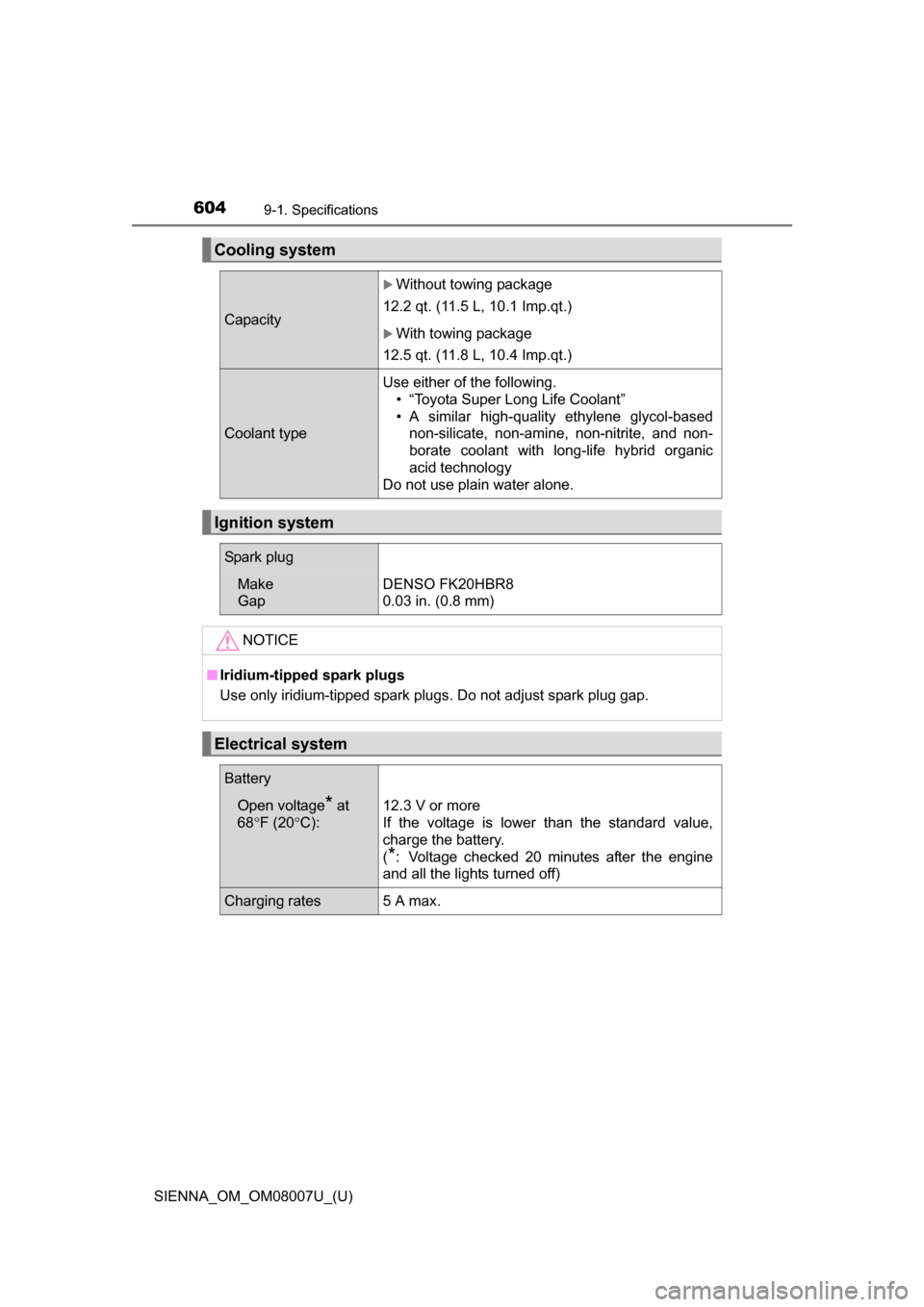
Cooling system
Capacity
Without towing package
12.2 qt. (11.5 L, 10.1 Imp.qt.)
With towing package
12.5 qt. (11.8 L, 10.4 Imp.qt.)
Coolant type Use either of the following.
• “Toyota Super Long Life Coolant”
• A similar high-quality ethylene glycol-basednon-silicate, non-amine, non-nitrite, and non-
borate coolant with long-life hybrid organic
acid technology
Do not use plain water alone.
Ignition system
Spark plug
Make
Gap DENSO FK20HBR8
0.03 in. (0.8 mm)
NOTICE
■
Iridium-tipped spark plugs
Use only iridium-tipped spark plugs. Do not adjust spark plug gap.
Electrical system
Battery
Open voltage* at
68 F (20 C): 12.3 V or more
If the voltage is lower than the standard value,
charge the battery.
(
*: Voltage checked 20 minutes after the engine
and all the lights turned off)
Charging rates 5 A max.