2017 PEUGEOT PARTNER TEPEE ELECTRIC brake
[x] Cancel search: brakePage 149 of 252
111
Hill start assist
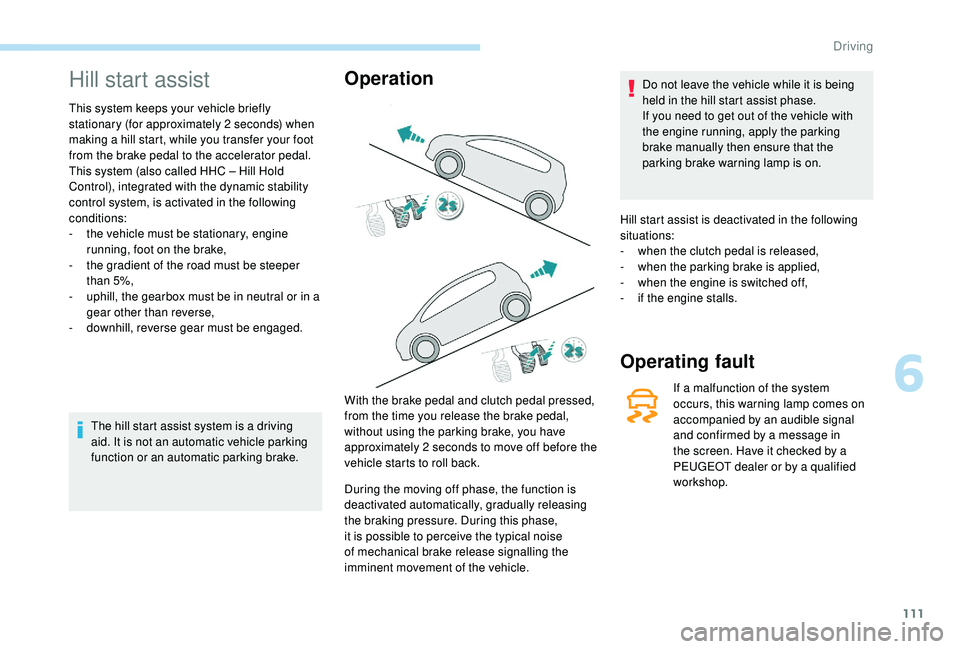
This system keeps your vehicle briefly
stationary (for approximately 2 seconds) when
making a hill start, while you transfer your foot
from the brake pedal to the accelerator pedal.
This system (also called HHC – Hill Hold
Control), integrated with the dynamic stability
control system, is activated in the following
conditions:
-
t
he vehicle must be stationary, engine
running, foot on the brake,
-
t
he gradient of the road must be steeper
than 5%,
-
u
phill, the gearbox must be in neutral or in a
gear other than reverse,
-
do
wnhill, reverse gear must be engaged.
The hill start assist system is a driving
aid. It is not an automatic vehicle parking
function or an automatic parking brake.
Operation
With the brake pedal and clutch pedal pressed,
from the time you release the brake pedal,
without using the parking brake, you have
approximately 2 seconds to move off before the
vehicle starts to roll back.
During the moving off phase, the function is
deactivated automatically, gradually releasing
the braking pressure. During this phase,
it is possible to perceive the typical noise
of mechanical brake release signalling the
imminent movement of the vehicle. Do not leave the vehicle while it is being
held in the hill start assist phase.
If you need to get out of the vehicle with
the engine running, apply the parking
brake manually then ensure that the
parking brake warning lamp is on.
Hill start assist is deactivated in the following
situations:
-
w
hen the clutch pedal is released,
-
w
hen the parking brake is applied,
-
w
hen the engine is switched off,
-
i
f the engine stalls.
Operating fault
If a malfunction of the system
occurs, this warning lamp comes on
accompanied by an audible signal
and confirmed by a message in
the screen. Have it checked by a
PEUGEOT dealer or by a qualified
workshop.
6
Driving
Page 156 of 252
118
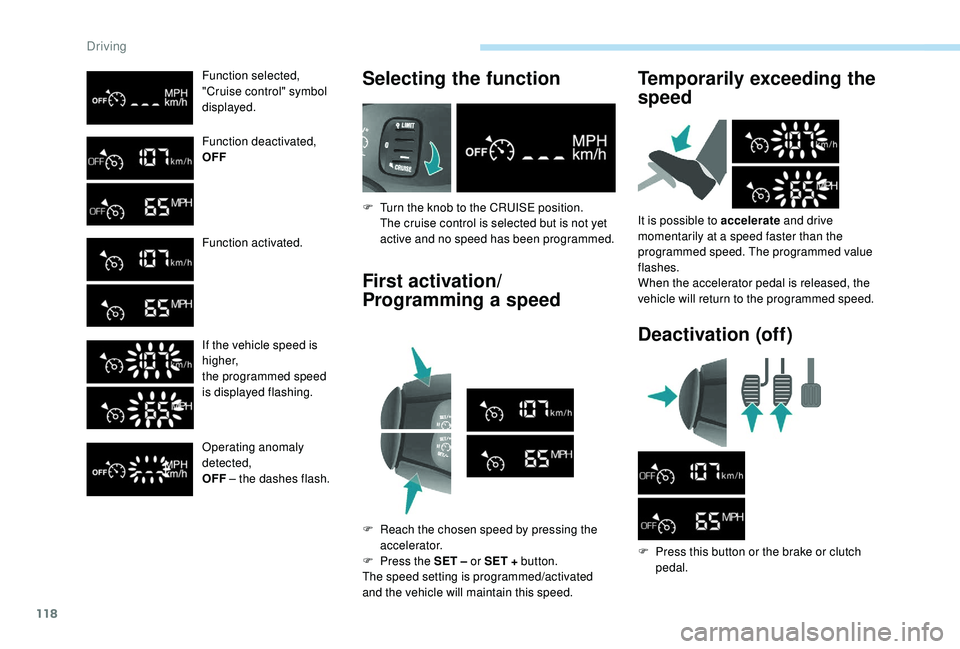
Function selected,
"Cruise control" symbol
displayed.
Function deactivated,
OFF
Function activated.
If the vehicle speed is
higher,
the programmed speed
is displayed flashing.
Operating anomaly
detected,
OFF – the dashes flash.Selecting the function
F Turn the knob to the CRUISE position.
The cruise control is selected but is not yet
active and no speed has been programmed.
First activation/
Programming a speed
F Reach the chosen speed by pressing the accelerator.
F
P
ress the SET – or SET + button.
The speed setting is programmed/activated
and the vehicle will maintain this speed.
Temporarily exceeding the
speed
It is possible to accelerate and drive
momentarily at a speed faster than the
programmed speed. The programmed value
flashes.
When the accelerator pedal is released, the
vehicle will return to the programmed speed.
Deactivation (off)
F Press this button or the brake or clutch pedal.
Driving
Page 158 of 252
120
When changing the programmed
reference speed by means of a maintained
press, remain vigilant as the speed can
increase or decrease rapidly.
Do not use the cruise control on slippery
roads or in heavy traffic.
When descending a steep hill, the cruise
control system cannot prevent the vehicle
from exceeding the programmed speed.
The cruise control system cannot in
any circumstances replace the need
to obser ve speed limits or the need for
vigilance on the part of the driver.
It is advisable to leave your feet near the
pedals.
To avoid any jamming under the pedals:
-
e
nsure that the mat is positioned and
secured to the floor correctly,
-
n
ever fit one mat on top of another.
Active City Brake
Active City Brake is a driving assistance
system that aims to avoid a frontal collision
or reduce the speed of an impact if the driver
does not react sufficiently (inadequate brake
application). This system has been designed to
improve driving safety.
The driver must always check the traffic
and assess the distance and relative
speed of other vehicles.
Active City Brake cannot in any
circumstances replace the need for
vigilance on the part of the driver.
Never look at the laser sensor through
an optical instrument (magnifying glass,
microscope, etc.) at a distance of less
than 10
centimetres: risk of eye injury!
Principle
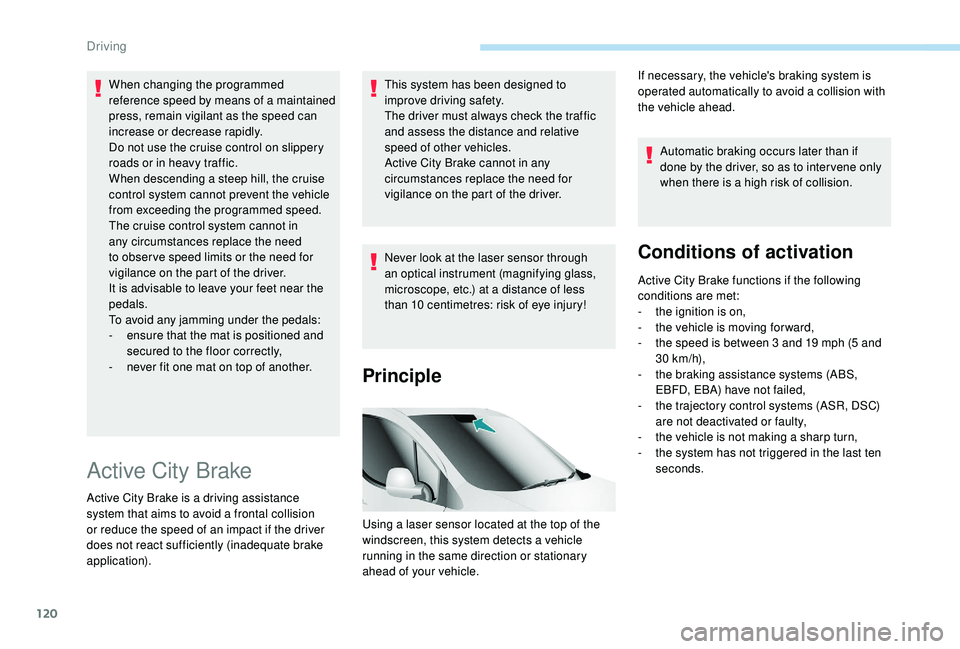
Using a laser sensor located at the top of the
windscreen, this system detects a vehicle
running in the same direction or stationary
ahead of your vehicle.Automatic braking occurs later than if
done by the driver, so as to inter vene only
when there is a high risk of collision.
Conditions of activation
Active City Brake functions if the following
conditions are met:
-
t
he ignition is on,
-
t
he vehicle is moving for ward,
-
t
he speed is between 3 and 19 mph (5 and
30
km/h),
-
t
he braking assistance systems (ABS,
EBFD, EBA) have not failed,
-
t
he trajectory control systems (ASR, DSC)
are not deactivated or faulty,
-
t
he vehicle is not making a sharp turn,
-
t
he system has not triggered in the last ten
seconds.
If necessary, the vehicle's braking system is
operated automatically to avoid a collision with
the vehicle ahead.
Driving
Page 159 of 252
121
Operation
When your vehicle is too close to or
approaches the vehicle ahead too quickly, the
system automatically applies the brakes to
avoid a collision.
You are then warned by the display of a
message.
Your vehicle's brake lamps come on to warn
other road users.The collision can be avoided if the speed
difference between your vehicle and
the one ahead is not more than 9
mph
(15
km/h).
Above this threshold, the system will do
what is possible to avoid or reduce the
accident by lowering the speed of impact.
The automatic braking can bring the vehicle to
a complete stop if the situation requires it.
In this case, the vehicle is held stationary
temporarily (for about 1.5
seconds) to allow
the driver to take back control by pressing the
brake pedal.
Unless the driver presses the clutch
quickly enough during automatic braking,
triggering of the system may cause the
engine to stall. During automatic braking, the driver can
always obtain a higher rate of deceleration
than that controlled by the system, by
pressing firmly on the brake pedal.
After an impact, the system is
automatically put out of ser vice: it no
longer operates.
You must go to a PEUGEOT dealer or a
qualified workshop to have the system
made operational again.
Operating limits
The system only detects vehicles that are
stationary or moving in the same direction as
your vehicle.
It does not detect small vehicles (bicycles,
motorcycles), pedestrians or animals, nor
non-reflective stationary objects.
This system will not trigger or will be interrupted
if the driver:
-
a
ccelerates hard
-
o
r turns the steering wheel sharply
(avoidance manoeuvre). When weather conditions are difficult
(extremely heavy rain, snow, fog, hail,
etc.), braking distances increase, which
may reduce the system’s ability to avoid a
collision.
The driver must therefore remain
particularly cautious.
Never let snow build up on the bonnet
or any object beyond the bonnet or the
front of the roof: this could enter the
field of vision of the sensor and obstruct
detection.Deactivation
The system is deactivated in the vehicle
configuration menu, accessible with the ignition
on.
Its status is stored when the ignition is switched off.
When the system is deactivated, a
message is displayed every time the
ignition is switched on, to warn you.
6
Driving
Page 167 of 252
129
Travelling abroad
Certain fuels could damage your vehicle's
engine.
In certain countries, the use of a particular
fuel may be required (specific octane rating,
specific trade name, etc.) to ensure correct
operation of the engine.
For any additional information, contact a dealer.
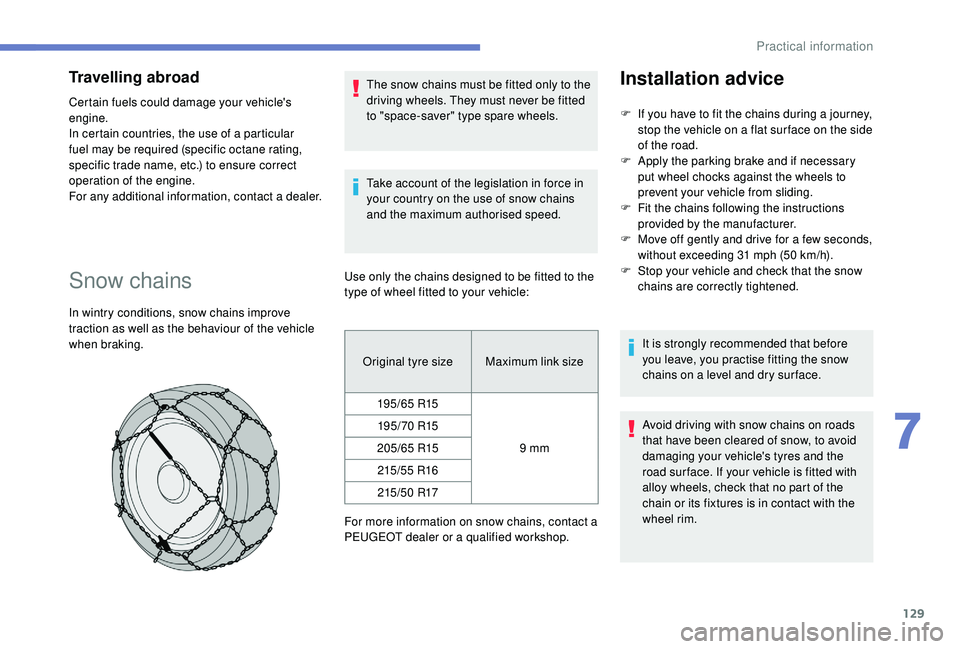
Snow chains
In wintry conditions, snow chains improve
traction as well as the behaviour of the vehicle
when braking.The snow chains must be fitted only to the
driving wheels. They must never be fitted
to "space-saver" type spare wheels.
Take account of the legislation in force in
your country on the use of snow chains
and the maximum authorised speed.
Use only the chains designed to be fitted to the
type of wheel fitted to your vehicle:
Original tyre size Maximum link size
195/65 R15
9
mm
19 5/ 70 R15
205/65 R15 215/5 5 R16215 / 5 0 R17
For more information on snow chains, contact a
PEUGEOT dealer or a qualified workshop. It is strongly recommended that before
you leave, you practise fitting the snow
chains on a level and dry sur face.
Avoid driving with snow chains on roads
that have been cleared of snow, to avoid
damaging your vehicle's tyres and the
road sur face. If your vehicle is fitted with
alloy wheels, check that no part of the
chain or its fixtures is in contact with the
wheel rim.
Installation advice
F If you have to fit the chains during a journey,
stop the vehicle on a flat sur face on the side
of the road.
F
A
pply the parking brake and if necessary
put wheel chocks against the wheels to
prevent your vehicle from sliding.
F
F
it the chains following the instructions
provided by the manufacturer.
F
M
ove off gently and drive for a few seconds,
without exceeding 31
mph (50 km/h).
F
S
top your vehicle and check that the snow
chains are correctly tightened.
7
Practical information
Page 174 of 252
136
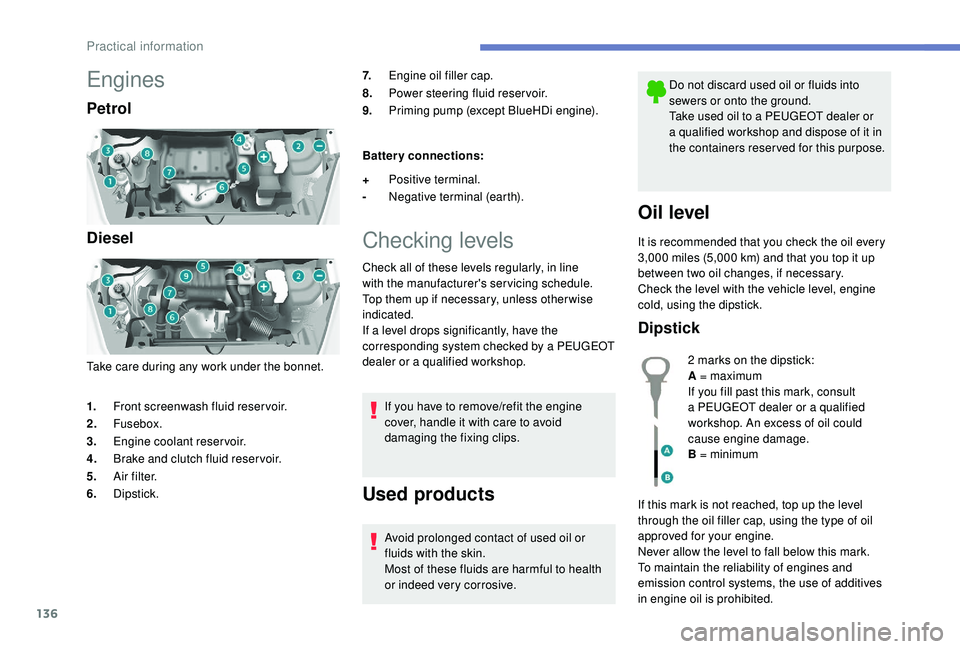
Engines
Petrol
Diesel
Take care during any work under the bonnet.7.
Engine oil filler cap.
8. Power steering fluid reservoir.
9. Priming pump (except BlueHDi engine).
Battery connections:
Checking levels
Check all of these levels regularly, in line
with the manufacturer's servicing schedule.
Top them up if necessary, unless other wise
indicated.
If a level drops significantly, have the
corresponding system checked by a PEUGEOT
dealer or a qualified workshop. If you have to remove/refit the engine
cover, handle it with care to avoid
damaging the fixing clips.
Used products
Avoid prolonged contact of used oil or
fluids with the skin.
Most of these fluids are harmful to health
or indeed very corrosive. Do not discard used oil or fluids into
sewers or onto the ground.
Take used oil to a PEUGEOT dealer or
a qualified workshop and dispose of it in
the containers reser ved for this purpose.
Oil level
It is recommended that you check the oil every
3,000
miles (5,000 km) and that you top it up
between two oil changes, if necessary.
Check the level with the vehicle level, engine
cold, using the dipstick.
Dipstick
1. Front screenwash fluid reser voir.
2. Fusebox.
3. Engine coolant reservoir.
4. Brake and clutch fluid reser voir.
5. A i r f i l t e r.
6. Dipstick. +
Positive terminal.
- Negative terminal (earth).
2 marks on the dipstick:
A = maximum
If you fill past this mark, consult
a PEUGEOT dealer or a qualified
workshop. An excess of oil could
cause engine damage.
B = minimum
If this mark is not reached, top up the level
through the oil filler cap, using the type of oil
approved for your engine.
Never allow the level to fall below this mark.
To maintain the reliability of engines and
emission control systems, the use of additives
in engine oil is prohibited.
Practical information
Page 175 of 252
137
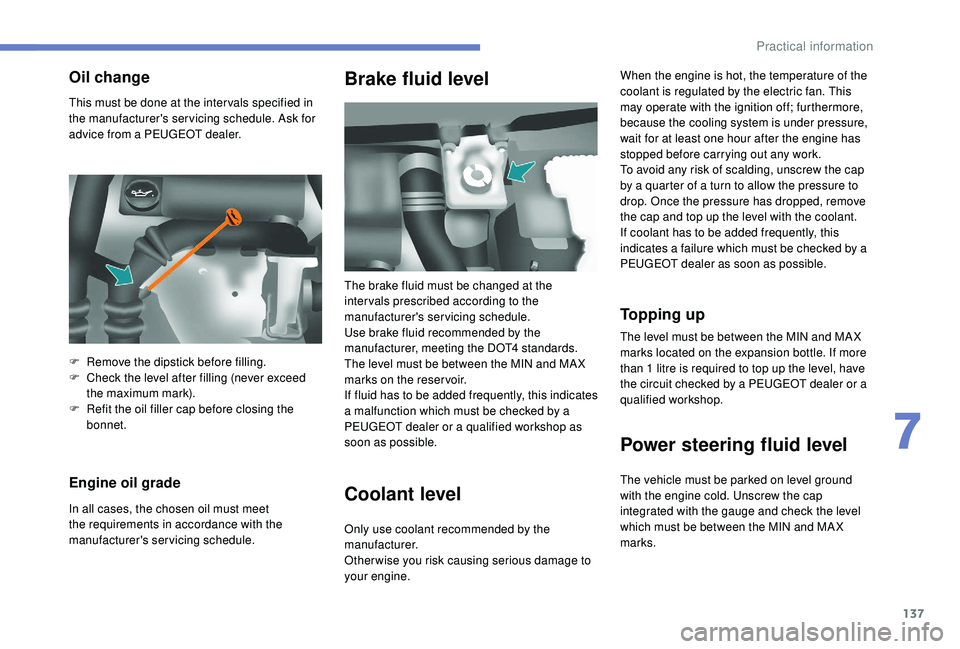
This must be done at the inter vals specified in
the manufacturer's servicing schedule. Ask for
advice from a PEUGEOT dealer.
Engine oil grade
In all cases, the chosen oil must meet
the requirements in accordance with the
manufacturer's servicing schedule.
Brake fluid level
Coolant levelWhen the engine is hot, the temperature of the
coolant is regulated by the electric fan. This
may operate with the ignition off; furthermore,
because the cooling system is under pressure,
wait for at least one hour after the engine has
stopped before carrying out any work.
To avoid any risk of scalding, unscrew the cap
by a quarter of a turn to allow the pressure to
drop. Once the pressure has dropped, remove
the cap and top up the level with the coolant.
If coolant has to be added frequently, this
indicates a failure which must be checked by a
PEUGEOT dealer as soon as possible.
To p p i n g u p
Oil change
The brake fluid must be changed at the
inter vals prescribed according to the
manufacturer's servicing schedule.
Use brake fluid recommended by the
manufacturer, meeting the DOT4 standards.
The level must be between the MIN and MA X
marks on the reservoir.
If fluid has to be added frequently, this indicates
a malfunction which must be checked by a
PEUGEOT dealer or a qualified workshop as
soon as possible.
Only use coolant recommended by the
manufacturer.
Otherwise you risk causing serious damage to
your engine.
F
R
emove the dipstick before filling.
F
C
heck the level after filling (never exceed
the maximum mark).
F
R
efit the oil filler cap before closing the
bonnet. The level must be between the MIN and MA X
marks located on the expansion bottle. If more
than 1
litre is required to top up the level, have
the circuit checked by a PEUGEOT dealer or a
qualified workshop.
Power steering fluid level
The vehicle must be parked on level ground
with the engine cold. Unscrew the cap
integrated with the gauge and check the level
which must be between the MIN and MA X
marks.
7
Practical information
Page 176 of 252
138
Screenwash fluid level
For optimal cleaning quality and safety, we
recommend that you use the PEUGEOT range
of products.
For optimum cleaning and to avoid freezing,
this fluid must not be topped up or replaced
with plain water.
Capacity of the screenwash reser voir:
approximately 3
litres.
Diesel additive level (Diesel
engine with particle filter)
A low additive level is indicated by
illumination of the Ser vice warning
lamp, accompanied by an audible
warning and a message on the screen.
If the message is still displayed and the Ser vice
warning lamp remains lit, consult a PEUGEOT
dealer or a qualified workshop.
To p p i n g u p
This additive must be topped up without delay
by a PEUGEOT dealer or a qualified workshop.
Checks
Battery
The battery does not require any
maintenance.
However, check regularly that the
terminals are correctly tightened
(versions without quick release
terminals) and that the connections
are clean.
Versions equipped with Stop & Start are
fitted with a 12
V lead-acid battery of
specific technology and specification.
Its replacement should be carried out
only by a PEUGEOT dealer or a qualified
workshop.
Brake pads
Brake wear depends on the style
of driving, particularly in the case
of vehicles used in town, over short
distances. It may be necessary to
have the condition of the brakes
checked, even between vehicle
services.
Unless there is a leak in the circuit, a drop in
the brake fluid level indicates that the brake
pads are worn.
Brake disc/drum wear
For information on checking
brake disc/drum wear, contact a
PEUGEOT dealer or a qualified
workshop.
Parking brake
If excessive travel or a loss of
effectiveness of this system is
noticed, the parking brake must
be checked, even between two
services.
This system must be checked by a PEUGEOT
dealer or a qualified workshop.
Once the engine is started, this signals that
the particle filter is starting to saturate (in
conditions of urban driving of exceptionally long
duration: low speeds, traffic jams, etc.).
To regenerate the filter, you are advised to
drive as soon as possible, as traffic conditions
allow, at a speed of at least 37
mph (around
60
km/h) for at least five minutes (until the
Ser vice warning lamp goes off and the
message disappears).
Relay noises may be heard under the
dashboard during regeneration of the particle
f i l t e r. At the start of winter, have your battery checked
by a PEUGEOT dealer or a qualified workshop.
Practical information