Page 286 of 566
284
3008-2_en_Chap07_infos-pratiques_ed01-2016
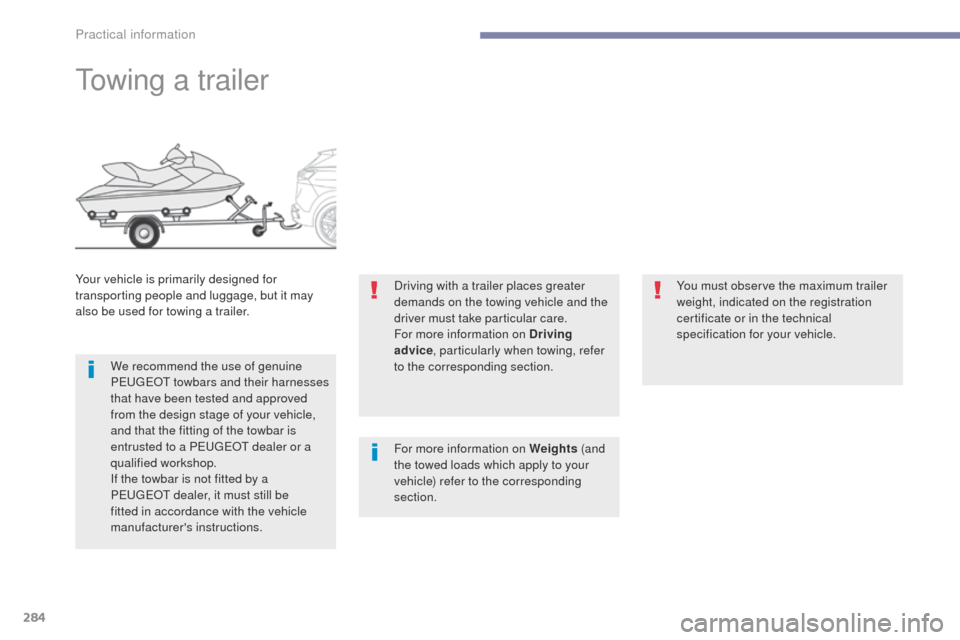
Towing a trailer
Your vehicle is primarily designed for
transporting people and luggage, but it may
also be used for towing a trailer.We recommend the use of genuine
PEUGEOT towbars and their harnesses
that have been tested and approved
from the design stage of your vehicle,
and that the fitting of the towbar is
entrusted to a PEUGEOT dealer or a
qualified workshop.
If the towbar is not fitted by a
PEUGEOT dealer, it must still be
fitted in accordance with the vehicle
manufacturer's instructions. Driving with a trailer places greater
demands on the towing vehicle and the
driver must take particular care.
For more information on Driving
advice
, particularly when towing, refer
to the corresponding section.
For more information on Weights (and
the towed loads which apply to your
vehicle) refer to the corresponding
section. You must observe the maximum trailer
weight, indicated on the registration
certificate or in the technical
specification for your vehicle.
Practical information
Page 287 of 566
285
3008-2_en_Chap07_infos-pratiques_ed01-2016
Towbar with quickly detachable towball
Presentation
A. Locked position
The latch is positioned to the right.
The trigger is facing toward the rear.
B. Unlocked position
The latch is positioned to the left.
The trigger is facing toward the front.Observe the legislation in force in the
country in which you are driving.
For information on the trailer weights
for your vehicle, refer to the "Technical
data" section.
For driving safely when Towing a
trailer, refer to the corresponding
section.
No tools are required to install or remove the
towball on this genuine towbar system.
1.
Carrier.
2.
P
rotective plug.
3.
S
afety eye.
4.
T
rauiler wiring harness connection socket.
5.
D
etachable towball.
6.
L
ocking / unlocking latch.
7.
L
ocking / unlocking trigger.
8.
K
ey-operated safety lock.
9.
S
afety lock protective cap.
10.
S
towing bag.
7
Practical information
Page 288 of 566
286
3008-2_en_Chap07_infos-pratiques_ed01-2016
Before each use
Check that the towball is correctly fitted, verifying the follow points:
- t he towball is correctly engaged (position A ),
-
t
he safety lock is on and the key removed; the trigger can no longer be operated,
-
t
he towball must not be able to move in its carrier; test by shaking it with your hand.
If the towball is not locked, the trailer could separate - Risk of an accident!
During use
Never release the locking system with a trailer or load carrier on the towball.
Never exceed the maximum authorised weight for the vehicle plus trailer - the Gross Train
Weight or GTW.
You must not exceed the maximum nose weight on the towbar: if exceeded, this could result
in detachment from the vehicle - Risk of an accident!
Check that the trailer lighting and signalling work correctly.
Before setting off, check the adjustment of the headlamp beam height.
For more information on Adjusting the headlamp beam height , refer to the corresponding
section.
Following use
When travelling without a trailer or load on a towbar-mounted carrier, the towball must be
removed and the protective plug inserted in the carrier. This measure applies particularly
where the towball might obscure visibility of the number plate or its lighting.
Maintenance
Correct operation is only possible if the towball
and its carrier are kept clean.
Before cleaning the vehicle with a high-
pressure jet wash, the towball must be removed
and the protective plug fitted to the carrier.
Go to a PEUGEOT dealer or a qualified
workshop for any work on the towbar system.
Practical information
Page 290 of 566
288
3008-2_en_Chap07_infos-pratiques_ed01-2016
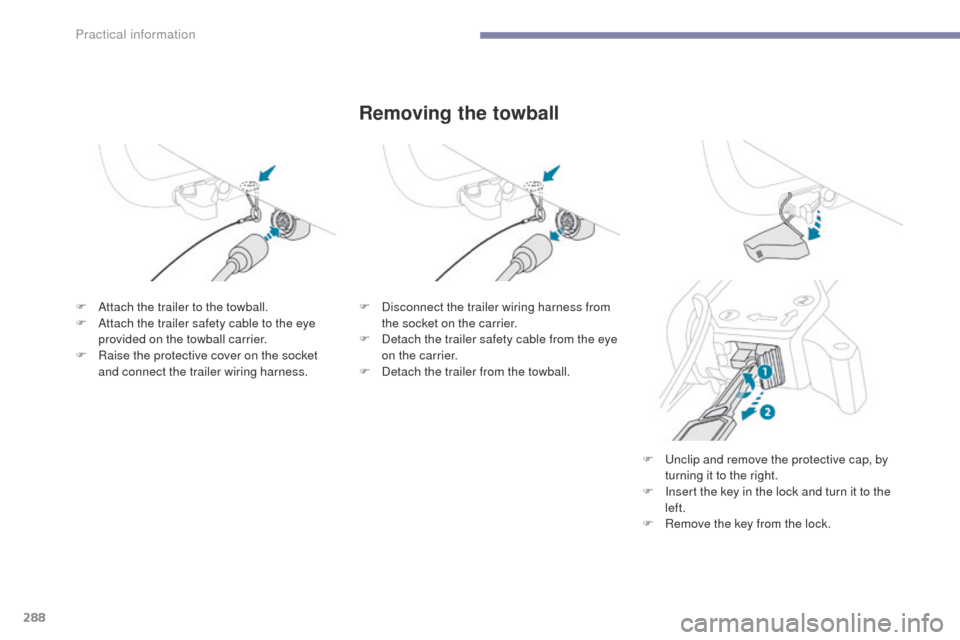
Removing the towball
F Attach the trailer to the towball.
F A ttach the trailer safety cable to the eye
provided on the towball carrier.
F
R
aise the protective cover on the socket
and connect the trailer wiring harness. F
D isconnect the trailer wiring harness from
the socket on the carrier.
F
D
etach the trailer safety cable from the eye
on the carrier.
F
D
etach the trailer from the towball.
F
U
nclip and remove the protective cap, by
turning it to the right.
F
I
nsert the key in the lock and turn it to the
left.
F
R
emove the key from the lock.
Practical information
Page 341 of 566

339
3008-2_en_Chap09_caracteristiques_ed01-2016
Petrol weights and towed loads (in kg)
The GTW and towed load values indicated are valid up to a maximum altitude of 1 000 metres; the towed load mentioned must be reduced by 10 % for
each additional 1 000 metres of altitude.
When towing the maximum authorised speed is reduced (comply with the legislation in force in your country).
High ambient temperatures may result in a reduction in the per formance of the vehicle to protect the engine; if the ambient temperature is above 37 °C,
limit the towed load.Petrol engine
1.2 litre PureTech 130 S&S 1.6 litre THP 150 1.6 litre THP 160 1.6 litre THP 165
S&S
Gearbox Manual
(6- speed) E AT 6
automatic (6- speed) E AT 6
automatic (6- speed) E AT 6
automatic (6- speed) E AT 6
automatic (6- speed)
Model code:
MR... M4... HNYH/S -
HNYH/1S HNY W/S -
HNY W/1S 5FEA
5FMA5GZW/S
Unladen weight 1 250 - 1 254---1 300
Kerb weight* 1 325 - 1 329---1 375
Gross vehicle weight (GV W) 1 910---1 950
Gross train weight (GTW)
on a 12% gradient 3 310 - 3 210
---3 500
Braked trailer (within the GTW limit)
on a 10% or 12% gradient 1 400 - 1 300
---1 550
Unbraked trailer 660---685
Recommended nose weight 70---70
* The kerb weight is equal to the unladen weight + driver (75 kg).
9
Technical data
Page 344 of 566

342
3008-2_en_Chap09_caracteristiques_ed01-2016
Diesel weights and towed loads (in kg)
The GTW and towed load values indicated are valid up to a maximum altitude of 1 000 metres; the towed load mentioned must be reduced by 10 % for
each additional 1 000 metres of altitude.
When towing, the maximum authorised speed is reduced (comply with the legislation in force in your country).
High ambient temperatures may result in a reduction in the per formance of the vehicle to protect the engine; if the ambient temperature is above 37 °C,
limit the towed load.Diesel engine
1.6 litre BlueHDi
100 S&S 1.6 litre BlueHDi 115 S&S
1.6 litre BlueHDi 120 S&S
Gearbox Manual
(5 -speed ) Manual
(6- speed) E AT 6
automatic (6- speed) Manual
(6- speed) E AT 6
automatic (6- speed)
Model code:
MC... BHY6/SBHXH/S -
BHXH/1S BHXW/SBHZH/S -
BHZH/1S BHZW/S
Unladen weight -1 300 - 1 304 1 3151 300 - 1 304 1 315
Kerb weight* -1 375 - 1 379 1 390 1 375 - 1 379 1 390
Gross vehicle weight (GV W) -1 970 - 1 980 1 990 1 970 - 1 980 1 990
Gross train weight (GTW)
on a 12% gradient -
3 470 - 3 380 3 290 3 470 - 3 380 3 290
Braked trailer (within the GTW limit)
on a 10% or 12% gradient -
1 500 - 1 400 1 300 1 500 - 1 400 1 300
Unbraked trailer -685 695685695
Recommended nose weight -70 707070
* The kerb weight is equal to the unladen weight + driver (75 kg).
Technical data
Page 345 of 566

343
3008-2_en_Chap09_caracteristiques_ed01-2016
The GTW and towed load values indicated are valid up to a maximum altitude of 1 000 metres; the towed load mentioned must be reduced by 10 % for
each additional 1 000 metres of altitude.
When towing, the maximum authorised speed is reduced (comply with the legislation in force in your country).
High ambient temperatures may result in a reduction in the per formance of the vehicle to protect the engine; if the ambient temperature is above 37 °C,
limit the towed load.Diesel engine
2.0 litre BlueHDi 150
2.0 litre BlueHDi 150 S&S 2.0 litre BlueHDi 180 S&S
GearboxManual
(6- speed) EAT6 automatic
(6- speed) Manual
(6- speed) EAT6 automatic
(6- speed)
Model code:
MJ... -
-AHRH/S
AHSH/S
AHXH/S AHWW/S
Unladen weight --1 425 1 465
Kerb weight* --1 500 1 540
Gross vehicle weight (GV W) --2 050 2 090
Gross train weight (GTW)
on a 12% gradient -
-3 700 3 730
Braked trailer (within the GTW limit)
on a 10% or 12% gradient -
-1 650 1 640
Unbraked trailer --74 5 750
Recommended nose weight --70 70
* The kerb weight is equal to the unladen weight + driver (75 kg).
Diesel weights and towed loads (in kg)
9
Technical data
Page 347 of 566

345
3008-2_en_Chap09_caracteristiques_ed01-2016
Identification markings
A. Vehicle identification number (VIN), under the bonnet.
The number is engraved on the body structure. D. Tyres / paint code label.
This label is affixed to the driver's door
aperture.
It bears the following information on the tyres:
-
t
he tyre pressures, unladen and laden,
-
t
he reference, size, type, load index and
speed rating,
-
t
he spare tyre pressure.
It also indicates the paint colour code.
B.
V
ehicle identification number (VIN),
on the dashboard.
The number is on a label, visible through the
windscreen.
Never reduce the pressure of a warm
tyre.
Low tyre pressures increase fuel
consumption.
Different visible markings for the identification of your vehicle.
Checking tyre pressures
The tyre pressures should be checked when
cold at least monthly.
The pressures given on the label are valid for
cold tyres. If you have driven for more than
10 minutes or more than 6 miles (10 kilometres)
at more than 30 mph (50 km/h), the tyres will be
warm; in this case 0.3 bar (30 kPa) should be
added to the pressures given on the label.
C. Manufacturer's label.
This self-destructing label is affixed to the right-
hand door aperture.
It bears the following information:
-
t
he name of the manufacturer,
-
t
he European Whole Vehicle Type Approval
number,
-
t
he vehicle identification number (VIN),
-
t
he maximum authorised vehicle weight
(the Gross Vehicle Weight or GV W),
-
t
he maximum authorised vehicle + trailer
weight (the Gross Train Weight or GTW),
-
t
he maximum weight on the front axle,
-
t
he maximum weight on the rear axle.
9
Technical data