Page 336 of 416
contact your skin, eyes, fabrics or
painted surfaces. After touching a
battery or battery cap, do not touch
or rub your eyes. Thoroughly wash
your hands. If the acid contacts your
eyes, skin or clothing, immediately
flush with water for at least 15
minutes and seek medical attention.
. Do not operate the vehicle if the
fluid in the battery is low. Low
battery fluid can cause a higher load
on the battery which can generate
heat, reduce battery life, and in
some cases lead to an explosion.
. When working on or near a battery,
always wear suitable eye protection
and remove all jewelry.
. Battery posts, terminals and related
accessories contain lead and lead
compounds. Wash hands after
handling.
. Keep the battery out of the reach of
children.
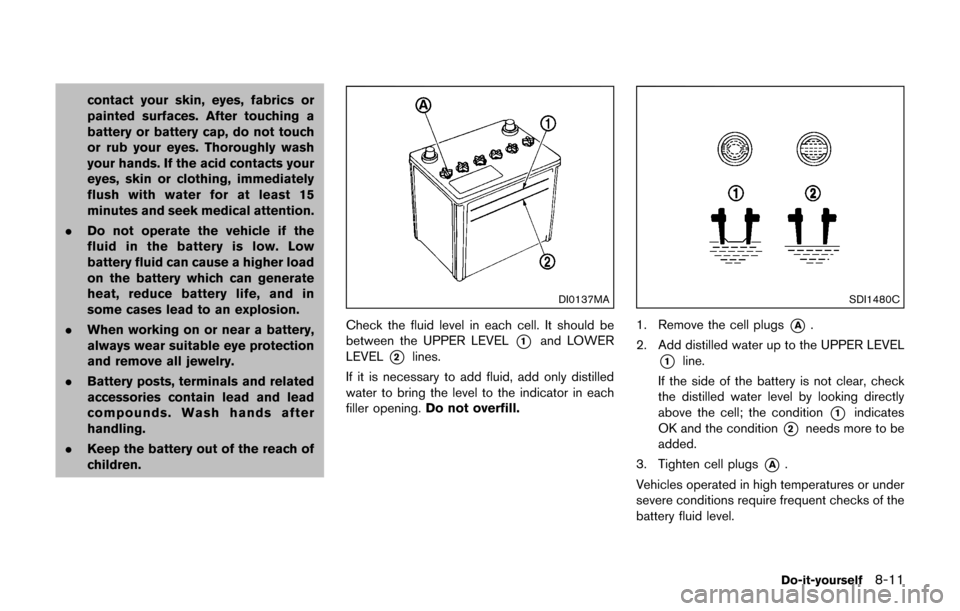
DI0137MA
Check the fluid level in each cell. It should be
between the UPPER LEVEL
*1and LOWER
LEVEL
*2lines.
If it is necessary to add fluid, add only distilled
water to bring the level to the indicator in each
filler opening. Do not overfill.
SDI1480C
1. Remove the cell plugs*A.
2. Add distilled water up to the UPPER LEVEL
*1line.
If the side of the battery is not clear, check
the distilled water level by looking directly
above the cell; the condition
*1indicates
OK and the condition
*2needs more to be
added.
3. Tighten cell plugs
*A.
Vehicles operated in high temperatures or under
severe conditions require frequent checks of the
battery fluid level.
Do-it-yourself8-11
Page 337 of 416
8-12Do-it-yourself
JUMP STARTING
If jump starting is necessary, see “Jump starting”
(P.6-9) . If the engine does not start by jump
starting, the battery may have to be replaced. It
is recommended you visit a NISSAN dealer for
this service.CAUTION
.Do not ground accessories directly
to the battery terminal. Doing so will
bypass the variable voltage control
system and the vehicle battery may
not charge completely.
. Use electrical accessories with the
engine running to avoid discharging
the vehicle battery.
The variable voltage control system measures
the amount of electrical discharge from the
battery and controls voltage generated by the
generator.
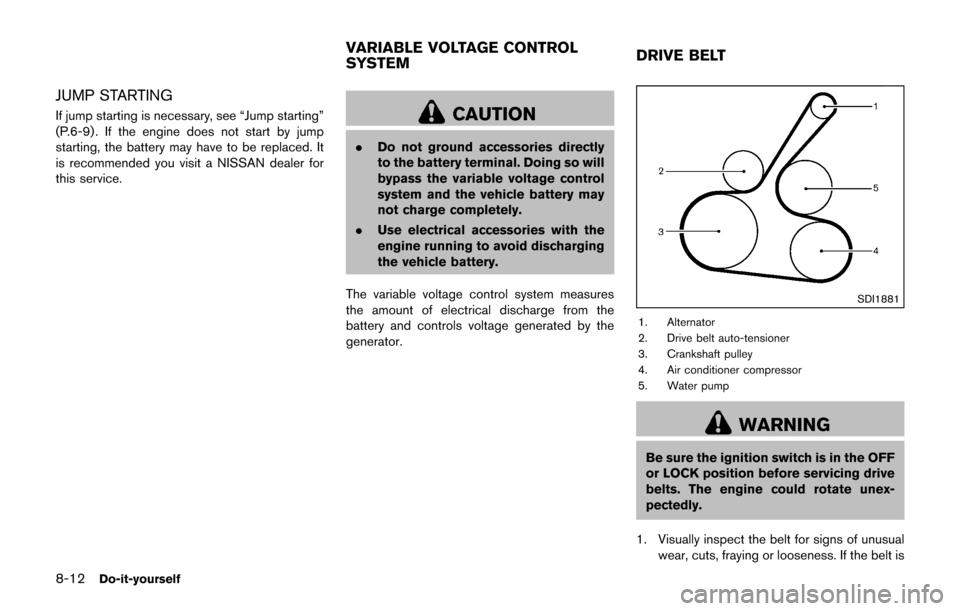
SDI1881
1. Alternator
2. Drive belt auto-tensioner
3. Crankshaft pulley
4. Air conditioner compressor
5. Water pump
WARNING
Be sure the ignition switch is in the OFF
or LOCK position before servicing drive
belts. The engine could rotate unex-
pectedly.
1. Visually inspect the belt for signs of unusual wear, cuts, fraying or looseness. If the belt is
VARIABLE VOLTAGE CONTROL
SYSTEM DRIVE BELT
Page 345 of 416

8-20Do-it-yourself
SDI2705
Extended storage fuse switch (if so
equipped)
To reduce battery drain, the extended storage
fuse switch comes from the factory switched off.
Prior to delivery of your vehicle, the switch is
pushed in (switched on) and should always
remain on.
If the extended storage fuse switch is not
pushed in (switched on) , the meter may display
a warning message. See “Extended storage fuse
warning message” (P.2-9).
If any electrical equipment does not operate,
remove the extended storage fuse switch and
check for an open fuse.NOTE:
If the extended storage fuse switch mal-
functions or if the fuse is open, it is not
necessary to replace the switch. In this
case, remove the extended storage fuse
switch and replace it with a new fuse of the
same rating.
How to remove the extended storage fuse
switch:
1. To remove the extended storage fuse switch,
be sure the ignition switch is in the OFF or
LOCK position.
2. Be sure the headlight switch is in the OFF position.
3. Remove the fuse box cover.
4. Pinch the storage fuse switch and pull it in the direction illustrated.
CAUTION
Be careful not to allow children to
swallow the battery and removed parts.
INTELLIGENT KEY BATTERY
REPLACEMENT
Page 346 of 416

SDI2451
Replace the battery in the Intelligent Key as
follows:
1. Remove the mechanical key from the In-telligent Key.
2. Insert a small screwdriver into the slit of the corner and twist it to separate the upper part
from the lower part. Use a cloth to protect the casing.
3. Replace the battery with a new one.
Recommended battery:
CR2025 or equivalent
.Do not touch the internal circuit andelectric terminals as doing so could
cause a malfunction.
.Hold the battery by the edges. Holdingthe battery across the contact points will
seriously deplete the storage capacity.
.Make sure that the +side faces the
bottom of the case.
SDI2452
4. Align the tips of the upper and lower parts
*1, and then push them together*2until it
is securely closed.
5. Operate the buttons to check its operation.
If you need any assistance for replacement, it is
recommended you visit a NISSAN dealer for this
service.
FCC Notice:
For USA:
This device complies with Part 15 of the
FCC Rules. Operation is subject to the
following two conditions: (1) This device
may not cause harmful interference, and
(2) this device must accept any interfer-
Do-it-yourself8-21
Page 350 of 416
Left side of the vehicle
Disconnect the battery negative cable before
replacing bulbs.
1. Remove clip
*A.
2. Pull up part
*Bof the air duct, and then
move part
*Csideways.
3. Remove the air duct
*D.
4. Remove back cover
*E.
5. Disconnect connector
*F.
6. Turn and pull out socket
*G, and then
remove the bulb.
JVM0489X
Right side of the vehicle
Disconnect the battery negative cable before
replacing bulbs.
1. Remove clip
*A.
2. Remove washer inlet
*B.
3. Remove back cover
*C.
4. Disconnect connector
*D.
5. Turn and pull out socket
*E, and then
remove the bulb.
Do-it-yourself8-25
Page 371 of 416

9-4Maintenance and schedules
hard steering or strange noises.
Warning lights and chimes:Make sure that
all warning lights and chimes are operating
properly.
Windshield defroster: Check that the air
comes out of the defroster outlets properly and
in sufficient quantity when operating the heater
or air conditioner.
Windshield wiper and washer*: Check that
the wipers and washers operate properly and
that the wipers do not streak.
Under the hood and vehicle
The maintenance items listed here should be
checked periodically (for example, each time you
check the engine oil or refuel) .
Battery*: Check the fluid level in each cell.
It should be between the MAX and MIN lines.
Vehicles operated in high temperatures or under
severe condition require frequent checks of the
battery fluid level.
NOTE:
Care should be taken to avoid situations
that can lead to potential battery discharge
and potential no-start conditions such as:
1. Installation or extended use of electro-
nic accessories that consume battery
power when the engine is not running (Phone chargers, GPS, DVD players,
etc.)
2. Vehicle is not driven regularly and/or
only driven short distances.
In these cases, the battery may need to be
charged to maintain battery health.
Brake and clutch fluid level*: Make sure that
the brake and clutch fluid level is between the
MAX and MIN lines on the reservoir.
Engine coolant level*: Check the coolant level
when the engine is cold.
Engine drive belt*: Make sure that the drive
belt is not frayed, worn, cracked or oily.
Engine oil level*: Check the level after parking
the vehicle on a level surface and turning off the
engine. Wait more than 10 minutes for the oil to
drain back into the oil pan.
Exhaust system: Make sure there are no loose
supports, cracks or holes. If the sound of the
exhaust seems unusual or there is a smell of
exhaust fumes, immediately have the exhaust
system inspected. It is recommended you visit a
NISSAN dealer for this service. (See “Precau-
tions when starting and driving” (P.5-2) for
exhaust gas (carbon monoxide) .)
Fluid leaks: Check under the vehicle for fuel,
oil, water or other fluid leaks after the vehicle has
been parked for a while. Water dripping from the air conditioner after use is normal. If you should
notice any leaks or if gasoline fumes are evident,
check for the cause and have it corrected
immediately.
Radiator and hoses:
Check the front of the
radiator and clean off any dirt, insects, leaves,
etc., that may have accumulated. Make sure the
hoses have no cracks, deformation, rot or loose
connections.
Underbody: The underbody is frequently ex-
posed to corrosive substances such as those
used on icy roads or to control dust. It is very
important to remove these substances, other-
wise rust will form on the floor pan, frame, fuel
lines and around the exhaust system. At the end
of winter, the underbody should be thoroughly
flushed with plain water, being careful to clean
those areas where mud and dirt may accumu-
late. For additional information, see “Cleaning
exterior” (P.7-2).
Windshield washer fluid*: Check that there is
adequate fluid in the reservoir.
Page 378 of 416
CHASSIS AND BODY MAINTENANCE
Abbreviations: I = Inspect and correct or replace as necessary, R = Replace
MAINTENANCE OPERATION
Perform at of miles, kilometers or
months, whichever comes first.Miles
61,000
(km 61,000)
Months MAINTENANCE INTERVAL
5
(8) 6 10
(16) 12 15
(24) 18 20
(32) 24 25
(40) 30 30
(48) 36 35
(56) 42 40
(64) 48 45
(72) 54 50
(80) 60 55
(88) 66 60
(96) 72
Brake lines and cables II II I I
Brake pads and rotors$ II I I I I
Brake fluid$ RR R
CVT fluid See NOTE (1)
II I I I I
Manual transmission gear oil See NOTE (2) II II I I
Transfer fluid and differential gear
oil See NOTE (2)
II II I I
Steering gear and linkage, axle
and suspension parts$ II I
Tire rotation See NOTE (3)
Propeller shaft (AWD) and drive
shaft boots$ II I I I I
Exhaust system$ II I
In-cabin microfilter RR R R
Intelligent Key battery RR R R
Maintenance and schedules9-11
Page 379 of 416
9-12Maintenance and schedules
MAINTENANCE OPERATION
Perform at of miles, kilometers or
months, whichever comes first.Miles
61,000
(km 61,000)
Months MAINTENANCE INTERVAL
65
(104) 78 70
(112) 84 75
(120) 90 80
(128) 96 85
(136) 102 90
(144) 108 95
(152) 114 100
(160) 120 105
(168) 126 110
(176) 132 115
(184) 138 120
(192) 144
Brake lines and cables II II I I
Brake pads and rotors$ II II I I
Brake fluid$ RR R
CVT fluid See NOTE (1)
II II I I
Manual transmission gear oil See NOTE (2) II II I I
Transfer fluid and differential gear
oil See NOTE (2)
II II I I
Steering gear and linkage, axle
and suspension parts$ II I
Tire rotation See NOTE (3)
Propeller shaft (AWD) and drive
shaft boots$ II II I I
Exhaust system$ III
In-cabin microfilter RRR R
Intelligent Key battery RRR R